
Medication profile
Duloxetine
Duloxetine is a serotonin-norepinephrine reuptake inhibitor, or SNRI, used to treat depression, generalized anxiety disorder and several chronic pain conditio
 Written by Sanjida Ahmed, PhD, Cellular and Molecular BiologyChief Operating Officer and Lead Scientist, Personalized Prescribing. Last reviewed October 2, 2026.
- Class
- SNRI (serotonin-norepinephrine reuptake inhibitor)
On this page
- What You Need to Know
- What Is Duloxetine Used For?
- What Are the Common Side Effects of Duloxetine?
- Can Duloxetine Cause Sexual Side Effects?
- Drug Interactions
- Duloxetine Dosage
- Should Duloxetine Be Taken with Food?
- Can Duloxetine Be Taken in the Morning or at Night?
- Tapering and Stopping Duloxetine
- How Should Duloxetine Be Tapered?
- Why Does Duloxetine Cause Withdrawal Symptoms?
- Frequently Asked Questions
Best-known brand name: Cymbalta
Duloxetine is also available under many generic names, including APO-Duloxetine, Auro-Duloxetine, pms-Duloxetine, Accel-Duloxetine, Alta-Duloxetine and other generic products. Health Canada currently lists multiple generic duloxetine products as marketed; the original Cymbalta brand is listed as cancelled post-market, although Cymbalta remains the best-known brand name internationally and an important SEO search term.
What You Need to Know
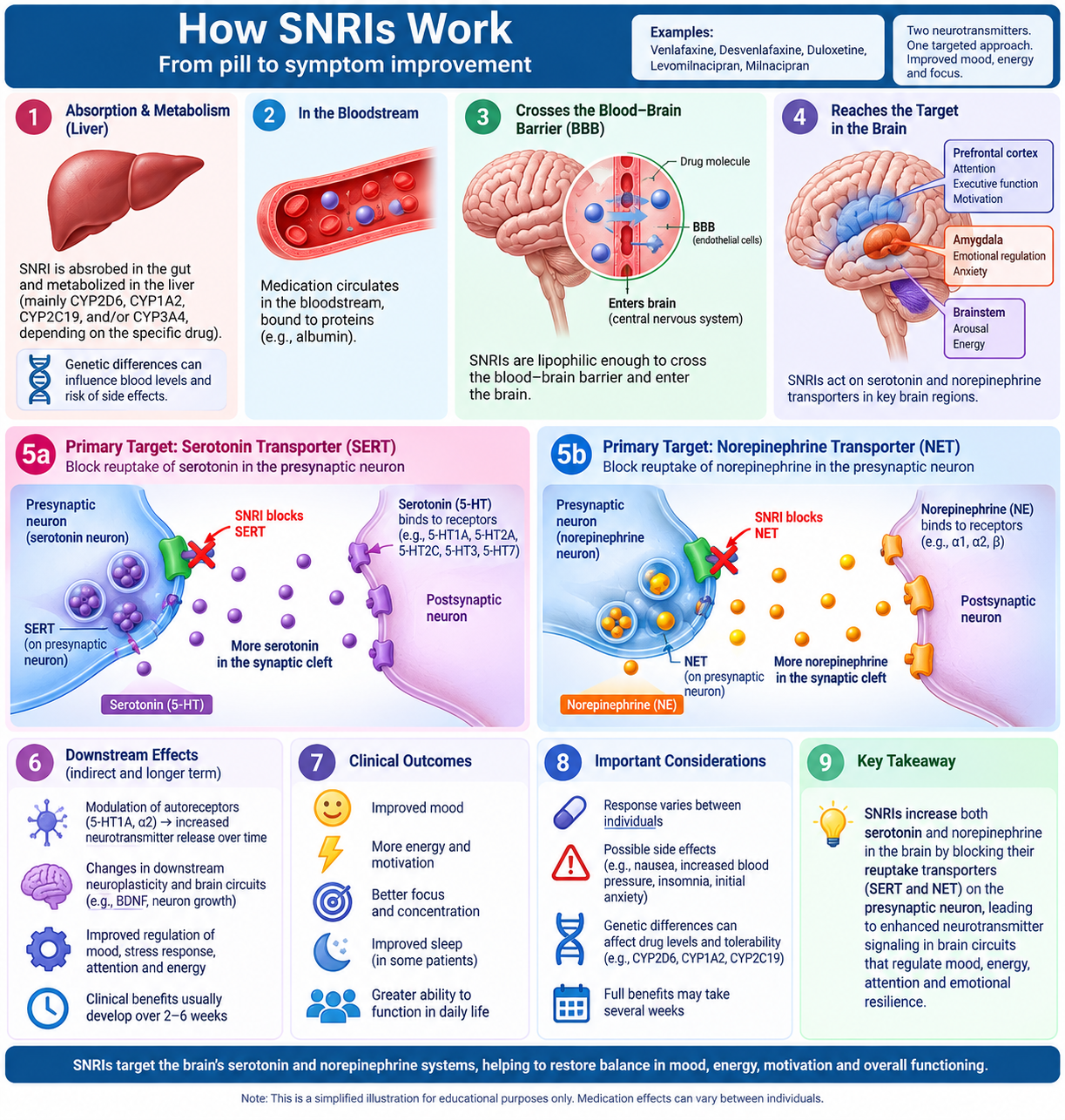
Duloxetine is a serotonin-norepinephrine reuptake inhibitor, or SNRI, used to treat depression, generalized anxiety disorder and several chronic pain conditions.
Unlike an SSRI, which primarily increases serotonin signaling, duloxetine affects two major neurotransmitters: Serotonin and Norepinephrine
Duloxetine blocks the transporters that normally recycle these neurotransmitters back into nerve cells.
This results in:
- Duloxetine
- Serotonin and norepinephrine reuptake decreases
- More serotonin and norepinephrine remain available for signaling
- Mood, anxiety and pain pathways gradually adapt
- Depression, anxiety or certain types of chronic pain may improve
This dual serotonin-norepinephrine mechanism helps explain why duloxetine is used for both mental-health conditions and chronic pain.
In Canada, duloxetine is approved in adults for major depressive disorder, generalized anxiety disorder, diabetic peripheral neuropathic pain, fibromyalgia, chronic low-back pain and chronic pain associated with osteoarthritis of the knee.
What Is Duloxetine Used For?
In Canada, duloxetine is approved for adults with:
- Major depressive disorder — MDD
- Generalized anxiety disorder — GAD
- Neuropathic pain associated with diabetic peripheral neuropathy
- Fibromyalgia pain
- Chronic low-back pain
- Chronic pain associated with osteoarthritis of the knee Duloxetine is therefore somewhat unusual among antidepressants because it can treat both:
Emotional symptoms such as depression and anxiety and certain chronic pain conditions
particularly when nerve signaling and central pain-processing pathways are involved.
What Are the Common Side Effects of Duloxetine?
Common side effects include:
- Nausea
- Dry mouth
- Constipation
- Reduced appetite
- Sleepiness
- Fatigue
- Increased sweating
- Dizziness
- Headache
- Insomnia in some people
- Sexual side effects In Canadian clinical trials for depression, the most commonly observed adverse effects occurring substantially more often than placebo included nausea, dry mouth, constipation, decreased appetite, fatigue, somnolence and increased sweating.
Some side effects are most noticeable during the first days or weeks of treatment and may decrease as the body adjusts.
Can Duloxetine Cause Sexual Side Effects?
Yes.
Like other medications that increase serotonin signaling, duloxetine can cause:
- Reduced sexual desire
- Delayed orgasm
- Difficulty reaching orgasm
- Delayed ejaculation
- Erectile difficulties Sexual side effects can persist during treatment in some patients and should be discussed with the prescribing healthcare professional rather than simply stopping the medication abruptly.
Like other antidepressants, duloxetine carries an important warning regarding suicidal thoughts and behaviour, particularly in children, adolescents and young adults during early treatment or after dose changes.
Health Canada’s current monograph recommends close monitoring for:
- Clinical worsening
- Unusual behavioural changes
- Agitation
- Suicidal thinking Duloxetine is not currently authorized by Health Canada for pediatric use.
Duloxetine and Liver Injury
Duloxetine can rarely cause significant liver injury.
The medication can increase liver enzymes, and clinically important liver injury has been reported.
Symptoms that should be reported promptly include:
- Yellow skin or eyes
- Dark urine
- Significant abdominal pain
- Persistent nausea or vomiting
- Loss of appetite
- Unusual fatigue In Canada, duloxetine is contraindicated in patients with liver disease resulting in hepatic impairment. It should also be used with extreme caution in people who consume substantial amounts of alcohol.
Increase Blood Pressure
Duloxetine increases norepinephrine signaling, thus, it can increase:
- Blood pressure
- Heart rate The average increase is usually small, but some people may experience a clinically important rise.
The Canadian monograph recommends checking blood pressure and heart rate before treatment and periodically during treatment particularly in people with hypertension or cardiovascular disease. Rare cases of hypertensive crisis have been reported.
- Serotonin Syndrome Duloxetine increases serotonin signaling.
Combining it with other strongly serotonergic medications can increase the risk of serotonin syndrome.
Symptoms may include:
-
Agitation
-
Confusion
-
Restlessness
-
Fever
-
Sweating
-
Rapid heart rate
-
Fluctuating blood pressure
-
Tremor
-
Muscle twitching
-
Muscle rigidity
-
Overactive reflexes
-
Diarrhea
-
Nausea or vomiting Severe serotonin syndrome requires urgent medical attention.
-
Bleeding Risk Serotonin is involved in platelet function.
Duloxetine and other serotonin-reuptake inhibitors can therefore increase bleeding tendency, particularly when combined with:
- Aspirin
- Ibuprofen
- Naproxen
- Other NSAIDs
- Warfarin
- Apixaban
- Rivaroxaban
- Other anticoagulant or antiplatelet medications Reported bleeding ranges from bruising and nosebleeds to more serious gastrointestinal or other bleeding.
Low Sodium — Hyponatremia
Duloxetine can occasionally cause hyponatremia, or abnormally low blood sodium, often through inappropriate antidiuretic hormone secretion.
The risk may be greater in:
-
Older adults
-
People taking diuretics
-
People who are dehydrated or volume-depleted Symptoms can include:
-
Headache
-
Confusion
-
Difficulty concentrating
-
Memory problems
-
Weakness
-
Unsteadiness Severe cases can be medically serious.
Mania or Hypomania
Like other antidepressants, duloxetine can occasionally trigger mania or hypomania, particularly in people with bipolar disorder.
Possible symptoms include:
-
Unusually elevated or irritable mood
-
Very high energy
-
Reduced need for sleep
-
Racing thoughts
-
Increased activity
-
Impulsive behaviour A history of bipolar disorder should therefore be considered before antidepressant treatment.
-
Angle-Closure Glaucoma Duloxetine can cause pupil dilation and may precipitate angle-closure glaucoma in susceptible individuals.
In Canada, it is contraindicated in people with uncontrolled narrow-angle glaucoma.
Sudden:
-
Eye pain
-
Blurred vision
-
Redness
-
Halos around lights requires urgent medical assessment.
-
Urinary Problems Duloxetine’s norepinephrine effects can sometimes contribute to:
-
Difficulty starting urination
-
Reduced urine flow
-
Urinary retention Significant difficulty urinating should be reported.
Drug Interactions
Duloxetine has several important drug interactions.
It is metabolized mainly by CYP1A2 and CYP2D6.
Duloxetine also inhibits CYP2D6, which means it can increase concentrations of some other medications.
MAO Inhibitors — Contraindicated
Examples include:
- Phenelzine
- Tranylcypromine
- Isocarboxazid
- Linezolid
- Methylene blue in relevant systemic use Combining duloxetine with an MAOI can cause severe serotonin toxicity.
Canadian prescribing information requires at least:
14 days after stopping an MAOI before starting duloxetine
and:
5 days after stopping duloxetine before starting an MAOI.
Fluvoxamine — Potent CYP1A2 Inhibitor
Fluvoxamine strongly inhibits CYP1A2.
Because CYP1A2 is an important duloxetine metabolic pathway:
- Fluvoxamine
- CYP1A2 inhibition
- Duloxetine metabolism slows dramatically
- Duloxetine exposure increases
In an interaction study, fluvoxamine increased duloxetine overall exposure by approximately six-fold.
Concurrent use with potent CYP1A2 inhibitors such as fluvoxamine is contraindicated in the current Canadian monograph.
Ciprofloxacin
Ciprofloxacin is another strong CYP1A2 inhibitor.
Therefore:
- Ciprofloxacin
- CYP1A2 activity falls
- Duloxetine metabolism decreases
- Duloxetine concentration can rise substantially
The Canadian product monograph lists ciprofloxacin and enoxacin among CYP1A2-inhibiting quinolone antibiotics that should not be combined with duloxetine.
Paroxetine and Other CYP2D6 Inhibitors
CYP2D6 also contributes to duloxetine metabolism.
Paroxetine is a strong CYP2D6 inhibitor.
In an interaction study:
- Paroxetine
- CYP2D6 inhibition
- Duloxetine exposure increased by approximately 60%.
Other medications that inhibit CYP2D6 may have similar effects.
These can include:
- Fluoxetine
- Bupropion
- Quinidine The magnitude of interaction varies, and CYP1A2 remains another major metabolic pathway.
Duloxetine Can Inhibit CYP2D6
This interaction works in the opposite direction as well.
Duloxetine is a moderate CYP2D6 inhibitor.
Therefore duloxetine may increase concentrations of medications that rely heavily on CYP2D6 for metabolism.
Examples may include certain:
- Tricyclic antidepressants
- Antipsychotics
- Antiarrhythmic medications
- Other CYP2D6 substrates In one study, duloxetine increased exposure to the tricyclic antidepressant desipramine approximately three-fold.
This means duloxetine can potentially cause CYP2D6 phenoconversion, making someone function more like a slower CYP2D6 metabolizer for another drug.
Other Serotonergic Medications
Examples include:
- SSRIs
- Other SNRIs
- Tricyclic antidepressants
- Tramadol
- Fentanyl
- Methadone
- Dextromethorphan
- Triptans
- Lithium
- Buspirone
- St. John’s Wort Combining serotonergic medications does not automatically mean they cannot be used together, but the overall risk of serotonin syndrome increases and should be considered.
Aspirin, NSAIDs and Blood Thinners
Examples include:
- Aspirin
- Ibuprofen
- Naproxen
- Warfarin
- Apixaban
- Rivaroxaban These can increase bleeding risk when combined with duloxetine.
Alcohol
Substantial alcohol consumption is an important concern because both alcohol and duloxetine can affect the liver.
The Canadian monograph advises that duloxetine should only be used in exceptional circumstances and with extreme caution in people who consume substantial amounts of alcohol.
Duloxetine Dosage
Duloxetine is usually given as a delayed-release capsule, most commonly in:
- 30 mg
- 60 mg strengths in Canada.
The delayed-release capsule should generally be swallowed whole rather than crushed or chewed because damaging the coating can affect how the medication is released.
Canadian Adult Dosing
| Condition | Typical starting approach | Recommended/target dose |
|---|---|---|
| Major depressive disorder | 30 mg/day may be used initially for tolerability | 60 mg once daily |
| Generalized anxiety disorder | 30 mg/day may be used initially | 60 mg once daily |
| Diabetic neuropathic pain | 30 mg/day may be used initially | 60 mg once daily |
| Fibromyalgia | 30 mg/day may be used initially | 60 mg once daily |
| Chronic low-back pain | 30 mg/day may be used initially | 60 mg once daily |
| Knee osteoarthritis pain | 30 mg/day may be used initially | 60 mg once daily |
For patients starting at 30 mg/day, the Canadian monograph generally describes increasing toward 60 mg/day within approximately 1–2 weeks, depending on tolerability.
Duloxetine Dosage for Depression
For major depressive disorder, the recommended Canadian dose is:
60 mg once daily
For people who may be sensitive to initial adverse effects:
30 mg once daily
may be considered initially, with a target of:
60 mg/day within 1–2 weeks.
The Canadian monograph states that there is no evidence that doses greater than 60 mg/day provide additional antidepressant benefit.
Duloxetine Dosage for Anxiety
For generalized anxiety disorder:
60 mg once daily
is the usual target.
A 30 mg starting dose can be used for tolerability.
Although doses up to 120 mg/day have been studied, the Canadian monograph states that doses above 60 mg/day have not demonstrated additional benefit overall and are less well tolerated.
Duloxetine Dosage for Nerve Pain and Chronic Pain
For most pain conditions, the usual target is:
60 mg once daily
A lower starting dose of:
30 mg once daily
may be used for the first 1–2 weeks.
For fibromyalgia and chronic low-back pain, doses above 60 mg/day have not demonstrated additional benefit overall and cause more adverse effects.
For diabetic neuropathic pain and knee osteoarthritis, doses as high as 120 mg/day have been evaluated in selected patients, but higher dosing is generally less well tolerated and may not provide substantial additional benefit.
Should Duloxetine Be Taken with Food?
Duloxetine may be taken:
With or without food.
However, taking it with food may help reduce initial nausea in some patients.
The delayed-release capsule should generally be:
Swallowed whole
and not:
- Crushed
- Chewed
- Opened and sprinkled on food
- Mixed into liquids because this can damage the enteric coating.
Can Duloxetine Be Taken in the Morning or at Night?
Yes.
Duloxetine is usually taken once daily, and the best time depends partly on how it affects the individual.
If duloxetine causes:
Activation or insomnia
morning dosing may be more comfortable.
If it causes:
Sleepiness
evening dosing may sometimes be preferred.
Consistency is generally more important than a universal morning-versus-evening rule.
Duloxetine and Kidney Function
In Canada, duloxetine is contraindicated in patients with:
Severe renal impairment
defined in the current monograph as creatinine clearance:
below 30 mL/min
or end-stage renal disease requiring dialysis.
Kidney function should therefore be considered when duloxetine is prescribed.
Duloxetine and Liver Function
Duloxetine is extensively processed by the liver.
The current Canadian monograph contraindicates duloxetine in people with:
Liver disease resulting in hepatic impairment.
This is an important distinction from many antidepressants where dose adjustment rather than avoidance may be sufficient.
Tapering and Stopping Duloxetine
Duloxetine should generally not be stopped suddenly after regular use.
Duloxetine has a well-recognized antidepressant discontinuation syndrome.
Symptoms can include:
- Dizziness
- Nausea
- Headache
- Tingling or unusual sensations
- “Electric shock” sensations
- Fatigue
- Irritability
- Anxiety
- Insomnia
- Vivid dreams or nightmares
- Sweating
- Diarrhea
- Vomiting
- Muscle aches Some cases can be quite uncomfortable.
How Should Duloxetine Be Tapered?
There is no single tapering schedule appropriate for every patient.
The Canadian monograph recommends tapering duloxetine when it is discontinued after more than one week of treatment. If troublesome symptoms develop after reducing the dose, returning temporarily to the previously tolerated dose and then reducing more gradually may be considered by the healthcare professional.
The taper depends on:
- Current dose
- Duration of treatment
- Previous withdrawal symptoms
- Reason for treatment
- Other medications
- Individual sensitivity Patients who have taken duloxetine for a long period or who have previously experienced difficult withdrawal may need a slower, more individualized reduction.
For a patient-facing website, I would avoid publishing a universal schedule such as:
60 mg → 30 mg → stop
because that may be too fast for some people.
Why Does Duloxetine Cause Withdrawal Symptoms?
During regular treatment, the brain adapts to increased:
Serotonin
and:
Norepinephrine signaling
If duloxetine is removed too quickly:
- Serotonin and norepinephrine reuptake inhibition suddenly decreases
- Neurotransmitter signaling changes rapidly
- The brain has insufficient time to readjust
- Discontinuation symptoms can occur
This is why duloxetine withdrawal is not evidence of addiction.
Physical adaptation and addiction are different concepts.
Frequently Asked Questions
Is Duloxetine the Same as Cymbalta?
Yes.
Cymbalta is the original and best-known brand name for duloxetine.
Generic duloxetine products are now widely used.
Is Duloxetine an Antidepressant?
Yes.
Duloxetine is an:
SNRI — serotonin-norepinephrine reuptake inhibitor
used to treat major depressive disorder and generalized anxiety disorder as well as several chronic pain conditions.
Is Duloxetine an SSRI?
No.
SSRIs primarily inhibit serotonin reuptake.
Duloxetine inhibits reuptake of both:
Serotonin + norepinephrine
which is why it is classified as an SNRI.
Does Duloxetine Increase Serotonin?
Yes, indirectly.
It blocks the serotonin transporter, reducing serotonin reuptake and allowing serotonin to remain available between neurons for longer.
Does Duloxetine Increase Norepinephrine?
Yes.
Duloxetine also inhibits the norepinephrine transporter, allowing norepinephrine to remain available for signaling for longer.
This norepinephrine activity contributes to both its antidepressant and pain-modulating effects.
Why Is Duloxetine Used for Both Depression and Pain?
Serotonin and norepinephrine participate in both:
Mood-regulation circuits
and:
Descending pain-inhibitory pathways
Duloxetine can therefore alter both emotional processing and the brain’s regulation of pain signals.
Does Duloxetine Treat Nerve Pain?
Yes.
In Canada, duloxetine is approved for neuropathic pain associated with diabetic peripheral neuropathy.
Is Duloxetine Used for Fibromyalgia?
Yes.
Duloxetine is approved in Canada for the management of pain associated with fibromyalgia.
Is Duloxetine Used for Back Pain?
Yes.
In Canada, duloxetine is approved for chronic low-back pain.
Can Duloxetine Help Osteoarthritis Pain?
Yes.
Duloxetine is approved in Canada for chronic pain associated with osteoarthritis of the knee.
How Long Does Duloxetine Take to Work for Depression or Anxiety?
The Canadian product monograph notes that therapeutic response for depression and generalized anxiety is generally seen within approximately:
1–4 weeks
although fuller improvement may continue beyond that period.
Does Duloxetine Work Faster for Pain?
Some patients in clinical pain studies experienced improvement within the first week, although individual response varies.
Does Duloxetine Cause Weight Gain?
Weight changes can occur, but duloxetine is not generally among the antidepressants most strongly associated with early weight gain.
Some people initially experience:
- Reduced appetite
- Nausea
- Modest weight loss Longer-term weight gain can occur in some individuals.
Does Duloxetine Make You Sleepy?
It can.
Some people experience:
-
Sleepiness
-
Fatigue while others experience:
-
Insomnia
-
Activation The timing of the dose may therefore be individualized.
Can Duloxetine Cause Sweating?
Yes.
Increased sweating, or hyperhidrosis, is a relatively common duloxetine side effect and is consistent with increased serotonin and norepinephrine activity.
Can Duloxetine Increase Blood Pressure?
Yes.
Duloxetine can increase blood pressure and heart rate, although average increases are generally modest.
Blood pressure should be checked before treatment and periodically thereafter.
Can Duloxetine Affect the Liver?
Yes, rarely but importantly.
Duloxetine can increase liver enzymes and has been associated with clinically significant liver injury.
It is contraindicated in Canada in patients with liver disease causing hepatic impairment.
Can Duloxetine Be Taken with an SSRI?
Sometimes serotonergic medications are combined under specialist supervision, but combining duloxetine with another SSRI or SNRI increases serotonergic activity and therefore increases the risk of serotonin syndrome.
The combination should not be undertaken without clinical supervision.
Can Duloxetine Be Taken with Bupropion?
The medications may sometimes be prescribed together, but there are several considerations.
Bupropion inhibits CYP2D6, which can potentially increase duloxetine exposure.
Both medications can also be activating and may affect:
- Blood pressure
- Sleep
- Anxiety
- Seizure threshold The combination should therefore be clinically reviewed rather than treated as automatically interchangeable or risk-free.
Can Fluoxetine or Paroxetine Affect Duloxetine?
Yes.
Both can inhibit CYP2D6, and paroxetine has been specifically shown to increase duloxetine exposure.
Combining serotonergic antidepressants also increases overall serotonin activity.
Can Ciprofloxacin Affect Duloxetine?
Yes—substantially.
Ciprofloxacin inhibits CYP1A2, a major duloxetine metabolic pathway.
The current Canadian monograph contraindicates this combination.
Can Fluvoxamine Affect Duloxetine?
Yes.
Fluvoxamine strongly inhibits CYP1A2 and increased duloxetine exposure approximately six-fold in an interaction study.
The combination is contraindicated in the current Canadian monograph.
Which Liver Enzymes Metabolize Duloxetine?
The two major enzymes are:
CYP1A2
and:
CYP2D6.
Is Duloxetine a CYP2D6 Inhibitor?
Yes.
Duloxetine is considered a:
Moderate CYP2D6 inhibitor
and can increase concentrations of medications that depend strongly on CYP2D6 metabolism.
Can Genetics Affect Duloxetine Metabolism?
Potentially, but the currently established clinical utility is limited.
CYP2D6 contributes to duloxetine metabolism, but CPIC concluded that available evidence does not support a clinically meaningful enough CYP2D6 genotype effect to recommend genotype-based duloxetine dosing.
Does a CYP2D6 Poor Metabolizer Result Mean Duloxetine Should Be Avoided?
No.
There is currently no CPIC recommendation to avoid or automatically reduce duloxetine solely because someone is a CYP2D6 Poor Metabolizer.
Other factors—including CYP1A2 activity, interacting medications, dose, liver function and clinical response—also influence exposure.
Can Duloxetine Fail Even if It Is Metabolized Normally?
Yes.
Drug metabolism is only one part of antidepressant response.
A patient may have appropriate drug exposure but an inadequate brain response.
In simple terms:
- PK — Pharmacokinetics Does an appropriate amount of duloxetine reach the brain?
Relevant factors include:
- CYP1A2 + CYP2D6 + drug interactions
- Drug exposure
Then:
- PD — Pharmacodynamics Does the brain respond appropriately?
Duloxetine acts through:
- SERT
- NET
- Serotonin + norepinephrine signaling
- Multiple receptors and neural pathways
- Clinical response
Therefore:
Normal drug metabolism does not guarantee that duloxetine will work.
Does Duloxetine Need to Be Tapered?
Yes, generally.
Abrupt discontinuation can cause significant withdrawal symptoms.
The current Canadian monograph recommends tapering after more than one week of treatment.
The taper should be individualized rather than applying one fixed schedule to everyone.
Is Duloxetine Addictive?
Duloxetine is not considered addictive in the way that opioids, benzodiazepines or some stimulants can be.
However, the nervous system adapts to regular treatment, which is why stopping too quickly can cause discontinuation symptoms.
Dependence in this physiological sense is not the same as addiction.
Can Pharmacogenomic Testing Tell Me Whether Duloxetine Will Work?
Not with certainty.
PGx testing may provide useful information about a patient’s broader drug-metabolism profile and medication interactions, but duloxetine does not currently have an established CYP2D6 genotype-based prescribing recommendation.
Response also depends on:
- Symptoms
- Diagnosis
- Dose
- CYP1A2 activity
- Drug interactions
- Serotonin signaling
- Norepinephrine signaling
- Receptor biology
- Previous medication response
- Individual brain biology Genetic information should therefore be integrated with clinical information rather than used as a stand-alone prediction.
References
This article is educational. It does not diagnose, and it does not replace advice from your prescriber or pharmacist. Never start, stop or change a medication based on a web page.