
Medication profile
Paroxetine (Paxil)
Paroxetine is one of the established SSRIs, along with medications such as:
 Written by Sanjida Ahmed, PhD, Cellular and Molecular BiologyChief Operating Officer and Lead Scientist, Personalized Prescribing. Last reviewed October 2, 2026.
- Best-known brand name
- Paxil
- Extended-release brand
- Paxil CR
- Medication class
- Selective Serotonin Reuptake Inhibitor — SSRI
On this page
- What You Need to Know About Paroxetine
- Is Paroxetine Available in Canada?
- 10 mg, 20 mg and 30 mg
- 12.5 mg and 25 mg
- What Is Paroxetine Used For?
- What Is Paxil CR Used For?
- Immediate-release paroxetine
- Controlled-release paroxetine
- How Does Paroxetine Work?
- SERT — Serotonin Transporter
- “Serotonin deficiency.”
- Does Paroxetine Increase Serotonin?
- How Long Does Paroxetine Take to Work?
- The third or fourth week
- What Are the Common Side Effects of Paroxetine?
- Does Paroxetine Cause Sleepiness?
- Sedating for one person
- Does Paroxetine Cause Weight Gain?
- Weight gain
- Does Paroxetine Cause Sexual Side Effects?
- Why Does Paroxetine Cause Sexual Dysfunction?
- Does Paroxetine Cause Dry Mouth or Constipation?
- Can Paroxetine Initially Increase Anxiety?
- Panic disorder
- 10 mg/day
- What Is Akathisia?
- Can Paroxetine Trigger Mania?
- Can Paroxetine Cause Serotonin Syndrome?
- Serotonin Syndrome
- Paroxetine and MAO Inhibitors
- Monoamine Oxidase Inhibitors — MAOIs
- 14-day separation
- Can Paroxetine Increase Bleeding Risk?
- Platelet function
- Can Paroxetine Cause Low Sodium?
- Can Paroxetine Affect the Eyes?
- Acute Angle-Closure Glaucoma
- Paroxetine and Pregnancy
- Why Is Paroxetine Discontinuation Important?
- Antidepressant Discontinuation Symptoms
- Does Paroxetine Need to Be Tapered?
- Paroxetine Drug Interactions
- Deactivates the parent drug
- Reduce activation
- Paroxetine Dosage in Canada
- 10 mg increments
- 1–2 week intervals
- Paroxetine Dosage in Older Adults
- Higher paroxetine concentrations
- Longer elimination
- 10 mg/day
- Paroxetine and Kidney or Liver Impairment
- 10 mg/day initially
- 40 mg/day
- Should Paroxetine Be Taken with Food?
- With or without food
- Once daily
- How Long Does Paroxetine Stay in the Body?
- 21 hours
- Frequently Asked Questions About Paroxetine
- Selective Serotonin Reuptake Inhibitor
- 10 mg/day
- 50% lower starting and maintenance doses
- Selecting an alternative medication not predominantly metabolized by CYP2D6
Paroxetine is an SSRI antidepressant used to treat depression and several anxiety-related disorders. In Canada, immediate-release paroxetine is approved in adults for major depressive disorder, obsessive-compulsive disorder, panic disorder, social anxiety disorder, generalized anxiety disorder and posttraumatic stress disorder.
Paroxetine works primarily by blocking:
SERT — Serotonin Transporter
SERT normally removes serotonin from the space between neurons after serotonin has been released.
The basic mechanism is:
- Paroxetine
- Blocks SERT
- Serotonin reuptake decreases
- More serotonin remains available between neurons
- Serotonin receptor signaling changes
- Emotional, anxiety and mood-related brain networks gradually adapt
- Depression, anxiety, panic or obsessive-compulsive symptoms may improve
Paroxetine is also pharmacologically important because it is extensively influenced by—and strongly inhibits—the liver enzyme: CYP2D6
This distinguishes it from some other SSRIs and makes drug interactions and pharmacogenomics particularly relevant.
What You Need to Know About Paroxetine
Paroxetine is one of the established SSRIs, along with medications such as:
- Fluoxetine
- Sertraline
- Citalopram
- Escitalopram
- Fluvoxamine All primarily inhibit serotonin reuptake, but they are not pharmacologically identical.
Paroxetine is notable for:
- Strong serotonin-reuptake inhibition
- Significant CYP2D6 metabolism
- Strong CYP2D6 inhibition
- Sexual side effects
- Sleepiness in some patients
- Weight change
- A relatively important risk of discontinuation symptoms if stopped too quickly Its mean elimination half-life is approximately 21 hours, and paroxetine displays nonlinear pharmacokinetics partly because CYP2D6 metabolism becomes saturated and paroxetine inhibits its own CYP2D6-mediated clearance.
Is Paroxetine Available in Canada?
Yes.
Generic immediate-release paroxetine tablets are currently marketed in Canada in strengths including:
10 mg, 20 mg and 30 mg
Health Canada currently lists the branded Paxil 20 mg tablet as marketed; the branded 10 mg and 30 mg tablets have been discontinued, although generic equivalents remain available.
Paxil CR, the controlled-release formulation, also remains marketed in Canada in:
12.5 mg and 25 mg
strengths.
The approved indications and dosing differ somewhat between immediate-release Paxil and Paxil CR.
What Is Paroxetine Used For?
Canadian immediate-release paroxetine is approved for adults with:
Major Depressive Disorder — MDD
Symptoms can include:
- Persistent low mood
- Loss of interest or pleasure
- Fatigue
- Reduced motivation
- Difficulty concentrating
- Changes in sleep
- Changes in appetite
- Negative thinking
Obsessive-Compulsive Disorder — OCD
OCD can involve:
Obsessions
recurrent intrusive thoughts, images or urges
and:
Compulsions
repetitive behaviours or mental rituals performed to reduce distress.
Paroxetine’s serotonergic effects can reduce the severity of obsessions and compulsions in some patients.
-
Panic Disorder Paroxetine can help reduce:
-
Recurrent panic attacks
-
Anticipatory anxiety
-
Fear of future attacks
-
Avoidance related to panic It is approved whether panic disorder occurs:
With or without agoraphobia.
Social Anxiety Disorder
Paroxetine can reduce excessive fear and anxiety associated with:
- Social interaction
- Speaking in front of others
- Being observed
- Performance situations
- Fear of embarrassment or judgment
Generalized Anxiety Disorder — GAD
Paroxetine can help symptoms such as:
- Excessive worry
- Persistent anxiety
- Restlessness
- Physical tension
- Difficulty concentrating
- Difficulty relaxing
Posttraumatic Stress Disorder — PTSD
Paroxetine is also approved in Canada for PTSD.
Potential symptoms include:
- Intrusive memories
- Avoidance
- Hyperarousal
- Excessive threat sensitivity
- Sleep disturbance
- Anxiety
- Emotional distress These six indications are included in the current Canadian Paxil product monograph.
What Is Paxil CR Used For?
Canadian Paxil CR has a somewhat different approved indication list.
It is authorized in adults for:
- Major depressive disorder
- Panic disorder
- Social anxiety disorder
- Premenstrual dysphoric disorder — PMDD Therefore, the approved uses of:
Immediate-release paroxetine
and:
Controlled-release paroxetine
should not automatically be treated as identical.
How Does Paroxetine Work?
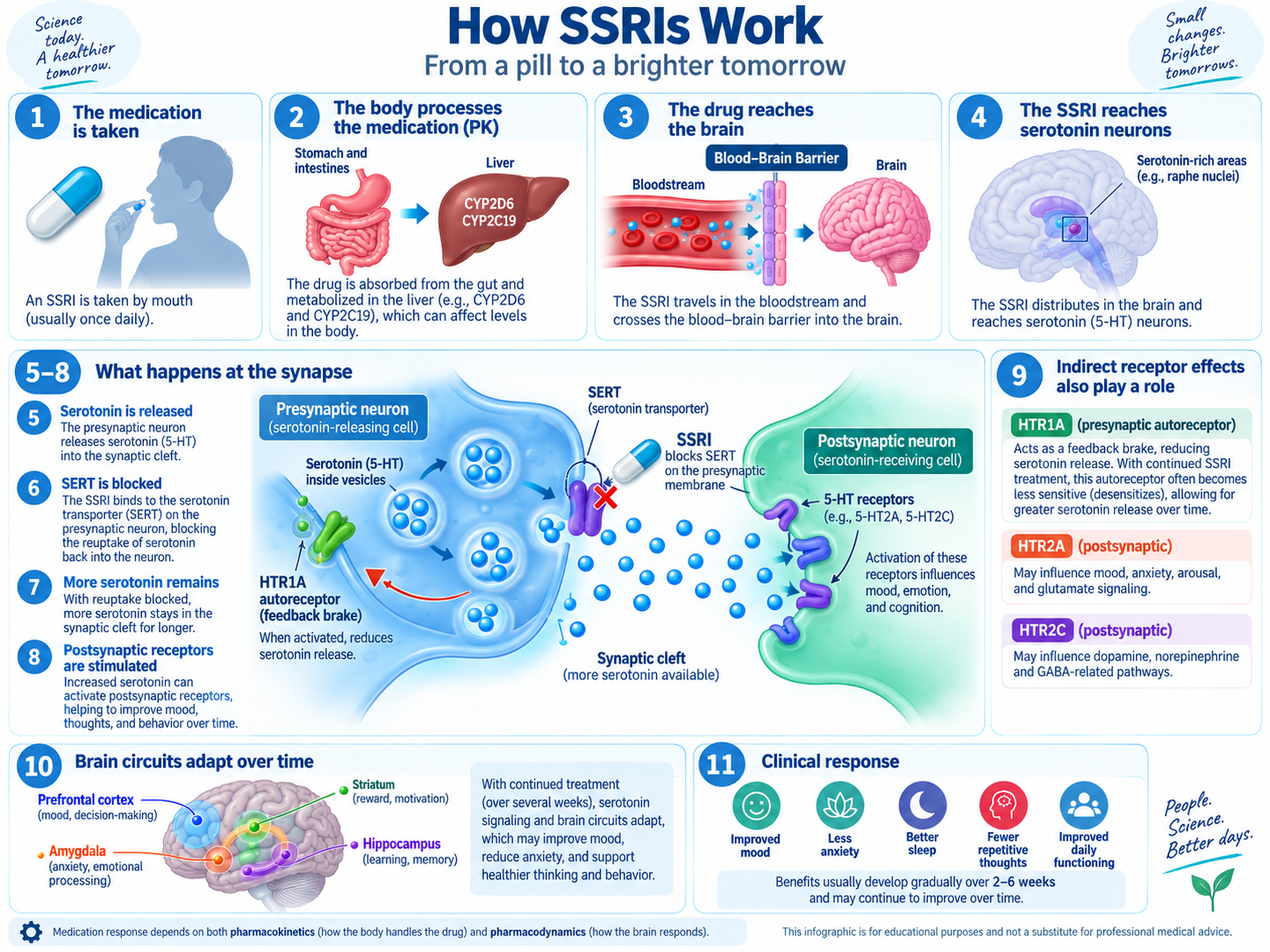
Paroxetine primarily inhibits:
SERT — Serotonin Transporter
Normally:
- Serotonin is released
- Serotonin activates receptors
- SERT transports serotonin back into the neuron
Paroxetine blocks SERT.
Therefore:
- Paroxetine
- SERT inhibition
- Serotonin reuptake decreases
- Extracellular serotonin availability increases
- Serotonin receptors receive altered signaling
- Neural networks gradually adapt
- Symptoms may improve
The clinical benefit should not be described simply as correcting a:
“Serotonin deficiency.”
Depression and anxiety disorders involve dysregulation across multiple brain regions, neurotransmitters and neural networks.
Does Paroxetine Increase Serotonin?
Yes, indirectly.
It does not release serotonin directly.
Instead:
- Paroxetine blocks SERT
- Serotonin is removed more slowly from the synapse
- Serotonin remains available longer
This altered serotonergic signaling eventually affects multiple serotonin receptors, including:
- 5-HT1A
- 5-HT2A
- 5-HT2C
- Other serotonin receptor systems The downstream receptor adaptation is part of why paroxetine’s therapeutic effects generally take longer than its initial transporter blockade.
How Long Does Paroxetine Take to Work?
Paroxetine begins inhibiting SERT relatively quickly, but clinical improvement is usually slower.
For depression, the Canadian monograph notes that therapeutic response may not become evident until approximately:
The third or fourth week
of treatment.
The overall process is:
- SERT inhibited
- Serotonin availability changes
- Serotonin receptors repeatedly experience altered signaling
- Autoreceptors and intracellular pathways adapt
- Neural networks gradually reorganize
- Depression or anxiety symptoms improve
Some symptoms such as:
- Sleep
- Anxiety
- Appetite may change earlier or later than mood itself.
What Are the Common Side Effects of Paroxetine?
Common side effects include:
- Nausea
- Sleepiness
- Dizziness
- Sweating
- Dry mouth
- Constipation
- Diarrhea
- Insomnia
- Tremor
- Fatigue or weakness
- Reduced appetite in some patients
- Sexual dysfunction In Canadian depression trials, nausea occurred in approximately 26%, somnolence in 23%, dry mouth in 18%, constipation in 14%, dizziness and insomnia in about 13%, and sweating in about 11% of paroxetine-treated patients.
Individual response varies substantially.
Does Paroxetine Cause Sleepiness?
It can.
Sleepiness or:
Somnolence
is relatively common with paroxetine.
Some patients instead experience:
- Insomnia
- Restlessness
- Activation Therefore, paroxetine can be:
Sedating for one person
and:
Activating for another.
The timing of administration can sometimes be adjusted according to individual tolerability.
Does Paroxetine Cause Weight Gain?
It can.
The current Canadian monograph lists:
Weight gain
as a frequent reported metabolic effect, although weight loss can also occur.
Weight changes during antidepressant treatment may reflect multiple factors:
- Appetite changes
- Recovery from depression
- Serotonin signaling
- Activity level
- Sleep
- Treatment duration
- Other medications Weight should therefore be interpreted individually rather than assuming every patient will gain weight.
Does Paroxetine Cause Sexual Side Effects?
Yes.
Sexual dysfunction is one of the clinically important adverse effects of paroxetine and other SSRIs.
Possible effects include:
- Reduced libido
- Delayed ejaculation
- Difficulty reaching orgasm
- Erectile dysfunction
- Reduced sexual arousal In pooled Canadian paroxetine trials, reported sexual adverse effects included decreased libido, ejaculatory disturbance, erectile difficulties and orgasmic dysfunction. For men, reported ejaculatory disturbance ranged from approximately 13–28%, although clinical-trial reporting likely underestimates the true frequency because sexual side effects are often not spontaneously reported.
The current Canadian monograph also states that there have been reports of:
Long-lasting sexual dysfunction continuing after SSRI discontinuation.
This appears to be uncommon, but patients should be informed that persistent symptoms have been reported.
Why Does Paroxetine Cause Sexual Dysfunction?
Increasing serotonin can suppress several pathways involved in sexual function.
Conceptually:
- Paroxetine
- SERT blockade
- Serotonin signaling increases
- 5-HT2-related signaling and other downstream pathways change
- Dopamine and sexual reflex pathways may be inhibited
- Possible:
- Reduced desire
- Delayed orgasm
- Delayed ejaculation
- Erectile difficulty Sexual response is complex and is also influenced by depression itself, anxiety, hormones and other medications.
Does Paroxetine Cause Dry Mouth or Constipation?
It can.
Both are recognized paroxetine adverse effects.
Paroxetine has somewhat broader receptor pharmacology than some highly selective SSRIs, and its effects on serotonergic and cholinergic systems can contribute to:
- Dry mouth
- Constipation
- Urinary hesitation in some patients In Canadian depression trials, dry mouth and constipation were reported more often with paroxetine than placebo.
Can Paroxetine Initially Increase Anxiety?
Yes.
When an SSRI is first started, some patients experience temporary:
- Anxiety
- Restlessness
- Agitation
- Insomnia
- Jitteriness This can be particularly relevant in:
Panic disorder
which is one reason the Canadian paroxetine monograph recommends a lower starting dose of:
10 mg/day
for panic disorder rather than the 20 mg starting dose used for many other indications.
What Is Akathisia?
Rarely, paroxetine can produce:
Akathisia
which is a distressing feeling of internal restlessness.
Symptoms can include:
- Inability to sit still
- Pacing
- Constant movement
- Feeling driven to move Akathisia can be mistaken for worsening anxiety.
The current Canadian product information specifically identifies akathisia as a possible adverse effect.
Can Paroxetine Trigger Mania?
Yes.
Like other antidepressants, paroxetine can potentially precipitate:
Mania
or:
Hypomania
in people susceptible to bipolar disorder.
Possible warning symptoms include:
- Unusually elevated or irritable mood
- Reduced need for sleep
- Racing thoughts
- Excessive activity
- Grandiosity
- Impulsive behaviour The possibility of bipolar disorder should therefore be considered when clinically appropriate before or during antidepressant treatment.
Can Paroxetine Cause Serotonin Syndrome?
Yes.
Serotonin Syndrome
can occur when serotonergic activity becomes excessive.
Risk increases when paroxetine is combined with other serotonergic medications.
Symptoms can include:
-
Agitation
-
Confusion
-
Sweating
-
Fever
-
Tremor
-
Muscle twitching
-
Clonus
-
Hyperreflexia
-
Rapid heartbeat
-
Diarrhea Potential interacting serotonergic drugs include:
-
Other SSRIs
-
SNRIs
-
MAO inhibitors
-
Tramadol
-
Lithium
-
Buspirone
-
Triptans
-
Some opioids
-
St. John’s Wort Combining serotonergic medications may sometimes be clinically appropriate, but it requires medication-specific assessment.
Paroxetine and MAO Inhibitors
Paroxetine must not be used concurrently with:
Monoamine Oxidase Inhibitors — MAOIs
because of the risk of serious serotonin toxicity.
Examples include:
- Phenelzine
- Tranylcypromine
- Moclobemide
- Linezolid in relevant circumstances
- Intravenous methylene blue Canadian Paxil labeling requires a minimum:
14-day separation
between paroxetine and MAOI treatment.
Switching antidepressants should therefore be directed by a healthcare professional.
Can Paroxetine Increase Bleeding Risk?
Yes.
Serotonin contributes to:
Platelet function
Platelets obtain serotonin partly through SERT.
When SSRIs inhibit SERT:
- Platelet serotonin uptake decreases
- Platelet aggregation can become less efficient
- Bleeding risk may increase
The risk can be greater when paroxetine is combined with:
- Aspirin
- Ibuprofen
- Naproxen
- Other NSAIDs
- Warfarin
- Other anticoagulants
- Antiplatelet medications Canadian labeling reports associations with gastrointestinal, gynecological and other bleeding and advises additional caution with medications affecting coagulation.
Can Paroxetine Cause Low Sodium?
Yes.
SSRIs can occasionally cause:
Hyponatremia
often through a syndrome resembling:
SIADH
Risk is greater in:
-
Older adults
-
Patients taking diuretics
-
People who are dehydrated or volume-depleted Symptoms can include:
-
Weakness
-
Headache
-
Confusion
-
Muscle twitching
-
Poor coordination Severe hyponatremia can be dangerous. Canadian labeling notes that many reported cases occurred in older adults.
Can Paroxetine Affect the Eyes?
Yes, rarely.
SSRIs can cause pupil dilation, which can precipitate:
Acute Angle-Closure Glaucoma
in a person with anatomically narrow drainage angles.
Symptoms can include:
- Sudden eye pain
- Redness
- Blurred vision
- Halos
- Headache
- Sudden visual change This requires urgent medical assessment.
Paroxetine and Pregnancy
Paroxetine requires particular consideration during pregnancy.
The current Canadian Paxil monograph reports epidemiological evidence associating first-trimester paroxetine exposure with an increased risk of congenital malformations, particularly cardiovascular defects such as atrial or ventricular septal defects. Canadian labeling therefore recommends considering other treatment options when pregnancy is planned or during the first trimester unless the expected benefits justify continued paroxetine treatment.
This does not mean a patient should abruptly stop paroxetine after learning they are pregnant.
Abrupt discontinuation can cause substantial withdrawal symptoms and may also increase the risk of psychiatric relapse.
The appropriate approach is:
Individualized benefit-risk assessment with the treating clinician.
Late-pregnancy SSRI exposure can also be associated with neonatal adaptation symptoms after delivery.
Why Is Paroxetine Discontinuation Important?
Paroxetine is particularly important to taper carefully.
Stopping suddenly, reducing the dose too quickly or sometimes even missing doses can cause:
Antidepressant Discontinuation Symptoms
Possible symptoms include:
- Dizziness
- Nausea
- Anxiety
- Agitation
- Sweating
- Headache
- Sleep disturbance
- Vivid dreams
- Flu-like symptoms
- Tingling
- Electric-shock sensations
- Tinnitus These symptoms are explicitly recognized in Canadian product information.
Paroxetine’s relatively short half-life and lack of a long-lived active metabolite contribute to its tendency to produce discontinuation symptoms when blood concentrations fall quickly.
Does Paroxetine Need to Be Tapered?
Generally:
Yes.
The Canadian monograph recommends:
Gradual dose reduction rather than abrupt discontinuation whenever possible.
There is no single taper schedule that works for everyone.
The appropriate taper depends on:
- Dose
- Treatment duration
- Previous withdrawal symptoms
- Underlying condition
- Other medications
- Individual sensitivity Some patients can taper relatively quickly, while others require a slower reduction.
Paroxetine Drug Interactions
Paroxetine has more clinically important metabolic interactions than many patients realize because it is a: Strong CYP2D6 Inhibitor
This means paroxetine can alter the concentrations or activation of other medications.
Paroxetine and Tamoxifen
This is an especially important interaction.
Tamoxifen is a prodrug used in hormone-sensitive breast cancer.
It requires:
CYP2D6
to form an important active metabolite:
Endoxifen
Paroxetine strongly inhibits CYP2D6.
Therefore:
- Tamoxifen
- Normally:
- CYP2D6
- Endoxifen
But with paroxetine:
- CYP2D6 inhibited
- Endoxifen concentration decreases
The current Canadian Paxil monograph warns that chronic paroxetine use can reduce endoxifen concentrations and notes studies suggesting that tamoxifen effectiveness may be reduced. It recommends considering an alternative antidepressant with little or no CYP2D6 inhibition when tamoxifen is being used.
This is one of paroxetine’s most clinically significant drug interactions.
Paroxetine and Other CYP2D6 Medications
Because paroxetine inhibits CYP2D6, it can change exposure to medications that depend heavily on this enzyme.
Examples may include:
- Atomoxetine
- Nortriptyline
- Desipramine
- Aripiprazole
- Brexpiprazole
- Risperidone
- Metoprolol
- Some opioids requiring CYP2D6 activation The direction and importance of the interaction depend on whether CYP2D6:
Deactivates the parent drug
or:
Activates a prodrug.
This is why CYP2D6 inhibition cannot simply be described as making every medication “stronger.”
Paroxetine, Codeine and Tramadol
Some medications require CYP2D6 to generate an important active metabolite.
For example:
Codeine
requires CYP2D6 conversion to morphine for much of its analgesic effect.
Strong CYP2D6 inhibition by paroxetine can therefore:
Reduce activation
and potentially reduce analgesic effectiveness.
Tramadol has a more complicated interaction because it also has serotonergic activity, creating both:
- Altered opioid activation
- Increased serotonin-toxicity concern Medication-specific assessment is important.
Paroxetine and Thioridazine or Pimozide
Paroxetine is contraindicated with:
Thioridazine
and:
Pimozide
because paroxetine can increase drug concentrations and increase the risk of serious cardiac effects.
These combinations are specifically contraindicated in Canadian product information.
Paroxetine Dosage in Canada
Dosage depends on the condition being treated.
For immediate-release Paxil/paroxetine, the current Canadian adult label gives the following general schedules:
| Condition | Starting dose | Typical / recommended dose | Maximum |
|---|---|---|---|
| Major depression | 20 mg/day | Often 20 mg/day | 50 mg/day |
| OCD | 20 mg/day | 40 mg/day | 60 mg/day |
| Panic disorder | 10 mg/day | 40 mg/day | 60 mg/day |
| Social anxiety disorder | 20 mg/day | 20 mg/day; adjust if needed | 50 mg/day |
| Generalized anxiety disorder | 20 mg/day | 20 mg/day; adjust if needed | 50 mg/day |
| PTSD | 20 mg/day | 20 mg/day; adjust if needed | 50 mg/day |
These are product-label ranges, not individualized treatment instructions.
Dose increases are generally made gradually, commonly in:
10 mg increments
at approximately:
1–2 week intervals
depending on response and tolerability.
Paroxetine Dosage in Older Adults
Older adults generally have:
Higher paroxetine concentrations
and:
Longer elimination
than younger adults.
The Canadian monograph recommends an initial dose of:
10 mg/day
for elderly or debilitated patients, with a maximum of:
40 mg/day.
Older adults also have a greater risk of:
- Hyponatremia
- Dizziness
- Falls
- Drug interactions
Paroxetine and Kidney or Liver Impairment
Clinically significant kidney or liver impairment can increase paroxetine exposure.
Canadian labeling recommends:
10 mg/day initially
with a maximum:
40 mg/day
for patients with clinically significant renal or hepatic impairment.
Dosing should be individualized.
Should Paroxetine Be Taken with Food?
Immediate-release paroxetine can be taken:
With or without food
and is generally given:
Once daily
The Canadian Paxil monograph recommends administration once daily, typically in the morning.
Food does not substantially alter the overall amount absorbed.
How Long Does Paroxetine Stay in the Body?
The average elimination half-life is approximately:
21 hours
although there is substantial person-to-person variation.
Steady-state concentrations usually develop over approximately:
7–14 days.
This is relevant when:
- Increasing the dose
- Evaluating side effects
- Starting an interacting drug
- Interpreting CYP2D6 effects
Frequently Asked Questions About Paroxetine
Is Paroxetine the Same as Paxil?
Yes.
Paxil is the best-known brand name for paroxetine.
In Canada, generic paroxetine remains widely available, and branded Paxil 20 mg and Paxil CR remain marketed.
Is Paroxetine an SSRI?
Yes.
Paroxetine is a:
Selective Serotonin Reuptake Inhibitor
and primarily blocks SERT.
Does Paroxetine Increase Serotonin?
Yes, indirectly.
It blocks SERT, reducing serotonin reuptake and increasing serotonin availability between neurons.
Does Paroxetine Increase Dopamine?
Not directly.
Paroxetine does not primarily inhibit DAT or directly stimulate dopamine receptors.
Any dopamine effects are downstream consequences of altered serotonin signaling.
Does Paroxetine Increase Norepinephrine?
Not as a primary therapeutic mechanism.
Unlike an SNRI, paroxetine does not principally inhibit NET.
Its main established action is:
SERT inhibition.
Does Paroxetine Cause Weight Gain?
It can.
Weight gain is listed as a frequent adverse effect in Canadian product information, although not everyone gains weight.
Does Paroxetine Cause Sexual Dysfunction?
Yes.
Potential effects include reduced libido, delayed ejaculation, erectile dysfunction and difficulty reaching orgasm. Persistent symptoms after discontinuation have also been reported.
Does Paroxetine Make You Sleepy?
It can.
Somnolence is a common side effect, although some patients experience insomnia instead.
Is Paroxetine Good for Anxiety?
Paroxetine has several Health Canada-approved anxiety-related indications, including:
- Panic disorder
- Social anxiety disorder
- Generalized anxiety disorder
- PTSD
- OCD Whether it is the best medication for a particular person depends on symptoms, previous response, side effects, drug interactions and pharmacokinetics.
Why Is Paroxetine Started at 10 mg for Panic Disorder?
Initial serotonergic activation can temporarily worsen:
- Anxiety
- Restlessness
- Panic symptoms The Canadian label therefore recommends a lower starting dose of:
10 mg/day
for panic disorder before gradual titration.
Does Paroxetine Have Withdrawal Symptoms?
It can cause significant discontinuation symptoms if stopped abruptly or reduced too quickly.
Symptoms may include dizziness, anxiety, nausea, sweating, sleep problems and electric-shock sensations.
Does Paroxetine Need to Be Tapered?
Usually yes.
Gradual reduction is recommended whenever clinically appropriate.
Can Paroxetine Be Taken with Tamoxifen?
This combination deserves particular caution.
Paroxetine strongly inhibits CYP2D6 and can reduce formation of tamoxifen’s active metabolite endoxifen. Canadian labeling recommends considering another antidepressant with little or no CYP2D6 inhibition when tamoxifen is being used.
Which Gene Is Most Important for Paroxetine?
For established pharmacokinetics:
CYP2D6
is the most important pharmacogenomic gene.
Does CYP2D6 Poor Metabolizer Status Matter?
Yes.
CPIC recommends considering approximately:
50% lower starting and maintenance doses
with slower titration compared with Normal Metabolizers.
Does CYP2D6 Intermediate Metabolizer Status Matter?
Potentially.
CPIC recommends considering:
A lower starting dose and slower titration.
What About CYP2D6 Ultrarapid Metabolizers?
CPIC recommends:
Selecting an alternative medication not predominantly metabolized by CYP2D6
because low paroxetine concentrations may decrease the probability of benefit.
Can SLC6A4 Predict Paroxetine Response?
Not reliably enough for routine clinical prescribing.
SLC6A4 encodes SERT and is directly relevant to paroxetine’s mechanism, but CPIC concludes that current evidence does not support using SLC6A4 genotype to guide antidepressant prescribing.
References
- [https://health-products.canada.ca/dpd-bdpp/info?code=14007&lang=eng&lang=eng)
- [https://health-products.canada.ca/dpd-bdpp/search-fast-recherche-rapide?code=9985&lang=eng&lang=eng)
- [https://dailymed.nlm.nih.gov/dailymed/drugInfo.cfm?setid=30fd2fc4-f661-44c9-a9a9-9d0de0892e3c)
- [https://pdf.hres.ca/dpd_pm/00036997.PDF)
- [https://files.cpicpgx.org/data/guideline/publication/serotonin_reuptake_inhibitor_antidepressants/2023/37032427.pdf)
- [https://pmc.ncbi.nlm.nih.gov/articles/PMC10564324/)
This article is educational. It does not diagnose, and it does not replace advice from your prescriber or pharmacist. Never start, stop or change a medication based on a web page.