
Quetiapine · How it works
How Does Quetiapine Work?
Quetiapine, best known by the brand name Seroquel, is a second-generation or atypical antipsychotic used to treat schizophrenia and bipolar disorder.
 Written by Sanjida Ahmed, PhD, Cellular and Molecular BiologyChief Operating Officer and Lead Scientist, Personalized Prescribing. Last reviewed October 2, 2026.
- Class
- Atypical antipsychotic
On this page
- How Does Quetiapine Work for Schizophrenia?
- “Too much dopamine.”
- What Does Quetiapine Do to Dopamine?
- Blocks dopamine receptors
- D2 antagonist
- Does Quetiapine Block Dopamine Everywhere in the Brain?
- Dopamine pathway involved
- Nigrostriatal pathway
- Extrapyramidal Symptoms — EPS
- Prefrontal Cortex — PFC
- Why Does Quetiapine Have Relatively Low EPS Risk?
- 5-HT2A antagonism
- What Does Quetiapine Do to Serotonin?
- 5-HT2A Serotonin Receptors
- Why Is 5-HT2A Blockade Important?
- “Lowering dopamine throughout the brain.”
- What Is Norquetiapine?
- Why Is Norquetiapine Important for Depression?
- How Does Quetiapine Work for Bipolar Depression?
- Does Norquetiapine Increase Norepinephrine?
- NET — Norepinephrine Transporter
- What Does 5-HT1A Partial Agonism Mean?
- 5-HT1A receptor
- Is Quetiapine a 5-HT1A Agonist?
- Does Quetiapine Increase Dopamine in the Prefrontal Cortex?
- Dopamine clearance
- How Does Quetiapine Work for Mania?
- Does Quetiapine Work Just by Making Someone Sleepy?
- Why Does Quetiapine Make You Sleepy?
- Histamine H1 Receptors
- Why Can Quetiapine Be Sedating at Low Doses?
- Receptor Affinity
- H1 histamine receptors
- D2 receptors
- Is Low-Dose Quetiapine Just an Antihistamine?
- Is Quetiapine a Sleeping Pill?
- An antipsychotic
- Why Does Quetiapine Increase Appetite?
- Why Can Quetiapine Cause Weight Gain?
- Weight gain is multifactorial
- Can Quetiapine Affect Blood Sugar and Cholesterol?
- Why Does Quetiapine Cause Dizziness When Standing?
- Alpha-1 Adrenergic Receptors
- Why Does Quetiapine Cause Dry Mouth and Constipation?
- Anticholinergic effects
- Why Can Quetiapine Cause Akathisia or Parkinsonism?
- D2 receptors
- Why Can Quetiapine Cause Tardive Dyskinesia?
- Tardive Dyskinesia
- How Is Quetiapine Different from Olanzapine?
- D2 + 5-HT2A
- Weight and metabolic effects
- Antipsychotic + sedating + antidepressant pharmacology
- How Is Quetiapine Different from Haloperidol?
- How Is Quetiapine Different from Aripiprazole?
- How Is Quetiapine Different from an Antidepressant Such as Duloxetine?
- SERT + NET
- NET inhibition + 5-HT1A partial agonism
- How Quickly Does Quetiapine Work?
- How Is Quetiapine Metabolized?
- Why Are CYP3A4 Drug Interactions Important?
- Reduced treatment response
- Can Quetiapine Fail Even When Metabolism Is Normal?
- Does the patient produce appropriate concentrations of quetiapine and norquetiapine?
- Does CYP3A4 Genotype Affect Quetiapine?
- What Does DPWG Recommend for CYP3A4 Poor Metabolizers?
- For depression
- Choose an alternative drug
- For indications other than depression
- Approximately 30% of the normal quetiapine dose
- How Strong Is the CYP3A4 Genetic Evidence?
- Potentially actionable when a Poor Metabolizer phenotype is established
- Does CYP2D6 Genotype Affect Quetiapine?
- What Is the Role of DRD2 Genetics?
- “Quetiapine will work”
- “Quetiapine will fail.”
- What Is the Role of HTR2A Genetics?
- What Is the Role of HTR1A Genetics?
- What Is the Role of SLC6A2 Genetics?
- What Is the Role of HTR2C Genetics?
- Antipsychotic-associated weight gain
- Can Pharmacogenomic Testing Predict Whether Quetiapine Will Work?
- Established or Clinically Actionable PK Information
- Emerging PD Information
- Why Might Quetiapine Work Very Well for One Person but Poorly for Another?
- Low motivation + low energy + anxiety + insomnia
- Hypersomnia + fatigue + metabolic vulnerability
- High striatal dopamine activity
Quetiapine, best known by the brand name Seroquel, is a second-generation or atypical antipsychotic used to treat schizophrenia and bipolar disorder. The extended-release formulation, Seroquel XR, is also used in Canada for selected patients with major depressive disorder after inadequate response or tolerability with approved antidepressant treatments. Seroquel and Seroquel XR remain marketed in Canada.
Quetiapine is unusual because its effects come from both the parent medication and an active metabolite called norquetiapine.
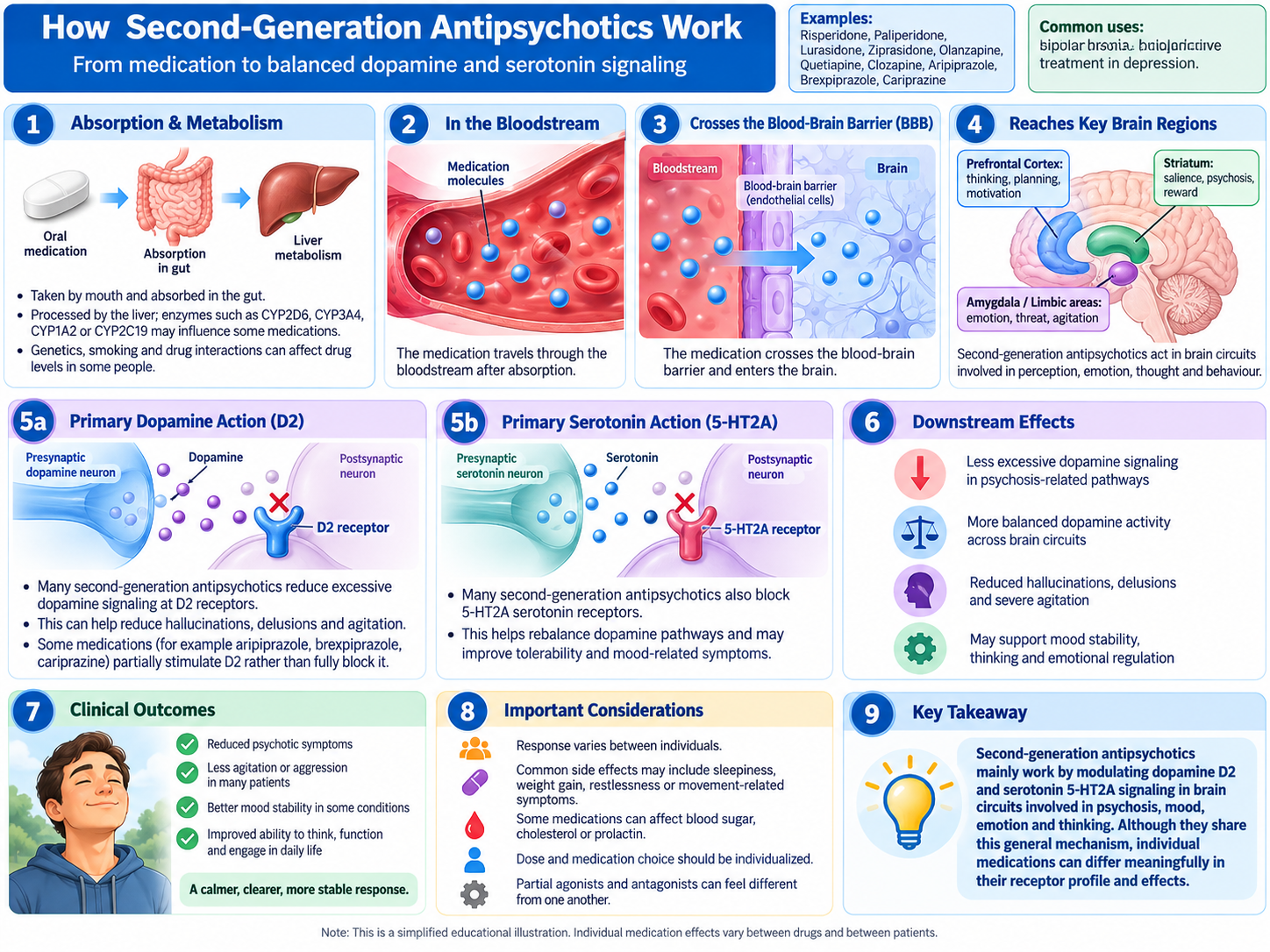
The main antipsychotic actions of quetiapine involve:
Dopamine D2 receptor antagonism
and:
Serotonin 5-HT2A receptor antagonism
Its active metabolite: Norquetiapine adds important effects involving:
- NET — Norepinephrine Transporter inhibition
- 5-HT1A partial agonist activity These additional actions may contribute to quetiapine’s antidepressant and anxiolytic properties. Official prescribing information states that the precise mechanism is not fully established, but D2 and 5-HT2A antagonism are considered central to its therapeutic activity.
A simplified overview is:
Quetiapine
- D2 receptor blockade
- 5-HT2A receptor blockade
- Dopamine-serotonin signaling changes
- Psychosis and mania may improve
while:
- Quetiapine
- CYP3A4 metabolism
- Norquetiapine
- NET inhibition
- 5-HT1A partial agonism
- Norepinephrine + serotonin signaling changes
- Potential antidepressant and anxiolytic effects
At the same time:
H1 blockade
→ sedation
α1 blockade
→ dizziness and orthostatic hypotension
H1 + 5-HT2C-related effects
→ increased appetite and weight gain
Muscarinic effects, particularly from norquetiapine
→ dry mouth and constipation
How Does Quetiapine Work for Schizophrenia?
Schizophrenia should not be described simply as:
“Too much dopamine.”
Dopamine signaling differs considerably between brain regions.
Psychotic symptoms are particularly associated with abnormally increased dopamine signaling in striatal and related limbic circuits, while other symptoms may involve reduced or inefficient signaling in cortical pathways.
Quetiapine’s principal antipsychotic action is:
D2 Dopamine Receptor Blockade
The general pathway is:
- Dysregulated dopamine signaling
- Excessive D2 receptor stimulation in psychosis-related pathways
- Potential:
- Hallucinations
- Delusions
- Paranoia
- Abnormal salience
- Disorganized thinking Quetiapine intervenes:
- Quetiapine
- Blocks D2 receptors
- Dopamine produces less D2-mediated signaling
- Psychosis-related dopamine signaling decreases
- Positive psychotic symptoms may improve
The official quetiapine labeling identifies combined D2 and 5-HT2A antagonism as the most likely basis for its antipsychotic efficacy.
What Does Quetiapine Do to Dopamine?
Quetiapine does not remove dopamine from the brain.
It primarily:
Blocks dopamine receptors
particularly:
D2
Normally:
- Dopamine released
- Dopamine binds D2 receptor
- D2 signaling occurs
With quetiapine:
- Quetiapine occupies D2
- Dopamine has less access to D2
- D2-mediated signaling decreases
This is an important distinction.
Quetiapine is a:
D2 antagonist
rather than a drug that directly reduces dopamine synthesis.
Does Quetiapine Block Dopamine Everywhere in the Brain?
Quetiapine can reach D2 receptors throughout the brain, but the consequence of D2 blockade depends heavily on the:
Dopamine pathway involved
Four pathways are especially useful for understanding quetiapine.
Mesolimbic and Striatal Dopamine — Antipsychotic Effect
Excessive or dysregulated dopamine activity in these pathways can contribute to:
- Hallucinations
- Delusions
- Paranoia
- Abnormal salience Therefore:
- Quetiapine
- D2 blockade in psychosis-related pathways
- Excessive dopamine signaling decreases
- Positive psychotic symptoms may improve
This is the D2 effect clinicians generally want.
Nigrostriatal Dopamine — Movement Side Effects
The:
Nigrostriatal pathway
helps regulate movement.
If D2 blockade becomes excessive:
- Quetiapine
- D2 signaling decreases in motor circuits
- Possible:
- Tremor
- Rigidity
- Slowed movement
- Akathisia
- Dystonia These are collectively known as:
Extrapyramidal Symptoms — EPS
Quetiapine generally has a lower tendency to produce EPS than potent, sustained D2 antagonists such as haloperidol, although the risk is not zero.
Tuberoinfundibular Dopamine — Prolactin
Dopamine normally suppresses prolactin release.
Therefore:
- Dopamine
- D2 receptors in the pituitary pathway
- Prolactin release suppressed
When D2 is blocked:
- Quetiapine
- Dopamine inhibition of prolactin decreases
- Prolactin may increase
However, quetiapine’s prolactin effect is generally less prominent than that of antipsychotics with stronger and more sustained D2 occupancy.
Prefrontal Dopamine — Cognition and Motivation
The:
Prefrontal Cortex — PFC
uses dopamine for:
- Attention
- Working memory
- Motivation
- Planning
- Executive function
- Emotional regulation Some people with schizophrenia may already have reduced or inefficient cortical dopamine signaling.
Therefore:
The ideal antipsychotic would reduce excessive dopamine signaling in psychosis-related pathways without unnecessarily suppressing dopamine in cortical pathways.
Quetiapine’s relatively transient D2 interaction and strong serotonergic actions may contribute to its different clinical profile compared with potent first-generation D2 blockers.
Why Does Quetiapine Have Relatively Low EPS Risk?
Quetiapine has relatively low affinity for D2 compared with some other antipsychotics and does not maintain continuous, very high D2 receptor occupancy throughout the dosing interval.
Its strong:
5-HT2A antagonism
also modifies dopamine release in movement-related pathways.
Conceptually:
Quetiapine
- Transient/moderate D2 blockade
- Strong 5-HT2A blockade
- Less persistent dopamine suppression in nigrostriatal pathways
- Lower EPS liability than strong sustained D2 antagonists
This does not mean quetiapine cannot cause akathisia, tremor or Parkinsonism. It can.
What Does Quetiapine Do to Serotonin?
Quetiapine has high affinity for:
5-HT2A Serotonin Receptors
Official pharmacology data show substantially greater affinity for 5-HT2A than for D2 receptors.
Therefore:
- Quetiapine
- 5-HT2A receptor blockade
- Serotonin regulation of dopamine pathways changes
- Regional dopamine signaling is modified
This serotonergic component is central to quetiapine’s classification as a:
Second-generation antipsychotic
rather than a predominantly D2-blocking first-generation antipsychotic.
Why Is 5-HT2A Blockade Important?
Serotonin regulates dopamine neurons.
In several brain regions, activation of 5-HT2A receptors can restrain dopamine release.
Therefore:
- 5-HT2A blocked
- Serotonergic restraint on dopamine may decrease in selected pathways
- Local dopamine release may increase
This can partially counter D2 blockade in regions such as:
- Prefrontal cortex
- Nigrostriatal pathways while D2 antagonism still reduces excessive dopamine signaling in psychosis-related circuits.
This helps explain why an atypical antipsychotic such as quetiapine cannot be described simply as:
“Lowering dopamine throughout the brain.”
What Is Norquetiapine?
Quetiapine has an active metabolite:
Norquetiapine also called: N-desalkylquetiapine
Quetiapine is converted to norquetiapine largely through:
CYP3A4
Norquetiapine has its own distinct pharmacology.
It has activity at:
- NET
- 5-HT1A
- 5-HT2A
- 5-HT2C
- H1
- Muscarinic receptors
- Adrenergic receptors and generally binds several of these targets more strongly than parent quetiapine.
This means the clinical effects of quetiapine are actually produced by:
Quetiapine + Norquetiapine rather than by the parent drug alone.
Why Is Norquetiapine Important for Depression?
Norquetiapine has two particularly interesting properties:
-
NET inhibition
-
5-HT1A partial agonism These are pharmacological actions commonly associated with:
-
Antidepressant effects
-
Anxiety reduction
-
Prefrontal neurotransmission Experimental pharmacology identified norquetiapine as a potent norepinephrine-reuptake inhibitor and partial 5-HT1A agonist, providing a plausible explanation for some of quetiapine’s antidepressant activity.
How Does Quetiapine Work for Bipolar Depression?
Bipolar depression involves dysregulation across:
- Dopamine
- Norepinephrine
- Serotonin
- Glutamate
- GABA
- Reward networks
- Stress systems
- Circadian and sleep pathways Quetiapine’s antidepressant mechanism likely involves more than D2 antagonism.
A useful model is:
- Quetiapine
- CYP3A4
- Norquetiapine
- NET inhibition
- Norepinephrine reuptake decreases
- Norepinephrine availability increases
plus:
- 5-HT1A partial agonism
- Serotonergic signaling changes
plus:
- 5-HT2A antagonism
- Serotonin-dopamine regulation changes
- Mood-related cortical and limbic networks adapt
- Depressive symptoms may improve
This mechanism is biologically plausible, but the complete antidepressant mechanism of quetiapine remains incompletely understood.
Does Norquetiapine Increase Norepinephrine?
Indirectly, yes.
Norquetiapine blocks:
NET — Norepinephrine Transporter
NET normally transports norepinephrine back into presynaptic nerve cells.
Therefore:
- Norquetiapine
- NET inhibition
- Norepinephrine reuptake decreases
- More norepinephrine remains available outside the neuron
This may contribute to effects on:
- Mood
- Energy
- Motivation
- Attention
- Anxiety Norquetiapine’s NET activity is substantially more important than that of parent quetiapine.
What Does 5-HT1A Partial Agonism Mean?
The:
5-HT1A receptor
is involved in:
- Anxiety
- Mood
- Stress regulation
- Serotonin feedback
- Prefrontal function A: Partial agonist activates a receptor, but not as strongly as a full agonist.
Norquetiapine has meaningful:
5-HT1A partial agonist activity
Therefore:
- Norquetiapine
- 5-HT1A partially activated
- Serotonin-related emotional and anxiety pathways are modulated
- Potential antidepressant and anxiolytic contribution
This makes norquetiapine pharmacologically different from the parent quetiapine molecule.
Is Quetiapine a 5-HT1A Agonist?
More precisely: Norquetiapine rather than parent quetiapine, has the stronger 5-HT1A partial-agonist activity.
It is therefore preferable to say:
Quetiapine treatment produces an active metabolite, norquetiapine, that has 5-HT1A partial-agonist properties.
rather than describing quetiapine itself as primarily a 5-HT1A agonist.
Does Quetiapine Increase Dopamine in the Prefrontal Cortex?
Potentially, indirectly.
This can occur through at least two mechanisms.
NET Inhibition
In the prefrontal cortex, NET contributes not only to norepinephrine clearance but also to:
Dopamine clearance
because DAT expression is relatively low there.
Therefore:
- Norquetiapine
- NET inhibited
- Norepinephrine clearance decreases
and:
- PFC dopamine clearance may also decrease
- Local catecholamine signaling may increase
5-HT2A Blockade
Quetiapine’s 5-HT2A antagonism may also facilitate dopamine release in selected cortical regions.
Therefore, the medication can:
Block D2 receptors while simultaneously: Increasing or preserving dopamine availability in certain cortical pathways
This is another reason quetiapine’s pharmacology cannot be reduced to: “It lowers dopamine.”
How Does Quetiapine Work for Mania?
Mania can involve dysregulation in:
-
Dopamine
-
Reward pathways
-
Arousal
-
Serotonin
-
Glutamate
-
GABA
-
Sleep systems
-
Circadian rhythms Symptoms can include:
-
Excessive energy
-
Reduced need for sleep
-
Racing thoughts
-
Rapid speech
-
Grandiosity
-
Increased goal-directed activity
-
Impulsivity
-
Agitation Quetiapine can reduce several aspects of this excessive activation.
- Quetiapine
- D2 antagonism
- Dopamine-driven activation decreases
- 5-HT2A antagonism
- Serotonin-dopamine regulation changes
- H1 antagonism
- Arousal decreases
- Manic agitation and overactivation may improve
Its antimanic effect should not be interpreted simply as sedation.
Does Quetiapine Work Just by Making Someone Sleepy?
No.
This is an important distinction.
Quetiapine’s:
Sedating effect largely comes from:
- H1 histamine receptor blockade whereas its antipsychotic action is more closely related to:
- D2 + 5-HT2A antagonism and its antidepressant properties may partly involve: Norquetiapine → NET + 5-HT1A Therefore: Sedation is a pharmacological effect but: Sedation is not the same thing as treating psychosis, mania or depression.
A person may become sleepy after the first doses while therapeutic improvement in psychosis or depression takes considerably longer.
Why Does Quetiapine Make You Sleepy?
Quetiapine and norquetiapine bind strongly to:
Histamine H1 Receptors
Histamine is one of the brain’s major wake-promoting neurotransmitters.
Normally:
- Histamine
- H1 receptors
- Wakefulness + alertness
Quetiapine blocks H1:
- Quetiapine
- H1 blockade
- Histamine-mediated wakefulness decreases
- Sedation + sleepiness
Official receptor-binding data show that H1 is one of quetiapine’s highest-affinity targets.
Why Can Quetiapine Be Sedating at Low Doses?
This relates to:
Receptor Affinity
Quetiapine binds some receptors much more readily than others.
Its affinity for:
H1 histamine receptors
is considerably stronger than its affinity for:
D2 receptors
Therefore, relatively modest exposure can produce strong H1 occupancy and sedation before substantial D2 blockade is achieved. Official receptor-binding data illustrate this large affinity difference.
Conceptually:
Lower exposure
- H1 blockade dominates
- Sedation
As exposure increases:
- 5-HT2A and D2 effects become increasingly relevant
- Mood-stabilizing / antipsychotic pharmacology becomes more prominent
This is a useful conceptual model, but it should not be converted into rigid dose bands, because receptor occupancy varies across individuals and formulations.
Is Low-Dose Quetiapine Just an Antihistamine?
No.
H1 blockade may dominate the subjective effect at low exposure, but quetiapine still has a broader receptor profile.
Even relatively low-dose treatment can affect:
- α1 adrenergic receptors
- Serotonin receptors
- Metabolism
- Appetite
- Blood pressure Therefore low-dose quetiapine should not be considered equivalent to an ordinary over-the-counter antihistamine.
Is Quetiapine a Sleeping Pill?
No.
Quetiapine is:
An antipsychotic
not a conventional hypnotic medication.
It is sometimes prescribed off-label for insomnia because it can be strongly sedating.
However, even when used at lower doses, it can cause:
- Daytime drowsiness
- Orthostatic hypotension
- Increased appetite
- Weight gain
- Metabolic effects
- Dry mouth
- Constipation Therefore:
The fact that quetiapine promotes sleep does not mean its risk-benefit profile is the same as that of medications specifically developed for insomnia.
Why Does Quetiapine Increase Appetite?
Several receptors contribute, particularly:
H1
and:
5-HT2C
These receptors participate in:
- Hunger
- Satiety
- Food reward
- Hypothalamic energy regulation Therefore:
- Quetiapine / norquetiapine
- H1 + 5-HT2C signaling altered
- Appetite and satiety regulation change
- Hunger may increase
- Food intake may increase
- Weight gain may occur
Weight gain is therefore not simply a question of willpower; the medication acts directly on neural pathways involved in appetite regulation.
Why Can Quetiapine Cause Weight Gain?
Weight gain can result from several interacting mechanisms:
- Increased appetite
- Reduced satiety
- H1 blockade
- 5-HT2C blockade
- Sedation and reduced activity
- Individual metabolic susceptibility
- Changes in glucose and lipid regulation Therefore:
Weight gain is multifactorial
rather than attributable to one receptor alone.
Can Quetiapine Affect Blood Sugar and Cholesterol?
Yes.
Quetiapine can contribute to:
- Increased blood glucose
- Insulin resistance
- Increased triglycerides
- Increased cholesterol
- Weight gain These metabolic effects are recognized in product labeling and are why weight, glucose and lipid monitoring can be important during treatment.
A patient can sometimes develop metabolic changes even without dramatic early weight gain.
Why Does Quetiapine Cause Dizziness When Standing?
Quetiapine strongly blocks:
Alpha-1 Adrenergic Receptors
Alpha-1 receptors help maintain blood pressure when someone stands.
Normally:
- Person stands
- α1 receptors activated
- Blood vessels constrict
- Blood pressure maintained
With quetiapine:
- α1 blocked
- Vascular constriction weakened
- Blood pressure may fall
- Dizziness or faintness
This is:
Orthostatic Hypotension
Official labeling directly links quetiapine’s α1 antagonism with orthostatic hypotension.
Why Does Quetiapine Cause Dry Mouth and Constipation?
This is particularly interesting because of:
Norquetiapine
Parent quetiapine has relatively weak affinity for muscarinic M1 receptors, while norquetiapine has substantially stronger M1 affinity.
Therefore:
- Quetiapine
- CYP3A4
- Norquetiapine
- Muscarinic receptor antagonism
- Possible:
- Dry mouth
- Constipation
- Blurred vision
- Urinary difficulty These are:
Anticholinergic effects
Severe constipation should be assessed rather than ignored, particularly when other anticholinergic medications are also being used.
Why Can Quetiapine Cause Akathisia or Parkinsonism?
Although quetiapine has relatively low EPS risk, it still blocks:
D2 receptors
If motor-circuit D2 blockade becomes excessive:
- D2 blockade
- Nigrostriatal dopamine signaling decreases
- Possible:
Akathisia
inner restlessness
Parkinsonism
stiffness, slowness, tremor
Dystonia
sustained muscle contraction
The risk depends on:
- Dose
- Drug concentration
- Individual dopamine biology
- Other medications
- Age
- Susceptibility
Why Can Quetiapine Cause Tardive Dyskinesia?
Long-term exposure to dopamine-receptor-blocking drugs can produce persistent adaptations within motor pathways.
The mechanism is not fully established, but may involve:
- D2 receptor adaptation
- Dopamine supersensitivity
- Basal ganglia plasticity
- Oxidative stress
- Altered motor circuitry Therefore:
- Long-term D2 blockade
- Motor networks adapt
- Abnormal involuntary movements may emerge
This is known as:
Tardive Dyskinesia
and can occasionally persist after treatment is stopped.
How Is Quetiapine Different from Olanzapine?
Both are second-generation antipsychotics and both block:
D2 + 5-HT2A
But their profiles differ substantially.
Olanzapine
generally, has stronger and more sustained:
- D2 antagonism
- 5-HT2C activity
- H1 activity
- Muscarinic activity and is particularly associated with:
Weight and metabolic effects
Quetiapine
has:
- Relatively transient D2 blockade
- Strong H1 and α1 activity
- An important active metabolite
- Norquetiapine NET inhibition
- Norquetiapine 5-HT1A partial agonism Therefore, quetiapine has a particularly distinctive:
Antipsychotic + sedating + antidepressant pharmacology
How Is Quetiapine Different from Haloperidol?
Haloperidol is strongly dominated by: D2 antagonism
Quetiapine combines: D2 blockade with 5-HT2A blockade
plus:
-
H1 blockade
-
α1 blockade
-
Norquetiapine NET inhibition
-
Norquetiapine 5-HT1A partial agonism Therefore, haloperidol generally has greater liability for:
-
Parkinsonism
-
Dystonia
-
EPS
-
Prolactin elevation while quetiapine generally has more prominent:
-
Sedation
-
Dizziness
-
Appetite increase
-
Weight/metabolic effects Individual responses vary.
How Is Quetiapine Different from Aripiprazole?
The dopamine mechanism differs fundamentally.
Quetiapine is primarily a: D2 antagonist
whereas:
Aripiprazole is primarily a: D2 partial agonist
Therefore:
Quetiapine → blocks D2 signaling
while:
Aripiprazole → partially stimulates D2 while competing with dopamine
This contributes to meaningful differences in:
- Prolactin
- Activation
- Akathisia
- Sedation
- Metabolic effects
How Is Quetiapine Different from an Antidepressant Such as Duloxetine?
Duloxetine directly inhibits:
SERT + NET
Quetiapine’s antidepressant pharmacology is broader.
Parent quetiapine provides:
5-HT2A antagonism + other receptor actions while its metabolite norquetiapine provides:
NET inhibition + 5-HT1A partial agonism
Therefore:
Duloxetine directly blocks monoamine transporters.
Quetiapine combines receptor antagonism with an active metabolite that affects NET and 5-HT1A.
This helps explain why quetiapine is still classified as an: Antipsychotic rather than as an SNRI.
How Quickly Does Quetiapine Work?
Different effects appear at different times.
- Sedation can occur after the first doses because H1 blockade begins rapidly.
- Agitation and sleep may improve relatively early.
- Mania can require days or longer for substantial improvement.
- Psychosis may require days to several weeks.
- Depressive symptoms can also take several weeks to show their full response. The sequence is:
- Quetiapine reaches brain receptors
- Immediate receptor occupancy
- Neurotransmitter signaling changes
- Neural circuits gradually adapt
- Clinical response develops
Therefore:
Feeling sleepy on the first night does not mean the full therapeutic effect has occurred.
How Is Quetiapine Metabolized?
Quetiapine is extensively metabolized in the liver.
The overwhelmingly important enzyme is:
CYP3A4
A key pathway is:
- Quetiapine
- CYP3A4
- Norquetiapine
- Other metabolites Further metabolism and elimination CYP3A4 is therefore important in two ways:
It affects how quickly parent quetiapine is cleared
and:
It contributes to formation of active norquetiapine
This makes quetiapine pharmacokinetics somewhat different from drugs where metabolism simply inactivates the parent compound.
Why Are CYP3A4 Drug Interactions Important?
Because CYP3A4 is the dominant metabolic pathway.
A strong CYP3A4 inhibitor can:
- Block CYP3A4
- Quetiapine metabolism decreases
- Quetiapine concentration rises
This can increase:
- Sedation
- Dizziness
- Orthostatic hypotension
- Other concentration-related effects Conversely:
- Strong CYP3A4 inducer
- Quetiapine metabolism accelerates
- Quetiapine concentration falls
- Potential:
Reduced treatment response
The effect can be very large; strong inducers such as phenytoin can increase quetiapine clearance several-fold.
Can Quetiapine Fail Even When Metabolism Is Normal?
Yes.
This is the distinction between:
- Pharmacokinetics — PK
Pharmacodynamics — PD
A patient can have perfectly ordinary quetiapine concentrations but still have:
- Inadequate antipsychotic response
- Inadequate antidepressant response
- Excessive sedation
- Weight gain
- Akathisia
- Cognitive dulling because: Getting an appropriate amount of drug to the brain is not the same as: Having the right receptor biology for that medication.
Quetiapine Pharmacokinetics — PK
PK asks: How much quetiapine and norquetiapine reach the brain?
The pathway is:
- Quetiapine dose
- Absorption
- CYP3A4 metabolism
-
Parent quetiapine exposure
-
Norquetiapine formation Brain exposure Important factors include:
-
CYP3A4 activity
-
CYP3A4 genotype
-
CYP3A4 inhibitors
-
CYP3A4 inducers
-
Liver function
-
Age
-
Dose
-
IR versus XR formulation
Quetiapine Pharmacodynamics — PD
PD asks: What happens after quetiapine and norquetiapine reach the brain?
Quetiapine
- D2 antagonism
- 5-HT2A antagonism Antipsychotic + antimanic activity while:
Norquetiapine
-
NET inhibition
-
5-HT1A partial agonism Potential antidepressant + anxiolytic activity At the same time:
-
H1 blockade → sedation and appetite
-
α1 blockade → orthostatic hypotension
-
5-HT2C-related effects → appetite and metabolic regulation
-
Muscarinic effects → dry mouth and constipation Therefore:
Normal quetiapine pharmacokinetics do not automatically mean optimal pharmacodynamic response.
Quetiapine Requires Both Appropriate Drug Exposure and Brain Compatibility
The complete pathway can be summarized as:
- Quetiapine is taken
- PK — Pharmacokinetics
- Absorption
- CYP3A4 metabolism
- Quetiapine concentration
- Norquetiapine formation
- Medication reaches the brain
- PD — Pharmacodynamics
Quetiapine
- D2 blockade + 5-HT2A blockade
- Antipsychotic / antimanic effects
and:
Norquetiapine
- NET inhibition + 5-HT1A partial agonism
- Potential antidepressant / anxiolytic effects
while:
- H1→ sedation + appetite
- α1→ orthostatic hypotension
- 5-HT2C→ appetite / metabolic regulation
- Muscarinic pathways→ dry mouth / constipation This creates two separate personalized-prescribing questions:
PK asks:
Does the patient produce appropriate concentrations of quetiapine and norquetiapine?
PD asks: Is this combination of D2, serotonin, norepinephrine, histamine and other receptor effects compatible with the patient’s underlying neurobiology and symptom pattern?
Both matter.
Does CYP3A4 Genotype Affect Quetiapine?
Potentially, and this relationship is more clinically relevant than most people realize.
The Dutch Pharmacogenetics Working Group — DPWG recognizes a gene-drug interaction between:
CYP3A4
and:
Quetiapine
particularly for: CYP3A4 Poor Metabolizers
A key reduced-function allele is: CYP3A4*22
Reduced CYP3A4 function can lead to:
- Reduced CYP3A4 activity
- Quetiapine clearance decreases
- Parent quetiapine concentration increases
At the same time:
Formation of norquetiapine may decrease
This distinction becomes especially interesting when quetiapine is being used for depression because norquetiapine may contribute importantly to antidepressant activity.
What Does DPWG Recommend for CYP3A4 Poor Metabolizers?
Current DPWG guidance distinguishes between indications.
For depression
DPWG recommends:
Choose an alternative drug
because reduced CYP3A4 activity may produce both:
- Excessive parent quetiapine exposure
- Reduced formation of active norquetiapine
For indications other than depression
such as schizophrenia or mania, DPWG recommends:
Approximately 30% of the normal quetiapine dose
for CYP3A4 Poor Metabolizers.
For other CYP3A4 phenotypes, DPWG does not recommend routine genotype-guided adjustment.
These are clinician-level recommendations, not instructions for self-adjustment.
How Strong Is the CYP3A4 Genetic Evidence?
The evidence is clinically interesting but more limited than classic PGx relationships such as:
- CYP2D6–nortriptyline
- CYP2D6–atomoxetine
- CYP2C19–citalopram The DPWG nevertheless considered the change in quetiapine exposure in CYP3A4 Poor Metabolizers large enough to justify a recommendation.
Therefore it is reasonable to describe CYP3A4 as:
Potentially actionable when a Poor Metabolizer phenotype is established
but not as a reason that every patient must undergo CYP3A4 testing before quetiapine treatment.
Does CYP2D6 Genotype Affect Quetiapine?
Not enough to require routine dose modification.
The DPWG reviewed the evidence and did not identify a clinically meaningful CYP2D6-quetiapine relationship requiring action.
Therefore:
CYP2D6 Poor Metabolizer- does not automatically require a lower quetiapine dose,
and:
CYP2D6 Ultrarapid Metabolizer- does not automatically require a higher dose.
This contrasts with antipsychotics such as:
- Aripiprazole
- Brexpiprazole
- Risperidone where CYP2D6 can have greater prescribing significance.
What Is the Role of DRD2 Genetics?
DRD2 encodes: Dopamine D2 Receptor, one of quetiapine’s principal direct pharmacodynamic targets.
The relationship is:
- DRD2
- D2 receptor expression/function
- Quetiapine antagonizes D2
- Dopamine signaling changes
- Antipsychotic response + movement effects may vary
DRD2 variants have been extensively studied in antipsychotic response.
However:
There is currently no validated DRD2 genotype-based quetiapine prescribing guideline.
Therefore DRD2 results should not independently be interpreted as:
“Quetiapine will work”
or:
“Quetiapine will fail.”
What Is the Role of HTR2A Genetics?
HTR2A encodes: 5-HT2A one of quetiapine’s most important serotonin targets.
The pathway is:
- HTR2A
- 5-HT2A receptor expression/function
- Quetiapine blocks 5-HT2A
- Serotonin regulation of dopamine changes
- Potential influence on treatment response
HTR2A is biologically relevant but currently has:
No validated quetiapine genotype-based prescribing recommendation.
What Is the Role of HTR1A Genetics?
HTR1A encodes: 5-HT1A which is particularly relevant to: Norquetiapine because norquetiapine has 5-HT1A partial-agonist activity.
Therefore:
- HTR1A
- 5-HT1A receptor function
- Norquetiapine partially stimulates 5-HT1A
- Serotonergic emotional and anxiety networks respond
This makes HTR1A biologically interesting, particularly when considering:
- Depression
- Anxiety
- Bipolar depression However:
No validated HTR1A-guided quetiapine treatment rule currently exists.
What Is the Role of SLC6A2 Genetics?
SLC6A2 encodes: NET — Norepinephrine Transporter. Norquetiapine directly inhibits NET.
Therefore:
- SLC6A2
- NET expression/function
- Norquetiapine blocks NET
- Norepinephrine availability changes
- Potential antidepressant response
This is arguably one of the most mechanistically relevant pharmacodynamic genes when quetiapine is being used for depressive symptoms.
However:
There is currently no validated SLC6A2 genotype-based quetiapine prescribing guideline.
The gene is biologically relevant but remains investigational for individual treatment selection.
What Is the Role of HTR2C Genetics?
HTR2C encodes: 5-HT2C which is involved in:
- Appetite
- Satiety
- Weight regulation
- Dopamine regulation
- Norepinephrine regulation Norquetiapine has meaningful 5-HT2C antagonistic activity.
Therefore, HTR2C variants have been investigated for:
Antipsychotic-associated weight gain
and metabolic effects.
However:
No HTR2C genotype currently predicts an individual patient’s quetiapine weight gain sufficiently well for routine prescribing.
Can Pharmacogenomic Testing Predict Whether Quetiapine Will Work?
Not with certainty.
The evidence can be divided into two categories.
Established or Clinically Actionable PK Information
-
CYP3A4 CYP3A4 Poor Metabolizer status can materially affect quetiapine exposure, and DPWG provides prescribing recommendations.
-
CYP2D6 Current evidence does not support routine genotype-based quetiapine adjustment.
Emerging PD Information
Potential pharmacodynamic genes include:
- DRD2
- HTR2A
- HTR1A
- HTR2C
- SLC6A2
- HRH1 These correspond closely to quetiapine or norquetiapine pharmacology but do not currently provide validated individual prescribing rules.
Therefore:
Pharmacogenomics can help identify some differences in quetiapine exposure, but it cannot yet reliably determine whether quetiapine’s receptor profile will provide an optimal response for an individual patient.
Why Might Quetiapine Work Very Well for One Person but Poorly for Another?
Two patients can carry the same diagnosis while having very different neurochemical patterns.
For example, one person with bipolar depression may have prominent:
Low motivation + low energy + anxiety + insomnia
while another has:
Hypersomnia + fatigue + metabolic vulnerability
The first patient may potentially benefit from a combination of:
- Norquetiapine NET inhibition
- 5-HT1A effects
- Sedation at night while the same H1-mediated sedation and appetite effects may be undesirable for another patient.
Likewise, in schizophrenia:
High striatal dopamine activity
may make D2 antagonism useful,
whereas excessive D2 suppression in someone particularly sensitive to dopamine blockade may cause:
- Akathisia
- Motor slowing
- Reduced motivation Therefore:
Diagnosis alone does not completely define medication compatibility.
This article is educational. It does not diagnose, and it does not replace advice from your prescriber or pharmacist. Never start, stop or change a medication based on a web page.