
Risperidone · How it works
How Does Risperidone Work?
Risperidone, best known by the brand name Risperdal, is a second-generation or atypical antipsychotic used primarily to treat schizophrenia, psychosis and acu
 Written by Sanjida Ahmed, PhD, Cellular and Molecular BiologyChief Operating Officer and Lead Scientist, Personalized Prescribing. Last reviewed October 2, 2026.
- Class
- Atypical antipsychotic
On this page
- How Does Risperidone Work for Schizophrenia?
- “Too much dopamine.”
- D2-Mediated Dopamine Signaling
- What Does Risperidone Do to Dopamine?
- D2 Receptors
- “Risperidone lowers dopamine”
- Why Does Brain Region Matter with Risperidone?
- Nigrostriatal Pathway
- Extrapyramidal Symptoms — EPS
- What Is the D2 Receptor Occupancy Window?
- Why Does Risperidone Raise Prolactin More Than Some Other Atypical Antipsychotics?
- What Does Risperidone Do to Serotonin?
- Second-Generation or Atypical Antipsychotic
- Why Is 5-HT2A Blockade Important?
- How Does Risperidone Work for Mania?
- Does Risperidone Work by Sedating Someone?
- D2 + 5-HT2A antagonism
- H1 histamine receptor antagonism
- Antipsychotic response
- Why Can Risperidone Make You Sleepy?
- H1 Histamine Receptors
- Why Can Risperidone Cause Weight Gain?
- Does Risperidone Have Strong Anticholinergic Effects?
- No meaningful muscarinic acetylcholine receptor affinity
- Why Does Risperidone Cause Dizziness When Standing?
- Alpha-1 Adrenergic Receptors
- Orthostatic Hypotension
- What Is Paliperidone and Why Does It Matter?
- What Is the Risperidone Active Moiety?
- Total active antipsychotic exposure
- CYP2D6 genetics
- How Is Risperidone Metabolized?
- How Does CYP2D6 Affect Risperidone?
- Greater concentration-related adverse-effect risk
- 67% of the normal risperidone dose
- A one-third dose reduction
- Not require a routine genotype-based adjustment
- Choosing an alternative medication
- DPWG CYP2D6 Guidance for Risperidone
- Why Do Fluoxetine and Paroxetine Matter with Risperidone?
- Why Does Kidney Function Matter With Risperidone?
- Paliperidone is importantly eliminated by the kidneys
- CYP2D6 + drug interactions + kidney function
- Can Risperidone Fail Even When CYP2D6 Metabolism Is Normal?
- What Is the Role of DRD2 Genetics?
- “Risperidone will work”
- “Risperidone will fail.”
- What Is the Role of HTR2A Genetics?
- What Is the Role of HTR2C?
- What Is the Role of DRD3?
- What Is the Role of ABCB1?
- Can Pharmacogenomic Testing Predict Whether Risperidone Will Work?
- Why Might Risperidone Work Very Well for One Person but Poorly for Another?
- Markedly elevated striatal dopamine signaling
- Psychosis together with significant prefrontal dopamine dysfunction
- D2 blockade
- Prolactin elevation
- CYP2D6 Poor Metabolizer status
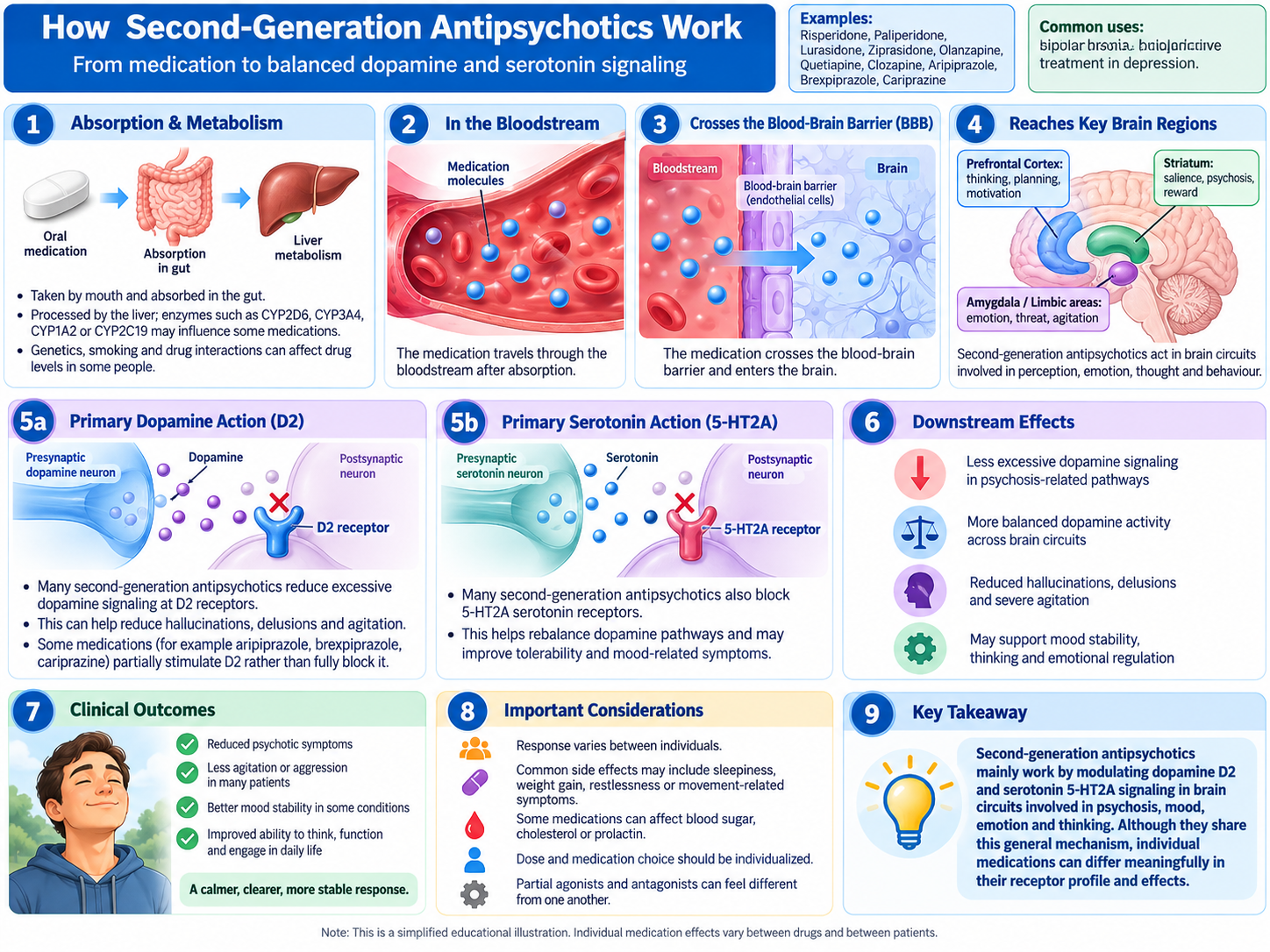
Risperidone, best known by the brand name Risperdal, is a second-generation or atypical antipsychotic used primarily to treat schizophrenia, psychosis and acute mania associated with bipolar I disorder.
Risperidone works mainly by blocking two important neurotransmitter receptors:
- Dopamine D2 Receptors
- Serotonin 5-HT2A Receptors Its clinical effects also come from an active metabolite called: 9-Hydroxyrisperidone — Paliperidone
Risperidone and paliperidone have similar antipsychotic receptor activity, and their combined concentrations are often referred to as the active moiety or active antipsychotic fraction. Current prescribing information identifies combined D2 and 5-HT2A antagonism as the principal proposed mechanism of risperidone’s therapeutic effect.
The basic mechanism can be summarized as:
Risperidone
- Blocks D2 dopamine receptors
- Blocks 5-HT2A serotonin receptors
- Dopamine-serotonin signaling changes
- Psychosis- and mania-related neural circuits become better regulated
- Hallucinations, delusions, agitation and manic symptoms may improve
At the same time:
- D2 blockade in movement pathways → akathisia / Parkinsonism / EPS
- D2 blockade in the pituitary pathway → increased prolactin
- α1 adrenergic blockade → dizziness / orthostatic hypotension
- H1 histamine blockade → some sedation / appetite effects This combination of therapeutic and adverse effects is central to understanding how risperidone works.
How Does Risperidone Work for Schizophrenia?
Schizophrenia should not be described simply as:
“Too much dopamine.”
Dopamine activity differs substantially between brain regions.
One of the strongest biological findings in psychosis is excessive or dysregulated dopamine signaling in striatal pathways, while cortical dopamine function may simultaneously be reduced or inefficient in some patients.
Risperidone primarily treats positive psychotic symptoms by reducing:
D2-Mediated Dopamine Signaling
The pathway can be represented as:
- Dysregulated striatal dopamine activity
- Excessive D2 receptor stimulation
- Abnormal salience and psychotic processing
- Potential:
- Hallucinations
- Delusions
- Paranoia
- Disorganized thinking Risperidone intervenes:
- Risperidone
- D2 receptor antagonism
- Dopamine cannot activate D2 receptors as strongly
- Excessive dopamine-related signaling decreases
- Positive psychotic symptoms may improve
D2 blockade is considered central to the antipsychotic effect of risperidone.
What Does Risperidone Do to Dopamine?
Risperidone does not remove dopamine from the brain.
It blocks dopamine from activating:
D2 Receptors
as effectively.
Normally:
- Dopamine released
- Dopamine binds D2 receptor
- D2 signaling occurs
With risperidone:
- Risperidone occupies D2 receptor
- Dopamine has less access to the receptor
- D2 signaling decreases
Therefore, saying:
“Risperidone lowers dopamine”
is an oversimplification.
A more accurate statement is:
Risperidone reduces dopamine signaling through D2 receptors.
The effect of doing this differs according to the brain pathway involved.
Why Does Brain Region Matter with Risperidone?
Dopamine serves very different functions in different brain pathways.
Four pathways are particularly important when understanding risperidone.
Mesolimbic and Striatal Dopamine — Antipsychotic Effect
Excessive dopamine signaling in psychosis-related striatal and limbic circuits can contribute to:
- Hallucinations
- Delusions
- Paranoia
- Excessive salience
- Severe agitation Therefore:
- Risperidone
- D2 blockade in psychosis-related pathways
- Excessive dopamine signaling decreases
- Psychotic symptoms may improve
This is the desired therapeutic effect.
Nigrostriatal Dopamine — Movement Side Effects
The:
Nigrostriatal Pathway
helps regulate movement.
If risperidone blocks too much D2 activity here:
- Risperidone
- D2 blockade in motor circuits
- Dopamine signaling becomes too weak
- Possible:
- Akathisia- inner restlessness
- Parkinsonism- slowness, stiffness and tremor
- Dystonia- involuntary sustained muscle contractions These are called:
Extrapyramidal Symptoms — EPS
PET studies demonstrate that risperidone’s D2 occupancy rises with dose. In one study, average D2 occupancy was approximately 66% at 2 mg/day, 73% at 4 mg/day and 79% at 6 mg/day, with mild EPS occurring in patients with the highest occupancies.
What Is the D2 Receptor Occupancy Window?
Antipsychotic treatment is often conceptualized as having a D2 receptor occupancy window.
Broadly:
- Too little D2 occupancy- may provide insufficient antipsychotic activity.
- Moderate D2 occupancy- can provide therapeutic benefit.
- Very high D2 occupancy- increases the probability of EPS and other dopamine-blocking effects. For risperidone, PET literature suggests antipsychotic effects can emerge around approximately:
60–65% D2 occupancy while occupancy greater than approximately: 80% is associated with a greater risk of extrapyramidal symptoms.
This is a population-level pharmacological framework, not an individual dosing target.
The important clinical principle is: More D2 blockade is not automatically better.
Once sufficient D2 blockade has been achieved, additional blockade may increase side effects without proportionally improving psychosis.
Tuberoinfundibular Dopamine — Prolactin
This pathway explains one of risperidone’s most characteristic adverse effects.
Dopamine normally suppresses:
Prolactin
release from the pituitary gland.
Normally:
- Dopamine
- D2 receptor stimulation
- Prolactin release inhibited
Risperidone blocks D2:
- Risperidone
- D2 blockade
- Dopamine's inhibitory effect is removed
- Prolactin rises
This is why risperidone is particularly associated with:
Hyperprolactinemia
compared with several other second-generation antipsychotics.
Possible consequences include:
- Reduced libido
- Erectile dysfunction
- Ejaculatory problems
- Menstrual irregularities
- Galactorrhea
- Breast enlargement
- Fertility changes
- Potential bone effects with prolonged significant hyperprolactinemia The relationship between the combined risperidone/paliperidone active exposure and prolactin has been demonstrated pharmacokinetically.
Why Does Risperidone Raise Prolactin More Than Some Other Atypical Antipsychotics?
Several factors contribute.
Risperidone and its active metabolite:
Paliperidone
both strongly block D2 receptors.
The pituitary is also less protected by the blood-brain barrier than many other brain regions, so circulating antipsychotic concentrations can exert substantial effects on pituitary D2 receptors.
Therefore:
- Risperidone + paliperidone exposure
- Pituitary D2 blockade
- Prolactin suppression decreases
- Prolactin increases
This is an important distinction when comparing risperidone with agents such as aripiprazole, which is a D2 partial agonist and may have very different effects on prolactin.
Prefrontal Dopamine — Cognition and Motivation
The: Prefrontal Cortex — PFC uses dopamine for:
- Attention
- Working memory
- Motivation
- Planning
- Executive function
- Emotional regulation Some people with schizophrenia may already have reduced or inefficient prefrontal dopamine signaling.
Therefore:
Reducing dopamine everywhere in the brain would not be an ideal antipsychotic strategy.
Excessive D2 blockade could theoretically worsen:
- Motivation
- Emotional expression
- Cognitive efficiency in susceptible patients.
This is one reason risperidone’s serotonin pharmacology also matters.
What Does Risperidone Do to Serotonin?
Risperidone strongly blocks: 5-HT2A Serotonin Receptors and its affinity for 5-HT2A receptors is high relative to many of its other receptor targets.
The pathway is:
- Risperidone
- 5-HT2A receptor blockade
- Serotonin's regulation of dopamine pathways changes
- Regional dopamine signaling is modified
This serotonin-dopamine interaction contributes to risperidone’s classification as a:
Second-Generation or Atypical Antipsychotic
rather than a purely D2-focused antipsychotic.
Why Is 5-HT2A Blockade Important?
Serotonin can regulate dopamine release.
Blocking 5-HT2A receptors may facilitate or preserve dopamine release in selected:
- Cortical pathways
- Nigrostriatal pathways while risperidone simultaneously blocks D2 receptors.
Conceptually:
In psychosis-related striatal pathways
- D2 blockade
- Excessive dopamine signaling decreases
while in selected cortical or motor pathways:
- 5-HT2A blockade
- Serotonergic restraint on dopamine release may decrease
- Some dopamine signaling may be preserved
This does not mean risperidone simultaneously “raises and lowers dopamine everywhere.”
Rather:
Its net dopamine effect depends on brain region, receptor occupancy and serotonin-dopamine interactions.
How Does Risperidone Work for Mania?
Bipolar mania can involve dysregulation across several systems, including:
-
Dopamine
-
Serotonin
-
Glutamate
-
GABA
-
Reward networks
-
Arousal systems
-
Sleep and circadian pathways Symptoms can include:
-
Excessive energy
-
Reduced need for sleep
-
Racing thoughts
-
Rapid speech
-
Grandiosity
-
Impulsivity
-
Irritability
-
Agitation
-
Psychotic symptoms Dopamine-related activation appears to contribute to several manic symptoms.
Therefore:
- Risperidone
- D2 antagonism
- Excessive dopamine-driven activation decreases
- 5-HT2A antagonism
- Serotonin-dopamine regulation changes
- Manic symptoms may improve
The antimanic effect is therefore not simply due to sedation.
Risperidone is much less strongly antihistaminergic than quetiapine, for example, yet it can still provide substantial antimanic benefit through its D2/5-HT2A pharmacology.
Does Risperidone Work by Sedating Someone?
No.
Sedation can occur, but it is not the central therapeutic mechanism.
The principal antipsychotic action is:
D2 + 5-HT2A antagonism
whereas sedation is more related to:
H1 histamine receptor antagonism
and broader CNS effects.
Therefore:
Sleepiness
does not equal:
Antipsychotic response
A patient might feel sleepy before hallucinations or delusions have meaningfully improved.
Why Can Risperidone Make You Sleepy?
Risperidone has affinity for:
H1 Histamine Receptors
Histamine normally promotes:
- Wakefulness
- Alertness
- Arousal Therefore:
- Risperidone
- H1 antagonism
- Histamine-mediated alertness decreases
- Sleepiness may occur
However, H1 blockade is less dominant in risperidone’s overall pharmacological profile than it is in medications such as:
- Quetiapine
- Olanzapine This helps explain why risperidone is often less sedating than those agents. Current receptor-binding data show high affinity for H1, but its therapeutic profile remains strongly D2/5-HT2 driven.
Why Can Risperidone Cause Weight Gain?
Weight regulation is complex and involves:
- Histamine signaling
- Serotonin signaling
- Hypothalamic appetite circuits
- Food reward
- Activity
- Glucose regulation
- Individual metabolic susceptibility Risperidone’s:
H1
and broader serotonergic effects can contribute to increased appetite and weight gain.
However, its metabolic burden is generally different from that of strongly H1/5-HT2C-active antipsychotics such as olanzapine.
Weight gain remains clinically important and cannot be predicted simply from receptor affinity alone.
Does Risperidone Have Strong Anticholinergic Effects?
No.
This is an important difference from:
- Clozapine
- Olanzapine
- Quetiapine Risperidone has essentially:
No meaningful muscarinic acetylcholine receptor affinity
at clinically relevant receptor-binding concentrations.
Therefore, direct muscarinic blockade is not a major component of risperidone’s mechanism.
This means side effects such as:
- Dry mouth
- Constipation
- Urinary retention
- Cognitive anticholinergic effects are generally less central to its pharmacological profile than with antipsychotics that strongly block muscarinic receptors.
Why Does Risperidone Cause Dizziness When Standing?
Risperidone strongly blocks:
Alpha-1 Adrenergic Receptors
Alpha-1 receptors help blood vessels constrict when a person stands.
Normally:
- Standing
- α1 activation
- Blood vessels constrict
- Blood pressure maintained
With risperidone:
- α1 blocked
- Compensatory vasoconstriction weakens
- Blood pressure may fall
- Possible:
- Dizziness
- Lightheadedness
- Faintness This is called:
Orthostatic Hypotension
Risperidone also binds α2 adrenergic receptors, although α1 antagonism is particularly relevant to orthostatic symptoms.
What Is Paliperidone and Why Does It Matter?
Risperidone is converted into an active metabolite: 9-Hydroxyrisperidone
also called: Paliperidone
Paliperidone is not merely a waste product.
It is itself an antipsychotic and is also marketed separately as a medication.
The pathway is:
- Risperidone
- CYP2D6
- Paliperidone
Both molecules then:
- Block D2
- Block 5-HT2A Contribute to the clinical antipsychotic effect Current prescribing information explicitly states that risperidone’s clinical effect results from the combined concentrations of risperidone and 9-hydroxyrisperidone.
What Is the Risperidone Active Moiety?
The: Active Moiety
means: Risperidone + Paliperidone
Because both molecules are pharmacologically active.
Therefore:
- Parent risperidone
- 9-hydroxyrisperidone =
Total active antipsychotic exposure
This becomes very important when interpreting:
CYP2D6 genetics
because CYP2D6 changes the balance between the two molecules.
How Is Risperidone Metabolized?
The most important enzyme is: CYP2D6 with smaller contributions from other pathways, including CYP3A4.
The central pathway is:
- Risperidone
- CYP2D6
- Paliperidone
- Both remain active
- Further elimination, including important renal elimination of paliperidone
CYP2D6 therefore does something unusual:
It converts one active antipsychotic into another active antipsychotic.
This is why CYP2D6’s effect on risperidone is more complex than with a medication whose metabolites are inactive.
How Does CYP2D6 Affect Risperidone?
CYP2D6 activity determines how rapidly risperidone is converted into paliperidone.
Therefore:
Lower CYP2D6 activity
- More parent risperidone
- Less rapid paliperidone formation while:
Higher CYP2D6 activity
- Less parent risperidone
- More rapid metabolite formation A meta-analysis of more than 2,000 adults found that compared with CYP2D6 Normal Metabolizers, dose-adjusted parent risperidone concentrations were about 2.35-fold higher in Intermediate Metabolizers and 6.2-fold higher in Poor Metabolizers. The difference in total active-moiety exposure was much smaller—approximately 1.18-fold and 1.44-fold, respectively—because paliperidone is also active.
This distinction is essential.
CYP2D6 Poor Metabolizer and Risperidone
A CYP2D6 Poor Metabolizer has little functional CYP2D6 activity.
Therefore:
- Low CYP2D6 activity
- Risperidone → paliperidone conversion slows
- Parent risperidone rises substantially
- Parent/metabolite ratio increases
- Potential:
Greater concentration-related adverse-effect risk
The DPWG considers this relationship clinically actionable.
For a CYP2D6 Poor Metabolizer, DPWG recommends:
67% of the normal risperidone dose
or approximately:
A one-third dose reduction
If troublesome CNS side effects remain despite that reduction, DPWG advises further reduction to:
50% of the normal dose.
These are clinician-level recommendations and should not be used for self-adjustment.
CYP2D6 Intermediate Metabolizer and Risperidone
An Intermediate Metabolizer has reduced CYP2D6 activity.
Therefore:
- Reduced CYP2D6
- Parent risperidone concentration increases
- Paliperidone formation decreases relative to parent drug
However, current DPWG guidance does:
Not require a routine genotype-based adjustment
for CYP2D6 Intermediate Metabolizers.
Clinical response and tolerability remain important.
CYP2D6 Normal Metabolizer and Risperidone
A Normal Metabolizer generally has the expected balance between:
Parent risperidone and: Paliperidone
DPWG recommends: Standard prescribing from a CYP2D6 perspective.
Normal metabolism does not guarantee that risperidone will work, because pharmacodynamics remain equally important.
CYP2D6 Ultrarapid Metabolizer and Risperidone
An Ultrarapid Metabolizer has unusually high CYP2D6 activity.
Therefore:
- High CYP2D6 activity
- Risperidone is converted more rapidly
- Parent risperidone falls
- Paliperidone formation increases
The overall balance of active drug may become less favourable for some patients.
DPWG recommends either:
Choosing an alternative medication
or:
Careful titration using the maximum recommended paliperidone dose as a safety reference.
For patient-facing website content, the practical message is:
If risperidone is ineffective in a CYP2D6 Ultrarapid Metabolizer, an antipsychotic that is less dependent on CYP2D6 may be preferable to simply escalating risperidone indefinitely.
DPWG CYP2D6 Guidance for Risperidone
| CYP2D6 phenotype | Main effect | DPWG approach |
|---|---|---|
| Normal Metabolizer | Expected risperidone/paliperidone balance | Standard dosing |
| Intermediate Metabolizer | Higher parent risperidone | No routine genotype adjustment |
| Poor Metabolizer | Markedly higher parent risperidone | Use ~67% usual dose; consider ~50% if CNS side effects persist |
| Ultrarapid Metabolizer | Rapid conversion, possible reduced effectiveness | Consider alternative or carefully titrate |
Why Do Fluoxetine and Paroxetine Matter with Risperidone?
Because both can strongly inhibit: CYP2D6
A person may genetically be a: CYP2D6 Normal Metabolizer
but take: Fluoxetine or: Paroxetine
The result can be:
- Normal CYP2D6 genotype
- Strong CYP2D6 inhibitor
- Functional CYP2D6 activity falls
- Risperidone → paliperidone conversion slows
- Parent risperidone concentration rises
This is called: Phenoconversion
Therefore:
Risperidone pharmacogenomics should never be interpreted from genotype alone without considering the patient’s current medications.
Why Does Kidney Function Matter With Risperidone?
This is another important aspect of the risperidone–paliperidone relationship.
Parent risperidone undergoes substantial hepatic metabolism.
But:
Paliperidone is importantly eliminated by the kidneys
and is much less extensively metabolized than risperidone. Human pharmacokinetic studies found that approximately 59% of a paliperidone dose was excreted unchanged in urine.
Therefore:
- Reduced kidney function
- Paliperidone elimination slows
- Active antipsychotic exposure can increase
So personalized risperidone prescribing may need to consider:
CYP2D6 + drug interactions + kidney function
rather than CYP2D6 alone.
Can Risperidone Fail Even When CYP2D6 Metabolism Is Normal?
Yes.
This demonstrates the distinction between:
- Pharmacokinetics — PK
Pharmacodynamics — PD
A patient can have completely normal risperidone metabolism but still experience:
- Poor response
- Excessive prolactin
- Akathisia
- Parkinsonism
- Emotional or motivational effects
- Weight gain because normal drug exposure does not guarantee that D2/5-HT2A blockade is biologically optimal for that patient.
Risperidone Pharmacokinetics — PK
PK asks: How does the body handle risperidone?
The pathway is:
- Risperidone dose
- Absorption
- CYP2D6 metabolism
- Paliperidone
- Risperidone + paliperidone active moiety
- Brain exposure
- Renal + metabolic elimination
Important PK factors include:
- CYP2D6 genotype
- Fluoxetine
- Paroxetine
- Other CYP2D6 inhibitors
- CYP3A4 inhibitors and inducers
- Kidney function
- Liver function
- Dose
Risperidone Pharmacodynamics — PD
PD asks: What happens when risperidone and paliperidone reach the brain?
Risperidone + paliperidone
- D2 antagonism
- 5-HT2A antagonism
- Dopamine-serotonin signaling changes
- Psychosis or mania may improve
At the same time:
- D2 blockade in nigrostriatal pathways → EPS / akathisia / Parkinsonism
- D2 blockade in tuberoinfundibular pathways → prolactin elevation
- α1 blockade → orthostatic hypotension
- H1 effects → some sedation / appetite effects Therefore:
Normal risperidone PK does not automatically mean optimal risperidone PD.
Risperidone Requires Both Appropriate Exposure and Brain Compatibility
The complete pathway can be summarized as:
- Risperidone is taken
- PK — Pharmacokinetics
- CYP2D6
- Paliperidone
- Risperidone + paliperidone exposure
- Kidney function + drug interactions
- Appropriate active antipsychotic concentration
- PD — Pharmacodynamics
- D2 blockade
- 5-HT2A blockade
- Dopamine-serotonin signaling changes
- Psychosis or mania may improve while:
- Motor D2 blockade → EPS
- Pituitary D2 blockade → prolactin
- α1 blockade → orthostatic hypotension
- H1 activity → some sedation/appetite effects Both matter.
What Is the Role of DRD2 Genetics?
DRD2 encodes: Dopamine D2 Receptor
which is the principal direct antipsychotic target of risperidone and paliperidone.
The biological pathway is:
- DRD2 gene
- D2 receptor expression/function
- Risperidone blocks D2
- Dopamine signaling decreases
- Potential effects on:
- Antipsychotic efficacy
- EPS susceptibility
- Prolactin response DRD2 variants such as: rs1800497 and rs1076560 and others have been investigated in antipsychotic pharmacogenetics.
However:
There is currently no validated DRD2 genotype-based risperidone prescribing guideline.
A DRD2 result should therefore not independently be interpreted as:
“Risperidone will work”
or:
“Risperidone will fail.”
What Is the Role of HTR2A Genetics?
HTR2A encodes: 5-HT2A Receptor which is another major risperidone target.
The pathway is:
- HTR2A
- 5-HT2A receptor expression/function
- Risperidone blocks 5-HT2A
- Serotonin regulation of dopamine changes
- Potential differences in response
Variants including: rs6311 and others have been studied in antipsychotic response.
However:
There is currently no validated HTR2A-guided risperidone dosing or medication-selection recommendation.
What Is the Role of HTR2C?
HTR2C encodes: 5-HT2C Receptor
5-HT2C is involved in:
- Appetite
- Satiety
- Body-weight regulation
- Dopamine modulation
- Norepinephrine modulation Variants such as: HTR2C rs3813929 and: rs1414334
have been investigated in relation to antipsychotic-associated weight and metabolic effects.
However:
No HTR2C genotype currently predicts an individual patient’s risperidone weight gain or metabolic response reliably enough for routine prescribing.
These remain pharmacodynamic research or clinical-consideration markers.
What Is the Role of DRD3?
DRD3 encodes: Dopamine D3 Receptor
Risperidone is primarily characterized by its D2 and 5-HT2A actions, but dopamine D3 biology has also been studied in relation to:
- Antipsychotic response
- Movement effects
- Tardive dyskinesia At present:
There is no validated DRD3-based risperidone prescribing rule.
What Is the Role of ABCB1?
ABCB1 encodes: P-Glycoprotein, a transporter that can influence movement of medications across biological barriers, including the: Blood-Brain Barrier
Risperidone and paliperidone have been investigated as P-glycoprotein substrates.
Therefore:
- ABCB1
- Drug transport across biological barriers
- Potential differences in brain exposure
- Potential differences in response or adverse effects
However:
ABCB1 genotype is not currently an established risperidone prescribing marker.
Can Pharmacogenomic Testing Predict Whether Risperidone Will Work?
It can provide useful information, particularly regarding:
Drug metabolism and exposure but it cannot guarantee clinical response. The strongest established relationship is: CYP2D6 → Pharmacokinetics because CYP2D6 determines much of the balance between: Risperidone and: Paliperidone and DPWG provides actionable recommendations for Poor and Ultrarapid Metabolizers.
Pharmacodynamic genes such as:
- DRD2
- HTR2A
- HTR2C
- DRD3
- ABCB1 may contribute to individual biological differences but currently lack validated stand-alone prescribing recommendations.
Therefore:
CYP2D6 may help determine whether risperidone exposure is appropriate, but it cannot determine by itself whether D2/5-HT2A blockade is the optimal antipsychotic mechanism for that patient.
Why Might Risperidone Work Very Well for One Person but Poorly for Another?
Two people can both have schizophrenia or psychosis yet have different neurobiological patterns.
One may have:
Markedly elevated striatal dopamine signaling
with relatively preserved prefrontal dopamine function.
Another may have:
Psychosis together with significant prefrontal dopamine dysfunction
Another may be unusually sensitive to:
D2 blockade
and develop akathisia or Parkinsonism.
Another may be particularly susceptible to:
Prolactin elevation
Another may have:
CYP2D6 Poor Metabolizer status
and develop high parent-risperidone exposure.
Therefore:
A diagnosis identifies the clinical disorder, but it does not completely define the patient’s dopamine biology, drug metabolism or receptor sensitivity.
This article is educational. It does not diagnose, and it does not replace advice from your prescriber or pharmacist. Never start, stop or change a medication based on a web page.