
Medication profile
Clozapine
Clozapine is an atypical antipsychotic medication used primarily for treatment-resistant schizophrenia—schizophrenia that has not responded adequately to othe
 Written by Sanjida Ahmed, PhD, Cellular and Molecular BiologyChief Operating Officer and Lead Scientist, Personalized Prescribing. Last reviewed October 2, 2026.
- Class
- Atypical antipsychotic
On this page
- What You Need to Know
- What Is Clozapine Used For?
- What Are the Common Side Effects of Clozapine?
- Why Does Clozapine Cause Excessive Saliva?
- Important: Clozapine and Severe Neutropenia
- Why Do People Taking Clozapine Need Regular Blood Tests?
- What are the common side-effects of Clozapine?
- Drug Interactions
- Clozapine Dosage
- Why Does Clozapine Have to Be Started So Slowly?
- What Happens If Clozapine Is Missed for Two or More Days?
- Tapering and Stopping Clozapine
- What Happens If Clozapine Is Stopped Suddenly?
- Frequently Asked Questions
- Is Clozapine the Same as Clozaril?
- Is Clozapine an Antipsychotic?
- Why Is Clozapine Usually Used Only After Other Antipsychotics?
- How Many Antipsychotics Usually Need to Fail Before Clozapine Is Considered?
- Why Do People Taking Clozapine Need Blood Tests?
- How Often Are Clozapine Blood Tests Done in Canada?
- Does Clozapine Cause Constipation?
- Why Does Clozapine Cause Drooling?
- Does Clozapine Cause Weight Gain?
- Does Clozapine Make You Sleepy?
- Can Clozapine Affect the Heart?
- Can Clozapine Cause Seizures?
- Does Smoking Affect Clozapine?
- Can Coffee Affect Clozapine?
- Can Ciprofloxacin Affect Clozapine?
- Can Fluvoxamine Affect Clozapine?
- Which Liver Enzyme Is Most Important for Clozapine?
- Can Genetics Affect Clozapine Metabolism?
- Does a CYP1A2 Result Tell Me How Much Clozapine I Need?
- Does Clozapine Need to Be Tapered?
- Can I Restart My Usual Clozapine Dose After Missing Several Days?
- How Long Does Clozapine Take to Work?
- Can Pharmacogenomic Testing Tell Me Whether Clozapine Will Work?
Brand Name: Clozaril is the best-known brand name for clozapine. In Canada, Clozaril and generic clozapine products are available. GEN-CLOZAPINE is also marketed in Canada, including orally disintegrating tablets in 12.5 mg, 25 mg, 50 mg, 100 mg and 200 mg strengths. Health Canada continues to list Clozaril as a marketed prescription product.
What You Need to Know
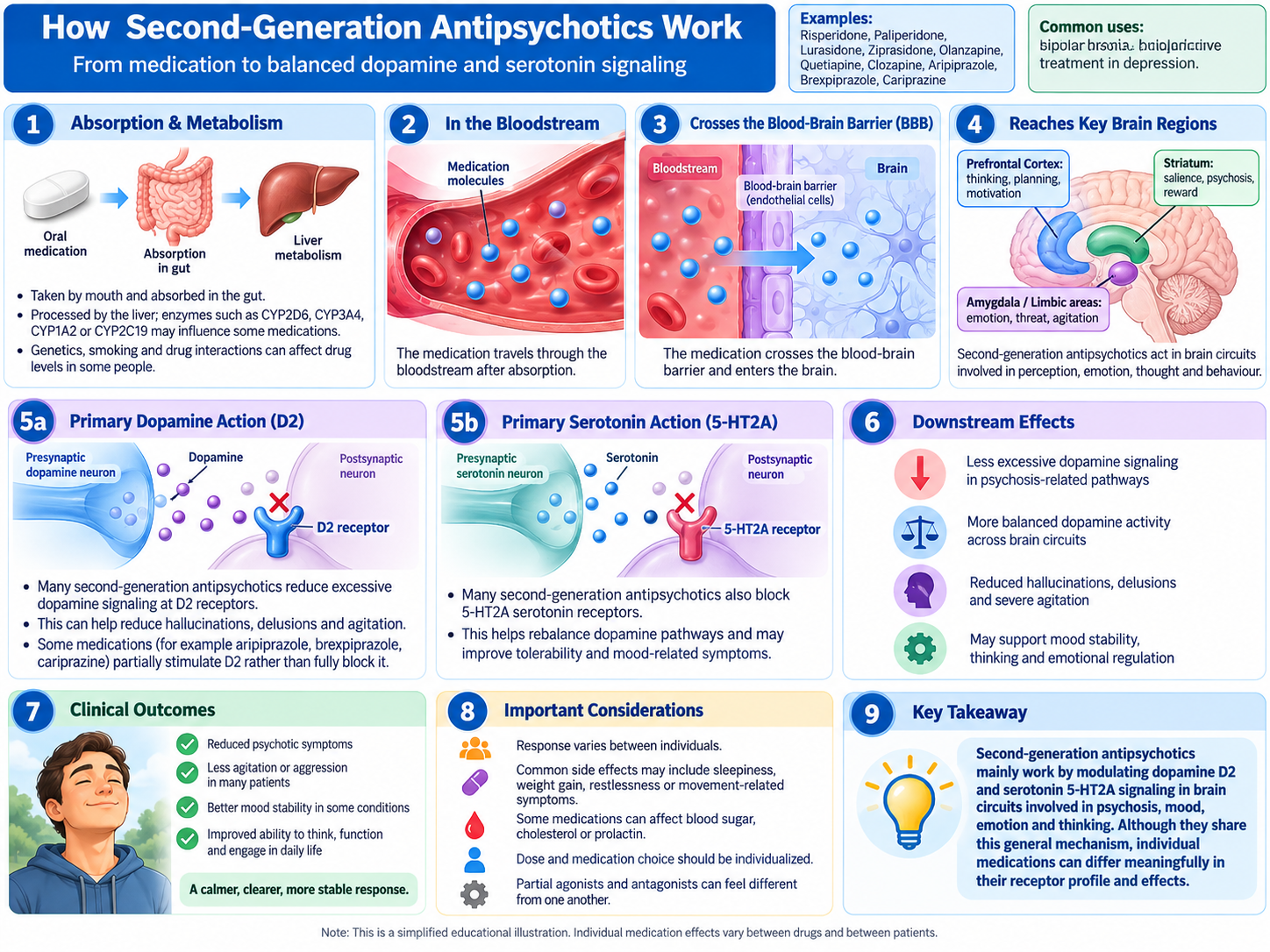
Clozapine is an atypical antipsychotic medication used primarily for treatment-resistant schizophrenia—schizophrenia that has not responded adequately to other antipsychotic medications.
Clozapine is different from most other antipsychotics because it can be effective in some patients who have not responded adequately to other medications.
In Canada, Clozaril is indicated for the management of treatment-resistant schizophrenia.
Treatment resistance generally means that an adequate response has not been achieved despite appropriate trials of at least two different antipsychotic medications, or that effective treatment could not be achieved because of intolerable adverse effects.
Clozapine affects several neurotransmitter systems, particularly:
-
Serotonin Clozapine requires more medical monitoring than most psychiatric medications because it can rarely cause serious adverse effects, including:
-
Severe neutropenia or agranulocytosis
-
Myocarditis and cardiomyopathy
-
Severe constipation and intestinal hypomotility
-
Seizures
-
Severe low blood pressure Regular blood testing is therefore an important part of clozapine treatment.
What Is Clozapine Used For?
- Treatment-Resistant Schizophrenia Clozapine is primarily used when schizophrenia has not responded adequately to other antipsychotic medications.
Symptoms of schizophrenia can include:
- Hallucinations
- Delusions
- Paranoia
- Disorganized thinking
- Disorganized behaviour
- Social withdrawal
- Reduced emotional expression
- Reduced motivation Clozapine can improve both positive symptoms, such as hallucinations and delusions, and some negative or broader symptoms in treatment-resistant patients. Canadian guidelines and labeling position clozapine as an important treatment when adequate trials of other antipsychotics have failed.
Clozapine and Suicidal Behaviour
Clozapine has also demonstrated an important effect on recurrent suicidal behaviour in schizophrenia and schizoaffective disorder.
In the United States, clozapine is specifically approved to reduce the risk of recurrent suicidal behaviour in patients with schizophrenia or schizoaffective disorder who are considered at chronic risk.
That is a U.S. indication. In Canada, the principal approved indication is treatment-resistant schizophrenia.
What Are the Common Side Effects of Clozapine?
Common side effects can include:
- Sleepiness or sedation
- Excessive saliva
- Constipation
- Dizziness
- Fast heart rate
- Low blood pressure
- Headache
- Tremor
- Nausea
- Increased sweating
- Dry mouth
- Fever
- Weight gain
- Increased appetite
- Blurred or altered vision In clinical studies, sedation, tachycardia, constipation, dizziness, hypotension and increased salivation were among the commonly reported adverse effects.
Why Does Clozapine Cause Excessive Saliva?
One of the unusual side effects of clozapine is:
Hypersalivation — excessive saliva
This may be particularly troublesome at night and can cause:
- Drooling
- Wet pillows
- Sleep disruption
- Difficulty swallowing saliva Interestingly, clozapine can cause both dry mouth and excessive salivation, reflecting its complicated actions at different muscarinic and adrenergic receptors.
Persistent excessive salivation should be discussed with the healthcare professional because treatment strategies are available.
Important: Clozapine and Severe Neutropenia
One of the most important risks associated with clozapine is a potentially dangerous reduction in certain white blood cells.
The cells of greatest concern are:
Neutrophils
Neutrophils help the body fight bacterial and fungal infections.
Clozapine can rarely cause:
Severe neutropenia
or:
Agranulocytosis
When neutrophils become extremely low:
- Ability to fight infection decreases
- Serious or potentially life-threatening infection can occur
This is why regular blood testing is required during clozapine treatment.
Why Do People Taking Clozapine Need Regular Blood Tests?
In Canada, regular hematological monitoring continues throughout clozapine treatment.
For Clozaril, the general Canadian monitoring schedule is:
First 26 weeks
- Blood test every week
- Weeks 27–52
If blood counts remain acceptable:
- Blood testing may move to every 2 weeks
- After 52 weeks
If clinically appropriate:
Blood testing may move to every 4 weeks
Regular blood monitoring continues for as long as clozapine treatment continues.
The healthcare team monitors blood measurements such as the:
Absolute Neutrophil Count — ANC
Patients should promptly report symptoms that could indicate infection, including:
- Fever
- Chills
- Sore throat
- Flu-like symptoms
- Unusual weakness
- Mouth sores
- Other signs of infection
What are the common side-effects of Clozapine?
Clozapine and Constipation — An Important Warning
Constipation with clozapine deserves considerably more attention than ordinary medication-related constipation.
Clozapine can slow movement through the gastrointestinal tract.
This is called: Gastrointestinal hypomotility
It can range from ordinary constipation to serious complications such as:
- Fecal impaction
- Ileus
- Intestinal obstruction
- Megacolon
- Bowel ischemia
- Perforation Rare cases can be fatal.
Patients and caregivers should monitor bowel movements rather than assuming constipation is harmless.
Symptoms requiring prompt assessment include:
- Significant abdominal pain
- Abdominal swelling
- Persistent vomiting
- Severe constipation
- Inability to pass stool or gas Current prescribing information recommends screening for constipation before treatment and monitoring bowel function during clozapine therapy. Preventive laxative treatment may be considered in patients at higher risk.
Clozapine and Myocarditis
Clozapine can rarely cause inflammation of the heart muscle called:
Myocarditis
It can also be associated with:
- Pericarditis
- Cardiomyopathy Myocarditis occurs most commonly early in treatment, particularly during the first several weeks, although cardiac complications can occur later as well.
Possible symptoms include:
- Chest pain
- Unexplained rapid heartbeat
- Shortness of breath
- Palpitations
- Unusual fatigue
- Fever
- Flu-like symptoms
- Low blood pressure These symptoms require prompt medical assessment.
If clozapine-associated myocarditis is suspected, treatment is generally stopped while cardiac evaluation is performed.
Clozapine and Seizures
Clozapine can lower the seizure threshold.
The risk increases with:
- Higher doses
- Higher clozapine blood concentrations
- Rapid dose increases
- Previous seizures
- Other medications that lower the seizure threshold Canadian product information notes that seizure risk rises at higher clozapine doses, particularly in the 600–900 mg/day range.
This is one reason clozapine is started at a very low dose and increased gradually.
Low Blood Pressure and Fainting
Clozapine can cause:
- Orthostatic hypotension
- Dizziness
- Fainting
- Rapid heart rate
- Occasionally slow heart rate These effects are particularly important when clozapine is first started or increased too rapidly.
Even very low initial doses can sometimes cause substantial blood-pressure changes.
This is why clozapine treatment normally begins with:
12.5 mg
rather than immediately starting at a therapeutic dose.
Clozapine and Weight Gain
Clozapine can cause significant metabolic changes, including:
-
Weight gain
-
Increased appetite
-
Higher blood glucose
-
Insulin resistance
-
Increased cholesterol
-
Increased triglycerides Monitoring commonly includes:
-
Weight
-
Body mass index
-
Blood glucose or HbA1c
-
Cholesterol
-
Triglycerides
-
Blood pressure These risks are important during long-term treatment.
Drug Interactions
Clozapine has several clinically important interactions because it is metabolized through multiple liver enzymes.
The most important is:
Other contributing enzymes include:
- CYP3A4
- CYP2D6
- CYP2C19 CYP1A2 is particularly important because both medications and cigarette smoking can dramatically alter its activity.
Fluvoxamine — Strong CYP1A2 Inhibitor
Fluvoxamine strongly inhibits CYP1A2.
The result can be:
- Fluvoxamine
- CYP1A2 inhibition
- Clozapine metabolism slows
- Clozapine concentration rises
- Greater risk of clozapine toxicity
Current U.S. prescribing information recommends reducing clozapine to approximately one-third of the original dose when it is combined with a strong CYP1A2 inhibitor such as fluvoxamine.
Any such adjustment must be managed by the treating clinician.
Ciprofloxacin — Strong CYP1A2 Inhibitor
Ciprofloxacin is an antibiotic that can strongly inhibit CYP1A2.
Therefore:
- Ciprofloxacin
- CYP1A2 inhibition
- Clozapine concentration may rise substantially
This interaction can be clinically important even if ciprofloxacin is prescribed only temporarily.
Current prescribing information specifically identifies ciprofloxacin as a strong CYP1A2 inhibitor requiring major clozapine dose consideration.
Cigarette Smoking
This is one of the most important clozapine interactions.
Cigarette smoke increases CYP1A2 activity.
Therefore:
- Regular cigarette smoking
- CYP1A2 activity increases
- Clozapine metabolism becomes faster
- Clozapine concentrations decrease
This may result in lower clozapine exposure.
But the reverse is especially important.
If a person suddenly:
Stops smoking
CYP1A2 induction decreases.
Therefore:
- Smoking stops
- CYP1A2 activity falls
- Clozapine metabolism slows
- Clozapine concentration can rise
This can increase adverse effects or potentially lead to toxicity. Tobacco smoke is specifically recognized as a CYP1A2 inducer in current prescribing information.
Important distinction
It is primarily components of tobacco smoke—not nicotine itself—that induce CYP1A2.
Therefore switching from cigarettes to a nicotine patch or another non-combustible nicotine product may still remove the CYP1A2-inducing effect of cigarette smoke.
Any major change in smoking habits should therefore be reported to the prescribing healthcare professional.
Caffeine and Coffee
Caffeine can inhibit CYP1A2 to some degree and may increase clozapine exposure, particularly when caffeine intake is high or changes substantially.
Current prescribing information lists caffeine as a moderate or weak CYP1A2 inhibitor.
The practical message is not necessarily that every patient must avoid coffee.
Rather:
Keep caffeine intake reasonably consistent and tell the healthcare team about major changes.
For example, abruptly going from very little caffeine to several large coffees per day could alter clozapine exposure.
Canadian Clozaril patient information specifically advises patients to tell their healthcare professional about both coffee intake and smoking habits.
Carbamazepine
Carbamazepine can:
- Induce drug-metabolizing enzymes
- Lower clozapine concentrations
- Suppress bone marrow function The combination is therefore especially problematic.
Current prescribing information lists carbamazepine as a strong CYP3A4 inducer, and strong CYP3A4 inducer combinations are generally not recommended.
Because both medications can affect blood cells, concurrent use requires particular concern.
Phenytoin, Rifampin and St. John’s Wort
These can increase CYP enzyme activity and may decrease clozapine exposure.
Examples include:
- Phenytoin
- Rifampin
- St. John’s Wort The result can be:
- Enzyme induction
- Faster clozapine metabolism
- Lower clozapine concentration
- Potential loss of effectiveness
If an inducer is subsequently stopped, clozapine concentrations may rise again.
Fluoxetine, Paroxetine and Bupropion
Some psychiatric medications can inhibit enzymes involved in clozapine metabolism.
Examples include:
- Fluoxetine
- Paroxetine
- Bupropion
- Duloxetine
- Sertraline Current U.S. labeling identifies CYP2D6 or CYP3A4 inhibition from several of these medications as potentially increasing clozapine concentrations and recommends clinical monitoring and dose adjustment when necessary.
Anticholinergic Medications
Clozapine already has substantial anticholinergic activity.
Additional anticholinergic drugs can increase the risk of severe bowel hypomotility.
Examples include:
- Benztropine
- Diphenhydramine
- Some bladder medications
- Some tricyclic antidepressants
- Other strongly anticholinergic medications The combination can increase:
Constipation → intestinal hypomotility → obstruction risk
Current prescribing information recommends avoiding additional anticholinergic medications when possible.
Alcohol, Benzodiazepines and Other Sedating Medications
Clozapine can cause significant sedation and blood-pressure lowering.
Combining it with:
-
Alcohol
-
Benzodiazepines
-
Sleep medications
-
Opioids
-
Other sedating medications may increase:
-
Sleepiness
-
Dizziness
-
Impaired coordination
-
Low blood pressure Canadian clozapine information advises particular caution when clozapine is started in patients taking benzodiazepines or other psychotropic medications.
Clozapine Dosage
Clozapine must be started very gradually.
This helps reduce the risks of:
- Severe hypotension
- Fainting
- Sedation
- Seizures Canadian Clozaril dosing guidance begins with:
Day 1
12.5 mg once or twice
Day 2
25 mg once or twice
If tolerated, the dose can then generally be increased by:
25–50 mg/day
with a target around:
300–450 mg/day by approximately the end of two weeks
Further increases are made more slowly.
Typical Therapeutic Dose
Canadian product information identifies a common therapeutic range of approximately:
300–600 mg/day
usually in divided doses.
Many patients can later be maintained at:
150–300 mg/day
depending on response and tolerability.
- Maximum Clozapine Dose The Canadian maximum is:
900 mg/day
However, doses above 600 mg/day require particular caution because adverse effects—especially seizures—become more likely.
The goal is not to reach a particular number but to identify the lowest dose that provides adequate benefit with acceptable tolerability.
Why Does Clozapine Have to Be Started So Slowly?
The slow titration is not simply to prevent ordinary side effects.
Rapid increases can increase the risk of:
- Severe hypotension
- Fainting
- Sedation
- Rapid heart rate
- Seizures Clozapine therefore has one of the more carefully controlled initiation schedules among psychiatric medications.
What Happens If Clozapine Is Missed for Two or More Days?
This is very important.
Patients should not simply restart their previous full dose after an interruption of two days or longer.
Canadian Clozaril information recommends restarting at:
12.5 mg once or twice on the first day
after an interruption of two days or more, followed by re-titration if tolerated.
Restarting a previous high dose suddenly can cause severe:
- Low blood pressure
- Fainting
- Cardiovascular complications Patients who have missed several doses should contact their prescriber or pharmacist before restarting.
Tapering and Stopping Clozapine
Clozapine generally should not be stopped abruptly unless there is an urgent medical reason.
For planned discontinuation, Canadian product information recommends reducing the dose gradually over:
1–2 weeks
rather than stopping suddenly.
A slower taper may sometimes be selected depending on:
- Dose
- Duration of treatment
- Psychiatric stability
- Previous withdrawal symptoms
- Risk of psychotic relapse
What Happens If Clozapine Is Stopped Suddenly?
There are two major concerns.
Return of Psychotic Symptoms
Symptoms such as:
- Hallucinations
- Delusions
- Paranoia
- Agitation may return, and in some cases can recur rapidly.
Cholinergic Rebound
Because clozapine strongly interacts with muscarinic acetylcholine receptors, sudden removal can produce cholinergic rebound.
Symptoms may include:
- Headache
- Nausea
- Vomiting
- Diarrhea
- Sweating
- Agitation Canadian labeling specifically warns about recurrence of psychosis and cholinergic rebound after abrupt discontinuation.
Urgent medical problems such as severe neutropenia or suspected myocarditis may nevertheless require immediate discontinuation under medical supervision.
Frequently Asked Questions
Is Clozapine the Same as Clozaril?
Yes.
Clozaril is the original well-known brand name for clozapine.
Generic clozapine products are also available in Canada.
Is Clozapine an Antipsychotic?
Yes.
Clozapine is an atypical or second-generation antipsychotic.
Why Is Clozapine Usually Used Only After Other Antipsychotics?
Because clozapine has important risks requiring regular monitoring, it is primarily reserved for treatment-resistant schizophrenia.
At the same time, clozapine can be particularly effective in this difficult-to-treat population.
How Many Antipsychotics Usually Need to Fail Before Clozapine Is Considered?
Treatment-resistant schizophrenia is generally considered after inadequate response to two adequate antipsychotic trials.
Canadian clozapine information describes non-responsiveness as failure to achieve a satisfactory clinical response despite appropriate courses of at least two chemically unrelated antipsychotics.
Why Do People Taking Clozapine Need Blood Tests?
Because clozapine can rarely cause a dangerous reduction in neutrophils.
Regular blood testing helps detect this problem before severe infection develops.
How Often Are Clozapine Blood Tests Done in Canada?
For stable patients following the Canadian Clozaril monitoring pathway:
First 26 weeks → weekly
Next 26 weeks → potentially every 2 weeks
After one year → potentially every 4 weeks
Monitoring continues during treatment.
Does Clozapine Cause Constipation?
Yes, and this should be taken seriously.
Clozapine can cause significant gastrointestinal hypomotility. Severe cases can lead to bowel obstruction, ileus and other potentially life-threatening complications.
Why Does Clozapine Cause Drooling?
Clozapine’s complex interaction with muscarinic and other receptors can increase saliva production or alter swallowing of saliva.
Excessive salivation is one of clozapine’s characteristic adverse effects.
Does Clozapine Cause Weight Gain?
Yes.
Clozapine can cause substantial weight gain in some patients and can also affect:
- Blood sugar
- Cholesterol
- Triglycerides Metabolic monitoring is therefore important.
Does Clozapine Make You Sleepy?
Yes.
Sedation and sleepiness are among the most common clozapine adverse effects.
Can Clozapine Affect the Heart?
Yes, rarely but importantly.
Clozapine can cause myocarditis, pericarditis or cardiomyopathy.
Unexplained chest pain, breathlessness, persistent rapid heartbeat, fever or severe fatigue—particularly early in treatment—should be assessed promptly.
Can Clozapine Cause Seizures?
Yes.
The risk is dose-related and becomes greater at higher doses and concentrations.
Does Smoking Affect Clozapine?
Yes—significantly.
Cigarette smoke induces CYP1A2 and can reduce clozapine concentrations.
Stopping smoking can have the opposite effect and cause clozapine levels to rise.
Patients should tell their healthcare professional before substantially changing their smoking habits.
Can Coffee Affect Clozapine?
Potentially.
Caffeine can inhibit CYP1A2 to some degree and may increase clozapine exposure.
Large changes in caffeine intake should therefore be mentioned to the healthcare professional.
Can Ciprofloxacin Affect Clozapine?
Yes.
Ciprofloxacin strongly inhibits CYP1A2 and can markedly increase clozapine concentrations.
This is a clinically important drug interaction.
Can Fluvoxamine Affect Clozapine?
Yes.
Fluvoxamine is a strong CYP1A2 inhibitor and can greatly increase clozapine exposure.
The combination requires careful dose management and clinical monitoring.
Which Liver Enzyme Is Most Important for Clozapine?
The most important is generally:
CYP1A2
CYP3A4 and CYP2D6 also contribute.
Can Genetics Affect Clozapine Metabolism?
Potentially, but the relationship is not as clinically actionable as with some other psychiatric medications.
CYP1A2 is important for clozapine metabolism, but the DPWG currently does not recommend genotype-based clozapine dosing based on CYP1A2.
Does a CYP1A2 Result Tell Me How Much Clozapine I Need?
No.
CYP1A2 activity is strongly affected by environmental and clinical factors, particularly smoking and drug interactions.
A genetic CYP1A2 result should not currently be used alone to determine a clozapine dose.
Does Clozapine Need to Be Tapered?
Usually yes when treatment is being stopped electively.
Canadian prescribing information recommends reducing the dose gradually over approximately 1–2 weeks. Some patients may require a more individualized approach.
Can I Restart My Usual Clozapine Dose After Missing Several Days?
No.
After two days or more without clozapine, Canadian prescribing information recommends restarting at a low dose—typically 12.5 mg once or twice on the first day—and then re-titrating.
This is an unusually important safety rule for clozapine.
How Long Does Clozapine Take to Work?
Some changes may become apparent during the first several weeks, but improvement in treatment-resistant schizophrenia can be gradual.
Canadian product information notes that therapeutic improvement may continue beyond the first month of treatment.
Can Pharmacogenomic Testing Tell Me Whether Clozapine Will Work?
Not with certainty.
Clozapine response depends on many factors, including:
- Diagnosis
- Symptoms
- Dose
- Clozapine concentration
- Smoking
- Other medications
- Dopamine receptor signaling
- Serotonin receptor signaling
- Individual brain biology There is currently no single genetic marker that reliably determines whether clozapine will succeed or fail.
References
This article is educational. It does not diagnose, and it does not replace advice from your prescriber or pharmacist. Never start, stop or change a medication based on a web page.