
Medication profile
Methylphenidate
Methylphenidate is one of the most widely used medications for ADHD.
 Written by Sanjida Ahmed, PhD, Cellular and Molecular BiologyChief Operating Officer and Lead Scientist, Personalized Prescribing. Last reviewed October 2, 2026.
- Class
- Stimulant
On this page
- What You Need to Know About Methylphenidate
- What Is Methylphenidate Used For?
- Attention-Deficit/Hyperactivity Disorder — ADHD
- Is Methylphenidate a Stimulant?
- Central Nervous System Stimulant
- Better focus
- Less impulsivity
- Reduced hyperactivity
- Improved behavioural control
- How Does Methylphenidate Work for ADHD?
- DAT — Dopamine Transporter
- NET — Norepinephrine Transporter
- What Does Methylphenidate Do to Dopamine?
- DAT — Dopamine Transporter
- What Does Methylphenidate Do to Norepinephrine?
- NET — Norepinephrine Transporter
- Prefrontal Cortex — PFC
- Why Is the Prefrontal Cortex Important in ADHD?
- Inverted-U relationship
- Too little dopamine/NE
- Optimal dopamine/NE
- Too much dopamine/NE
- How Quickly Does Methylphenidate Work?
- Within the same day
- Immediate-Release vs Extended-Release Methylphenidate
- Immediate-Release Methylphenidate
- Two or three doses per day
- Once daily in the morning
- Swallowed whole
- Once daily in the morning
- Once daily in the morning
- In the evening
- Delayed-release + extended-release formulation
- Children 6–12 years of age
- Are Different Methylphenidate Products Equivalent Milligram-for-Milligram?
- What Are the Common Side Effects of Methylphenidate?
- Why Does Methylphenidate Reduce Appetite?
- Can Methylphenidate Affect Growth?
- Why Can Methylphenidate Cause Insomnia?
- Can Methylphenidate Increase Anxiety?
- Can Methylphenidate Increase Heart Rate and Blood Pressure?
- Heart rate
- Blood pressure
- Can Methylphenidate Cause Psychosis or Mania?
- Can Methylphenidate Cause Tics?
- Can Methylphenidate Cause Priapism?
- Medical emergency
- Methylphenidate and Raynaud’s Phenomenon
- Peripheral vasculopathy
- Raynaud’s phenomenon
- Is Methylphenidate Addictive?
- Abuse and dependence potential
- Drug Interactions
- Monoamine Oxidase Inhibitors — MAOIs
- Hypertensive crisis
- Antihypertensive medications
- Serotonin syndrome
- Methylphenidate Dosage
- 20–30 mg/day
- 18 mg once daily in the morning
- Children 6–12: 54 mg/day
- Adolescents 13–18: 54 mg/day
- Adults: 72 mg/day
- 10–20 mg once daily in the morning
- 10 mg weekly increments
- 60 mg/day in children and adolescents
- 25 mg once daily in the morning
- 70 mg/day for children and adolescents
- 20 mg once daily in the evening
- 100 mg/day
- Should Methylphenidate Be Taken with Food?
- With or without food
- Can Extended-Release Methylphenidate Be Crushed?
- Swallowed whole
- What Happens When Methylphenidate Wears Off?
- Does Methylphenidate Need to Be Tapered?
- Frequently Asked Questions
- Methylphenidate hydrochloride
- DAT + NET reuptake inhibition
- Presynaptic neurotransmitter release and transporter reversal
- 30–60 minutes
- CES1 — Carboxylesterase 1
Best-known historical brand name: Ritalin
Common Canadian extended-release brands: Concerta, Biphentin, Foquest and Jornay PM
Methylphenidate is a central nervous system stimulant used primarily to treat attention-deficit/hyperactivity disorder (ADHD). Some immediate-release methylphenidate products are also approved for narcolepsy.
Methylphenidate works mainly by increasing the availability of two important neurotransmitters: Dopamine and: Norepinephrine
It does this primarily by blocking two transporter proteins:
DAT — Dopamine Transporter and: NET — Norepinephrine Transporter
A simplified pathway is:
- Methylphenidate
- Blocks DAT + NET
- Dopamine and norepinephrine reuptake decreases
- More dopamine + norepinephrine remain available between neurons
- Prefrontal and other attention-related brain networks function more effectively
- Attention, focus, impulse control and hyperactivity may improve
Current Canadian Concerta labeling describes methylphenidate as blocking the reuptake of dopamine and norepinephrine into presynaptic neurons and increasing their extracellular availability.
What You Need to Know About Methylphenidate
Methylphenidate is one of the most widely used medications for ADHD.
It may help improve:
- Attention
- Concentration
- Working memory
- Task persistence
- Impulse control
- Hyperactivity
- Behavioural regulation
- Executive functioning Methylphenidate is available in several formulations that release the medication at very different rates.
In Canada, currently marketed methylphenidate products include Concerta, Biphentin, Foquest, Jornay PM, immediate-release generic methylphenidate and other extended-release generics. Health Canada lists these products as controlled drugs under Schedule III of the Controlled Drugs and Substances Act.
The original Ritalin 10 mg product was discontinued from the Canadian market in 2022, although Ritalin remains the best-known historical brand name and generic immediate-release methylphenidate continues to be available.
What Is Methylphenidate Used For?
The principal use is:
Attention-Deficit/Hyperactivity Disorder — ADHD
ADHD may involve symptoms such as:
Inattention
-
Difficulty sustaining attention
-
Easily distracted
-
Difficulty completing tasks
-
Poor organization
-
Forgetfulness
-
Difficulty following multi-step instructions Hyperactivity
-
Excessive movement
-
Difficulty remaining seated
-
Restlessness
-
Excessive talking Impulsivity
-
Acting before thinking
-
Interrupting
-
Difficulty waiting
-
Poor behavioural inhibition Methylphenidate treatment does not cure ADHD. It helps improve symptoms while the medication is active.
Some immediate-release Canadian methylphenidate products are also indicated for narcolepsy, a sleep disorder associated with excessive daytime sleepiness.
Approved indications differ between formulations.
Is Methylphenidate a Stimulant?
Yes.
Methylphenidate is classified as a:
Central Nervous System Stimulant
It increases activity within dopamine and norepinephrine systems involved in:
- Attention
- Alertness
- Executive function
- Motivation
- Behavioural control However, the effect in ADHD is not simply to make someone “more stimulated.”
At an appropriate dose, methylphenidate can actually result in:
Better focus
Less impulsivity
Reduced hyperactivity
Improved behavioural control
because dopamine and norepinephrine signaling in executive-control networks becomes better regulated.
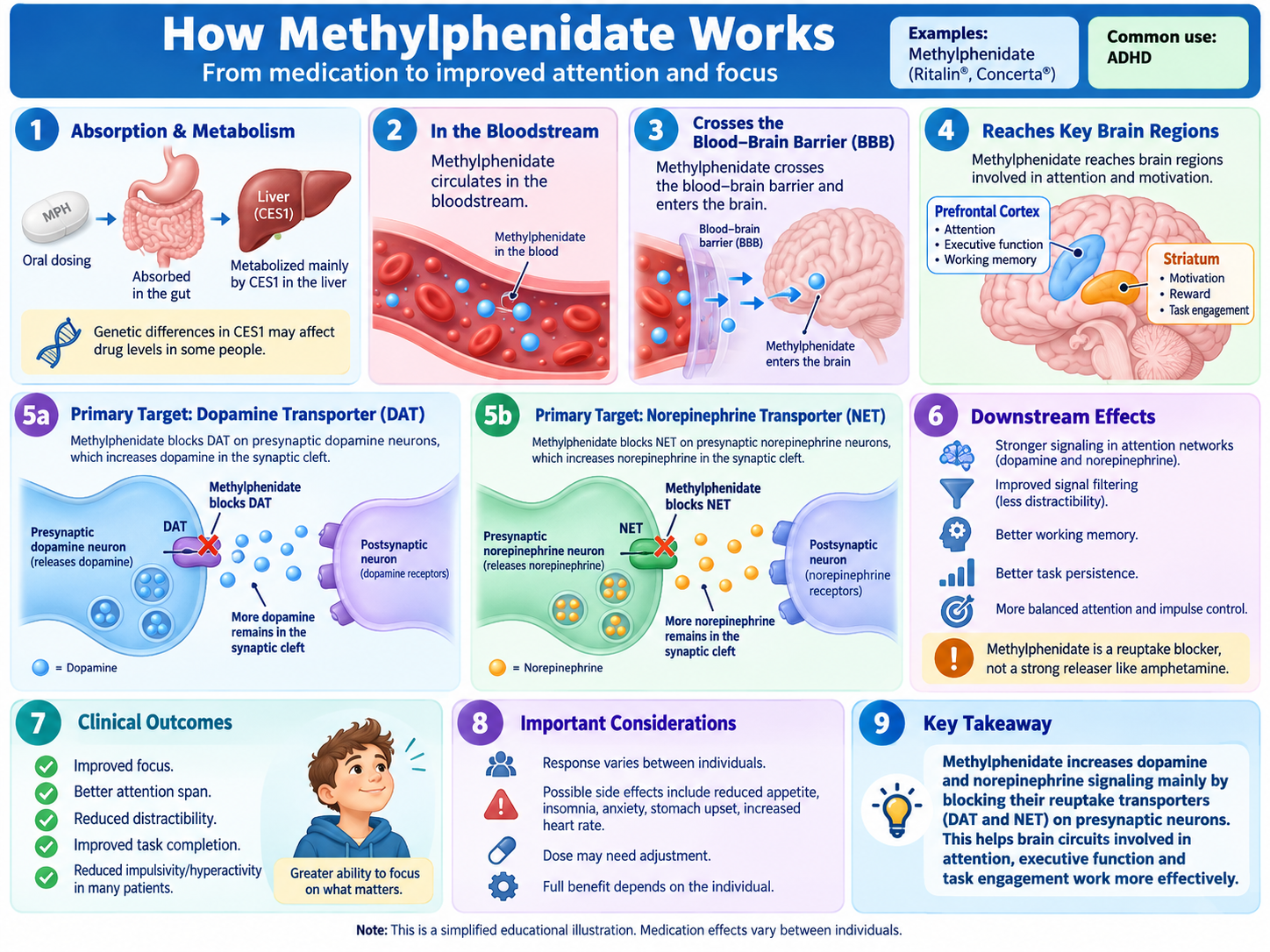
How Does Methylphenidate Work for ADHD?
Two transporters are particularly important:
DAT — Dopamine Transporter
and:
NET — Norepinephrine Transporter
Normally, these transporters remove dopamine and norepinephrine from the space between neurons.
Methylphenidate inhibits both.
Therefore:
- Dopamine + norepinephrine are released
- Normally:
DAT + NET remove them
But with methylphenidate:
- DAT + NET are inhibited
- Dopamine and norepinephrine remain available longer
- Neural signaling increases
- Attention and executive-control networks respond
- ADHD symptoms may improve
The exact mechanism of ADHD itself is more complex and should not be described simply as a dopamine or norepinephrine deficiency.
What Does Methylphenidate Do to Dopamine?
Methylphenidate primarily inhibits:
DAT — Dopamine Transporter
DAT normally removes dopamine from the synapse.
Therefore:
- Methylphenidate
- DAT blockade
- Dopamine reuptake decreases
- More dopamine remains available for signaling
Dopamine is particularly important for:
- Motivation
- Reward
- Attention
- Salience
- Task initiation
- Working memory
- Reinforcement learning The effect varies depending on the brain region.
What Does Methylphenidate Do to Norepinephrine?
Methylphenidate also inhibits:
NET — Norepinephrine Transporter
Therefore:
- Methylphenidate
- NET blockade
- Norepinephrine reuptake decreases
- More norepinephrine remains available for signaling
Norepinephrine contributes to:
- Alertness
- Attention
- Working memory
- Mental energy
- Stress responsiveness
- Executive control Dopamine and norepinephrine work together particularly closely in the:
Prefrontal Cortex — PFC
Why Is the Prefrontal Cortex Important in ADHD?
The prefrontal cortex helps regulate:
- Attention
- Working memory
- Planning
- Organization
- Decision-making
- Behavioural inhibition
- Emotional regulation
- Resistance to distraction Optimal prefrontal function depends on appropriately regulated:
Dopamine
and:
Norepinephrine
Too little catecholamine signaling can weaken prefrontal networks.
But excessive stimulation can also impair them.
This is often described as an:
Inverted-U relationship
Conceptually:
Too little dopamine/NE
→ weak attention and executive control
Optimal dopamine/NE
→ stronger PFC performance
Too much dopamine/NE
→ overstimulation, anxiety, restlessness or impaired cognition
This helps explain why the correct methylphenidate dose is highly individual.
How Quickly Does Methylphenidate Work?
Methylphenidate differs from antidepressants because its clinical effect can often begin:
Within the same day
Immediate-release formulations may begin producing noticeable effects relatively quickly.
Extended-release formulations are designed to provide therapeutic concentrations for longer portions of the day.
For example, controlled-release methylphenidate studies show behavioural and cognitive improvement beginning within approximately one hour for some preparations and persisting for many hours, depending on the formulation.
The exact onset and duration depend heavily on the product.
Immediate-Release vs Extended-Release Methylphenidate
Methylphenidate is available in several delivery systems.
The active drug is the same, but the way it enters the bloodstream can be very different.
Immediate-Release Methylphenidate
Immediate-release tablets produce a relatively rapid rise and fall in methylphenidate concentration.
They may require:
Two or three doses per day
depending on the treatment plan.
Potential advantages include:
-
Flexible timing
-
Shorter duration
-
Easier adjustment of specific parts of the day Potential disadvantages include:
-
Multiple daily doses
-
More pronounced peaks and troughs
-
Rebound symptoms in some patients
-
Concerta Concerta is a once-daily extended-release methylphenidate tablet.
Current Health Canada records confirm Concerta remains marketed in Canada in:
- 18 mg
- 27 mg
- 36 mg
- 54 mg strengths. Concerta produces an initial methylphenidate release followed by gradually increasing release over several hours.
Canadian pharmacokinetic information describes an initial concentration peak at approximately one hour followed by gradually increasing concentrations over the next several hours, with average peak concentrations occurring roughly 6–10 hours after dosing.
Concerta is normally taken:
Once daily in the morning
and should be:
Swallowed whole
rather than crushed, chewed or divided.
- Biphentin Biphentin is a controlled-release methylphenidate capsule marketed in Canada.
Health Canada lists Biphentin in multiple strengths including 10, 15, 20, 30, 40, 50, 60 and 80 mg formulations.
Biphentin is generally taken:
Once daily in the morning
The capsule can be swallowed whole, or for patients unable to swallow it, some formulations allow the capsule to be opened and the beads sprinkled onto appropriate soft food without chewing.
- Foquest Foquest is another long-acting methylphenidate formulation marketed in Canada.
Available strengths include:
- 25 mg
- 35 mg
- 45 mg
- 55 mg
- 70 mg
- 85 mg
- 100 mg Health Canada currently lists Foquest as marketed.
Foquest is intended to provide an extended duration of methylphenidate exposure through a combination of immediate and delayed-release components.
It is usually taken:
Once daily in the morning
and should not be crushed or chewed. The capsule can be opened and sprinkled onto certain soft foods according to product instructions.
- Jornay PM Jornay PM is unusual because it is taken:
In the evening
rather than in the morning.
It uses a:
Delayed-release + extended-release formulation
designed so that relatively little methylphenidate is released immediately after the evening dose, with medication becoming available the following morning.
Health Canada currently lists Jornay PM as marketed in:
- 20 mg
- 40 mg
- 60 mg
- 80 mg
- 100 mg strengths. In Canada, Jornay PM is currently authorized for ADHD in:
Children 6–12 years of age
but not currently authorized for adolescents 13–17 or adults.
This is an important example of why indication and dosage should be checked by specific methylphenidate formulation, rather than assuming all products are interchangeable.
Are Different Methylphenidate Products Equivalent Milligram-for-Milligram?
No.
This is extremely important.
Immediate-release methylphenidate, Concerta, Biphentin, Foquest and Jornay PM have different:
- Release profiles
- Peak concentrations
- Timing of exposure
- Duration of effect
- Delivery technologies Therefore:
Different methylphenidate formulations should not automatically be substituted milligram-for-milligram.
Foquest and Jornay PM labeling specifically caution against direct milligram-for-milligram substitution from other methylphenidate preparations.
What Are the Common Side Effects of Methylphenidate?
Common side effects can include:
-
Reduced appetite
-
Weight loss
-
Difficulty sleeping
-
Headache
-
Abdominal pain
-
Nausea
-
Dry mouth
-
Nervousness
-
Irritability
-
Feeling jittery
-
Dizziness
-
Increased sweating
-
Increased heart rate
-
Increased blood pressure Children may be particularly likely to experience:
-
Reduced appetite
-
Abdominal discomfort
-
Insomnia
-
Weight changes Canadian methylphenidate labeling identifies decreased appetite, nausea, dry mouth, abdominal symptoms, insomnia, tachycardia and weight reduction among recognized adverse effects.
Why Does Methylphenidate Reduce Appetite?
Dopamine and norepinephrine participate in:
- Appetite
- Reward
- Motivation
- Sympathetic arousal By increasing catecholamine signaling:
- Methylphenidate
- ↑ dopamine + norepinephrine
- Appetite signaling can decrease
This is why some patients eat less during the hours when methylphenidate is most active.
For children and adolescents, clinicians often monitor:
- Weight
- Height
- Growth trajectory
- Nutritional intake
Can Methylphenidate Affect Growth?
Potentially.
Long-term stimulant treatment has been associated with reduced:
- Weight gain
- Height gain in some children.
Current methylphenidate labeling recommends monitoring growth during longer-term therapy. Children who are not growing or gaining weight as expected may require reassessment of treatment.
The effect varies between individuals and should be considered alongside the substantial functional benefits that effective ADHD treatment can provide.
Why Can Methylphenidate Cause Insomnia?
Dopamine and norepinephrine promote:
- Alertness
- Wakefulness
- Attention
- Arousal If methylphenidate remains active too late in the day:
- Catecholamine signaling remains elevated
- Falling asleep may become more difficult
This is why most long-acting formulations are taken in the morning.
Immediate-release dosing later in the day may also interfere with sleep in sensitive patients.
Jornay PM is an exception because its specialized formulation delays methylphenidate release until many hours after the evening dose.
Can Methylphenidate Increase Anxiety?
Yes, in some patients.
Increased norepinephrine and dopamine signaling can sometimes produce:
-
Nervousness
-
Restlessness
-
Physical tension
-
Racing heart
-
Irritability
-
Anxiety This may be more likely if:
-
The dose is too high
-
Drug exposure is unusually high
-
Baseline anxiety is prominent
-
The formulation produces an undesirable peak However, ADHD itself can also cause anxiety through:
-
Chronic disorganization
-
Overwhelm
-
Academic or workplace difficulty
-
Impulsivity Therefore, some people actually experience less anxiety when ADHD is effectively treated.
Can Methylphenidate Increase Heart Rate and Blood Pressure?
Yes.
Methylphenidate increases catecholamine signaling and can increase:
Heart rate
and:
Blood pressure
usually modestly, although some individuals experience larger changes.
Canadian stimulant labeling advises cardiovascular assessment and monitoring, particularly in patients with:
-
Known heart disease
-
Structural cardiac abnormalities
-
High blood pressure
-
Arrhythmias
-
Relevant family history. Patients who develop:
-
Chest pain
-
Fainting
-
Significant shortness of breath while taking methylphenidate should receive medical assessment.
Can Methylphenidate Cause Psychosis or Mania?
Rarely, yes.
Excessive dopaminergic stimulation can potentially cause:
- Hallucinations
- Paranoia
- Delusional thinking
- Mania
- Severe agitation This can occur even in people without a previous psychotic disorder, although the absolute risk at prescribed doses is low.
Patients with:
- Bipolar disorder
- Previous psychosis
- Strong psychiatric vulnerability require careful monitoring.
Canadian methylphenidate labeling warns about new or worsening psychotic and manic symptoms.
Can Methylphenidate Cause Tics?
Tics can emerge or worsen in some patients, although the relationship between stimulants and tic disorders is more complicated than previously believed.
Patients with:
- Existing tics
- Tourette syndrome
- Family history of tic disorders should be monitored clinically.
Development of a tic does not automatically mean methylphenidate must be stopped, but the medication and dose should be reassessed.
Can Methylphenidate Cause Priapism?
Rarely.
Priapism
is a prolonged or painful erection that does not resolve normally.
It has been reported during methylphenidate treatment and sometimes after dose changes or discontinuation.
A prolonged painful erection is a:
Medical emergency
because untreated priapism can damage penile tissue.
Canadian methylphenidate patient information specifically warns patients to seek urgent medical care for sustained or painful erections.
Methylphenidate and Raynaud’s Phenomenon
Stimulants including methylphenidate have been associated with:
Peripheral vasculopathy
including:
Raynaud’s phenomenon
Symptoms can include fingers or toes becoming:
- Cold
- Painful
- Numb
- Pale
- Blue or red These effects are usually mild and intermittent, but rare more serious complications have occurred.
Patients should report new circulation problems affecting the fingers or toes.
Is Methylphenidate Addictive?
Methylphenidate has:
Abuse and dependence potential
which is why it is a controlled drug in Canada.
The risk is particularly important when methylphenidate is:
- Taken in larger amounts than prescribed
- Used by someone for whom it was not prescribed
- Crushed or manipulated for nonmedical use
- Used to achieve euphoria Canadian Health Canada records classify marketed methylphenidate products as Controlled Drugs — CDSA Schedule III.
When appropriately prescribed and monitored for ADHD, the clinical purpose is therapeutic symptom control—not intoxication.
Medication should be:
- Stored securely
- Never shared
- Taken only as prescribed
Drug Interactions
Methylphenidate has several important interactions.
MAO Inhibitors
Methylphenidate should not be taken with:
Monoamine Oxidase Inhibitors — MAOIs
because of the risk of severe:
Hypertension
or:
Hypertensive crisis
Canadian labeling contraindicates methylphenidate during MAOI treatment and for at least:
14 days after stopping an MAOI.
Blood Pressure Medications
Methylphenidate may reduce the effectiveness of some:
Antihypertensive medications
because stimulants can increase:
- Blood pressure
- Heart rate Blood pressure may therefore require closer monitoring when the medications are combined.
Other Medications That Increase Heart Rate or Blood Pressure
Combining methylphenidate with other sympathomimetic medications may increase:
-
Heart rate
-
Blood pressure
-
Restlessness
-
Tremor Examples can include certain:
-
Stimulants
-
Decongestants
-
Other adrenergic medications The complete medication list should be reviewed before treatment.
Antipsychotics
Methylphenidate and many antipsychotics have partly opposing effects on dopamine signaling.
For example:
Methylphenidate
increases extracellular dopamine
while:
Haloperidol
blocks D2 dopamine receptors.
Canadian labeling advises caution when methylphenidate and antipsychotics are combined, particularly during dose changes because movement-related symptoms can sometimes emerge.
The combination can nevertheless be clinically appropriate in selected patients.
Serotonergic Medications
Rare cases of:
Serotonin syndrome
have been reported when methylphenidate is combined with serotonergic medications.
Examples include:
- SSRIs
- SNRIs
- Tricyclic antidepressants
- Other serotonergic drugs Current Canadian product labeling advises careful observation when combinations are clinically warranted.
Methylphenidate itself is principally a dopamine/norepinephrine medication, not a conventional serotonergic antidepressant.
Warfarin and Certain Anticonvulsants
Older and current Canadian methylphenidate labeling reports that methylphenidate may affect the metabolism of:
- Warfarin
- Phenytoin
- Phenobarbital
- Primidone
- Some antidepressants Monitoring of drug concentrations or coagulation may be required when methylphenidate is started or stopped in patients taking these medications.
Alcohol
Alcohol should generally be used cautiously or avoided with methylphenidate.
Alcohol can:
- Worsen CNS side effects
- Alter behaviour and judgment
- Potentially affect release from certain modified-release formulations Some controlled-release product information specifically advises avoiding alcohol.
Methylphenidate Dosage
There is no single methylphenidate dose that is appropriate for everyone.
The dose depends heavily on:
- Age
- Formulation
- ADHD symptoms
- Duration of coverage required
- Previous stimulant exposure
- Side effects
- Heart rate and blood pressure
- Appetite
- Sleep
- Clinical response The general goal is:
Use the lowest dose that provides meaningful symptom improvement with acceptable side effects.
Because formulations differ substantially, dosage should always be interpreted according to the specific product.
Immediate-Release Methylphenidate Dosage
For currently marketed Canadian immediate-release generic methylphenidate, tablets are available in strengths such as:
- 5 mg
- 10 mg
- 20 mg. Adult immediate-release dosing is generally divided two or three times daily. One Canadian generic monograph describes an average adult dose of approximately:
20–30 mg/day
with some patients requiring lower or higher doses and generally not exceeding:
60 mg/day.
These are product-label examples rather than universal dosing instructions.
- Concerta Dosage For patients new to methylphenidate, Canadian Concerta labeling recommends:
18 mg once daily in the morning
as a starting dose.
Product-label maximums include:
Children 6–12: 54 mg/day
Adolescents 13–18: 54 mg/day
Adults: 72 mg/day
with dose adjustment generally at weekly intervals according to benefit and tolerability.
The 27 mg tablet provides an intermediate step between 18 mg and 36 mg.
- Biphentin Dosage Canadian Biphentin labeling generally uses an initial dose of:
10–20 mg once daily in the morning
with adjustments in:
10 mg weekly increments
according to response.
The labeled maximum is generally:
60 mg/day in children and adolescents
and:
80 mg/day in adults.
- Foquest Dosage For methylphenidate-naïve patients, Foquest labeling describes a starting dose of:
25 mg once daily in the morning
with individualized adjustment no more frequently than approximately every five days.
Maximum labeled doses are:
70 mg/day for children and adolescents
and:
100 mg/day for adults.
Foquest should not be substituted milligram-for-milligram for another methylphenidate formulation.
Jornay PM Dosage
Jornay PM is taken in the:
Evening
rather than the morning.
For Canadian children aged 6–12 years, the labeled starting dose is:
20 mg once daily in the evening
with possible weekly adjustments of 20 mg.
Doses above:
100 mg/day
have not been studied or recommended.
Canadian labeling suggests beginning administration around 8 PM, with timing individualized approximately between 6:30 PM and 9:30 PM to optimize next-morning and daytime effects.
Again, Jornay PM should not be substituted milligram-for-milligram with other methylphenidate products.
Should Methylphenidate Be Taken with Food?
This depends on the formulation.
Some products can be taken:
With or without food
but food can alter:
- Rate of absorption
- Peak concentration
- Timing of effect with some modified-release preparations.
For controlled-release products such as Biphentin, establishing a reasonably consistent morning routine regarding food can help maintain consistent drug exposure.
Always follow the instructions for the specific product.
Can Extended-Release Methylphenidate Be Crushed?
Usually:
No.
Products such as Concerta should be:
Swallowed whole
because crushing or chewing destroys the controlled-release system.
Some capsule formulations, including Biphentin and Foquest, can be opened and sprinkled onto specific soft foods, but the beads themselves should not be crushed or chewed.
The administration instructions depend on the formulation.
What Happens When Methylphenidate Wears Off?
Some patients experience a temporary return or intensification of symptoms as medication concentrations fall.
This is sometimes called:
Rebound
Possible symptoms include:
-
Irritability
-
Restlessness
-
Emotional reactivity
-
Hyperactivity
-
Reduced concentration
-
Fatigue The timing of rebound can provide useful information about:
-
Dose
-
Duration
-
Formulation
-
Timing of treatment A different release profile may sometimes provide smoother coverage.
Does Methylphenidate Need to Be Tapered?
For most patients taking therapeutic doses, methylphenidate does not require the same type of prolonged taper used for medications such as benzodiazepines or some antidepressants.
However, stopping should still be discussed with the prescriber.
Stopping methylphenidate may result in:
- Return of ADHD symptoms
- Fatigue
- Reduced motivation
- Sleep changes
- Mood changes in some patients Abrupt withdrawal after prolonged misuse or very high-dose exposure can produce more significant fatigue or depressive symptoms.
Treatment should therefore be individualized rather than changed without clinical guidance.
Frequently Asked Questions
Is Methylphenidate the Same as Ritalin?
Ritalin is the best-known historical brand name for methylphenidate.
The original Ritalin 10 mg product is no longer marketed in Canada, but generic immediate-release methylphenidate remains available.
Is Concerta Methylphenidate?
Yes.
Concerta contains:
Methylphenidate hydrochloride
in an extended-release tablet designed for once-daily dosing.
Is Biphentin Methylphenidate?
Yes.
Biphentin is a controlled-release methylphenidate capsule.
Is Foquest Methylphenidate?
Yes.
Foquest contains controlled-release methylphenidate and provides long-duration coverage.
Is Methylphenidate a Stimulant?
Yes.
It is a central nervous system stimulant and a controlled medication in Canada.
Does Methylphenidate Increase Dopamine?
Yes, indirectly.
It inhibits DAT, causing more dopamine to remain available outside neurons.
Does Methylphenidate Increase Norepinephrine?
Yes, indirectly.
It inhibits NET, reducing norepinephrine reuptake.
Does Methylphenidate Release Dopamine Like Amphetamine?
Not to the same degree or through the same mechanism.
Methylphenidate’s principal clinical mechanism is:
DAT + NET reuptake inhibition
Amphetamine has stronger effects involving:
Presynaptic neurotransmitter release and transporter reversal
This distinction helps explain some of the pharmacological differences between the two stimulant classes.
Is Methylphenidate the Same as Amphetamine?
No.
Both are stimulants used for ADHD, but they are chemically and pharmacologically different.
Methylphenidate
primarily blocks DAT and NET.
Amphetamine
both affects transporters and increases presynaptic dopamine and norepinephrine release.
How Long Does Methylphenidate Take to Work?
Depending on formulation, effects may begin within approximately:
30–60 minutes
for some immediate or early-release components.
The duration can range from several hours for immediate-release products to much of the day for extended-release formulations.
Does Methylphenidate Cause Weight Loss?
It can.
Reduced appetite and weight loss are common stimulant effects, particularly when treatment begins.
Growth and weight should be monitored in children receiving longer-term therapy.
Does Methylphenidate Cause Insomnia?
It can.
The risk is greater if the medication remains active late in the evening or the dose produces excessive stimulation.
Can Methylphenidate Make Anxiety Worse?
Yes in some patients, particularly when the dose or exposure is too high.
In others, successful ADHD treatment may actually reduce anxiety related to chronic distractibility and poor executive control.
Can Methylphenidate Cause Emotional Blunting?
Some patients describe feeling:
- Flat
- Overfocused
- Quiet
- Less spontaneous
- Emotionally restricted when the stimulant dose is excessive or poorly matched.
This can be a reason to reassess:
- Dose
- Formulation
- Timing
- Medication choice rather than assuming it is the desired treatment effect.
Can Methylphenidate Increase Blood Pressure?
Yes.
Blood pressure and heart rate can increase and should be monitored, particularly in patients with cardiovascular risk factors.
Can Methylphenidate Be Taken with Guanfacine?
Yes.
The medications are sometimes intentionally combined.
They work through complementary mechanisms:
Methylphenidate
→ increases dopamine and norepinephrine availability
while:
Guanfacine
→ directly stimulates alpha-2A adrenergic receptors.
The combination should be prescribed and monitored clinically.
Can Methylphenidate Be Taken with Antidepressants?
Often yes, depending on the antidepressant and the individual.
However, combinations may affect:
- Blood pressure
- Heart rate
- Anxiety
- Serotonergic activity
- Drug concentrations The complete medication regimen should be reviewed by a clinician or pharmacist.
Can Methylphenidate Be Taken With an MAOI?
No.
Canadian labeling contraindicates methylphenidate during MAOI treatment and for at least 14 days following MAOI discontinuation because severe hypertension may occur.
Does Methylphenidate Need to Be Tapered?
Not usually in the same way as antidepressants or benzodiazepines when used therapeutically.
However, medication changes should still be supervised because ADHD symptoms may return and some patients may experience fatigue or mood changes after stopping.
Which Gene Metabolizes Methylphenidate?
The most important enzyme is:
CES1 — Carboxylesterase 1
Methylphenidate is converted largely to inactive:
Ritalinic acid.
Does CYP2D6 Affect Methylphenidate?
CYP2D6 is not a major methylphenidate metabolic pathway.
This differs substantially from:
- Atomoxetine
- Many antidepressants
- Some antipsychotics Methylphenidate is primarily metabolized by CES1.
What Is the function of CES1?
Changes in CES1 cause a reduced-function variant associated with slower methylphenidate metabolism and higher exposure in pharmacokinetic studies.
However, there is currently no established genotype-based dose adjustment.
Does SLC6A3 Predict Methylphenidate Response?
Not reliably enough for routine prescribing.
SLC6A3 encodes DAT, methylphenidate’s principal dopamine transporter target, but genetic association studies have produced inconsistent results.
Can Pharmacogenomic Testing Determine the Best Methylphenidate Dose?
Not currently with the precision available for medications with established CPIC or DPWG gene-dose guidelines.
Genetic information involving CES1, SLC6A3, SLC6A2, ADRA2A, COMT and dopamine receptors may provide biological context, but dosing should still be individualized through:
-
Clinical response
-
Side effects
-
Duration of coverage
-
Formulation
-
Cardiovascular monitoring
-
Appetite and sleep References
This article is educational. It does not diagnose, and it does not replace advice from your prescriber or pharmacist. Never start, stop or change a medication based on a web page.