
Methylphenidate · How it works
How Does Methylphenidate Work?
Methylphenidate, historically best known by the brand name Ritalin and also available in extended-release formulations such as Concerta, Biphentin and Foquest
 Written by Sanjida Ahmed, PhD, Cellular and Molecular BiologyChief Operating Officer and Lead Scientist, Personalized Prescribing. Last reviewed October 2, 2026.
- Class
- Stimulant
On this page
- DAT — Dopamine Transporter
- NET — Norepinephrine Transporter
- How Does Methylphenidate Work for ADHD?
- “Low dopamine”
- “Low norepinephrine.”
- What Does Methylphenidate Do to Dopamine?
- What Does Methylphenidate Do to Norepinephrine?
- Prefrontal Cortex — PFC
- Why Is the Prefrontal Cortex Important in ADHD?
- Why Does NET Affect Both Norepinephrine and Dopamine in the Prefrontal Cortex?
- Which Receptors Are Important After Methylphenidate Raises Dopamine and Norepinephrine?
- DAT + NET
- Dopamine D1 Receptors
- Alpha-2A Adrenergic Receptors
- What Does the D1 Dopamine Receptor Do?
- D1 receptor
- What Does the Alpha-2A Receptor Do?
- Alpha-2A adrenergic receptor
- Why Can a Stimulant Make Someone with ADHD Feel Calmer?
- How Does Methylphenidate Improve Attention?
- How Does Methylphenidate Improve Working Memory?
- How Does Methylphenidate Reduce Impulsivity?
- Prefrontal top-down control
- How Does Methylphenidate Reduce Hyperactivity?
- Too much energy
- How Does Methylphenidate Affect Motivation?
- “This task is worth doing, and I should stay with it.”
- What Is the Role of the Striatum?
- PFC + Striatum + Frontostriatal Networks
- Does Methylphenidate Simply Increase Dopamine Everywhere?
- “Methylphenidate raises dopamine.”
- Why Is the Dose-Response Relationship an Inverted U?
- Too little catecholamine signaling
- Optimal signaling
- Too much signaling
- Inverted-U Curve
- Why Can Too Much Methylphenidate Make Someone Feel Worse?
- Why Can Methylphenidate Cause Emotional Blunting or “Zombie-Like” Behaviour?
- Why Can Methylphenidate Increase Anxiety?
- Stress and arousal
- Why Can Methylphenidate Cause Insomnia?
- Why Can Methylphenidate Reduce Appetite?
- Why Does Methylphenidate Increase Heart Rate or Blood Pressure?
- Sympathetic Nervous System
- Does Methylphenidate Release Dopamine Like Amphetamine?
- Blocking DAT + NET
- Keeps released dopamine and norepinephrine around longer
- Promotes release and reverse transport of dopamine and norepinephrine
- How Is Methylphenidate Different from Amphetamine?
- How Is Methylphenidate Different from Atomoxetine?
- NET + DAT
- How Is Methylphenidate Different from Guanfacine?
- Why Does Methylphenidate Work Within Hours While Antidepressants Take Weeks?
- Immediate transporter inhibition
- Why Does the Effect Wear Off?
- Several hours of coverage
- Much longer daytime coverage
- Why Can Different Methylphenidate Formulations Feel Different?
- Concentration-versus-time curves
- What Is Dexmethylphenidate?
- Racemic methylphenidate
- Why Can the Same Methylphenidate Dose Affect Two People Differently?
- Better attention + better impulse control
- Anxiety + appetite loss + insomnia
- Very little benefit
- How Is Methylphenidate Metabolized?
- CES1 — Carboxylesterase 1
- Ritalinic Acid
- Does CYP2D6 Affect Methylphenidate?
- What Is CES1 rs71647871?
- CES1 rs71647871
- Does CES1 Genotype Determine the Methylphenidate Dose?
- Can Methylphenidate Fail Even If CES1 Metabolism Is Normal?
- DAT + NET mechanism
- Pharmacodynamic response
- What Is the Role of SLC6A3 Genetics?
- DAT — Dopamine Transporter
- 40-bp VNTR
- 9-repeat and 10-repeat alleles
- What Is the Role of SLC6A2 Genetics?
- NET — Norepinephrine Transporter
- What Is the Role of ADRA2A Genetics?
- Alpha-2A Adrenergic Receptor
- What Is the Role of DRD4 Genetics?
- Dopamine D4 receptor
- What Is the Role of COMT rs4680?
- Prefrontal cortex
- COMT rs4680 — Val158Met
- What About DRD2 Genetics?
- Can Pharmacogenomic Testing Predict Whether Methylphenidate Will Work?
- Polygenic + clinical + dose-dependent
- “Methylphenidate will work”
- “Methylphenidate will fail”
- Why Might Methylphenidate Work Very Well for One Person but Poorly for Another?
- Poor sustained attention + weak working memory
- Severe hyperactivity + impulsivity
- Low motivation + difficulty initiating tasks
- High arousal + anxiety + emotional reactivity
- Toward the optimal range
- Insufficient change
- Excessive activation
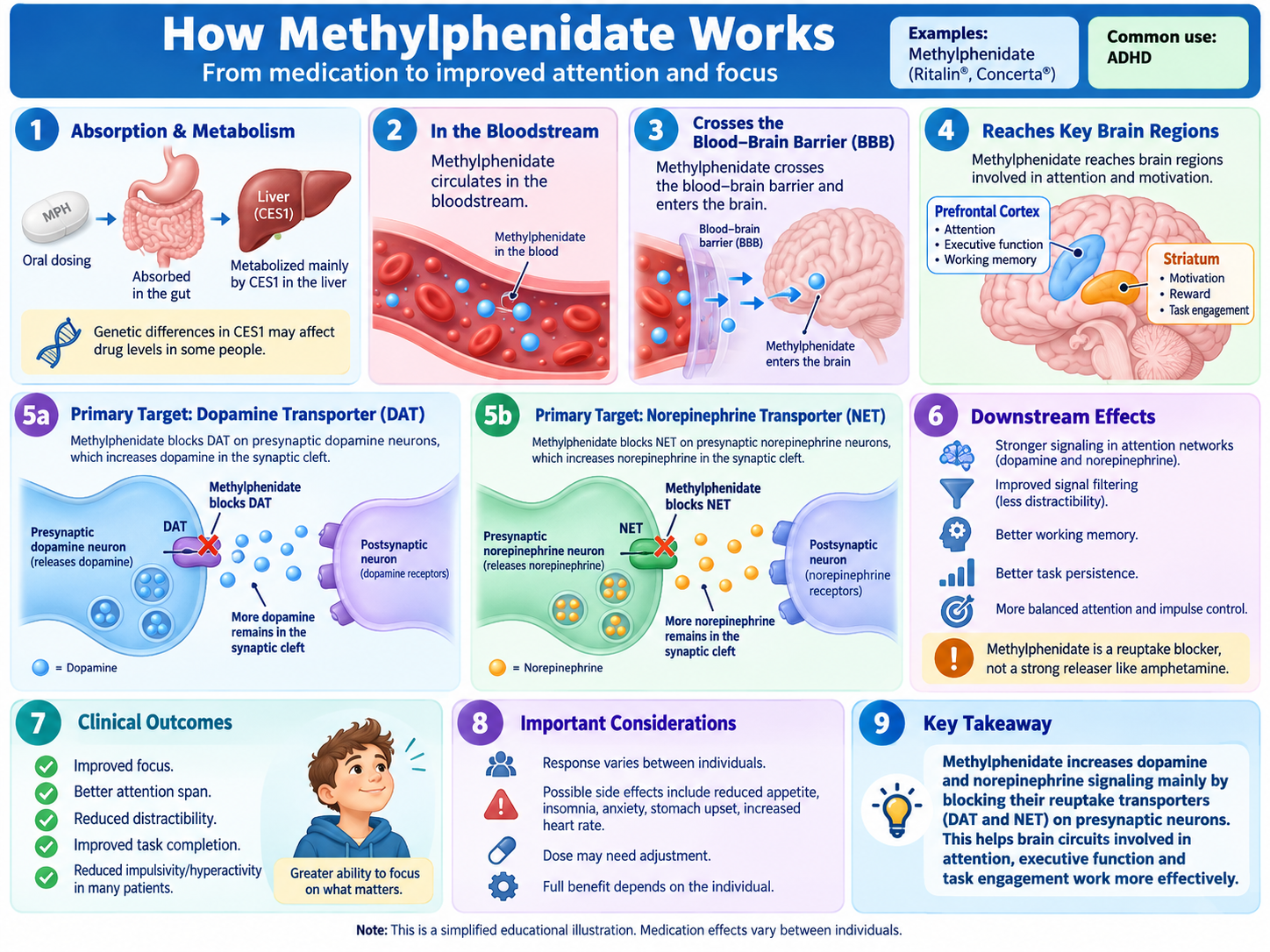
Methylphenidate, historically best known by the brand name Ritalin and also available in extended-release formulations such as Concerta, Biphentin and Foquest, is a central nervous system stimulant used primarily to treat attention-deficit/hyperactivity disorder (ADHD).
Methylphenidate works mainly by increasing the availability of two neurotransmitters:
Dopamine and: Norepinephrine
It does this primarily by blocking two transporter proteins:
DAT — Dopamine Transporter
and:
NET — Norepinephrine Transporter
These transporters normally remove dopamine and norepinephrine from the space between nerve cells after they have been released.
The basic mechanism is:
- Methylphenidate
- Blocks DAT + NET
- Dopamine reuptake decreases
- Norepinephrine reuptake decreases
- More dopamine + norepinephrine remain available for signaling
- Dopamine and adrenergic receptors receive stronger signaling
- Prefrontal and frontostriatal brain networks function more effectively
- Attention, working memory, impulse control and hyperactivity may improve
Current prescribing information identifies inhibition of dopamine and norepinephrine reuptake as a principal pharmacological action of methylphenidate, while noting that the exact mechanism responsible for its therapeutic ADHD effects is not completely understood.
How Does Methylphenidate Work for ADHD?
ADHD should not simply be described as:
“Low dopamine”
or:
“Low norepinephrine.”
ADHD involves dysregulation across brain networks responsible for:
- Attention
- Working memory
- Behavioural inhibition
- Motivation
- Reward processing
- Task initiation
- Executive function
- Emotional regulation Two particularly important neurotransmitter systems are:
Dopamine — DA and: Norepinephrine — NE
Methylphenidate helps regulate both.
The simplified process is:
- Methylphenidate
- DAT + NET inhibition
- Dopamine + norepinephrine availability increases
- Dopamine and adrenergic receptor signaling changes
- Prefrontal and frontostriatal networks become better regulated
- ADHD symptoms may improve
Research supports an important role for both dopamine and norepinephrine in methylphenidate’s effects on attention and executive functioning.
What Does Methylphenidate Do to Dopamine?
Dopamine is involved in:
- Attention
- Motivation
- Reward
- Task initiation
- Learning
- Reinforcement
- Salience
- Movement After dopamine is released, it is normally transported back into the presynaptic neuron by:
DAT — Dopamine Transporter DAT is encoded by the: SLC6A3 gene
Methylphenidate binds to DAT and inhibits it.
Therefore:
- Dopamine is released
- Normally:
DAT removes dopamine
But with methylphenidate:
- DAT is inhibited
- Dopamine is cleared more slowly
- Extracellular dopamine availability increases
- Dopamine receptors receive greater stimulation
This is one of methylphenidate’s principal pharmacodynamic actions.
What Does Methylphenidate Do to Norepinephrine?
Methylphenidate also inhibits:
NET — Norepinephrine Transporter which is encoded by: SLC6A2
Norepinephrine helps regulate:
- Attention
- Alertness
- Working memory
- Mental energy
- Response inhibition
- Stress response
- Executive function Normally:
- Norepinephrine is released
- NET removes norepinephrine
With methylphenidate:
- NET inhibited
- Norepinephrine reuptake decreases
- Norepinephrine availability increases
- Adrenergic receptors receive stronger signaling
This is particularly important in the:
Prefrontal Cortex — PFC
Why Is the Prefrontal Cortex Important in ADHD?
The prefrontal cortex is heavily involved in:
- Sustaining attention
- Ignoring distractions
- Working memory
- Planning
- Organization
- Decision-making
- Controlling impulses
- Regulating behaviour
- Emotional control Successful PFC function requires carefully regulated amounts of:
Dopamine
and:
Norepinephrine
Methylphenidate increases the availability of both.
Therefore:
- Methylphenidate
- ↑ Dopamine + ↑ Norepinephrine in relevant PFC networks
- Prefrontal signaling becomes stronger and more efficient
- Attention and executive control may improve
At clinically relevant doses, stimulant effects on PFC catecholamine signaling can differ substantially from the broad behavioural activation produced by much higher stimulant exposures.
Why Does NET Affect Both Norepinephrine and Dopamine in the Prefrontal Cortex?
This is one of the most interesting aspects of ADHD pharmacology.
In the striatum, dopamine is cleared predominantly by: DAT
But the prefrontal cortex has relatively: Low DAT availability
Instead, the:
Norepinephrine Transporter — NET also helps remove dopamine from the extracellular space in the PFC.
Therefore:
- Methylphenidate blocks NET
- Less norepinephrine is removed
and:
- Less dopamine is removed through NET
- Both norepinephrine and dopamine can increase in the PFC
This helps explain why NET is relevant not only to norepinephrine but also to prefrontal dopamine regulation.
Which Receptors Are Important After Methylphenidate Raises Dopamine and Norepinephrine?
Methylphenidate’s primary targets are:
DAT + NET
But DAT and NET blockade is only the beginning.
The resulting dopamine and norepinephrine then act on receptors.
Two receptor systems are particularly important for PFC function:
Dopamine D1 Receptors
and:
Alpha-2A Adrenergic Receptors
A simplified pathway is:
- Methylphenidate
- DAT + NET blockade
- ↑ Dopamine + ↑ Norepinephrine
- D1 receptor stimulation
- α2A receptor stimulation
- Prefrontal networks function more effectively
- Attention + working memory + behavioural inhibition improve
Animal and neurobiological studies support both D1 dopamine and α2 adrenergic receptor involvement in the cognitive effects of therapeutic stimulant treatment.
What Does the D1 Dopamine Receptor Do?
The:
D1 receptor
is encoded by:
DRD1
Appropriate D1 receptor signaling in the prefrontal cortex helps regulate:
- Working memory
- Attention
- Signal-to-noise ratio
- Resistance to distraction Too little D1 stimulation can produce weak PFC signaling.
But too much can also impair function.
Therefore:
Dopamine follows an optimal-range relationship.
What Does the Alpha-2A Receptor Do?
The:
Alpha-2A adrenergic receptor
is encoded by:
ADRA2A
Norepinephrine activation of alpha-2A receptors can strengthen prefrontal networks involved in:
- Attention
- Working memory
- Behavioural inhibition
- Executive control This is the same receptor directly stimulated by:
Guanfacine But methylphenidate reaches it differently.
Guanfacine
Directly stimulates α2A
while:
Methylphenidate
- Blocks NET
- Norepinephrine availability increases
- Natural norepinephrine stimulates α2A
The two medications therefore influence related PFC pathways through different mechanisms.
Why Can a Stimulant Make Someone with ADHD Feel Calmer?
This is one of the most common questions about methylphenidate.
The word:
“Stimulant”
refers to the medication’s pharmacological class.
It does not mean that the intended therapeutic effect is to make a person hyperactive.
When dopamine and norepinephrine signaling in executive-control networks moves toward a more effective range:
- PFC function improves
- Behavioural inhibition improves
- Distractibility decreases
- Impulsive responding decreases
- The person may appear calmer and more organized
Methylphenidate is therefore not calming because it is a sedative.
It can appear calming because:
Top-down brain control becomes stronger.
How Does Methylphenidate Improve Attention?
Attention requires the brain to:
- Identify relevant information
- Maintain focus
- Ignore distractions
- Shift attention when appropriate
- Hold goals in working memory Methylphenidate increases dopamine and norepinephrine signaling within networks that perform these functions.
The pathway is:
- DAT + NET inhibition
- Optimal catecholamine signaling increases
- Relevant PFC signals become stronger
- Distracting signals become easier to suppress
- Sustained attention may improve
How Does Methylphenidate Improve Working Memory?
Working memory allows us to temporarily hold information in mind while using it.
Examples include:
- Remembering instructions
- Keeping track of several steps
- Holding a goal in mind
- Solving a problem without losing your place Dopamine D1 and norepinephrine alpha-2A signaling help regulate the neuronal networks responsible for these functions.
Therefore:
- Methylphenidate
- ↑ dopamine + norepinephrine
- D1 + α2A signaling improves
- PFC network connectivity becomes more effective
- Working memory may improve
Research supports an inverted-U relationship between catecholamine signaling and PFC working-memory performance.
How Does Methylphenidate Reduce Impulsivity?
Impulse control depends heavily on:
Prefrontal top-down control
The PFC helps inhibit an immediate action long enough to:
- Think
- Evaluate consequences
- Choose an appropriate response If these networks are functioning inefficiently:
- Immediate stimulus
- Rapid response
- Action occurs before adequate evaluation
Methylphenidate can strengthen executive networks:
- ↑ PFC dopamine + norepinephrine
- Improved behavioural inhibition
- Greater ability to pause before acting
- Impulsivity may decrease
How Does Methylphenidate Reduce Hyperactivity?
Hyperactivity is not simply caused by:
Too much energy
It can reflect weak regulation of:
- Motor behaviour
- Attention
- Impulse control
- Arousal
- Response inhibition Methylphenidate strengthens brain networks responsible for controlling behaviour.
Therefore:
- Improved attention
- Improved response inhibition
Improved executive control
Excessive movement and behavioural impulsivity may decrease
How Does Methylphenidate Affect Motivation?
Dopamine plays an important role in:
- Reward
- Motivation
- Effort
- Reinforcement
- Task initiation Methylphenidate increases extracellular dopamine, including within striatal and cortical circuits.
Therefore:
- DAT inhibition
- Dopamine signaling increases
- Effort and reward-related signals become more salient
- Starting and persisting with tasks may become easier
This does not mean methylphenidate simply creates motivation.
It may improve the neural signaling involved in deciding:
“This task is worth doing, and I should stay with it.”
What Is the Role of the Striatum?
Although the prefrontal cortex is central to executive function, methylphenidate also strongly affects dopamine signaling in the:
Striatum
The striatum contributes to:
- Motivation
- Reward
- Habit formation
- Action selection
- Motor control
- Reinforcement learning Human imaging studies demonstrate substantial methylphenidate interaction with DAT in the striatum.
Therefore methylphenidate should not be described as acting only in the prefrontal cortex.
A more accurate model is:
PFC + Striatum + Frontostriatal Networks
working together.
Does Methylphenidate Simply Increase Dopamine Everywhere?
No.
The effect depends on:
- Brain region
- Transporter density
- Baseline neurotransmitter release
- Dose
- Formulation
- Receptor type For example:
PFC
NET contributes substantially to clearance of both dopamine and norepinephrine.
Striatum
DAT is especially important for dopamine clearance.
Therefore, the same methylphenidate molecule can influence catecholamine signaling differently in different parts of the brain.
This is one reason a regional view of ADHD pharmacology is more useful than simply saying:
“Methylphenidate raises dopamine.”
Why Is the Dose-Response Relationship an Inverted U?
More dopamine and norepinephrine are not always better.
PFC function is often conceptualized as:
Too little catecholamine signaling
→ weak executive function
Optimal signaling
→ strongest attention and working memory
Too much signaling
→ poorer cognitive control, anxiety or overstimulation
This produces an:
Inverted-U Curve
A simplified model is:
LOW
DistractedPoor working memory
- Low alertness
- BALANCED
FocusedOrganized
- Controlled
- HIGH
OverfocusedAnxious
Restless
Irritable
Experimental research demonstrates inverted-U effects of both dopamine D1 and norepinephrine receptor signaling on PFC cognitive function.
This helps explain why:
The best methylphenidate dose is not necessarily the highest dose.
Why Can Too Much Methylphenidate Make Someone Feel Worse?
If drug exposure becomes excessive:
- DAT + NET inhibition increases
- Dopamine + norepinephrine signaling becomes excessive
- The person may experience:
- Jitteriness
- Anxiety
- Irritability
- Excessive focus
- Emotional restriction
- Insomnia
- Appetite suppression
- Increased heart rate
- Increased blood pressure Cognitively:
More stimulant does not necessarily mean more attention.
Once catecholamine signaling passes the optimal range, PFC performance may worsen.
Why Can Methylphenidate Cause Emotional Blunting or “Zombie-Like” Behaviour?
Some patients describe feeling:
- Flat
- Less spontaneous
- Overly quiet
- Emotionally restricted
- Excessively focused This is not the intended therapeutic endpoint.
One possible explanation is:
- Excessive catecholamine stimulation
- PFC networks become overly constrained
- Flexibility and spontaneous behaviour decrease
- Emotional or behavioural flattening
When this occurs, it can be clinically useful to reassess:
- Dose
- Formulation
- Timing
- Medication choice rather than assuming that more behavioural suppression means better ADHD treatment.
Why Can Methylphenidate Increase Anxiety?
Norepinephrine is also involved in:
Stress and arousal
At an appropriate level:
NE
supports:
-
Attention
-
Alertness
-
Executive function But excessive NE signaling can activate:
-
Sympathetic arousal
-
Vigilance
-
Stress responses Therefore:
- Too much methylphenidate
- Excessive NE signaling
- Possible:
- Anxiety
- Tremor
- Sweating
- Palpitations
- Restlessness Again, the issue is not simply whether norepinephrine is “high” or “low.”
It is whether signaling is appropriately regulated for the relevant brain region and receptor system.
Why Can Methylphenidate Cause Insomnia?
Dopamine and norepinephrine promote:
- Wakefulness
- Alertness
- Attention
- Arousal If significant methylphenidate activity remains too late in the day:
- Catecholamine signaling remains elevated
- Brain remains more alert
- Sleep initiation may become more difficult
This is why formulation and timing matter.
Immediate-release and extended-release methylphenidate products may contain the same active drug but produce very different:
- Peaks
- Duration
- Evening exposure
Why Can Methylphenidate Reduce Appetite?
Dopamine and norepinephrine influence:
- Hunger
- Reward
- Motivation
- Sympathetic activity During the period when methylphenidate is active:
- ↑ dopamine + norepinephrine
- Appetite and food-reward signaling may decrease
- Reduced appetite
This can contribute to:
- Lower food intake
- Weight loss
- Slower weight gain in children The effect often varies across the day as the medication concentration rises and falls.
Why Does Methylphenidate Increase Heart Rate or Blood Pressure?
Norepinephrine is involved not only in the brain but also in regulation of the:
Sympathetic Nervous System
Therefore:
- Methylphenidate
- NET inhibition
- Noradrenergic signaling increases
- Sympathetic cardiovascular activity increases
- Possible:
↑ Heart rate
and:
↑ Blood pressure
This is why stimulant treatment includes cardiovascular consideration and monitoring.
Does Methylphenidate Release Dopamine Like Amphetamine?
This requires an important distinction.
Methylphenidate and amphetamine both increase dopamine and norepinephrine availability, but they do so differently.
Methylphenidate
works predominantly by:
Blocking DAT + NET
It prevents the transporters from efficiently clearing dopamine and norepinephrine.
Amphetamine
does more than block transporters.
It enters presynaptic neurons and can:
- Affect VMAT2
- Increase cytoplasmic catecholamines
- Reverse DAT and NET transport
- Promote neurotransmitter efflux Therefore:
Methylphenidate
primarily:
Keeps released dopamine and norepinephrine around longer
whereas:
Amphetamine
more actively:
Promotes release and reverse transport of dopamine and norepinephrine
At therapeutically relevant exposures, this distinction is an important pharmacological difference between the two stimulant families.
How Is Methylphenidate Different from Amphetamine?
Both can effectively treat ADHD.
But:
Methylphenidate
- DAT + NET blockade
- Released DA + NE remain available longer
while:
Amphetamine
- Enters catecholamine neuron
- VMAT2 + transporter mechanisms
- DA + NE release/efflux increases
Because the mechanisms are different, one person may respond very well to:
Methylphenidate
but poorly to:
Amphetamine
or vice versa.
A poor response to one stimulant family does not necessarily predict a poor response to the other.
How Is Methylphenidate Different from Atomoxetine?
Atomoxetine
primarily blocks:
NET
It therefore increases norepinephrine and, indirectly, dopamine particularly in the PFC.
Methylphenidate
blocks:
NET + DAT
Therefore, methylphenidate has stronger direct effects on dopamine transport, especially in dopamine-rich regions such as the striatum.
Simplified:
Atomoxetine
NET inhibition
→ ↑ NE + indirect ↑ PFC dopamine
Methylphenidate
NET + DAT inhibition
→ ↑ NE + ↑ dopamine
This is one reason methylphenidate generally has a faster and more immediately observable clinical effect than atomoxetine.
How Is Methylphenidate Different from Guanfacine?
Guanfacine does not block NET or DAT.
Instead, it directly stimulates:
Alpha-2A Adrenergic Receptors
Therefore:
Methylphenidate
- NET inhibition
- More norepinephrine available
- Natural norepinephrine activates α2A
while:
Guanfacine
Directly activates α2A
Both can improve prefrontal function through related catecholamine pathways, which helps explain why the medications can sometimes be used together.
Why Does Methylphenidate Work Within Hours While Antidepressants Take Weeks?
Methylphenidate’s primary therapeutic mechanism is:
Immediate transporter inhibition
Once an effective concentration reaches the brain:
- DAT + NET are inhibited
- Dopamine + norepinephrine availability changes
- Behavioural effects can occur the same day
SSRIs also inhibit their transporter quickly, but many antidepressant effects require substantial:
- Autoreceptor adaptation
- Downstream signaling changes
- Network plasticity Methylphenidate can therefore produce observable attention and behavioural effects much more rapidly.
Why Does the Effect Wear Off?
Methylphenidate’s therapeutic effect generally tracks the amount of active medication available.
As the body metabolizes methylphenidate:
- Methylphenidate concentration falls
- DAT + NET blockade decreases
- Dopamine + norepinephrine signaling returns toward baseline
- ADHD symptoms can return
This is why release formulation is so important.
An immediate-release product may provide:
Several hours of coverage
whereas extended-release preparations are designed to provide:
Much longer daytime coverage
The underlying mechanism is the same—the difference is how the medication is delivered over time.
Why Can Different Methylphenidate Formulations Feel Different?
Products such as:
- Immediate-release methylphenidate
- Concerta
- Biphentin
- Foquest
- Jornay PM all deliver methylphenidate.
But they create different:
Concentration-versus-time curves
For example:
- Rapid release
- Faster concentration increase
- Earlier peak
- Earlier decline
while:
- Extended release
- Gradual or multiphasic delivery
- More prolonged exposure
- Longer clinical coverage
Therefore, two products containing the same number of milligrams do not necessarily produce the same clinical experience.
What Is Dexmethylphenidate?
Most conventional methylphenidate contains two mirror-image forms:
d-methylphenidate
and:
l-methylphenidate
The:
d-isomer
is substantially more pharmacologically active.
Current prescribing information identifies the d-isomer as the more active component of racemic methylphenidate.
Dexmethylphenidate
is essentially the isolated active d-enantiomer.
Therefore:
Racemic methylphenidate
= d + l methylphenidate
while:
Dexmethylphenidate
= primarily the pharmacologically active d-form
The two should not simply be treated as milligram-for-milligram equivalent.
Why Can the Same Methylphenidate Dose Affect Two People Differently?
Two patients can take the same dose and experience very different effects.
One may experience:
Better attention + better impulse control
another:
Anxiety + appetite loss + insomnia
and another:
Very little benefit
There are two broad explanations:
Pharmacokinetics — PK
How much methylphenidate reaches the brain?
and:
Pharmacodynamics — PD
How does the brain respond once methylphenidate reaches DAT and NET?
How Is Methylphenidate Metabolized?
Methylphenidate is unusual compared with many psychiatric medications because it is not primarily metabolized by CYP2D6 or CYP2C19.
Its principal metabolic enzyme is:
CES1 — Carboxylesterase 1
CES1 is expressed particularly in the liver.
It converts methylphenidate into:
Ritalinic Acid
which is essentially pharmacologically inactive.
The pathway is:
- Methylphenidate
- CES1
- Ritalinic acid
- Elimination
CES1 is therefore the major pharmacokinetic gene of interest for methylphenidate.
Does CYP2D6 Affect Methylphenidate?
Not in the clinically important way it affects many other psychiatric medications.
This is an important distinction.
Atomoxetine
has a major CYP2D6 relationship.
Amphetamine
has some CYP2D6 involvement.
Methylphenidate
is primarily metabolized through:
CES1
The DPWG specifically concluded that methylphenidate therapy is not expected to be meaningfully affected by CYP2D6 genetic variation.
What Is CES1 rs71647871?
One of the most important methylphenidate pharmacokinetic variants studied to date is:
CES1 rs71647871
also called:
G143E
This variant reduces CES1 enzyme activity.
The proposed pathway is:
- CES1 reduced function
- Methylphenidate breakdown decreases
- Methylphenidate exposure increases
- Potentially:
Greater medication effect
or:
More concentration-related adverse effects
A controlled pharmacokinetic study found that carriers of the 143E variant had a median d-methylphenidate exposure roughly 2.5 times that of controls in that study.
Does CES1 Genotype Determine the Methylphenidate Dose?
Currently:
No established clinical dosing guideline does.
CES1 rs71647871 clearly has pharmacokinetic relevance, but evidence is not yet sufficient for an established:
- CPIC dosing algorithm
- DPWG methylphenidate-CES1 dosing algorithm Therefore:
A reduced-function CES1 result may provide biologically meaningful information about exposure, but it should not currently be interpreted as an automatic dose instruction.
Clinical titration remains essential.
Can Methylphenidate Fail Even If CES1 Metabolism Is Normal?
Absolutely.
Normal CES1 metabolism only addresses:
Pharmacokinetics
It does not tell us whether methylphenidate’s:
DAT + NET mechanism
is optimal for that particular patient.
A patient can have normal drug exposure but still experience:
- Poor response
- Excessive anxiety
- Irritability
- Emotional blunting
- Poor duration of benefit
- Inadequate control of impulsivity because the:
Pharmacodynamic response
may differ.
Methylphenidate Pharmacokinetics — PK
PK asks: Does an appropriate amount of methylphenidate reach the brain?
The pathway is:
- Methylphenidate formulation
- Drug release
- Absorption
- CES1 metabolism
- Active methylphenidate concentration
- Medication reaches the brain
Important influences include:
- Dose
- Release formulation
- CES1 activity
- Timing
- Food effects for specific products
- Individual absorption
Methylphenidate Pharmacodynamics — PD
PD asks: What happens once methylphenidate reaches the brain?
- Methylphenidate
- DAT / SLC6A3 inhibition
- NET / SLC6A2 inhibition
- ↑ Dopamine + ↑ Norepinephrine availability
- D1 dopamine receptor signaling
- α2A adrenergic signaling
- Prefrontal + frontostriatal networks respond
- Attention, working memory and behavioural control may improve
Therefore:
Normal PK does not automatically mean optimal PD response.
What Is the Role of SLC6A3 Genetics?
SLC6A3
encodes:
DAT — Dopamine Transporter
which is one of methylphenidate’s principal drug targets.
The relationship is direct:
- SLC6A3
- DAT expression/function
- Methylphenidate blocks DAT
- Dopamine signaling changes
- Clinical response
One of the most studied SLC6A3 variants is the:
40-bp VNTR
commonly involving:
9-repeat and 10-repeat alleles
SLC6A3 variants have been associated with methylphenidate response in some studies, but findings vary across populations and study designs.
Therefore:
There is currently no validated SLC6A3 genotype-based methylphenidate prescribing guideline.
What Is the Role of SLC6A2 Genetics?
SLC6A2
encodes:
NET — Norepinephrine Transporter
Methylphenidate directly inhibits NET.
Therefore:
- SLC6A2
- NET expression/function
- Methylphenidate inhibits NET
- Norepinephrine and PFC dopamine signaling change
- Attention-related networks respond
Variants such as:
- rs28386840
- rs5569 have shown associations with methylphenidate response in some studies and meta-analyses.
However, effect sizes and replication are not sufficient for a validated individual prescribing rule.
What Is the Role of ADRA2A Genetics?
ADRA2A
encodes:
Alpha-2A Adrenergic Receptor
which is an important downstream receptor for norepinephrine in the PFC.
The pathway is:
- Methylphenidate blocks NET
- Norepinephrine increases
- Norepinephrine activates α2A
- PFC function changes
The:
ADRA2A rs1800544
variant has been associated with methylphenidate response in pooled pharmacogenetic studies.
But:
There is no validated ADRA2A-based methylphenidate dosing recommendation.
What Is the Role of DRD4 Genetics?
DRD4
encodes the:
Dopamine D4 receptor
The gene contains a well-studied VNTR including:
4-repeat
and:
7-repeat
alleles.
DRD4 has been extensively investigated in:
- ADHD biology
- Attention
- Novelty seeking
- Stimulant response Some pooled studies have reported associations between the DRD4 4-repeat and methylphenidate response.
However:
DRD4 genotype is not currently a validated methylphenidate prescribing test.
What Is the Role of COMT rs4680?
COMT
helps metabolize catecholamines and is particularly important for dopamine regulation in the:
Prefrontal cortex
The commonly studied variant is:
COMT rs4680 — Val158Met
which changes COMT enzyme activity.
The biological hypothesis is:
- COMT activity
- PFC dopamine clearance
- Baseline dopamine signaling
- Response to a dopamine-enhancing medication
Some research has found associations between COMT rs4680 and methylphenidate response. However, the DPWG reviewed the evidence and concluded that it does not support a clinically actionable COMT-based methylphenidate prescribing recommendation.
What About DRD2 Genetics?
DRD2
encodes the dopamine D2 receptor.
D2 signaling is relevant to:
- Motivation
- Reward
- Motor function
- Presynaptic autoregulation
- Striatal dopamine signaling Methylphenidate does not directly bind D2 in the way an antipsychotic such as haloperidol does.
Instead:
- Methylphenidate increases dopamine availability
- Dopamine interacts with D2 and other dopamine receptors
DRD2 variants are biologically relevant candidates, but there is currently no validated DRD2-guided methylphenidate dosing recommendation.
Can Pharmacogenomic Testing Predict Whether Methylphenidate Will Work?
There are several biologically relevant levels.
- Pharmacokinetic genes particularly:
CES1
may influence drug exposure.
-
Pharmacodynamic genes including:
-
SLC6A3
-
SLC6A2
-
ADRA2A
-
DRD4
-
DRD2
-
COMT may influence aspects of dopamine and norepinephrine signaling.
But methylphenidate response is:
Polygenic + clinical + dose-dependent
No single result currently provides a reliable:
“Methylphenidate will work”
or:
“Methylphenidate will fail”
prediction.
A meta-analysis has found statistically significant associations for several candidate variants, but such group-level associations have not yet translated into validated individual treatment algorithms.
Methylphenidate Needs Both Appropriate Drug Exposure and Brain Compatibility
The entire process can be summarized as:
- Methylphenidate is taken
- PK — Pharmacokinetics
- Formulation releases methylphenidate
- Absorption
- CES1 metabolism
- Appropriate methylphenidate exposure
- PD — Pharmacodynamics
- DAT + NET blockade
- ↑ Dopamine + ↑ Norepinephrine
- D1 + α2A + other receptor signaling
- Prefrontal and frontostriatal networks respond
- Attention + working memory + impulse control may improve
Both contribute to treatment outcome.
Why Might Methylphenidate Work Very Well for One Person but Poorly for Another?
Two patients can both have ADHD while having different predominant symptoms.
One may experience:
Poor sustained attention + weak working memory
Another:
Severe hyperactivity + impulsivity
Another:
Low motivation + difficulty initiating tasks
Another:
High arousal + anxiety + emotional reactivity
Their baseline dopamine and norepinephrine patterns may also differ across:
- Prefrontal cortex
- Striatum
- Other neural circuits Methylphenidate increases both dopamine and norepinephrine signaling.
For one patient this may move neurotransmission:
Toward the optimal range
For another it may produce:
Insufficient change
or:
Excessive activation
This is why ADHD medication selection cannot be determined from the ADHD diagnosis alone.
This article is educational. It does not diagnose, and it does not replace advice from your prescriber or pharmacist. Never start, stop or change a medication based on a web page.