
Mirtazapine · How it works
How Does Mirtazapine Work?
Mirtazapine, best known by the brand name Remeron, is an antidepressant used primarily to treat major depressive disorder.
 Written by Sanjida Ahmed, PhD, Cellular and Molecular BiologyChief Operating Officer and Lead Scientist, Personalized Prescribing. Last reviewed October 2, 2026.
- Class
- SSRI (selective serotonin reuptake inhibitor)
On this page
- How Does Mirtazapine Work for Depression?
- Low serotonin
- Low norepinephrine
- SERT inhibition
- SERT + NET inhibition
- What Is the Main Target of Mirtazapine?
- Alpha-2 Adrenergic Receptors
- Inhibitory feedback receptors
- What Is an Alpha-2 Autoreceptor?
- How Does Mirtazapine Increase Serotonin?
- Does Mirtazapine Block the Serotonin Transporter?
- 5-HT2 + 5-HT3 receptors are blocked
- What Does 5-HT2 Blockade Do?
- 5-HT2 Serotonin Receptor Family
- Why Might 5-HT2A Blockade Help Sleep?
- Improved sleep continuity
- Histamine H1 blockade
- What Is the Role of 5-HT2C?
- 5-HT2C receptor
- Increased appetite
- Weight gain
- α2 + 5-HT2 + 5-HT3 + H1 receptors
- What Does 5-HT3 Blockade Do?
- 5-HT3 Receptors
- Ligand-gated ion channel
- Less nausea and gastrointestinal activation
- Does Mirtazapine Increase 5-HT1A Signaling?
- 5-HT1A-mediated signaling
- Antidepressant + anxiolytic effects
- Why Does Mirtazapine Cause Sleepiness?
- Histamine H1 Receptor Blockade
- At bedtime
- Is Mirtazapine a Sleeping Pill?
- Is Lower-Dose Mirtazapine More Sedating?
- H1 blockade is already very strong
- Greater noradrenergic signaling may partially counter sedation
- Why Does Mirtazapine Increase Appetite?
- Why Can Mirtazapine Cause Weight Gain?
- “Eating more.”
- Why Does Mirtazapine Cause Less Sexual Dysfunction Than Many SSRIs?
- Mirtazapine increases serotonergic activity
- Blocks 5-HT2 receptors
- Why Does Mirtazapine Cause Less Nausea Than Some SSRIs?
- blocks 5-HT3 receptors
- Increased serotonergic activity
- Does Mirtazapine Increase Norepinephrine in the Prefrontal Cortex?
- Prefrontal Cortex — PFC
- Does Mirtazapine Affect Dopamine?
- 5-HT2C receptors
- Indirect downstream effect
- Why Does Mirtazapine Take Time to Work?
- Days to weeks
- Why Can Mirtazapine Improve Sleep Before Mood?
- How Is Mirtazapine Different From an SSRI?
- How Is Mirtazapine Different From an SNRI?
- SERT + NET
- Norepinephrine + serotonin signaling
- How Is Mirtazapine Different from Trazodone?
- How Is Mirtazapine Different from Bupropion?
- Norepinephrine + dopamine
- α2 + serotonin-receptor + histamine-receptor blockade
- How Is Mirtazapine Metabolized?
- Why Is CYP3A4 Important for Mirtazapine?
- Does CYP2D6 Genotype Affect Mirtazapine?
- CYP2D6 is pharmacokinetically relevant
- Does CYP2C19 Affect Mirtazapine?
- CYP2C19 genotype
- Can Mirtazapine Fail Even When Metabolism Is Normal?
- Pharmacokinetics — PK
- Pharmacodynamics — PD
- What Is the Role of ADRA2A Genetics?
- Alpha-2A Adrenergic Receptor
- What Is the Role of ADRA2C?
- Alpha-2C Adrenergic Receptor
- What Is the Role of HTR2A Genetics?
- What Is the Role of HTR2C Genetics?
- What About HTR3 Genes?
- What About HRH1 Genetics?
- Histamine H1 Receptor
- Can Pharmacogenomic Testing Predict Whether Mirtazapine Will Work?
- Pharmacokinetic factors
- Pharmacodynamic factors
- “Mirtazapine will work”
- “Mirtazapine will fail”
- Why Might Mirtazapine Work Very Well for One Person but Poorly for Another?
- Insomnia + low appetite + weight loss + anxiety
- Excessive sleeping + increased appetite + fatigue
- Low motivation + cognitive slowing
- Mirtazapine Requires Both Appropriate Drug Exposure and Brain Compatibility
Mirtazapine, best known by the brand name Remeron, is an antidepressant used primarily to treat major depressive disorder.
Mirtazapine works very differently from common antidepressants such as SSRIs and SNRIs. It does not primarily block the serotonin transporter (SERT) or norepinephrine transporter (NET).
Instead, mirtazapine acts mainly by blocking several receptors, particularly:
-
Alpha-2 adrenergic receptors
-
5-HT2 serotonin receptors
-
5-HT3 serotonin receptors
-
Histamine H1 receptors These actions produce a distinctive combination of:
-
Increased norepinephrine signaling
-
Increased and modified serotonin signaling
-
Sedation
-
Increased appetite A simplified mechanism is:
- Mirtazapine
- Blocks inhibitory α2 adrenergic receptors
- Norepinephrine release increases
- Serotonergic activity increases while:
- 5-HT2 + 5-HT3 receptors are blocked
- Serotonin signaling through these pathways decreases
and relatively more serotonergic signaling remains available through pathways such as:
- 5-HT1A
- Mood and emotional networks adapt
while:
- H1 histamine receptors are blocked
- Sedation + increased appetite
- Depressive symptoms may improve
The complete antidepressant mechanism is not fully understood, but this combination of noradrenergic enhancement and selective serotonin-receptor blockade is central to how mirtazapine works.
How Does Mirtazapine Work for Depression?
Depression is not simply caused by:
Low serotonin
or:
Low norepinephrine
Major depressive disorder can involve dysregulation across networks responsible for:
- Mood
- Motivation
- Reward
- Attention
- Stress response
- Emotional regulation
- Sleep
- Appetite
- Cognitive function Mirtazapine influences several of these systems at the same time.
The overall pathway can be thought of as:
- Mirtazapine
- Removes α2 inhibitory feedback
- Norepinephrine + serotonin signaling increase
- 5-HT2 and 5-HT3 pathways are simultaneously blocked
- The pattern of serotonin signaling changes
- Adrenergic and serotonin networks adapt
- Mood, anxiety, sleep and appetite may improve
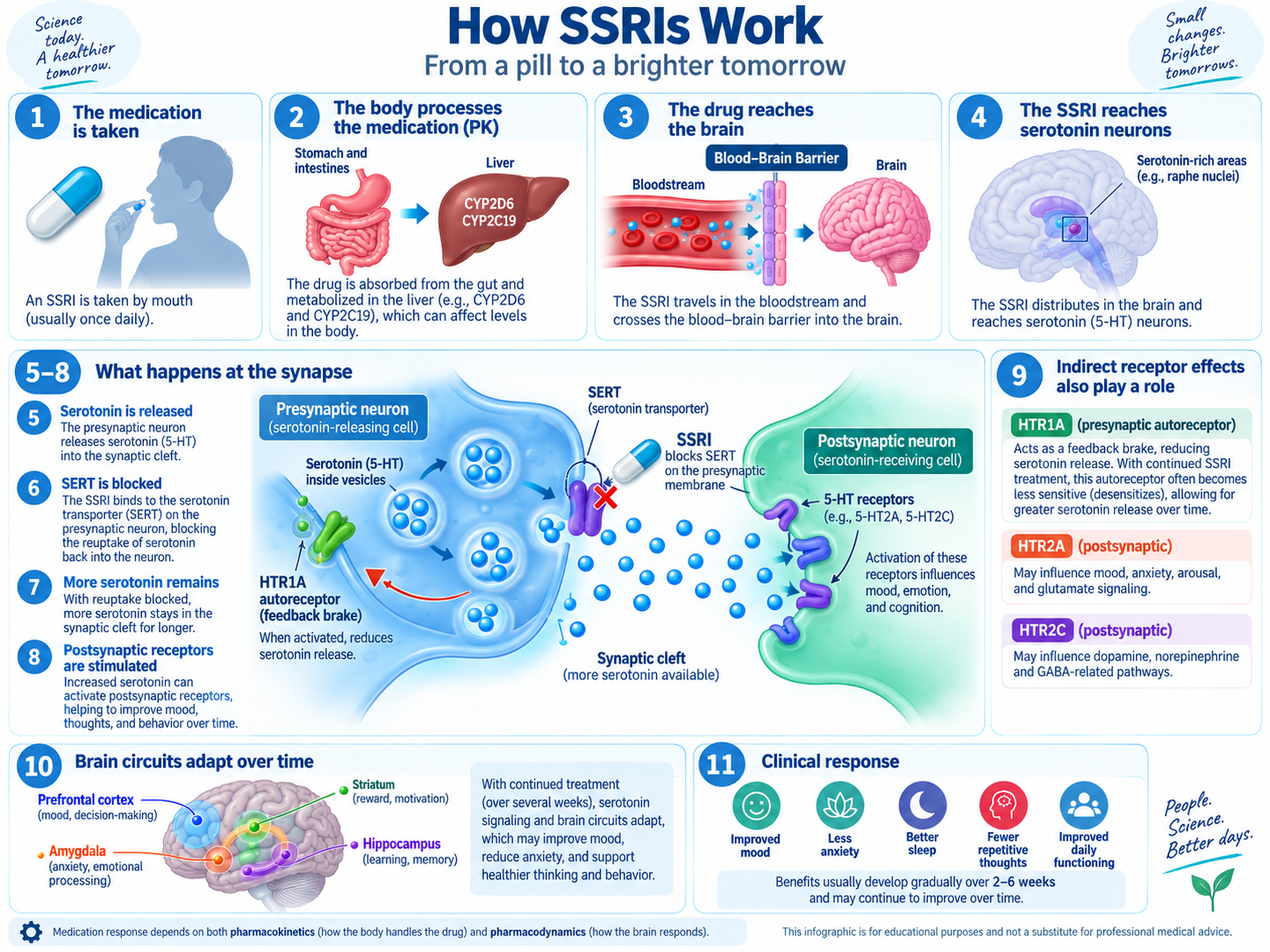
This makes mirtazapine different from an SSRI, where the first step is simply:
SERT inhibition
and different from an SNRI, where the first step is:
SERT + NET inhibition
What Is the Main Target of Mirtazapine?
One of mirtazapine’s most important actions is blockade of:
Alpha-2 Adrenergic Receptors
Alpha-2 receptors often act as:
Inhibitory feedback receptors
They help regulate how much norepinephrine and, indirectly, serotonin is released.
There are two especially relevant types of alpha-2 receptor function:
Autoreceptors
located on norepinephrine neurons.
and:
Heteroreceptors
located on other neurons, including serotonin neurons.
Mirtazapine blocks both types.
What Is an Alpha-2 Autoreceptor?
An Autoreceptor is a receptor located on the same type of neuron that releases the neurotransmitter activating it.
For norepinephrine neurons:
- Norepinephrine is released
- Norepinephrine activates presynaptic α2 autoreceptors
- The neuron receives a feedback signal to release less norepinephrine
This is essentially a biological brake.
Mirtazapine blocks this brake.
Therefore:
- Mirtazapine
- α2 autoreceptor blockade
- Negative feedback decreases
- Norepinephrine release increases
This enhanced noradrenergic signaling is an important part of mirtazapine’s antidepressant mechanism.
How Does Mirtazapine Increase Serotonin?
This occurs somewhat differently.
Noradrenergic neurons influence serotonin neurons.
In addition, alpha-2 receptors can function as inhibitory: Heteroreceptors on serotonergic nerve terminals.
Mirtazapine blocks these inhibitory receptors.
The simplified pathway is:
- Mirtazapine
- Blocks α2 inhibitory receptors
- Noradrenergic drive increases
- Inhibitory control over serotonin release decreases Serotonergic transmission increases However, mirtazapine simultaneously blocks specific serotonin receptor pathways.
This is what makes its serotonin effect unusual.
Does Mirtazapine Block the Serotonin Transporter?
No.
This is a critical difference from SSRIs.
SSRIs
such as:
- Escitalopram
- Sertraline
- Fluoxetine primarily work through:
- SERT blockade
- Serotonin reuptake decreases
Mirtazapine does not significantly inhibit SERT as its main mechanism.
Instead:
Mirtazapine
- α2 blockade
- Serotonin release/signaling increases
while:
5-HT2 + 5-HT3 receptors are blocked
Therefore, mirtazapine changes serotonin signaling through a very different pathway.
What Does 5-HT2 Blockade Do?
Mirtazapine blocks members of the:
5-HT2 Serotonin Receptor Family
particularly:
5-HT2A
and:
5-HT2C
These receptors participate in several functions including:
- Anxiety
- Sleep
- Sexual function
- Appetite
- Dopamine regulation
- Norepinephrine regulation
- Emotional processing Therefore:
- Mirtazapine
- 5-HT2A + 5-HT2C antagonism
- Signaling through these receptors decreases
This contributes to mirtazapine’s distinctive clinical profile.
Why Might 5-HT2A Blockade Help Sleep?
5-HT2A signaling can promote:
- Cortical activation
- Arousal
- Sleep disruption in some contexts Blocking 5-HT2A may therefore contribute to:
Improved sleep continuity
However, mirtazapine’s most powerful sedating mechanism is still:
Histamine H1 blockade
rather than serotonin blockade alone.
What Is the Role of 5-HT2C?
The:
5-HT2C receptor
is involved in:
- Appetite
- Satiety
- Dopamine regulation
- Norepinephrine regulation
- Anxiety
- Reward pathways Mirtazapine blocks 5-HT2C receptors.
This may contribute to:
Increased appetite
and:
Weight gain
It may also indirectly influence dopamine and norepinephrine signaling in certain brain regions.
However, mirtazapine should not be described as a direct dopamine-enhancing drug.
Its direct pharmacological targets remain primarily:
α2 + 5-HT2 + 5-HT3 + H1 receptors
What Does 5-HT3 Blockade Do?
Mirtazapine also blocks:
5-HT3 Receptors
The 5-HT3 receptor is unusual because it is a:
Ligand-gated ion channel
rather than a G-protein-coupled receptor like most serotonin receptors.
5-HT3 receptors are important in:
- Nausea
- Vomiting
- Gastrointestinal signaling
- Some anxiety-related pathways Therefore:
- Mirtazapine
- 5-HT3 receptor blockade
- Less 5-HT3 signaling
- Potentially:
Less nausea and gastrointestinal activation
This helps explain why mirtazapine can have a different gastrointestinal profile from SSRIs and SNRIs.
Does Mirtazapine Increase 5-HT1A Signaling?
Indirectly, this is thought to be part of its pharmacology.
Mirtazapine increases serotonergic activity but blocks:
5-HT2
and:
5-HT3
receptors.
Because these pathways are blocked, serotonergic transmission may become relatively more weighted toward:
5-HT1A-mediated signaling
The conceptual pathway is:
- Mirtazapine
- ↑ serotonin availability/signaling
- 5-HT2 blocked
- 5-HT3 blocked
- Relative preservation of 5-HT1A signaling
- Potential contribution to:
Antidepressant + anxiolytic effects
This should not be interpreted as mirtazapine directly stimulating 5-HT1A receptors.
It does not act like:
Buspirone
which is a direct 5-HT1A partial agonist.
Instead, the effect on 5-HT1A is indirect.
Why Does Mirtazapine Cause Sleepiness?
One of mirtazapine’s strongest receptor effects is:
Histamine H1 Receptor Blockade
Histamine is an important neurotransmitter for:
- Wakefulness
- Alertness
- Arousal Histamine neurons in the hypothalamus help keep the brain awake.
Normally:
- Histamine
- H1 receptors
- Wakefulness
Mirtazapine blocks H1 receptors.
Therefore:
- Mirtazapine
- H1 blockade
- Histamine-mediated wakefulness decreases
- Sleepiness and sedation
This is why mirtazapine is commonly taken:
At bedtime
Is Mirtazapine a Sleeping Pill?
No.
Mirtazapine is an:
Antidepressant
not primarily a hypnotic medication.
However, because it strongly blocks H1 histamine receptors, sedation can be substantial.
This makes mirtazapine clinically attractive in some patients whose depression includes:
- Difficulty falling asleep
- Frequent nighttime waking
- Poor appetite
- Weight loss But the fact that it causes sleepiness does not mean insomnia is its primary approved indication.
Is Lower-Dose Mirtazapine More Sedating?
This is commonly stated, but it should be presented carefully.
The theory is that at lower doses:
H1 blockade is already very strong
while at higher doses:
Greater noradrenergic signaling may partially counter sedation
This has led to the common clinical statement:
Lower doses of mirtazapine may sometimes feel more sedating than higher doses.
However, the relationship is not consistent enough to be treated as a universal rule.
A patient can remain very sleepy at:
- 15 mg
- 30 mg
- 45 mg Therefore:
Increasing mirtazapine solely to reduce sedation is not a reliable strategy and should not be done without clinical guidance.
Why Does Mirtazapine Increase Appetite?
Several receptor systems are involved.
Two important ones are:
H1
and:
5-HT2C
Both participate in regulation of:
- Appetite
- Satiety
- Food reward
- Energy balance Therefore:
Mirtazapine
- H1 blockade
- 5-HT2C blockade
- Satiety signaling decreases / appetite regulation changes
- Hunger may increase
- Food intake may increase
- Weight gain can occur
This is why increased appetite and weight gain are among mirtazapine’s most characteristic adverse effects.
Why Can Mirtazapine Cause Weight Gain?
Weight gain is likely multifactorial.
Potential contributors include:
- Increased appetite
- H1 blockade
- 5-HT2C blockade
- Reduced satiety
- Increased food reward
- Sedation and reduced physical activity in some patients
- Individual metabolic susceptibility Therefore weight gain is not simply a consequence of:
“Eating more.”
The medication alters neural systems that participate in appetite and energy regulation.
Why Does Mirtazapine Cause Less Sexual Dysfunction Than Many SSRIs?
SSRIs increase serotonin broadly by inhibiting SERT.
Increased signaling at receptors including:
5-HT2A
and:
5-HT2C
has been associated with sexual adverse effects.
Mirtazapine is different:
Mirtazapine increases serotonergic activity
but simultaneously:
Blocks 5-HT2 receptors
Therefore:
- Certain serotonin-mediated sexual pathways are less strongly activated
- Sexual dysfunction may be less prominent than with some SSRIs
Mirtazapine can still cause sexual adverse effects. The risk is simply generally considered lower than with many serotonin-reuptake inhibitors.
Why Does Mirtazapine Cause Less Nausea Than Some SSRIs?
SSRIs increase serotonin signaling at many serotonin receptors, including:
5-HT3
5-HT3 receptors are strongly involved in:
- Nausea
- Vomiting
- Gastrointestinal activation Mirtazapine:
blocks 5-HT3 receptors
Therefore:
Increased serotonergic activity
but:
- 5-HT3 blocked
- Less stimulation of nausea-related serotonin pathways
This helps explain why mirtazapine may be useful in patients who experience substantial gastrointestinal intolerance with some serotonergic antidepressants.
Does Mirtazapine Increase Norepinephrine in the Prefrontal Cortex?
Its alpha-2 antagonism can increase central norepinephrine release.
Norepinephrine in the:
Prefrontal Cortex — PFC
contributes to:
- Attention
- Working memory
- Mental energy
- Motivation
- Executive control Therefore:
- Mirtazapine
- α2 autoreceptor blockade
- Norepinephrine release increases
- PFC noradrenergic signaling may increase
This may contribute to improvement in:
- Energy
- Concentration
- Motivation as depression responds.
However, mirtazapine’s sedating H1 effect can dominate subjectively, particularly early in treatment.
Does Mirtazapine Affect Dopamine?
Indirectly, yes.
Mirtazapine is not primarily a dopamine transporter inhibitor and does not directly stimulate dopamine receptors.
However:
Norepinephrine
and:
Serotonin
both regulate dopamine neurons.
In particular, blockade of:
5-HT2C receptors
may reduce serotonergic restraint on dopamine and norepinephrine release in certain cortical regions.
Therefore:
- 5-HT2C blockade
- Dopaminergic inhibition may decrease in selected pathways
- PFC dopamine signaling may increase indirectly
This could contribute to effects on:
- Motivation
- Cognitive function
- Reward But it should be described as an:
Indirect downstream effect
rather than mirtazapine’s primary mechanism.
Why Does Mirtazapine Take Time to Work?
Mirtazapine begins binding receptors relatively quickly.
But the antidepressant effect usually develops over:
Days to weeks
because receptor blockade is only the first step.
The process is more like:
- Mirtazapine binds α2, 5-HT2, 5-HT3 and H1 receptors
- Neurotransmitter release changes
- Receptor signaling changes
- Intracellular signaling adapts
- Gene expression and neural plasticity change
- Mood-related networks gradually reorganize
- Clinical improvement develops
Sedation may therefore occur:
Before
the full antidepressant benefit appears.
Why Can Mirtazapine Improve Sleep Before Mood?
H1 receptor blockade occurs immediately after sufficient drug concentrations are reached.
Therefore:
- Mirtazapine
- H1 receptor blockade
- Wakefulness decreases
- Sleepiness may occur on the first doses
But antidepressant benefit involves slower adaptation in:
- Serotonin pathways
- Norepinephrine pathways
- Neural networks Therefore:
Sleep may improve before mood improves.
This does not mean an early sleep response predicts the eventual antidepressant response.
How Is Mirtazapine Different From an SSRI?
The comparison is fundamental.
SSRI
- SERT inhibition
- Serotonin reuptake decreases
- Serotonin signaling broadly increases
Mirtazapine:
- α2 blockade
- Norepinephrine + serotonergic activity increase
while:
5-HT2 + 5-HT3 blocked
and:
H1 blocked
Therefore:
Mirtazapine modifies the pattern of serotonergic signaling rather than simply inhibiting serotonin reuptake**.**
This contributes to different side-effect profiles.
SSRIs commonly cause:
-
Nausea
-
Sexual dysfunction
-
Initial activation Mirtazapine more characteristically causes:
-
Sedation
-
Increased appetite
-
Weight gain
How Is Mirtazapine Different From an SNRI?
SNRIs such as:
- Duloxetine
- Venlafaxine
- Desvenlafaxine
- Levomilnacipran primarily inhibit:
SERT + NET
Mirtazapine does not.
Instead:
Mirtazapine
- α2 receptor blockade
- Neurotransmitter release increases
Therefore, both an SNRI and mirtazapine may increase:
Norepinephrine + serotonin signaling
but they reach that outcome through very different molecular mechanisms.
How Is Mirtazapine Different from Trazodone?
Both medications can be sedating, but they are pharmacologically different.
Mirtazapine
primarily:
- blocks α2 receptors
- blocks 5-HT2 receptors
- blocks 5-HT3 receptors
- strongly blocks H1 receptors Trazodone
primarily:
- blocks 5-HT2A receptors
- inhibits SERT to some degree
- blocks H1 receptors
- blocks alpha-1 adrenergic receptors Therefore, both may improve sleep, but their antidepressant mechanisms differ.
How Is Mirtazapine Different from Bupropion?
Bupropion works primarily by altering:
Norepinephrine + dopamine
through reuptake-related mechanisms.
Mirtazapine works through:
α2 + serotonin-receptor + histamine-receptor blockade
Bupropion is generally more:
activating
whereas mirtazapine is generally more:
sedating
This is one reason the two medications may sometimes be chosen for very different depressive symptom profiles.
How Is Mirtazapine Metabolized?
Mirtazapine is extensively metabolized in the liver.
Important enzymes include:
CYP2D6 CYP3A4
and:
CYP1A2
The simplified pathway is:
- Mirtazapine
- CYP2D6 + CYP3A4 + CYP1A2
- Demethylated and hydroxylated metabolites
- Conjugation
- Elimination
Because several metabolic pathways are involved, mirtazapine is not dependent on a single CYP enzyme to the degree seen with medications such as atomoxetine.
Why Is CYP3A4 Important for Mirtazapine?
CYP3A4 contributes significantly to mirtazapine metabolism.
Therefore:
- Strong CYP3A4 inhibitor
- Mirtazapine metabolism decreases
- Mirtazapine exposure may increase
This may potentially increase:
- Sedation
- Dizziness
- Other concentration-related effects Conversely:
- CYP3A4 inducer
- Mirtazapine metabolism increases
- Mirtazapine concentration may decrease
Medications such as carbamazepine and phenytoin can substantially reduce mirtazapine concentrations through enzyme induction.
Does CYP2D6 Genotype Affect Mirtazapine?
CYP2D6 contributes to mirtazapine metabolism.
Therefore:
- Reduced CYP2D6 activity
- Mirtazapine clearance may decrease somewhat
- Exposure may increase
However, the effect is generally modest because mirtazapine has several metabolic pathways.
The Dutch Pharmacogenetics Working Group has reviewed CYP2D6 and mirtazapine and does not currently recommend a routine dose adjustment based solely on CYP2D6 phenotype.
Therefore:
CYP2D6 is pharmacokinetically relevant
but:
it is not currently an actionable stand-alone dosing marker for mirtazapine.
Does CYP2C19 Affect Mirtazapine?
CYP2C19 is not a major determinant of mirtazapine clearance.
Current pharmacogenetic guidance does not recommend mirtazapine dose changes based on:
CYP2C19 genotype
This differs from medications such as:
- Citalopram
- Escitalopram where CYP2C19 has established clinical relevance.
Can Mirtazapine Fail Even When Metabolism Is Normal?
Yes.
This illustrates the difference between:
Pharmacokinetics — PK
Pharmacodynamics — PD
A patient can have normal mirtazapine exposure but still experience:
- Little antidepressant benefit
- Excessive sedation
- Significant appetite increase
- Weight gain
- Inadequate improvement in anxiety
- Other adverse effects because drug concentration is only one part of treatment response.
Mirtazapine Pharmacokinetics — PK
PK asks: Does an appropriate amount of mirtazapine reach the brain?
The pathway is:
- Mirtazapine dose
- Absorption
- CYP2D6 + CYP3A4 + CYP1A2
- Drug interactions
- Mirtazapine concentration
- Medication reaches the brain
Important factors include:
- Dose
- Age
- Liver function
- Kidney function
- CYP inhibitors
- CYP inducers
Mirtazapine Pharmacodynamics — PD
PD asks: What happens once mirtazapine reaches the brain?
- Mirtazapine
- α2 adrenergic receptor blockade
- ↑ norepinephrine + serotonergic transmission
- 5-HT2A / 5-HT2C blockade
- 5-HT3 blockade
- H1 blockade
- Mood + anxiety + sleep + appetite systems respond
- Depressive symptoms may improve
Therefore:
Normal mirtazapine metabolism does not automatically mean optimal pharmacodynamic response.
What Is the Role of ADRA2A Genetics?
ADRA2A
encodes the:
Alpha-2A Adrenergic Receptor
Alpha-2 receptors are central to mirtazapine’s mechanism.
The relationship is:
- ADRA2A
- α2A receptor expression/function
- Mirtazapine blocks α2 signaling
- Norepinephrine release changes
- Clinical response may be influenced
This makes ADRA2A a biologically plausible pharmacodynamic gene.
However:
There is no validated ADRA2A genotype-based mirtazapine prescribing guideline.
What Is the Role of ADRA2C?
ADRA2C
encodes the:
Alpha-2C Adrenergic Receptor
Alpha-2C receptors also participate in:
- Norepinephrine feedback
- Stress signaling
- Emotional regulation Because mirtazapine antagonizes central alpha-2 receptors, ADRA2C variation is also biologically interesting.
But:
There is currently no established ADRA2C-guided mirtazapine prescribing rule.
What Is the Role of HTR2A Genetics?
HTR2A
encodes:
5-HT2A
one of mirtazapine’s important serotonin receptor targets.
The pathway is:
- HTR2A
- 5-HT2A receptor biology
- Mirtazapine blocks 5-HT2A
- Serotonin signaling changes
- Potential effects on mood, anxiety, sleep and sexual function
HTR2A variants have been extensively studied in antidepressant treatment.
However:
No validated HTR2A genotype-based mirtazapine prescribing guideline currently exists.
What Is the Role of HTR2C Genetics?
HTR2C
encodes:
5-HT2C
which mirtazapine also antagonizes.
5-HT2C signaling is relevant to:
-
Appetite
-
Weight
-
Dopamine
-
Norepinephrine
-
Anxiety Therefore HTR2C variants could theoretically influence:
-
Appetite increase
-
Weight gain
-
Mood response
-
Downstream catecholamine signaling However:
HTR2C genotype is not currently a validated predictor of mirtazapine response or weight gain.
What About HTR3 Genes?
The 5-HT3 receptor is composed of subunits encoded by genes including:
HTR3A
and:
HTR3B
Mirtazapine directly blocks 5-HT3 receptors.
This creates biological interest in HTR3 variants for:
- Nausea
- Gastrointestinal effects
- Anxiety
- Antidepressant tolerability But there is currently:
No validated HTR3-based mirtazapine prescribing recommendation.
What About HRH1 Genetics?
HRH1
encodes the:
Histamine H1 Receptor
Mirtazapine’s strong H1 antagonism is responsible for much of its:
- Sedation
- Appetite increase
- Weight-related effect Therefore:
- HRH1
- H1 receptor biology
- Mirtazapine blocks H1
- Wakefulness + appetite regulation change
This makes HRH1 an interesting pharmacodynamic candidate.
However:
HRH1 genotype is not currently used clinically to select or dose mirtazapine.
Can Pharmacogenomic Testing Predict Whether Mirtazapine Will Work?
Not with certainty.
Several biological layers are involved.
Pharmacokinetic factors
include:
- CYP2D6
- CYP3A4
- CYP1A2
- Liver function
- Kidney function
- Drug interactions
Pharmacodynamic factors
include:
- ADRA2A
- ADRA2C
- HTR2A
- HTR2C
- HTR3A / HTR3B
- HRH1
- Baseline norepinephrine and serotonin function
- Sleep biology
- Appetite regulation No single genetic variant currently provides a reliable:
“Mirtazapine will work”
or:
“Mirtazapine will fail”
prediction.
Pharmacogenomic information should therefore be considered as part of a broader clinical assessment rather than a deterministic answer.
Why Might Mirtazapine Work Very Well for One Person but Poorly for Another?
Two patients can both have major depression but present very differently.
One may have:
Insomnia + low appetite + weight loss + anxiety
Another may have:
Excessive sleeping + increased appetite + fatigue
Another may mainly have:
Low motivation + cognitive slowing
Mirtazapine’s distinctive profile may be particularly compatible with some symptom patterns and less compatible with others.
For example:
- Depression + insomnia + poor appetite
- H1 sedation + appetite stimulation may be helpful
while:
- Depression + hypersomnia + obesity
- The same effects may be undesirable
This demonstrates why:
Medication compatibility depends not only on diagnosis, but also on the patient’s symptom pattern and underlying biology.
Mirtazapine Requires Both Appropriate Drug Exposure and Brain Compatibility
The complete pathway can be summarized as:
- Mirtazapine is taken
- PK — Pharmacokinetics
- Absorption
- CYP2D6 + CYP3A4 + CYP1A2
- Drug interactions + liver/kidney function
- Appropriate mirtazapine exposure
- PD — Pharmacodynamics
- α2 receptor blockade
- ↑ Norepinephrine + serotonergic activity
- 5-HT2 blockade
- 5-HT3 blockade
- H1 blockade
- Mood + anxiety + sleep + appetite pathways respond
- Depressive symptoms may improve
This leads to two different personalized-prescribing questions:
This article is educational. It does not diagnose, and it does not replace advice from your prescriber or pharmacist. Never start, stop or change a medication based on a web page.