Medication profile
Risperidone (Risperdal)
Risperidone can be very effective, but several adverse effects deserve particular attention:
 Written by Sanjida Ahmed, PhD, Cellular and Molecular BiologyChief Operating Officer and Lead Scientist, Personalized Prescribing. Last reviewed October 2, 2026.
- Best-known brand name
- Risperdal
- Long-acting injectable brand
- Risperdal Consta
- Medication class
- Second-generation (atypical) antipsychotic
On this page
- What You Need to Know About Risperidone
- Is Risperidone Available in Canada?
- Risperdal Consta
- What Is Risperidone Used For?
- Acute treatment
- Maintenance treatment
- Positive psychotic symptoms
- Monotherapy for acute manic episodes associated with Bipolar I Disorder
- Short-term symptomatic management of aggression or psychotic symptoms
- Is Risperidone Approved for Children in Canada?
- Is Risperidone Used for Autism?
- How Does Risperidone Work?
- D2 Dopamine Receptors
- 5-HT2A Serotonin Receptors
- Alpha-1 adrenergic receptors
- “Lowering dopamine.”
- What Does Risperidone Do to Dopamine?
- Why Can Risperidone Cause Movement Side Effects?
- Extrapyramidal Symptoms — EPS
- What Is Akathisia?
- Worsening agitation
- Why Does Risperidone Increase Prolactin?
- Tuberoinfundibular Pathway
- What Symptoms Can High Prolactin Cause?
- Reduced bone mineral density
- Serum prolactin
- What Does Risperidone Do to Serotonin?
- 5-HT2A Antagonist
- D2 + 5-HT2A antagonism
- Second-generation antipsychotic
- Does Risperidone Have Anticholinergic Effects?
- No meaningful muscarinic receptor affinity
- Why Can Risperidone Cause Dizziness When Standing?
- Alpha-1 Adrenergic Receptors
- Orthostatic Hypotension
- Does Risperidone Cause Sleepiness?
- H1 histamine receptor affinity
- What Are the Common Side Effects of Risperidone?
- Does Risperidone Cause Weight Gain?
- 18% of risperidone-treated patients
- 7% of baseline body weight
- Can Risperidone Increase Blood Sugar?
- Can Risperidone Affect Cholesterol and Triglycerides?
- Can Risperidone Cause Tardive Dyskinesia?
- Tardive Dyskinesia — TD
- What Is Neuroleptic Malignant Syndrome?
- Neuroleptic Malignant Syndrome — NMS
- Can Risperidone Affect the Heart?
- Can Risperidone Lower White Blood Cells?
- Risperidone and Parkinson’s Disease or Lewy Body Dementia
- Parkinson’s disease
- Dementia with Lewy bodies
- Risperidone and Pregnancy
- Risperidone and Breastfeeding
- 9-hydroxyrisperidone / paliperidone
- Risperidone Drug Interactions
- Genotype + interacting medications
- Reduced treatment effectiveness
- Risperidone Dosage for Schizophrenia
- 1–2 mg/day
- 4–6 mg/day
- Risperidone Dosage for Bipolar Mania
- 2–3 mg once daily
- 6 mg/day
- Risperidone Dosage for Severe Alzheimer’s Dementia
- 0.25 mg twice daily
- 0.5 mg twice daily — 1 mg/day
- Risperidone and Kidney Function
- Risperidone and Liver Function
- Unbound fraction of risperidone
- Can Risperidone Be Taken with Food?
- How Long Does Risperidone Stay in the Body?
- 9-hydroxyrisperidone / paliperidone
- 20–24 hours
- Does Risperidone Need to Be Tapered?
- Frequently Asked Questions About Risperidone
- D2 dopamine receptors
- 5-HT2A serotonin receptors
- Paliperidone — 9-hydroxyrisperidone
- 67% of the usual risperidone dose
- Not require a routine dose adjustment
- An alternative medication
Risperidone is a second-generation antipsychotic used primarily for schizophrenia and related psychotic disorders and acute manic episodes associated with bipolar I disorder. In Canada, oral risperidone also has a narrowly defined short-term indication for aggression or psychotic symptoms in severe Alzheimer’s dementia when non-medication approaches have failed and there is a risk of harm to the patient or others.
Risperidone’s two most important receptor actions are:
Dopamine D2 receptor antagonism
and:
Serotonin 5-HT2A receptor antagonism
It also has significant activity at:
- Alpha-1 adrenergic receptors
- Alpha-2 adrenergic receptors
- Histamine H1 receptors but essentially no clinically meaningful affinity for muscarinic acetylcholine receptors.
A simplified mechanism is:
Risperidone
- Blocks D2 dopamine receptors
- Blocks 5-HT2A serotonin receptors
- Dopamine-serotonin signaling changes
- Psychosis and manic symptoms may improve
Risperidone is also unusual because the body converts it into a pharmacologically active metabolite:
9-Hydroxyrisperidone — Paliperidone
Risperidone and paliperidone both contribute to the overall clinical effect.
What You Need to Know About Risperidone
Risperidone can be very effective, but several adverse effects deserve particular attention:
- Extrapyramidal symptoms — EPS
- Elevated prolactin
- Weight gain
- Blood glucose changes
- Lipid changes
- Sleepiness
- Dizziness and orthostatic hypotension
- Sexual and reproductive effects
- Tardive dyskinesia
- Rare neuroleptic malignant syndrome
- Drug interactions involving CYP2D6 and CYP3A4 Risperidone is generally less strongly sedating and anticholinergic than medications such as quetiapine or olanzapine, but it has a comparatively important tendency to increase prolactin and can produce dose-related D2-mediated movement symptoms. Canadian labeling specifically notes persistent prolactin elevation and dose-related Parkinsonian adverse effects.
Is Risperidone Available in Canada?
Yes.
Multiple generic oral risperidone tablets are currently marketed in Canada, including products from several manufacturers. Health Canada added newly marketed JAMP risperidone tablets in 2026.
The original Risperdal oral tablets, M-Tabs and oral solution have largely been discontinued in Canada, although the brand remains widely recognized. The long-acting intramuscular formulation:
Risperdal Consta
remains marketed in 12.5 mg, 25 mg, 37.5 mg and 50 mg strengths.
This page focuses primarily on oral risperidone. Long-acting injectable risperidone has a different dosing and initiation schedule and should not be converted milligram-for-milligram from oral treatment without specific prescribing guidance.
What Is Risperidone Used For?
Schizophrenia and Related Psychotic Disorders
Canadian oral risperidone is indicated for both:
Acute treatment
and:
Maintenance treatment
of schizophrenia and related psychotic disorders.
Symptoms may include:
- Hallucinations
- Delusions
- Paranoia
- Disorganized thinking
- Severe behavioural disturbance
- Social withdrawal
- Reduced motivation Risperidone’s strongest effects generally involve:
Positive psychotic symptoms
such as hallucinations and delusions.
Risperidone for Bipolar Disorder
Risperidone is approved in Canada as:
Monotherapy for acute manic episodes associated with Bipolar I Disorder
It is not approved in the cited Canadian oral monograph as a long-term prophylactic treatment for bipolar disorder. The controlled evidence supporting the indication was based on short-term acute-mania trials.
Manic symptoms can include:
- Excessive energy
- Reduced need for sleep
- Racing thoughts
- Rapid or excessive speech
- Grandiosity
- Irritability
- Impulsivity
- Agitation
- Increased goal-directed activity
- Psychotic symptoms in some patients
Risperidone for Severe Alzheimer’s Dementia
Canada has a narrowly defined indication for risperidone in severe Alzheimer’s dementia.
It may be used for the:
Short-term symptomatic management of aggression or psychotic symptoms
when:
- Dementia is severe
- Non-pharmacological approaches have not worked
- There is a risk of harm to the patient or another person The indication does not mean risperidone treats Alzheimer’s disease itself or improves dementia progression, cognition or general functioning.
This indication must be balanced against important risks in older adults, particularly:
- Increased mortality
- Stroke
- Transient ischemic attack
- Sedation
- Falls
- Orthostatic hypotension In pooled Canadian risperidone dementia trials, cerebrovascular adverse events occurred in approximately 3% of risperidone-treated patients versus 1% with placebo.
Is Risperidone Approved for Children in Canada?
Under the current Canadian oral generic product monograph:
No.
The safety and efficacy of risperidone have not been established for patients under 18 years of age, and its use is not recommended in the Canadian monograph.
This is important for website content because U.S. labeling includes pediatric indications that should not automatically be presented as Canadian-approved indications.
Is Risperidone Used for Autism?
Risperidone is sometimes discussed internationally in relation to irritability associated with autism, particularly because U.S. labeling includes a pediatric indication.
However:
Autism is not an approved indication in the current Canadian oral risperidone monograph, and Canadian labeling does not recommend risperidone in patients under 18 years of age.
Any Canadian pediatric use should therefore be described as a specialist clinical decision rather than as an approved Canadian indication.
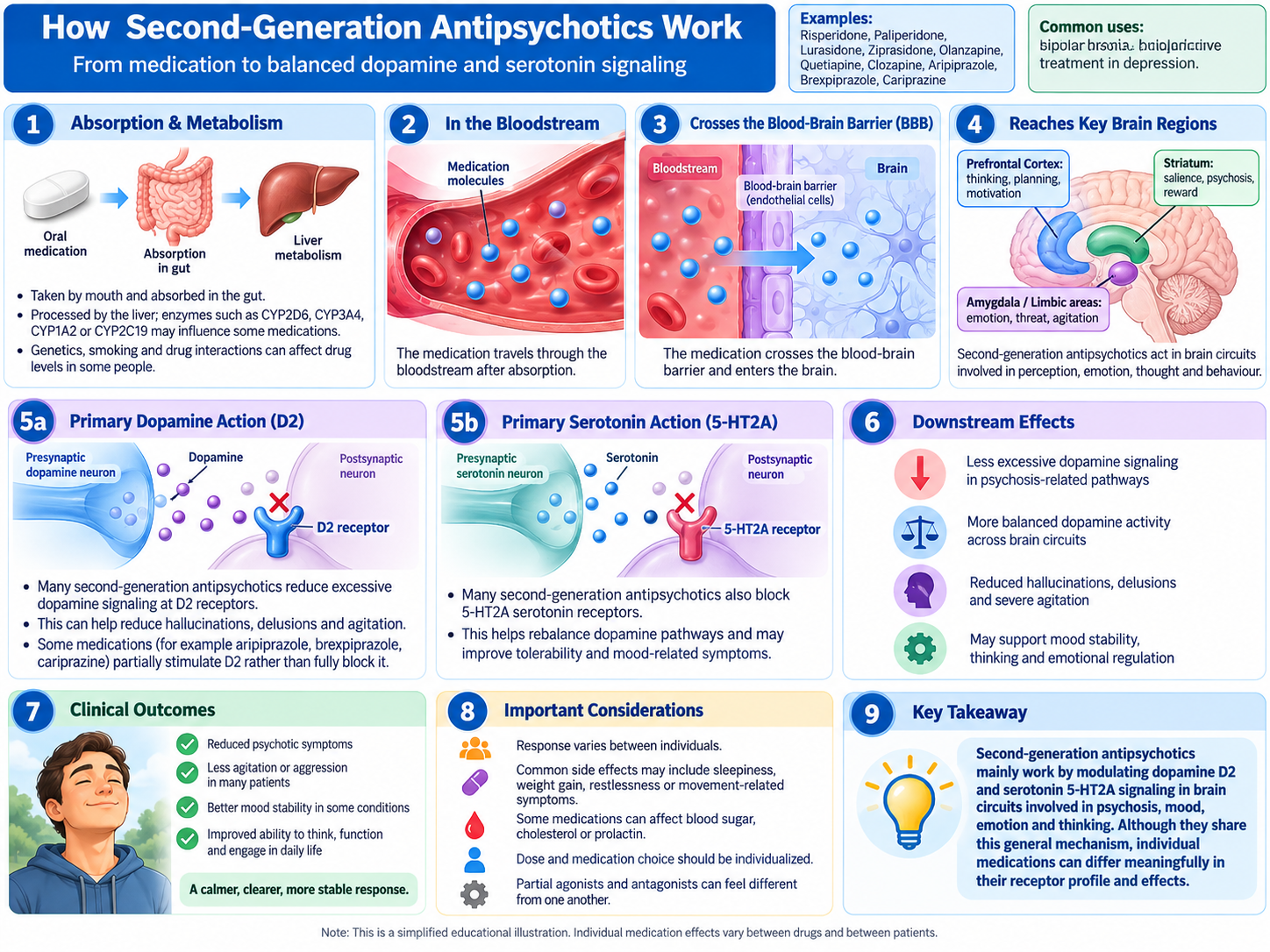
How Does Risperidone Work?
Risperidone has high affinity for:
D2 Dopamine Receptors
and:
5-HT2A Serotonin Receptors
It also binds strongly to:
Alpha-1 adrenergic receptors
and more weakly to:
Alpha-2 adrenergic + H1 histamine receptors.
Its central pathway is:
Risperidone
- D2 receptor blockade
- 5-HT2A receptor blockade
- Dopamine and serotonin signaling change differently across brain pathways
- Psychotic or manic symptoms may improve
Risperidone should not simply be described as:
“Lowering dopamine.”
It reduces D2-mediated dopamine signaling, and the consequences depend strongly on which dopamine pathway is involved.
What Does Risperidone Do to Dopamine?
Dopamine normally binds to D2 receptors.
With risperidone:
- Dopamine released
- Risperidone occupies D2 receptors
- Dopamine has less ability to activate D2
- D2-mediated signaling decreases
In psychosis-related striatal and limbic circuits, reducing excessive D2 signaling can help improve:
- Hallucinations
- Delusions
- Paranoia
- Severe agitation
- Abnormal salience However, D2 receptors also have important functions elsewhere in the brain.
Why Can Risperidone Cause Movement Side Effects?
The: Nigrostriatal Dopamine Pathway helps regulate movement.
If risperidone blocks too much D2 signaling in this pathway:
- D2 blockade
- Motor dopamine signaling decreases
- Possible:
- Akathisia- inner restlessness
- Parkinsonism- slowness, stiffness and tremor
- Dystonia- involuntary muscle contractions These effects are collectively known as:
Extrapyramidal Symptoms — EPS
Canadian clinical trials found that Parkinsonian effects were generally mild but clearly dose related. Higher schizophrenia doses did not necessarily produce greater benefit and were associated with more EPS.
What Is Akathisia?
Akathisia is a particularly important antipsychotic side effect.
Symptoms can include:
- Inner restlessness
- Inability to remain seated
- Pacing
- Repeated leg movement
- Feeling compelled to move Akathisia can sometimes be mistaken for:
Anxiety
or:
Worsening agitation
which matters because increasing D2 blockade in someone with medication-induced akathisia can potentially worsen the problem.
Why Does Risperidone Increase Prolactin?
This is one of risperidone’s most important pharmacodynamic effects.
Dopamine normally inhibits prolactin secretion in the:
Tuberoinfundibular Pathway
Therefore:
- Dopamine → D2 receptor
- Prolactin release suppressed
Risperidone blocks D2:
- Risperidone
- D2 blockade
- Dopamine can no longer suppress prolactin as effectively
- Prolactin increases
Canadian labeling specifically states that prolactin elevation can persist during chronic risperidone administration.
What Symptoms Can High Prolactin Cause?
Persistent hyperprolactinemia may contribute to:
- Reduced libido
- Erectile dysfunction
- Ejaculatory problems
- Menstrual irregularities
- Absent menstrual periods
- Breast enlargement
- Galactorrhea or unexpected milk production
- Fertility problems Long-standing hyperprolactinemia associated with hypogonadism may also contribute to:
Reduced bone mineral density
in both men and women.
For persistent symptoms, measuring:
Serum prolactin
may be clinically appropriate.
What Does Risperidone Do to Serotonin?
Risperidone is potent:
5-HT2A Antagonist
Serotonin helps regulate dopamine release.
Therefore:
- Risperidone
- 5-HT2A blocked
- Serotonin's control over dopamine pathways changes
- Regional dopamine signaling is modified
The combination of:
D2 + 5-HT2A antagonism
is an important reason risperidone is classified as a:
Second-generation antipsychotic
rather than a purely dopamine-focused first-generation antipsychotic.
Does Risperidone Have Anticholinergic Effects?
Risperidone is different from medications such as:
- Olanzapine
- Clozapine
- Quetiapine because it has essentially:
No meaningful muscarinic receptor affinity
at clinically relevant receptor-binding concentrations.
The Canadian monograph therefore states that direct anticholinergic effects are not expected from muscarinic receptor blockade.
This does not mean symptoms such as constipation or dry mouth can never occur, but direct muscarinic antagonism is not a major feature of risperidone pharmacology.
Why Can Risperidone Cause Dizziness When Standing?
Risperidone has high affinity for:
Alpha-1 Adrenergic Receptors
Alpha-1 receptors help blood vessels constrict when a person stands.
Therefore:
- Risperidone
- α1 blockade
- Normal vascular constriction is weakened
- Blood pressure may fall on standing
- Dizziness or faintness
This is:
Orthostatic Hypotension
Canadian trials documented orthostatic hypotension with compensatory increases in heart rate.
Does Risperidone Cause Sleepiness?
It can.
Risperidone has some:
H1 histamine receptor affinity
and also affects CNS dopamine and serotonin pathways.
Possible effects include:
- Somnolence
- Fatigue
- Reduced alertness
- Dizziness However, risperidone is generally not as strongly antihistaminergic or sedating as drugs such as quetiapine or olanzapine. Its H1 affinity is lower than its D2, 5-HT2 and α1 affinity.
What Are the Common Side Effects of Risperidone?
Common or clinically important adverse effects include:
- Akathisia
- Parkinsonism or other EPS
- Sleepiness
- Dizziness
- Headache
- Anxiety or restlessness
- Increased prolactin
- Sexual dysfunction
- Weight gain
- Increased appetite
- Orthostatic hypotension
- Increased heart rate
- Gastrointestinal symptoms In Canadian schizophrenia trials, the most frequently reported adverse reactions included insomnia, agitation, extrapyramidal disorder, anxiety and headache. Parkinsonian effects were dose related.
Does Risperidone Cause Weight Gain?
Yes.
In pooled Canadian schizophrenia trials:
18% of risperidone-treated patients
gained at least:
7% of baseline body weight
compared with:
9% receiving placebo.
Longer-term studies reported an average weight gain of approximately 2.3 kg.
Risperidone generally has a different metabolic profile from olanzapine, but clinically meaningful weight gain can still occur.
Can Risperidone Increase Blood Sugar?
Yes.
Hyperglycemia and diabetes have been reported with risperidone, including rare serious cases involving:
- Diabetic ketoacidosis
- Hyperosmolar coma Canadian labeling recommends monitoring for symptoms of hyperglycemia and periodic glucose assessment in patients at risk.
Symptoms of high glucose may include:
- Excessive thirst
- Frequent urination
- Increased hunger
- Weakness
Can Risperidone Affect Cholesterol and Triglycerides?
Yes.
Dyslipidemia has been observed with atypical antipsychotics, and increased cholesterol and triglycerides have been reported with risperidone.
For longer-term treatment, metabolic monitoring commonly includes:
- Weight or BMI
- Blood pressure
- Glucose or HbA1c
- Lipids according to the patient’s baseline risk and clinical guidelines.
Can Risperidone Cause Tardive Dyskinesia?
Yes.
Tardive Dyskinesia — TD
is a potentially persistent movement disorder caused by long-term exposure to dopamine-receptor-blocking medications.
Symptoms may include involuntary:
-
Lip movements
-
Tongue movements
-
Chewing movements
-
Facial movements
-
Finger or limb movements Risk generally increases with:
-
Longer treatment
-
Greater cumulative exposure
-
Older age
-
Individual susceptibility Canadian labeling recommends using the smallest effective dose and periodically reassessing whether continued treatment is required.
What Is Neuroleptic Malignant Syndrome?
Rarely, risperidone can cause:
Neuroleptic Malignant Syndrome — NMS
Possible symptoms include:
- High fever
- Severe muscle rigidity
- Altered mental status
- Confusion
- Sweating
- Rapid heart rate
- Blood-pressure instability NMS can be life-threatening and requires urgent medical treatment.
Can Risperidone Affect the Heart?
Yes.
Potential cardiovascular effects include:
- Orthostatic hypotension
- Increased heart rate
- Conduction abnormalities
- QT prolongation
- Rare ventricular arrhythmias QT prolongation and serious arrhythmias have been reported, particularly in patients with additional risk factors such as cardiac disease, interacting QT-prolonging medications, overdose or electrolyte abnormalities.
Risperidone should therefore be used cautiously when significant QT risk factors are present.
Can Risperidone Lower White Blood Cells?
Rarely.
Reports include:
- Leukopenia
- Neutropenia
- Agranulocytosis Patients with previous low white blood cell counts or drug-induced neutropenia may require closer monitoring. Unexplained fever or infection during treatment should be evaluated.
Risperidone and Parkinson’s Disease or Lewy Body Dementia
Patients with:
Parkinson’s disease
or:
Dementia with Lewy bodies
can be especially sensitive to dopamine receptor blockade.
Possible increased risks include:
- Severe Parkinsonism
- Confusion
- Reduced consciousness
- Postural instability
- Neuroleptic malignant syndrome Canadian labeling specifically advises weighing risks and benefits carefully in these populations.
Risperidone and Pregnancy
Antipsychotic treatment during pregnancy requires individualized benefit-risk assessment.
Exposure during the third trimester has been associated with neonatal:
- Tremor
- Abnormal muscle tone
- Agitation
- Sleepiness
- Respiratory difficulty
- Feeding problems
- Withdrawal-like or extrapyramidal symptoms Canadian labeling advises using risperidone during pregnancy only when expected benefits justify the potential risks.
A patient should not abruptly stop antipsychotic treatment after discovering a pregnancy without discussing it with the treating clinician, because relapse of psychosis or bipolar disorder can itself carry substantial risk.
Risperidone and Breastfeeding
Both:
Risperidone
and:
9-hydroxyrisperidone / paliperidone
can enter human breast milk.
The current Canadian product monograph advises against breastfeeding while receiving risperidone.
Individual decisions should be discussed with the prescribing and maternal-health team.
Risperidone Drug Interactions
Risperidone has several clinically important interactions.
Fluoxetine
Fluoxetine strongly inhibits: CYP2D6
Risperidone is substantially metabolized by CYP2D6.
Therefore:
- Fluoxetine
- CYP2D6 inhibited
- Risperidone → paliperidone conversion slows
- Parent risperidone concentration increases
In a Canadian interaction study, fluoxetine increased risperidone peak exposure by approximately 2- to 3-fold, while the combined active fraction of risperidone plus 9-hydroxyrisperidone increased by about 50%.
Dose reassessment may therefore be appropriate when fluoxetine is started or stopped.
Paroxetine
Paroxetine is also strong: CYP2D6 inhibitor
and can increase risperidone exposure.
In one interaction study, the combined concentration of risperidone plus 9-hydroxyrisperidone increased approximately:
45%
after four weeks of paroxetine treatment.
This is an important example of:
Phenoconversion
where a genetically normal CYP2D6 metabolizer can function more like a slower metabolizer because another medication inhibits CYP2D6.
Bupropion and Other CYP2D6 Inhibitors
Other strong CYP2D6 inhibitors, including: Bupropion can also reduce functional CYP2D6 activity.
The exact effect depends on:
- Inhibitor strength
- Dose
- CYP2D6 genotype
- Risperidone dose
- Renal function Therefore, a PGx interpretation should assess:
Genotype + interacting medications
rather than genotype alone.
Carbamazepine
Carbamazepine is strong: CYP3A4 inducer and: P-glycoprotein inducer
It substantially reduces concentrations of both risperidone and its active metabolite.
Therefore:
- Carbamazepine
- Risperidone clearance increases
- Active antipsychotic exposure decreases
- Potential:
Reduced treatment effectiveness
Stopping carbamazepine can then cause risperidone exposure to rise again.
Rifampin
Rifampin is another strong CYP3A4 and P-glycoprotein inducer.
It can reduce the combined:
Risperidone + paliperidone active fraction.
Itraconazole and Strong CYP3A4 Inhibitors
Itraconazole can increase risperidone exposure.
In Canadian interaction data, itraconazole increased concentrations of the combined active antipsychotic fraction by approximately:
70%.
Strong CYP3A4/P-gp inhibitors therefore warrant medication review.
Levodopa and Dopamine Agonists
Risperidone blocks dopamine receptors.
Levodopa and dopamine agonists attempt to increase dopamine signaling.
Therefore:
Risperidone may oppose their therapeutic effects.
Canadian labeling specifically warns that risperidone can antagonize levodopa and dopamine agonists.
Blood-Pressure Medications
Because risperidone blocks α1 receptors, it can increase the hypotensive effects of antihypertensive medications.
Clinically significant hypotension has been reported with these combinations.
Alcohol and Other CNS-Depressant Drugs
Risperidone acts on the central nervous system.
Combining it with:
-
Alcohol
-
Benzodiazepines
-
Opioids
-
Sedating antihistamines
-
Other sedating psychiatric medications may increase:
-
Sleepiness
-
Dizziness
-
Impaired coordination
-
Falls Canadian labeling recommends caution with alcohol and other centrally acting drugs.
Methylphenidate and Other Psychostimulants
Risperidone is sometimes used in patients who are also receiving stimulant medication.
Canadian labeling warns that extrapyramidal symptoms can emerge when:
- Risperidone
- Methylphenidate or another psychostimulant is started, stopped or adjusted.
Gradual adjustment may be appropriate when changing either medication.
Risperidone Dosage for Schizophrenia
For adults, current Canadian oral labeling generally begins with:
1–2 mg/day
given once daily or divided into two doses.
The dose is then increased gradually toward a typical target of:
4–6 mg/day
depending on clinical response and tolerability.
Canadian clinical trials found therapeutic effects in the 4–8 mg/day range, but doses above 10 mg/day were not more effective and caused more EPS and other adverse effects. Safety above 16 mg/day was not established.
These are product-label ranges, not individualized dosing instructions.
Risperidone Dosage for Bipolar Mania
The Canadian adult starting dose is:
2–3 mg once daily
Dose adjustments can be made according to clinical response and tolerability.
Doses above:
6 mg/day
were not studied in the acute bipolar trials, and the most commonly used doses in controlled studies were approximately:
1–4 mg/day.
Risperidone Dosage for Severe Alzheimer’s Dementia
The Canadian product-label starting dose is:
0.25 mg twice daily
with cautious adjustment.
For most patients, the optimal labeled dose is:
0.5 mg twice daily — 1 mg/day
with a maximum of:
1 mg twice daily — 2 mg/day.
This is intended for the narrow short-term indication involving severe Alzheimer’s dementia with aggression or psychotic symptoms and risk of harm.
Risperidone and Kidney Function
Kidney function is particularly important because the active fraction, including:
Paliperidone
is substantially eliminated through the kidneys.
In moderate-to-severe renal impairment, clearance of risperidone plus its active metabolite decreased by approximately:
60%
in pharmacokinetic studies.
The Canadian monograph therefore recommends:
- Lower starting doses
- Slower titration
- Lower subsequent doses in renal impairment.
This makes:
Kidney functions an important component of personalized risperidone prescribing.
Risperidone and Liver Function
Risperidone is extensively metabolized in the liver.
Hepatic impairment can increase the:
Unbound fraction of risperidone
and potentially increase its pharmacological effects.
Canadian labeling recommends:
- Lower starting doses
- Slower titration in liver impairment.
Can Risperidone Be Taken with Food?
Yes.
Food does not meaningfully alter the overall absorption of oral risperidone.
It can therefore generally be taken:
With or without food.
How Long Does Risperidone Stay in the Body?
The pharmacokinetics are unusual because both:
Risperidone
and:
9-hydroxyrisperidone / paliperidone
are active.
The combined active antipsychotic fraction has an elimination half-life of approximately:
20–24 hours
in typical subjects.
Steady-state concentrations are reached more quickly for parent risperidone, while 9-hydroxyrisperidone generally requires several days.
This supports once- or twice-daily oral dosing depending on the patient.
Does Risperidone Need to Be Tapered?
There is no single Canadian product-label taper schedule that applies to every patient.
Abrupt discontinuation may result in:
- Return of psychosis
- Return of mania
- Sleep disturbance
- Agitation
- Withdrawal-like symptoms and withdrawal syndrome has been reported with risperidone/paliperidone products.
When stopping is clinically appropriate, dose reduction is generally individualized according to:
- Diagnosis
- Current dose
- Duration of treatment
- Previous relapse history
- Other medications
- Reason for discontinuation Patients treated for schizophrenia or bipolar disorder should not stop risperidone simply because they feel better without discussing it with their treating clinician.
Frequently Asked Questions About Risperidone
Is Risperidone the Same as Risperdal?
Yes.
Risperdal is the original best-known brand name.
The original oral Risperdal products are no longer marketed in Canada, but multiple generic oral risperidone products remain available. Risperdal Consta, the long-acting injectable formulation, remains marketed.
Is Risperidone an Antipsychotic?
Yes.
It is classified as a:
Second-generation or atypical antipsychotic.
Does Risperidone Block Dopamine?
Yes.
It primarily blocks:
D2 dopamine receptors
rather than removing dopamine from the brain.
Does Risperidone Block Serotonin?
It strongly blocks:
5-HT2A serotonin receptors
which modifies serotonin’s regulation of dopamine pathways.
Does Risperidone Increase Prolactin?
Yes.
Persistent prolactin elevation is a well-established risperidone effect caused mainly by D2 blockade in the tuberoinfundibular pathway.
Does Risperidone Cause Weight Gain?
It can.
In pooled schizophrenia trials, 18% of risperidone-treated patients gained at least 7% of baseline body weight, compared with 9% receiving placebo.
Does Risperidone Cause Diabetes?
It can increase blood glucose and has been associated with new or worsened diabetes in susceptible patients.
Does Risperidone Cause Movement Problems?
It can.
D2 blockade may cause:
- Akathisia
- Parkinsonism
- Tremor
- Dystonia and these effects become more likely with excessive D2 blockade or higher exposure.
Does Risperidone Make You Sleepy?
It can, although risperidone is generally less strongly sedating than quetiapine or olanzapine.
Does Risperidone Cause Sexual Side Effects?
It can.
Sexual dysfunction may occur through:
- Prolactin elevation
- Dopamine blockade
- Other neuroendocrine effects Possible symptoms include reduced libido, erectile dysfunction and ejaculatory problems.
Is Risperidone Used for Bipolar Disorder?
Yes.
In Canada it is approved as monotherapy for:
Acute manic episodes associated with Bipolar I disorder.
Is Risperidone Used for Bipolar Depression?
It is not an approved treatment for bipolar depression in the current Canadian oral risperidone monograph.
Its Canadian bipolar indication is:
Acute mania.
Is Risperidone Used for Autism in Canada?
The current Canadian oral product monograph does not authorize pediatric use and does not list autism as an approved indication.
- What Is the Active Metabolite of Risperidone?
Paliperidone — 9-hydroxyrisperidone
which is itself an active antipsychotic.
Which Enzyme Metabolizes Risperidone?
Primarily:
CYP2D6
with a smaller contribution from:
CYP3A4.
Does CYP2D6 Poor Metabolizer Status Matter?
Yes.
DPWG recommends using:
67% of the usual risperidone dose
for CYP2D6 Poor Metabolizers, with a further reduction to about 50% if CNS adverse effects remain problematic.
What About CYP2D6 Intermediate Metabolizers?
Current DPWG guidance does:
Not require a routine dose adjustment
for Intermediate Metabolizers.
What About CYP2D6 Ultrarapid Metabolizers?
DPWG recommends considering:
An alternative medication
or carefully titrating risperidone because inadequate clinical response may occur.
Does CYP2C19 Matter for Risperidone?
CYP2C19 is not a major established risperidone metabolic pathway.
The principal actionable pharmacogenomic gene is:
CYP2D6.
Can DRD2 Predict Whether Risperidone Will Work?
Not reliably enough for routine prescribing.
DRD2 is the direct D2 receptor target of risperidone, but no validated DRD2 genotype-based prescribing guideline currently exists.
References
- [https://health-products.canada.ca/dpd-bdpp/search-fast-recherche-rapide?lang=eng&no=0124332003&no=0124332003)
- [https://health-products.canada.ca/dpd-bdpp/info?code=106613&lang=eng&lang=eng)
- https://pdf.hres.ca/dpd_pm/00066052.PDF
- [https://pmc.ncbi.nlm.nih.gov/articles/PMC10923774/)
- [https://cpicpgx.org/gene/CYP2D6/)
This article is educational. It does not diagnose, and it does not replace advice from your prescriber or pharmacist. Never start, stop or change a medication based on a web page.