
Medication profile
Brexpiprazole (Rexulti is the brand name used in Canada and the United States. In the European Union)
Brexpiprazole is an atypical antipsychotic medication used to treat schizophrenia and, at lower doses, as an add-on treatment for major depressive disorder wh
 Written by Sanjida Ahmed, PhD, Cellular and Molecular BiologyChief Operating Officer and Lead Scientist, Personalized Prescribing. Last reviewed October 2, 2026.
- Brand Name
- Rexulti is the brand name used in Canada and the United States. In the European Union, brexpiprazole is marketed as Rxulti. Rexulti is currently marketed in Canada in 0.25 mg, 0.5 mg, 1 mg, 2 mg, 3 mg and 4 mg tablets.
- Class
- Atypical antipsychotic
On this page
- What You Need to Know
- What Is Brexpiprazole Used For?
- What Are the Common Side Effects of Brexpiprazole?
- Weight Gain
- Drug Interactions
- Tapering and Stopping Brexpiprazole
- Brexpiprazole and Pharmacogenomic Testing
- What Happens in a CYP2D6 Poor Metabolizer?
- What If a CYP2D6 Poor Metabolizer Also Takes a CYP3A4 Inhibitor?
- Frequently Asked Questions
What You Need to Know
Brexpiprazole is an atypical antipsychotic medication used to treat schizophrenia and, at lower doses, as an add-on treatment for major depressive disorder when an antidepressant alone has not provided enough benefit.
In Canada, brexpiprazole is also approved for the symptomatic management of agitation associated with Alzheimer’s dementia in patients with aggressive behaviour that has not responded adequately to non-medication approaches.
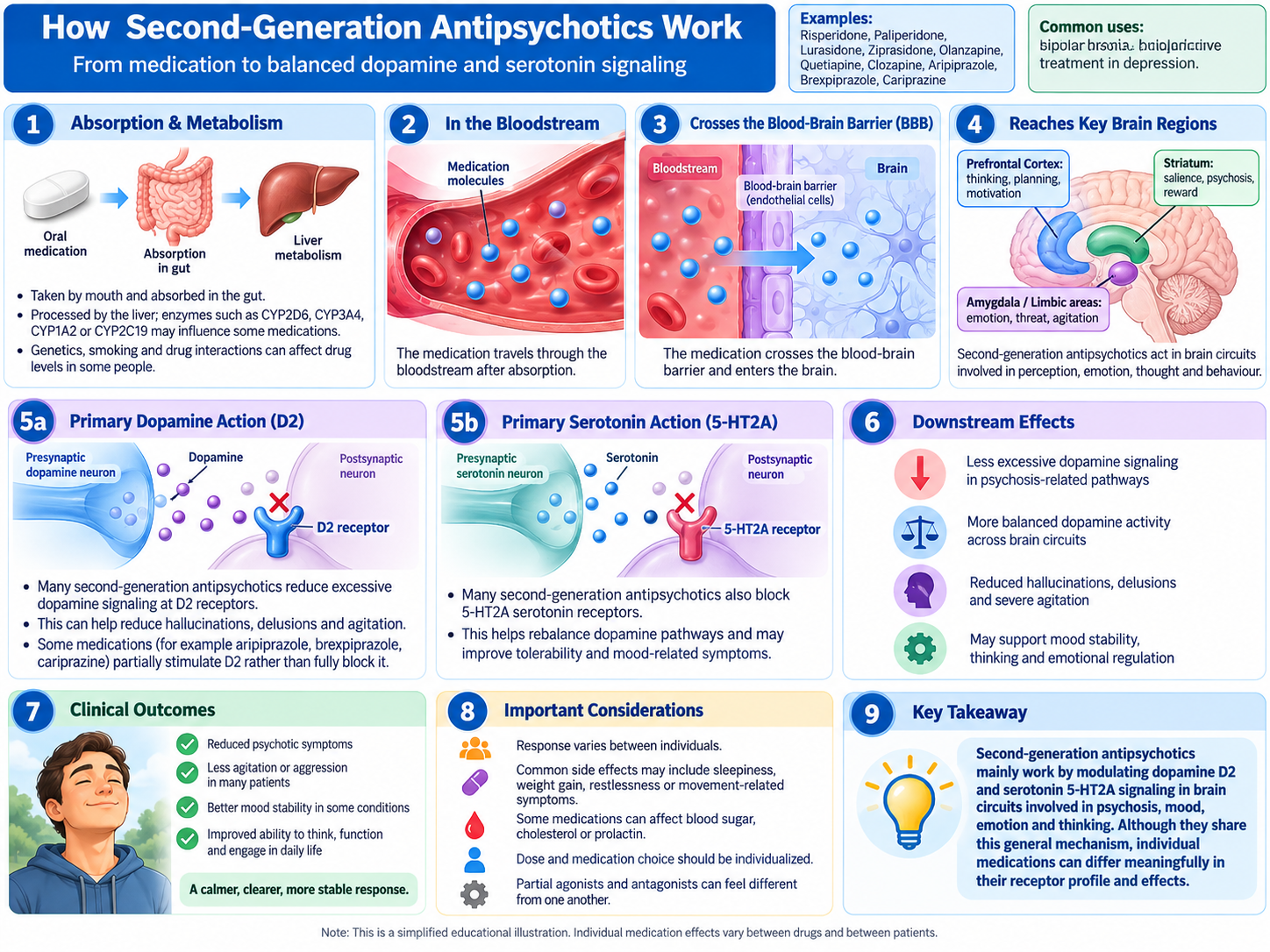
Brexpiprazole works mainly by modifying the activity of two important neurotransmitter systems:
- Dopamine
- Serotonin It acts as a partial agonist at dopamine D2 receptors and serotonin 5-HT1A receptors, and as an antagonist at serotonin 5-HT2A receptors.
Because it partially stimulates rather than simply blocks dopamine D2 receptors, brexpiprazole is sometimes described as a dopamine-serotonin modulator.
Brexpiprazole is metabolized mainly by:
- CYP2D6
- CYP3A4 This is important because genetics and drug interactions can significantly alter the amount of brexpiprazole in the body.
What Is Brexpiprazole Used For?
In Canada, Rexulti is approved for:
- Schizophrenia in adults
- Major depressive disorder (MDD) as an add-on to an antidepressant when previous antidepressant treatment has provided an inadequate response
- Agitation associated with Alzheimer’s dementia, particularly aggressive behaviour that has not responded adequately to non-drug approaches Brexpiprazole is not an antidepressant by itself in its approved MDD indication. It is used together with an antidepressant to enhance treatment response.
For Alzheimer’s-related agitation, it is not intended to be taken only when needed. Treatment is given regularly, and the Canadian monograph notes that significant benefit may take six to eight weeks to become apparent.
What Are the Common Side Effects of Brexpiprazole?
Common side effects can include:
- Weight gain
- Akathisia or restlessness
- Sleepiness
- Headache
- Insomnia
- Tremor
- Dizziness
- Fatigue
- Increased appetite
- Constipation Across adult clinical trials, weight gain, akathisia, headache, sleepiness and insomnia were among the more frequently reported adverse effects.
When brexpiprazole is added to an antidepressant for depression, two particularly important side effects are:
Akathisia
Akathisia is an uncomfortable internal feeling of restlessness.
A person may experience:
- Difficulty sitting still
- Constant leg movement
- Pacing
- An urge to keep moving
- Physical agitation In MDD clinical trials, akathisia occurred more frequently with brexpiprazole than placebo and became more common at higher doses.
Weight Gain
Weight gain can occur during both short- and long-term treatment.
Weight should therefore be monitored during treatment, together with blood sugar and lipid levels.
Brexpiprazole and other atypical antipsychotics can cause changes involving:
-
Body weight
-
Blood glucose
-
Cholesterol
-
Triglycerides The Canadian product monograph recommends baseline and periodic monitoring of body weight, blood glucose and fasting lipids.
-
Tardive Dyskinesia Long-term treatment with antipsychotic medications can sometimes cause tardive dyskinesia.
This can involve involuntary movements such as:
- Lip smacking
- Tongue movements
- Facial movements
- Repetitive mouth movements
- Uncontrolled movements of the arms, legs or body Tardive dyskinesia can sometimes persist even after treatment is stopped, so new involuntary movements should be reported promptly.
Neuroleptic Malignant Syndrome
A rare but potentially life-threatening reaction called neuroleptic malignant syndrome (NMS) can occur with antipsychotics.
Symptoms can include:
-
High fever
-
Severe muscle stiffness
-
Confusion
-
Altered consciousness
-
Rapid heart rate
-
Blood-pressure instability
-
Heavy sweating These symptoms require urgent medical attention.
-
Compulsive Behaviours Brexpiprazole has been associated with unusual or difficult-to-control urges, including:
-
Gambling
-
Compulsive shopping
-
Binge eating
-
Compulsive sexual behaviour
-
Other impulsive behaviours A new or unusually intense urge should be discussed with the prescribing healthcare professional. Dose reduction or discontinuation may sometimes be considered.
Dizziness and Falls
Brexpiprazole can sometimes cause:
- Dizziness
- Sleepiness
- Reduced blood pressure when standing
- Impaired coordination These effects may increase the risk of falls, particularly in older adults.
Brexpiprazole and Alzheimer’s Dementia
This requires special consideration.
Antipsychotic medications are associated with an increased risk of death in elderly patients with dementia.
Brexpiprazole is nevertheless approved in Canada for carefully selected patients with agitation associated with Alzheimer’s dementia, particularly aggressive behaviour that has not responded to non-pharmacological approaches.
The healthcare professional should weigh potential benefit against risks, including cardiovascular events, stroke and mortality.
Drug Interactions
Brexpiprazole is primarily metabolized by:
CYP2D6 + CYP3A4
Medications that inhibit or increase the activity of these enzymes can substantially change brexpiprazole exposure.
Fluoxetine — Strong CYP2D6 Inhibitor
Fluoxetine can strongly inhibit CYP2D6.
Therefore:
- Fluoxetine
- CYP2D6 activity decreases
- Brexpiprazole metabolism slows
- Brexpiprazole exposure may increase
Dose adjustment may be required depending on the indication and other medications.
There is an important exception for adjunctive treatment of major depressive disorder: Canadian and U.S. labeling notes that the standard MDD dosing recommendations were developed in trials in which CYP2D6 inhibitors such as fluoxetine and paroxetine were permitted, so this effect is already partly incorporated into the MDD dosing recommendations.
Paroxetine — Strong CYP2D6 Inhibitor
Paroxetine also strongly inhibits CYP2D6 and can increase brexpiprazole exposure.
Outside the specific MDD-label exception described above, use with a strong CYP2D6 inhibitor generally calls for: Approximately half the usual brexpiprazole dose.
Bupropion — CYP2D6 Inhibitor
Bupropion can substantially inhibit CYP2D6.
Therefore:
- Brexpiprazole + bupropion
- Reduced CYP2D6 activity
- Slower brexpiprazole metabolism
- Potentially higher brexpiprazole exposure
This interaction can become particularly important when a person also has genetically reduced CYP2D6 activity.
Strong CYP3A4 Inhibitors
Examples include:
- Ketoconazole
- Itraconazole
- Clarithromycin Strong CYP3A4 inhibition reduces another major pathway responsible for brexpiprazole metabolism.
The Canadian monograph recommends approximately: Half the usual brexpiprazole dose
when a strong CYP3A4 inhibitor is being used.
Ketoconazole, for example, nearly doubled brexpiprazole exposure in an interaction study.
CYP2D6 and CYP3A4 Inhibitors Together
If both pathways are inhibited simultaneously, brexpiprazole exposure can increase substantially.
For patients receiving both:
- Strong/moderate CYP2D6 inhibition
- Strong/moderate CYP3A4 inhibition the Canadian monograph recommends approximately: One-quarter of the usual brexpiprazole dose.
Strong CYP3A4 Inducers
Examples include:
- Carbamazepine
- Rifampin
- Phenytoin These medications increase CYP3A4 activity.
Therefore:
- CYP3A4 induction
- Brexpiprazole is metabolized more rapidly
- Brexpiprazole exposure decreases
- Treatment may become less effective
The Canadian monograph recommends gradually increasing brexpiprazole to approximately twice the usual dose over one to two weeks when used with a strong CYP3A4 inducer. This adjustment should only be performed by the prescribing healthcare professional.
Dosage
Brexpiprazole is generally taken:
Once daily, with or without food.
Canadian dosing differs depending on the condition being treated.
| Condition | Starting dose | Target dose | Canadian maximum |
|---|---|---|---|
| Schizophrenia | 1 mg/day | 2–4 mg/day | 4 mg/day |
| Major depression — adjunct | 0.5–1 mg/day | 2 mg/day | 2 mg/day |
| Alzheimer’s-related agitation | 0.5 mg/day | 2 mg/day | 3 mg/day |
Brexpiprazole Dosage for Depression
When used together with an antidepressant for major depressive disorder:
- Start: 0.5 mg or 1 mg once daily
- Increase to 1 mg/day
- Target: 2 mg/day
Dose increases are generally made at approximately weekly intervals, depending on response and tolerability.
The Canadian maximum recommended dose for adjunctive MDD is:
2 mg/day
The Canadian monograph notes that doses above 2 mg/day did not demonstrate additional benefit in the evaluated MDD studies.
Brexpiprazole Dosage for Schizophrenia
For adults:
- Days 1–4: 1 mg/day
- Days 5–7: 2 mg/day
- If clinically appropriate:
2–4 mg/day
The maximum Canadian recommended dose is:
4 mg/day.
Brexpiprazole Dosage for Agitation Associated With Alzheimer’s Dementia
Canadian dosing is:
- Days 1–7: 0.5 mg/day
- Days 8–14: 1 mg/day
- Day 15 onward: 2 mg/day
The recommended target dose is:
2 mg/day
After at least 14 days at 2 mg/day, the dose can be increased to:
3 mg/day
if clinically warranted.
Tapering and Stopping Brexpiprazole
Brexpiprazole is unusual because it has a very long elimination half-life—approximately 91 hours.
The Canadian Rexulti product monograph states that no specific dose-reduction procedure is required when treatment is discontinued.
This means it does not have a mandatory tapering schedule similar to some antidepressants.
However: Brexpiprazole should not simply be stopped without discussing it with the prescribing healthcare professional.
Stopping treatment can allow the underlying condition to return, including:
- Depression
- Psychotic symptoms
- Agitation
- Behavioural symptoms The long half-life means brexpiprazole leaves the body gradually even after the final dose.
In some patients—particularly those who have taken antipsychotic treatment for a long period—a clinician may still choose a gradual dose reduction to monitor for symptom recurrence and make the transition easier.
There is therefore no universal schedule such as:
4 mg → 2 mg → 1 mg → stop
that should be applied to every patient.
The approach should depend on the diagnosis, dose, duration of treatment, other medications and risk of relapse.
Brexpiprazole and Pharmacogenomic Testing
Brexpiprazole is particularly relevant to pharmacogenomic testing because one of its two major metabolic enzymes is:
CYP2D6
Genetic differences in CYP2D6 can cause people to metabolize brexpiprazole at different rates.
The basic pathway is:
- Brexpiprazole
- CYP2D6 + CYP3A4
- Inactive metabolites
- Elimination
DPWG specifically classifies CYP2D6–brexpiprazole as an actionable pharmacogenomic relationship.
What Happens in a CYP2D6 Poor Metabolizer?
A CYP2D6 Poor Metabolizer has little or no functional CYP2D6 enzyme activity.
Therefore:
- Reduced CYP2D6 metabolism
- Brexpiprazole is cleared more slowly
- Brexpiprazole concentration increases
- Potentially greater risk of concentration-related side effects
Canadian pharmacokinetic analysis found approximately 47% greater brexpiprazole exposure in CYP2D6 Poor Metabolizers compared with normal/extensive metabolizers.
For known CYP2D6 Poor Metabolizers, the Canadian product monograph recommends:
Half the usual brexpiprazole dose.
The Dutch Pharmacogenetics Working Group independently gives the same recommendation.
What If a CYP2D6 Poor Metabolizer Also Takes a CYP3A4 Inhibitor?
This is especially important.
If CYP2D6 is genetically very low and CYP3A4 is inhibited:
- CYP2D6 Poor Metabolizer
- CYP3A4 inhibitor
- Both major metabolic pathways are reduced
- Brexpiprazole exposure can increase substantially
The Canadian monograph recommends approximately: One-quarter of the usual dose
for a CYP2D6 Poor Metabolizer who is also taking a strong or moderate CYP3A4 inhibitor.
Frequently Asked Questions
Is Brexpiprazole the Same as Rexulti?
Yes.
Rexulti is the Canadian and U.S. brand name for brexpiprazole.
In Europe, it is marketed as Rxulti.
Is Brexpiprazole an Antipsychotic?
Yes.
Brexpiprazole is an atypical antipsychotic used for schizophrenia and other approved psychiatric indications.
Is Brexpiprazole Used for Depression?
Yes.
Brexpiprazole can be used as an add-on to an antidepressant when major depressive disorder has not responded adequately to antidepressant treatment alone.
It is not approved in Canada as stand-alone treatment for depression.
How Does Brexpiprazole Affect Dopamine?
Brexpiprazole is a partial agonist at dopamine D2 receptors.
This means it activates the receptor less strongly than dopamine itself.
Its effect can therefore help moderate dopamine signaling rather than simply shutting it down.
Does Brexpiprazole Affect Serotonin?
Yes.
Brexpiprazole acts as a:
- 5-HT1A partial agonist
- 5-HT2A antagonist These effects contribute to changes in serotonin and dopamine signaling within the brain.
Does Brexpiprazole Cause Weight Gain?
It can. Weight gain is one of the better-recognized side effects of brexpiprazole, particularly with longer-term treatment.
Weight, glucose and blood lipids should therefore be monitored.
Does Brexpiprazole Cause Akathisia?
Yes. Akathisia—an uncomfortable internal restlessness—is one of the more characteristic side effects, particularly when brexpiprazole is used as an add-on treatment for depression.
Does Brexpiprazole Make You Sleepy?
It can. Some patients experience sleepiness or sedation, while others may experience insomnia or restlessness.
Can Brexpiprazole Cause Compulsive Gambling?
Rarely, yes. Brexpiprazole has been associated with unusual compulsive urges involving gambling, shopping, eating and sexual behaviour.
How Long Does Brexpiprazole Take to Work?
The timing depends on the condition being treated.
Some changes may occur during the first few weeks, while improvement in schizophrenia or depression can develop gradually.
For agitation associated with Alzheimer’s dementia, the Canadian monograph notes that significant clinical benefit may take six to eight weeks.
Can Fluoxetine Affect Brexpiprazole?
Yes. Fluoxetine strongly inhibits CYP2D6, one of the main enzymes responsible for brexpiprazole metabolism.
This can increase brexpiprazole exposure.
Can Bupropion Affect Brexpiprazole?
Yes. Bupropion inhibits CYP2D6 and can potentially increase brexpiprazole concentrations.
This interaction can be particularly important in someone who already has reduced CYP2D6 activity.
Which Liver Enzymes Metabolize Brexpiprazole?
The two most important are:
- CYP2D6
- CYP3A4
Can Genetics Affect Brexpiprazole Side Effects?
Yes. CYP2D6 Poor Metabolizers have higher brexpiprazole exposure, which can potentially increase concentration-related adverse effects.
Both the Canadian product monograph and DPWG recommend a lower dose for CYP2D6 Poor Metabolizers.
Does a CYP2D6 Normal Metabolizer Result Mean Brexpiprazole Will Work?
No. CYP2D6 primarily tells us something about drug metabolism and exposure.
It does not tell us whether dopamine and serotonin receptors in the brain will respond optimally.
A person can metabolize brexpiprazole normally and still experience:
- Inadequate benefit
- Akathisia
- Weight gain
- Other side effects Medication response involves both pharmacokinetics and pharmacodynamics.
Should I Change My Brexpiprazole Dose Based on My Genetic Result?
No patient should change their own dose.
A CYP2D6 result should be interpreted by a healthcare professional together with:
- Diagnosis
- Current dose
- Other medications
- CYP3A4 interactions
- Side effects
- Previous treatment response
- Kidney and liver function
Does Brexpiprazole Need to Be Tapered?
The Canadian product monograph states that no specific dose-reduction procedure is required at the end of treatment.
However, stopping an antipsychotic should still generally be discussed with the treating healthcare professional because symptoms of the underlying condition may return. Brexpiprazole’s long half-life of approximately 91 hours means it leaves the body gradually.
Can Pharmacogenomic Testing Tell Me Whether Brexpiprazole Will Work?
Not with certainty.
Pharmacogenomic testing can provide clinically useful information about CYP2D6 metabolism and brexpiprazole exposure, but effectiveness also depends on:
- Dopamine signaling
- Serotonin signaling
- Receptor biology
- Diagnosis
- Symptoms
- Dose
- Other medications
- Drug interactions
- Previous treatment response
- Individual brain biology PGx testing should therefore be used as one component of personalized medication selection rather than a stand-alone answer.
Why Pharmacogenomic Testing May Matter
Brexpiprazole provides a good example of an established psychiatric pharmacogenomic relationship:
- CYP2D6 genetics
- CYP2D6 enzyme activity
- Brexpiprazole metabolism
- Drug exposure
- Potential effectiveness and side-effect risk
A person who is a:
CYP2D6 Poor Metabolizer
may have:
- Slower metabolism
- Higher brexpiprazole exposure
- Greater potential for concentration-related adverse effects
This relationship is strong enough that both the Canadian prescribing information and DPWG recommend approximately 50% of the usual dose for CYP2D6 Poor Metabolizers.
At the same time, metabolism is only the first part of treatment response.
PK asks:
Does an appropriate amount of brexpiprazole reach the brain?
PD asks:
Do the dopamine and serotonin systems respond appropriately when it gets there?
Both can influence the eventual clinical outcome.
References
This article is educational. It does not diagnose, and it does not replace advice from your prescriber or pharmacist. Never start, stop or change a medication based on a web page.