
Medication profile
Levomilnacipran (Fetzima)
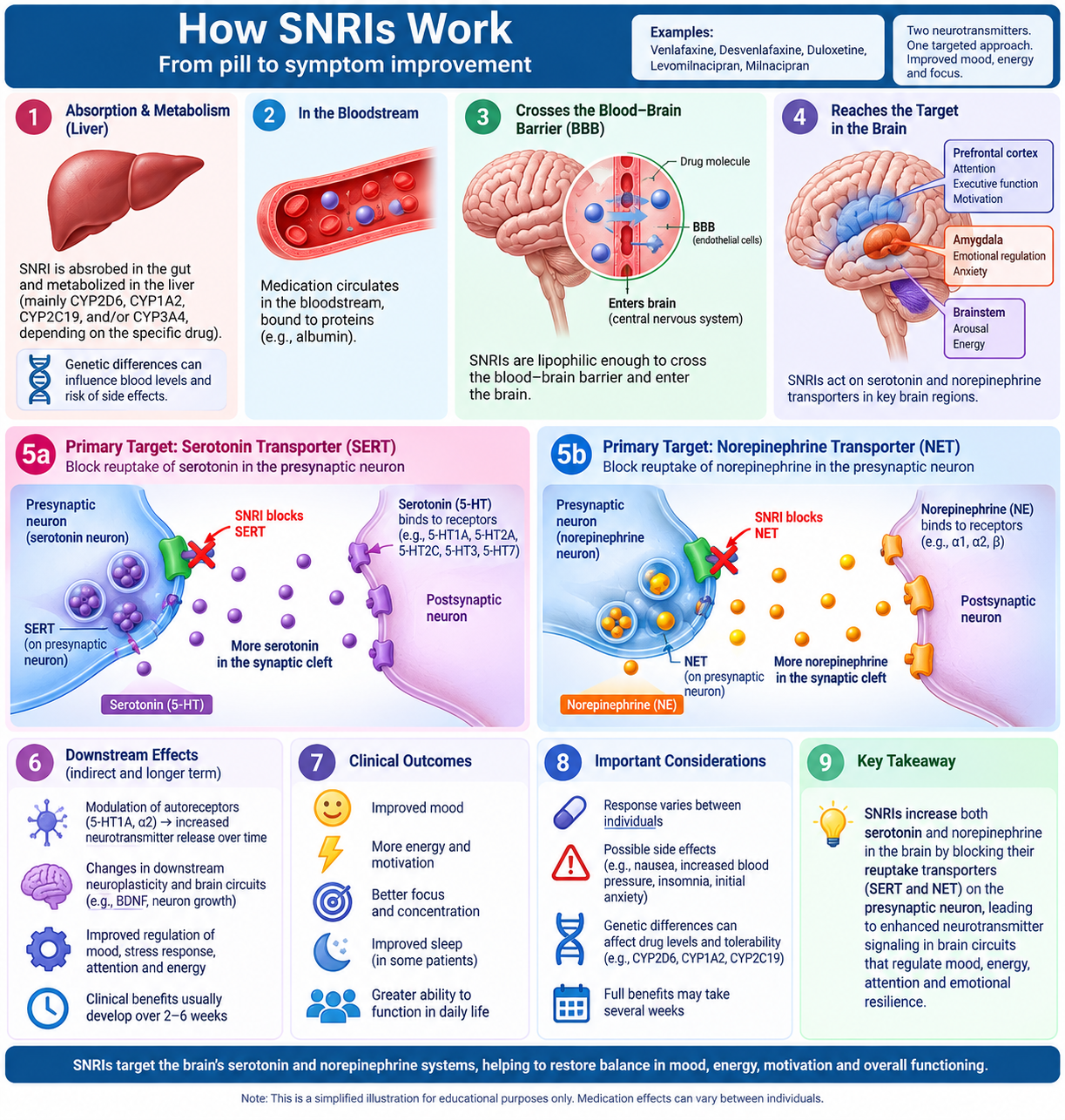
Levomilnacipran works by blocking two transporter proteins: NET — Norepinephrine Transporter and: SERT — Serotonin Transporter
 Written by Sanjida Ahmed, PhD, Cellular and Molecular BiologyChief Operating Officer and Lead Scientist, Personalized Prescribing. Last reviewed October 2, 2026.
- Best-known brand name
- Fetzima
- Class
- SNRI (serotonin-norepinephrine reuptake inhibitor)
On this page
- What You Need to Know About Levomilnacipran
- What Is Levomilnacipran Used For?
- Is Levomilnacipran More Noradrenergic Than Other SNRIs?
- Norepinephrine-forward SNRI
- What Does Norepinephrine Do?
- What Does Serotonin Do?
- What Are the Common Side Effects of Levomilnacipran?
- Can Levomilnacipran Increase Blood Pressure?
- Systolic blood pressure by about 3 mmHg
- Diastolic blood pressure by about 3.2 mmHg
- Before treatment
- Can Levomilnacipran Increase Heart Rate?
- Important Canadian Cardiovascular Restrictions
- Can Levomilnacipran Cause Urinary Problems?
- Urethral resistance
- Can Levomilnacipran Cause Sexual Side Effects?
- Serotonin Syndrome
- Which Drugs Increase the Risk of Serotonin Syndrome?
- Monoamine Oxidase Inhibitors — MAOIs
- At least 14 days should pass after stopping an MAOI before starting Fetzima
- SIADH — Syndrome of Inappropriate Antidiuretic Hormone Secretion
- Acute angle-closure glaucoma
- Mania or hypomania
- Levomilnacipran Drug Interactions
- Levomilnacipran Cmax by 39%
- Serotonin syndrome
- Levomilnacipran Dosage
- 40–120 mg once daily
- 20 mg once daily for 2 days
- 40 mg increments
- Possible additional individual benefit
- How Should Fetzima Be Taken?
- Extended-release capsule
- Swallowed whole
- Can Levomilnacipran Be Taken in the Morning or at Night?
- Once daily
- Levomilnacipran and Kidney Function
- Levomilnacipran and Liver Function
- Renal elimination
- How Long Does Levomilnacipran Stay in the Body?
- 12 hours
- 6–8 hours
- Does Levomilnacipran Need to Be Tapered?
- Why Does Levomilnacipran Cause Withdrawal Symptoms?
- Frequently Asked Questions
- SNRI antidepressant
- SERT + NET
- Major depressive disorder
- 1S,2R enantiomer of milnacipran
- Can Levomilnacipran Be Taken with Food?
- With or without food
- Swallowed whole
- Pharmacokinetics — PK
- Pharmacodynamic — PD response
- Can Pharmacogenomic Testing Tell Whether Levomilnacipran Will Work?
Levomilnacipran is a serotonin-norepinephrine reuptake inhibitor (SNRI) used to treat major depressive disorder (MDD) in adults.
In Canada, Fetzima remains marketed as an extended-release capsule in 20 mg, 40 mg, 80 mg and 120 mg strengths. Health Canada also approved APO-Levomilnacipran in January 2026 as a generic equivalent; its current database status is approved rather than marketed.
Levomilnacipran differs somewhat from many other SNRIs because it has a relatively strong effect on:
in addition to:
In experimental studies, levomilnacipran inhibited norepinephrine reuptake with approximately twice the potency of serotonin reuptake, making it more norepinephrine-preferring than duloxetine, venlafaxine or desvenlafaxine.
What You Need to Know About Levomilnacipran
Levomilnacipran works by blocking two transporter proteins: NET — Norepinephrine Transporter and: SERT — Serotonin Transporter
Normally, these transporters recycle norepinephrine and serotonin after they have been released from nerve cells.
Levomilnacipran inhibits this recycling.
Therefore:
- Levomilnacipran
- Blocks NET + SERT
- Norepinephrine reuptake decreases
- Serotonin reuptake decreases
- More norepinephrine and serotonin remain available for signaling
- Neurotransmitter receptors and brain networks gradually adapt
- Depressive symptoms may improve
The exact antidepressant mechanism is not fully understood, but Health Canada’s product monograph identifies potentiation of serotonin and norepinephrine signaling in the central nervous system as the presumed basis of its antidepressant action.
What Is Levomilnacipran Used For?
In Canada, Fetzima is approved for: Major Depressive Disorder — MDD in adults.
Symptoms of major depression may include:
- Persistent low mood
- Loss of interest or pleasure
- Low motivation
- Reduced energy
- Difficulty concentrating
- Sleep changes
- Appetite changes
- Feelings of hopelessness
- Negative or repetitive thinking
- Difficulty functioning at work, school or home Levomilnacipran is not currently authorized by Health Canada for pediatric use, because safety and effectiveness have not been established in patients under 18.
Is Levomilnacipran More Noradrenergic Than Other SNRIs?
Yes, pharmacologically. Levomilnacipran is unusual among commonly used SNRIs because laboratory studies show approximately: 2-fold greater potency for norepinephrine reuptake inhibition than serotonin reuptake inhibition.
By comparison, medications such as:
- Duloxetine
- Venlafaxine
- Desvenlafaxine generally, show greater relative preference for serotonin reuptake inhibition.
Therefore, levomilnacipran can be thought of as a relatively:
Norepinephrine-forward SNRI
However, this does not mean it should automatically be considered superior for people with fatigue, poor concentration or low motivation.
Clinical antidepressant response remains highly individual.
What Does Norepinephrine Do?
Norepinephrine contributes to:
- Alertness
- Energy
- Attention
- Concentration
- Working memory
- Motivation
- Stress responses
- Sympathetic nervous-system activity By inhibiting NET:
- Levomilnacipran
- Norepinephrine reuptake decreases
- Norepinephrine signaling increases
This may contribute to improvements in:
- Energy
- Concentration
- Mental alertness
- Motivation in some patients.
But the same noradrenergic mechanism can also contribute to side effects such as:
- Increased heart rate
- Increased blood pressure
- Sweating
- Restlessness
- Insomnia
- Urinary hesitation Thus:
More norepinephrine is not automatically better—the clinical effect depends on the patient’s symptoms, brain region, receptor response and drug exposure.
What Does Serotonin Do?
Serotonin participates in:
- Mood regulation
- Anxiety
- Emotional responses
- Repetitive thinking
- Sleep
- Appetite
- Sexual function Levomilnacipran blocks:
SERT
Therefore:
- Serotonin reuptake decreases
- Serotonin remains available longer
- Serotonin receptor signaling changes
- Mood and emotional networks gradually adapt
This combined serotonin-norepinephrine action gives levomilnacipran its classification as an SNRI.
What Are the Common Side Effects of Levomilnacipran?
Common side effects include:
- Nausea
- Headache
- Dry mouth
- Constipation
- Vomiting
- Abdominal discomfort
- Dizziness
- Increased sweating
- Insomnia
- Anxiety or activation
- Increased heart rate
- Palpitations
- Increased blood pressure
- Reduced appetite
- Urinary hesitation
- Sexual side effects In Canadian clinical trials, nausea and headache were reported in approximately 17% of levomilnacipran-treated patients; dry mouth in 10%, constipation and increased sweating in about 9%, and dizziness in about 8%. Tachycardia, palpitations and insomnia were also reported more frequently than with placebo.
Can Levomilnacipran Increase Blood Pressure?
Yes.
This is one of the more important considerations with levomilnacipran because of its strong norepinephrine effect.
In Canadian short-term studies, Fetzima increased average:
Systolic blood pressure by about 3 mmHg
and:
Diastolic blood pressure by about 3.2 mmHg
after 8–10 weeks compared with placebo.
Some patients experience larger increases.
Blood pressure should therefore be checked:
Before treatment
and:
Periodically during treatment.
Can Levomilnacipran Increase Heart Rate?
Yes.
Levomilnacipran can produce a clinically noticeable increase in heart rate.
In short-term MDD trials, average heart rate increased by approximately:
- 7.2 beats/minute at 40 or 80 mg/day
- 9.1 beats/minute at 120 mg/day. This effect is consistent with increased norepinephrine signaling.
Patients with significant:
- Tachycardia
- Arrhythmias
- Cardiovascular disease require particular consideration.
Important Canadian Cardiovascular Restrictions
The current Canadian Fetzima monograph states that levomilnacipran should not be used in patients with:
- Myocardial infarction or cardiac intervention within the previous 12 months
- NYHA Class III or IV congestive heart failure
- Uncontrolled tachyarrhythmia
- Uncontrolled hypertension
- A history of cerebrovascular accident These Canadian restrictions are important because product labeling can differ between countries.
Can Levomilnacipran Cause Urinary Problems?
Yes.
This is a particularly characteristic levomilnacipran adverse effect.
Norepinephrine can increase:
Urethral resistance
Therefore:
- Levomilnacipran
- Increased noradrenergic signaling
- Urethral sphincter tone/resistance may increase
- Possible:
- Difficulty starting urination
- Weak urinary flow
- Urinary hesitation
- Painful urination
- Urinary retention In Canadian controlled trials, obstructive urinary events occurred in about 8% of levomilnacipran-treated patients versus 1% with placebo. Urinary hesitation increased with dose and occurred predominantly in males.
Particular caution may be appropriate in patients with:
- Enlarged prostate
- Previous urinary retention
- Prostatitis
- Other lower urinary-tract obstruction
Can Levomilnacipran Cause Sexual Side Effects?
Yes.
Like other SNRIs, levomilnacipran may cause sexual dysfunction.
Possible effects include:
-
Erectile dysfunction
-
Ejaculatory difficulty
-
Delayed ejaculation
-
Reduced libido
-
Difficulty reaching orgasm
-
Changes in sexual arousal In Canadian trials, sexual adverse effects were reported more frequently in men. Erectile dysfunction and urinary hesitation were among the adverse effects that showed a dose-related increase.
-
Serotonin Syndrome Levomilnacipran increases serotonin signaling and can therefore cause:
Serotonin Syndrome
especially when combined with other serotonergic medications.
Symptoms may include:
- Agitation
- Confusion
- Sweating
- Fever
- Rapid heart rate
- Tremor
- Muscle twitching
- Overactive reflexes
- Muscle rigidity
- Diarrhea
- Nausea
- Vomiting Severe serotonin syndrome can be life-threatening.
Which Drugs Increase the Risk of Serotonin Syndrome?
Potentially important serotonergic combinations include:
- SSRIs
- Other SNRIs
- Tricyclic antidepressants
- Tramadol
- Fentanyl
- Methadone
- Tapentadol
- Dextromethorphan
- Triptans
- Buspirone
- Lithium
- Amphetamine-based medications
- Tryptophan
- St. John’s Wort These combinations are not necessarily always prohibited, but overall serotonergic activity should be considered carefully.
MAO Inhibitors — Contraindicated
Levomilnacipran should not be used together with:
Monoamine Oxidase Inhibitors — MAOIs
because of the risk of severe serotonin toxicity.
Examples include:
- Phenelzine
- Tranylcypromine
- Linezolid
- Intravenous methylene blue in relevant circumstances For the current Canadian Fetzima monograph:
At least 14 days should pass after stopping an MAOI before starting Fetzima
and:
At least 14 days should pass after stopping Fetzima before starting an MAOI.
This differs from some U.S. labeling, so Canadian website content should use the Canadian interval.
- Bleeding Risk Like SSRIs and other SNRIs, levomilnacipran may interfere with normal platelet function.
This can increase bleeding risk, particularly when combined with:
-
Aspirin
-
Ibuprofen
-
Naproxen
-
Other NSAIDs
-
Warfarin
-
Apixaban
-
Rivaroxaban
-
Other anticoagulants or antiplatelet drugs Bleeding may range from:
-
Easy bruising
-
Nosebleeds to, rarely:
-
Gastrointestinal or other serious bleeding.
Low Sodium — Hyponatremia
Levomilnacipran can cause:
Hyponatremia
sometimes through:
SIADH — Syndrome of Inappropriate Antidiuretic Hormone Secretion
Risk may be greater in:
-
Older adults
-
People taking diuretics
-
People who are dehydrated or volume depleted Possible symptoms include:
-
Headache
-
Confusion
-
Difficulty concentrating
-
Memory problems
-
Weakness
-
Unsteadiness Severe hyponatremia can cause seizures, coma and other serious complications.
-
Angle-Closure Glaucoma Levomilnacipran may dilate the pupils.
In people with anatomically narrow drainage angles, this can trigger:
Acute angle-closure glaucoma
Symptoms can include:
- Severe eye pain
- Redness
- Blurred vision
- Changes in vision
- Swelling around the eye These symptoms require urgent medical attention.
Mania or Hypomania
Like other antidepressants, levomilnacipran can occasionally trigger:
Mania or hypomania
particularly in someone with bipolar disorder.
Possible symptoms include:
- Unusually high or irritable mood
- Very high energy
- Reduced need for sleep
- Racing thoughts
- Increased activity
- Impulsive behaviour Patients should therefore generally be assessed for possible bipolar disorder before antidepressant treatment.
Suicidal Thoughts and Behaviour
As with other antidepressants, careful monitoring is important for:
-
Worsening depression
-
Agitation
-
Behavioural changes
-
Self-harm
-
Suicidal thinking especially when:
-
Starting treatment
-
Changing the dose
-
Treating younger adults The Canadian monograph carries a serious warning regarding suicidal thinking, behaviour and behavioural changes during antidepressant therapy.
Levomilnacipran Drug Interactions
Levomilnacipran has somewhat fewer CYP-mediated interactions than medications such as fluoxetine or fluvoxamine, but several interactions remain clinically important.
Strong CYP3A4 Inhibitors
Levomilnacipran undergoes oxidative metabolism primarily through:
CYP3A4
Strong CYP3A4 inhibitors can therefore increase exposure.
Examples include:
- Ketoconazole
- Itraconazole
- Clarithromycin
- Some antiviral medications In a clinical study, ketoconazole increased:
Levomilnacipran Cmax by 39%
and:
Overall exposure by 57%.
Therefore:
- Strong CYP3A4 inhibitor
- Levomilnacipran metabolism decreases
- Drug exposure increases
- Potentially more:
- Nausea
- Sweating
- Tachycardia
- Blood-pressure elevation
- Urinary effects
CYP3A4 Inducers
CYP3A4 inducers can decrease levomilnacipran exposure.
Examples include:
- Carbamazepine
- Rifampin
- Phenytoin
- Certain other enzyme-inducing medications Carbamazepine reduced levomilnacipran exposure by approximately 29% by AUC in a clinical interaction study. The Canadian monograph does not recommend a routine dose adjustment based solely on this interaction.
Other Serotonergic Medications
Combining levomilnacipran with other medications that increase serotonin can increase the risk of:
Serotonin syndrome
Important examples include:
- SSRIs
- SNRIs
- Tramadol
- Fentanyl
- Methadone
- Buspirone
- Triptans
- Dextromethorphan
- Lithium Clinical monitoring is especially important during initiation and dose increases.
Medications That Increase Blood Pressure or Heart Rate
Because levomilnacipran can increase both heart rate and blood pressure, combining it with another medication that has similar effects may produce additive cardiovascular effects.
Examples can include:
- Stimulants
- Some decongestants
- Other sympathomimetic medications The Canadian monograph specifically warns about medications that increase heart rate or blood pressure.
Aspirin, NSAIDs and Blood Thinners
Combining levomilnacipran with:
- Aspirin
- Ibuprofen
- Naproxen
- Warfarin
- Other anticoagulants can increase bleeding risk.
Alcohol
Alcohol use is not recommended with Fetzima.
This is particularly relevant because Fetzima is an extended-release formulation. In laboratory testing, higher alcohol concentrations caused faster release of levomilnacipran from the capsule formulation.
For a patient-facing website, the simple recommendation is:
Avoid alcohol while taking Fetzima unless specifically discussed with the healthcare professional.
Levomilnacipran Dosage
Fetzima is available in Canada as extended-release capsules containing:
- 20 mg
- 40 mg
- 80 mg
- 120 mg The recommended Canadian adult dose range is:
40–120 mg once daily
Treatment is started at:
20 mg once daily for 2 days
then increased to:
40 mg once daily.
If further dose increases are considered appropriate, the dose may be increased in:
40 mg increments
up to:
120 mg once daily maximum.
Importantly, the Canadian monograph states that additional benefit was not consistently demonstrated above 40 mg/day in clinical studies.
That makes dose escalation a balance between:
Possible additional individual benefit
and:
Greater exposure and potentially more adverse effects.
How Should Fetzima Be Taken?
Fetzima is an:
Extended-release capsule
It should be:
Swallowed whole
and should not be:
- Opened
- Crushed
- Chewed It can be taken:
With or without food.
However, the Canadian monograph notes that taking it with food can improve gastrointestinal tolerability, particularly nausea and vomiting.
Can Levomilnacipran Be Taken in the Morning or at Night?
Fetzima is taken:
Once daily
Because levomilnacipran can be activating and may cause:
- Insomnia
- Increased heart rate
- Sweating
- Restlessness morning dosing may suit some patients.
Other patients may tolerate a different schedule better.
The most important consideration is usually taking it consistently at approximately the same time each day.
Levomilnacipran and Kidney Function
Kidney function is especially important because levomilnacipran is eliminated predominantly through the kidneys.
Approximately:
58% of a dose is recovered in urine as unchanged levomilnacipran.
Canadian dosing guidance is:
| Kidney function | Canadian maximum dose |
|---|---|
| Mild renal impairment | No adjustment generally required |
| Moderate impairment — CrCl 30–59 mL/min | 80 mg/day maximum |
| Severe impairment — CrCl 15–29 mL/min | 40 mg/day maximum |
| End-stage renal disease | Not recommended |
This makes renal function one of the most important determinants of levomilnacipran exposure.
Levomilnacipran and Liver Function
Unlike many antidepressants, the current Canadian Fetzima monograph states that:
No dose adjustment is required solely for mild, moderate or severe hepatic impairment.
This reflects the important role of:
Renal elimination
in levomilnacipran clearance.
How Long Does Levomilnacipran Stay in the Body?
Levomilnacipran has a terminal half-life of approximately:
12 hours
and is formulated as an extended-release capsule for:
Once-daily dosing.
Peak concentration is generally reached approximately:
6–8 hours
after an oral dose.
Does Levomilnacipran Need to Be Tapered?
Yes, generally.
Fetzima should not normally be stopped abruptly after regular treatment.
Sudden discontinuation can produce symptoms including:
- Irritability
- Anxiety
- Agitation
- Dizziness
- Sensory disturbances
- “Electric shock” sensations
- Confusion
- Fatigue
- Emotional instability
- Insomnia
- Tinnitus
- Rarely seizures The Canadian monograph recommends:
Gradually reducing the dose whenever possible.
There is no universal tapering schedule appropriate for every patient.
The taper should consider:
- Current dose
- Length of treatment
- Previous withdrawal symptoms
- Depression severity
- Other medications
- Individual sensitivity
Why Does Levomilnacipran Cause Withdrawal Symptoms?
During regular treatment:
- NET + SERT remain inhibited
- Norepinephrine and serotonin systems adapt
If the medication is suddenly removed:
- NET/SERT inhibition falls rapidly
- Norepinephrine and serotonin signaling changes quickly
- The brain has insufficient time to readjust
- Discontinuation symptoms can occur
This represents physiological adaptation, not addiction.
Frequently Asked Questions
Is Levomilnacipran the Same as Fetzima?
Yes.
Fetzima is the best-known brand name for extended-release levomilnacipran.
Fetzima remains marketed in Canada in 20 mg, 40 mg, 80 mg and 120 mg extended-release capsules.
Is Levomilnacipran an Antidepressant?
Yes.
Levomilnacipran is an:
SNRI antidepressant
approved in Canada for major depressive disorder in adults.
Is Levomilnacipran an SSRI?
No.
An SSRI primarily inhibits:
SERT
Levomilnacipran inhibits both:
SERT + NET
and is therefore an:
SNRI
Does Levomilnacipran Increase Norepinephrine?
Indirectly, yes.
It blocks NET, reducing norepinephrine reuptake and allowing more norepinephrine to remain available for signaling.
Does Levomilnacipran Increase Serotonin?
Yes, indirectly.
It also blocks SERT, reducing serotonin reuptake.
Is Levomilnacipran More Norepinephrine-Focused Than Duloxetine?
Pharmacologically, yes.
Laboratory studies show levomilnacipran has greater relative potency for inhibiting NET than SERT, whereas duloxetine has greater relative preference for serotonin reuptake inhibition.
This does not establish that one medication is clinically superior to the other.
Does Levomilnacipran Give You More Energy?
Some patients may experience improvement in:
- Energy
- Alertness
- Concentration
- Motivation as depression improves.
Its prominent norepinephrine mechanism makes this biologically plausible.
However, other patients may experience:
- Anxiety
- Restlessness
- Insomnia
- Palpitations instead.
Individual response matters.
Is Levomilnacipran Used for Anxiety?
Its Canadian approved indication is major depressive disorder, not an anxiety disorder.
Because norepinephrine can increase physiological arousal, levomilnacipran may also feel activating in some patients.
Is Levomilnacipran Used for Fibromyalgia?
Fetzima’s Canadian indication is:
Major depressive disorder
not fibromyalgia.
This is an important distinction from milnacipran, a related but different medication.
Is Levomilnacipran the Same as Milnacipran?
No.
Levomilnacipran is the:
1S,2R enantiomer of milnacipran
and is the pharmacologically more active stereoisomer.
It has a somewhat stronger relative preference for norepinephrine reuptake inhibition.
The medications should not be treated as interchangeable.
How Long Does Levomilnacipran Take to Work?
Some changes may appear during the first few weeks, but antidepressant improvement generally develops progressively over several weeks.
The medication changes NET and SERT activity quickly, but the therapeutic response requires:
- Receptor adaptation
- Intracellular signaling changes
- Neural-network adaptation So, transporter inhibition occurs before the full antidepressant effect.
Can Levomilnacipran Make Anxiety Worse at First?
Yes.
Because levomilnacipran affects both serotonin and particularly norepinephrine signaling, some people may initially experience:
- Nervousness
- Restlessness
- Insomnia
- Increased heart rate
- Sweating
- Anxiety These effects may improve with adaptation, but persistent or severe activation should be discussed with the prescriber.
Does Levomilnacipran Cause Weight Gain?
Weight gain is not generally one of levomilnacipran’s most prominent short-term adverse effects.
Reduced appetite can occur.
Long-term individual weight responses vary, and depression itself as well as other medications can affect weight.
Does Levomilnacipran Cause Sexual Side Effects?
Yes.
Possible effects include:
- Erectile dysfunction
- Ejaculatory problems
- Reduced libido
- Orgasm difficulties Sexual effects were especially noticeable in men in clinical trials.
Can Levomilnacipran Cause Difficulty Urinating?
Yes.
Its noradrenergic effect can increase urethral resistance and cause:
- Urinary hesitation
- Dysuria
- Urinary retention This is particularly important in men with prostate or urinary-outflow problems.
Can Levomilnacipran Increase Heart Rate?
Yes.
In Canadian clinical trials, heart rate increased by approximately 7–9 beats per minute on average, depending on dose.
Can Levomilnacipran Increase Blood Pressure?
Yes.
Blood pressure should be measured before starting therapy and periodically during treatment.
Can Levomilnacipran Be Taken with Food?
Yes.
Fetzima can be taken:
With or without food
although taking it with food may reduce nausea and vomiting.
Can Fetzima Capsules Be Opened or Crushed?
No.
The extended-release capsule should be:
Swallowed whole
and should not be opened, crushed or chewed.
Does Levomilnacipran Need to Be Tapered?
Generally, yes.
The Canadian monograph recommends gradual reduction whenever possible because abrupt discontinuation can produce withdrawal symptoms.
Which Enzyme Metabolizes Levomilnacipran?
The principal oxidative enzyme is:
CYP3A4
with minor contributions from:
- CYP2C8
- CYP2C19
- CYP2D6
- CYP2J2. However, much of levomilnacipran is eliminated unchanged through the kidneys.
Does CYP2D6 Poor Metabolizer Status Require a Lower Levomilnacipran Dose?
No established guideline says so.
CPIC concluded that altered CYP2D6 or CYP2C19 metabolism does not significantly affect levomilnacipran enough to support genotype-based dosing recommendations.
Does CYP3A4 Genetic Testing Determine the Levomilnacipran Dose?
No.
CYP3A4 is important to metabolism, but there is currently no established genotype-based levomilnacipran dosing guideline.
Drug interactions affecting CYP3A4 are currently more clinically actionable than CYP3A4 genotype.
Can Levomilnacipran Fail Even If It Is Metabolized Normally?
Yes.
Normal metabolism addresses primarily:
Pharmacokinetics — PK
but antidepressant response also requires an appropriate:
Pharmacodynamic — PD response
The complete pathway is:
- Levomilnacipran
- PK
- Renal elimination + CYP3A4 metabolism + drug interactions
- Appropriate drug exposure
- PD
- NET + SERT inhibition
- ↑ norepinephrine + ↑ serotonin signaling
- Adrenergic + serotonin receptor systems respond
- Mood and cognitive networks adapt
- Symptoms may improve
Therefore:
Normal drug exposure does not automatically mean optimal antidepressant response.
Can Pharmacogenomic Testing Tell Whether Levomilnacipran Will Work?
Not with certainty.
Potentially relevant biology includes:
PK
-
CYP3A4
-
CYP2C8
-
CYP2C19
-
CYP2D6
-
Kidney function PD
-
SLC6A2 — NET
-
SLC6A4 — SERT
-
Serotonin receptors
-
Adrenergic receptors
-
Baseline norepinephrine and serotonin function However, there is currently no validated gene or combination of genes that guarantees levomilnacipran response or determines its exact dose.
References
- [http://health-products.canada.ca/dpd-bdpp/info?code=92536&lang=eng&lang=eng)
- [https://health-products.canada.ca/noc-ac/nocInfo?no=36763)
- https://pubmed.ncbi.nlm.nih.gov/23499664/
- [https://pmc.ncbi.nlm.nih.gov/articles/PMC3868664/)
- https://www.abbvie.ca/content/dam/abbvie-dotcom/ca/en/documents/products/FETZIMA_PM_EN.pdf
This article is educational. It does not diagnose, and it does not replace advice from your prescriber or pharmacist. Never start, stop or change a medication based on a web page.