
Medication profile
Aripiprazole (Abilify)
Aripiprazole is an atypical antipsychotic medication used to treat schizophrenia, bipolar disorder and several other psychiatric conditions.
 Written by Sanjida Ahmed, PhD, Cellular and Molecular BiologyChief Operating Officer and Lead Scientist, Personalized Prescribing. Last reviewed October 2, 2026.
- Brand Names
- Abilify, Abilify Maintena and Abilify Asimtufii. Abilify is the best-known oral brand. Abilify Maintena is a long-acting monthly injection, while Abilify Asimtufii is a longer-acting injectable formulation. These products are currently marketed in Canada.
- Class
- Atypical antipsychotic
On this page
- What You Need to Know
- What Is Aripiprazole Used For?
- How Does Aripiprazole Work?
- What Are the Common Side Effects of Aripiprazole?
- What Is Akathisia?
- Drug Interactions
- Why Is the Dose for Depression Usually Lower?
- 2–5 mg/day
- 5–10 mg/day
- Long-Acting Aripiprazole Injections
- Abilify Maintena
- Abilify Asimtufii
- Tapering and Stopping Aripiprazole
- How Is Aripiprazole Usually Tapered?
- Frequently Asked Questions
- Is Aripiprazole an antipsychotic?
- Is Abilify the same as Aripiprazole?
- Is Aripiprazole used for depression?
- Does Aripiprazole increase or decrease dopamine?
- Does Aripiprazole affect serotonin?
- Does Aripiprazole cause weight gain?
- Does Aripiprazole make you sleepy?
- Why does Aripiprazole cause restlessness?
- Can Aripiprazole cause compulsive gambling or shopping?
- How long does Aripiprazole take to work?
- Can Aripiprazole be taken with an antidepressant?
- Can Bupropion affect Aripiprazole?
- Which liver enzymes metabolize Aripiprazole?
- Can genetics affect Aripiprazole side effects?
- Does a CYP2D6 Normal Metabolizer result mean Aripiprazole will work?
- Should I change my Aripiprazole dose based on a genetic test?
- Can Pharmacogenomic Testing Tell Me Whether Aripiprazole Will Work?
- Why Pharmacogenomic Testing May Matter
Other international brand names include Opipza, Mezofy, Arip-MT, Aripiprex, Ariply, Aripra, Ariprax and numerous generic aripiprazole products. Brand availability varies by country.
What You Need to Know
Aripiprazole is an atypical antipsychotic medication used to treat schizophrenia, bipolar disorder and several other psychiatric conditions. It is also used at lower doses together with an antidepressant for some people with major depressive disorder.
Aripiprazole works differently from many older antipsychotic medications.
Instead of simply blocking dopamine receptors, it acts as a partial agonist at dopamine D2 receptors. This means its effect can vary depending on how much dopamine activity is already present.
A simplified way to think about it is:
- When dopamine activity is excessive
- Aripiprazole can reduce excessive D2 signaling
and
- When dopamine activity is relatively low
- Its partial agonist activity can preserve some dopamine signaling
Aripiprazole also affects serotonin receptors, including:
- 5-HT1A — partial agonist
- 5-HT2A — antagonist These combined effects influence brain pathways involved in thinking, perception, mood, motivation and behaviour.
What Is Aripiprazole Used For?
Depending on the country, formulation and age of the patient, aripiprazole may be prescribed for:
- Schizophrenia
- Bipolar I disorder, particularly manic or mixed episodes
- Major depressive disorder, as an add-on to an antidepressant
- Irritability associated with autism
- Tourette’s disorder Long-acting injectable aripiprazole formulations are also used for maintenance treatment of conditions such as schizophrenia and bipolar I disorder in adults.
Approved indications and age ranges vary between countries and formulations.
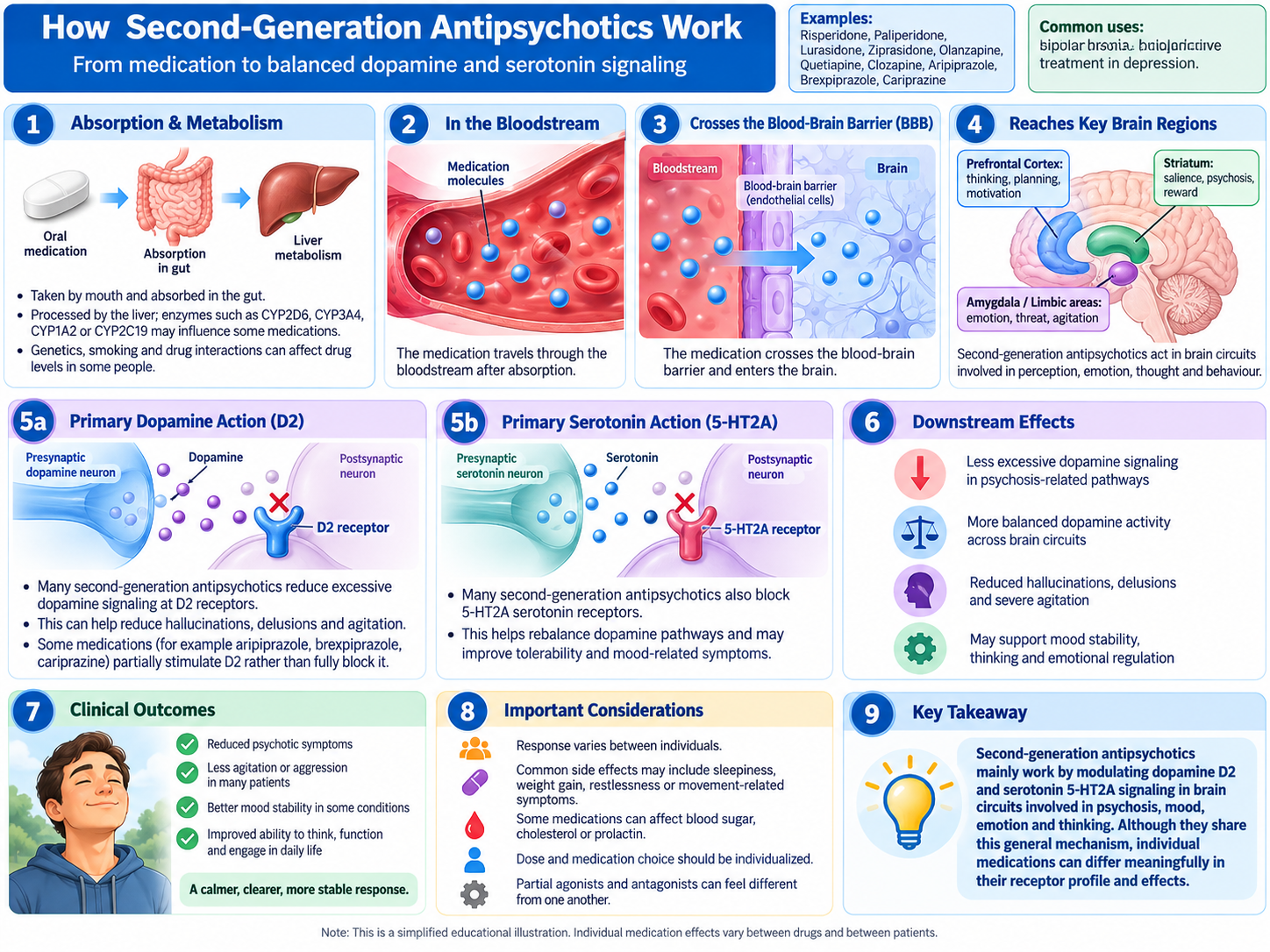
How Does Aripiprazole Work?
Aripiprazole mainly affects two neurotransmitter systems:
- Dopamine
- Serotonin Its most important action is at the dopamine D2 receptor.
Unlike traditional dopamine antagonists that strongly block D2 receptors, aripiprazole is a partial D2 agonist.
A simplified pathway is:
- Aripiprazole reaches the brain
- Interacts with dopamine D2/D3 and serotonin receptors
- Modulates dopamine and serotonin signaling
- Activity in relevant brain circuits changes
- Symptoms may improve
This is why aripiprazole is sometimes described informally as a dopamine-system stabilizer, although that term is an oversimplification rather than a formal pharmacological classification.
What Are the Common Side Effects of Aripiprazole?
Common side effects can include:
- Akathisia
- Restlessness
- Insomnia
- Anxiety
- Headache
- Nausea
- Vomiting
- Dizziness
- Sleepiness or fatigue
- Constipation
- Tremor
- Blurred vision When aripiprazole is added to an antidepressant for depression, akathisia, restlessness and insomnia are among the particularly important adverse effects.
What Is Akathisia?
Akathisia is one of the most important aripiprazole side effects for patients to recognize.
It can feel like:
- An uncomfortable internal restlessness
- An inability to sit still
- Constantly needing to move the legs
- Pacing
- Feeling physically agitated
- Feeling as though you need to “get out of your skin” Akathisia can sometimes be mistaken for anxiety or worsening psychiatric symptoms.
If substantial restlessness develops after starting aripiprazole or increasing the dose, it should be discussed with the prescribing healthcare professional.
Like other antipsychotics, aripiprazole can cause movement-related adverse effects.
These can include:
- Akathisia
- Tremor
- Muscle stiffness
- Parkinsonian symptoms
- Dystonia Long-term antipsychotic exposure can also cause tardive dyskinesia, which involves involuntary movements that can sometimes persist after the medication is stopped.
Examples include repetitive:
-
Mouth movements
-
Tongue movements
-
Lip smacking
-
Facial movements
-
Limb or body movements New involuntary movements should be discussed promptly with a healthcare professional.
-
Metabolic Effects Aripiprazole can affect:
-
Body weight
-
Blood glucose
-
Cholesterol
-
Triglycerides Although aripiprazole is often considered to have a lower metabolic burden than some atypical antipsychotics, weight gain and metabolic abnormalities can still occur.
Monitoring may include:
-
Weight
-
Waist circumference
-
Blood glucose or HbA1c
-
Cholesterol and triglycerides
-
Blood pressure Antipsychotic treatment guidelines recommend metabolic monitoring during treatment.
-
Impulse-Control Problems A particularly unusual potential adverse effect of aripiprazole is the development of new or unusually intense compulsive urges.
Reported behaviours include:
- Problem gambling
- Compulsive shopping or spending
- Binge or compulsive eating
- Increased or compulsive sexual behaviour
- Other unusual impulse-control behaviours Patients and families may not immediately recognize that a new behaviour could be related to the medication.
These urges have sometimes improved after the aripiprazole dose was reduced or treatment was stopped under medical supervision.
Neuroleptic Malignant Syndrome
A rare but serious reaction called neuroleptic malignant syndrome (NMS) can occur with antipsychotic medications.
Symptoms can include:
-
Very high fever
-
Severe muscle stiffness
-
Confusion
-
Changes in consciousness
-
Rapid heart rate
-
Blood pressure instability This requires urgent medical assessment.
-
Aripiprazole and Elderly Patients With Dementia Antipsychotic medications, including aripiprazole, are associated with an increased risk of death in elderly patients with dementia-related psychosis.
Aripiprazole is not approved for treatment of dementia-related psychosis.
Drug Interactions
Aripiprazole is metabolized mainly by two liver enzymes: CYP2D6 and CYP3A4
Medications that inhibit or increase the activity of these enzymes can substantially change aripiprazole exposure.
Fluoxetine — Strong CYP2D6 Inhibitor
Fluoxetine can strongly inhibit CYP2D6.
This can reduce aripiprazole metabolism and increase the amount of aripiprazole in the body.
- Fluoxetine
- CYP2D6 inhibition
- Slower aripiprazole metabolism
- Higher aripiprazole exposure
- Potentially greater risk of adverse effects
The U.S. prescribing information recommends reducing the usual aripiprazole dose by approximately 50% when it is given with a strong CYP2D6 inhibitor, although dosing for adjunctive treatment of depression has additional label-specific considerations.
Paroxetine — Strong CYP2D6 Inhibitor
Paroxetine also strongly inhibits CYP2D6 and can increase aripiprazole exposure.
The same general interaction applies:
- Paroxetine
- CYP2D6 inhibition
- Aripiprazole concentration may increase
A dose adjustment may therefore be needed depending on the indication and clinical circumstances.
Bupropion — CYP2D6 Inhibitor
Bupropion is also a clinically important CYP2D6 inhibitor.
Although bupropion itself is primarily metabolized through CYP2B6, it can significantly reduce CYP2D6 activity.
Therefore:
Aripiprazole + bupropion
may result in:
Reduced CYP2D6 activity → increased aripiprazole exposure
This interaction can be especially important in someone who already has genetically reduced CYP2D6 activity.
Strong CYP3A4 Inhibitors
Examples include:
- Itraconazole
- Ketoconazole
- Clarithromycin These medications can reduce CYP3A4-mediated aripiprazole metabolism.
The result can be:
Higher aripiprazole concentrations
and potentially:
Greater adverse-effect risk
The FDA prescribing information recommends approximately half of the usual aripiprazole dose with a strong CYP3A4 inhibitor.
Strong CYP3A4 Inducers
Examples include:
- Carbamazepine
- Rifampin Other strong enzyme-inducing medications may have similar effects.
These drugs increase CYP3A4 activity and can substantially increase the metabolism of aripiprazole.
- CYP3A4 induction
- Faster aripiprazole metabolism
- Lower aripiprazole exposure
- Potentially reduced therapeutic effect
The U.S. oral Abilify label recommends increasing the aripiprazole dose when used with a strong CYP3A4 inducer; its table describes doubling the usual dose gradually over 1–2 weeks. This should only be done by the prescribing clinician.
Strong CYP2D6 + CYP3A4 Inhibition
If both pathways are substantially inhibited, the effect can become much larger.
The U.S. label recommends:
- Strong CYP2D6 inhibitor + strong CYP3A4 inhibitor
- Approximately one-quarter of the usual aripiprazole dose
for relevant oral treatment circumstances.
This demonstrates why medication interactions need to be considered together rather than one at a time.
-
Benzodiazepines Examples include:
-
Lorazepam
-
Diazepam
-
Clonazepam Combining aripiprazole with sedating medications can increase:
-
Drowsiness
-
Dizziness
-
Impaired alertness The aripiprazole label specifically reports greater sedation and orthostatic hypotension when oral aripiprazole was combined with lorazepam.
Blood Pressure Medications
Because aripiprazole can contribute to orthostatic hypotension, it may enhance the blood-pressure-lowering effect of antihypertensive medications.
Symptoms may include:
- Dizziness
- Lightheadedness
- Feeling faint when standing Blood pressure may need additional monitoring.
Dosage
Aripiprazole dosing differs substantially depending on why it is being prescribed.
For oral aripiprazole, current U.S. prescribing information gives the following general adult ranges.
| Condition | Typical adult starting dose | Common target/range | Maximum |
|---|---|---|---|
| Schizophrenia | 10–15 mg/day | 10–15 mg/day | 30 mg/day |
| Bipolar mania — monotherapy | 15 mg/day | 15 mg/day | 30 mg/day |
| Bipolar mania + lithium/valproate | 10–15 mg/day | 15 mg/day | 30 mg/day |
| Major depression — adjunct | 2–5 mg/day | 5–10 mg/day | 15 mg/day |
Aripiprazole is generally taken once daily, with or without food.
Approved dosing may differ by country, patient age and specific product.
Why Is the Dose for Depression Usually Lower?
When aripiprazole is used for major depressive disorder, it is usually being used as an adjunct, meaning it is added to an antidepressant rather than used as the primary antidepressant.
The goal is not the same degree of dopamine D2 modulation generally needed for schizophrenia or acute mania.
For depression, treatment often begins at:
2–5 mg/day
with a usual target of:
5–10 mg/day
and a U.S.-label maximum of:
15 mg/day.
Some patients experience clinically meaningful effects—or side effects such as akathisia—at relatively low doses.
Long-Acting Aripiprazole Injections
Aripiprazole is also available in long-acting formulations.
Abilify Maintena
Generally administered approximately once monthly.
Abilify Asimtufii
Designed for administration approximately once every two months.
These products have different dosing and initiation requirements from oral aripiprazole and should not be substituted milligram-for-milligram. Both are currently marketed in Canada.
Tapering and Stopping Aripiprazole
Aripiprazole should generally not be stopped suddenly without discussing it with the prescribing healthcare professional.
Abruptly discontinuing an antipsychotic can create two different problems:
Return or worsening of the original condition
Symptoms of:
- Schizophrenia
- Mania
- Psychosis
- Depression may return.
Withdrawal or rebound symptoms
Some people can experience symptoms such as:
- Insomnia
- Anxiety
- Restlessness
- Agitation
- Nausea
- Sweating
- Mood changes
- Movement-related symptoms It can sometimes be difficult to distinguish withdrawal symptoms from the return of the underlying condition.
How Is Aripiprazole Usually Tapered?
There is no single aripiprazole taper suitable for every patient.
The taper depends on:
- Current dose
- How long aripiprazole has been taken
- Why it was prescribed
- Previous episodes of psychosis or mania
- Other medications
- Previous withdrawal symptoms
- Risk of relapse Guidelines recommend withdrawing antipsychotics gradually rather than abruptly. NICE recommends reducing antipsychotic medication over at least 4 weeks when stopping treatment for bipolar disorder and similarly recommends at least 4 weeks when an antipsychotic used to augment depression is withdrawn. Longer and slower tapering may be appropriate after prolonged treatment.
For schizophrenia or psychotic disorders, tapering requires particular caution because stopping antipsychotic treatment can increase the risk of relapse. Guidelines recommend gradual withdrawal and continued monitoring after discontinuation.
For a patient-facing website, I would not provide a fixed schedule such as 15 mg → 10 mg → 5 mg → stop, because the appropriate reductions can be very different depending on the patient’s condition and duration of treatment.
Frequently Asked Questions
Is Aripiprazole an antipsychotic?
Yes. Aripiprazole is an atypical antipsychotic used primarily for schizophrenia and bipolar disorder and for several other psychiatric indications.
Is Abilify the same as Aripiprazole?
Yes. Abilify is the original well-known brand name for aripiprazole.
Is Aripiprazole used for depression?
Yes, but usually as an add-on treatment.
Aripiprazole can be added to an antidepressant when major depressive disorder has not responded adequately to antidepressant treatment alone.
Does Aripiprazole increase or decrease dopamine?
It can do aspects of both.
Aripiprazole is a partial dopamine D2 receptor agonist.
When dopamine activity is high, it can reduce excessive dopamine receptor signaling.
When dopamine is lower, aripiprazole still provides partial D2 receptor stimulation rather than completely blocking the receptor.
This is one reason aripiprazole differs from pure dopamine D2 antagonists.
Does Aripiprazole affect serotonin?
Yes. Aripiprazole acts as a partial agonist at 5-HT1A receptors and an antagonist at 5-HT2A receptors. These serotonin effects may contribute to its effects on mood, anxiety, cognition and dopamine signaling.
Does Aripiprazole cause weight gain?
It can. Aripiprazole often causes less weight gain than some other atypical antipsychotics, but weight gain and metabolic changes are still possible and should be monitored.
Does Aripiprazole make you sleepy?
It can cause sleepiness in some people.
However, other people experience the opposite effect, including:
- Restlessness
- Activation
- Insomnia
- Akathisia Individual responses vary substantially.
Why does Aripiprazole cause restlessness?
Aripiprazole’s effects on dopamine receptors can produce akathisia, an uncomfortable internal feeling of restlessness that often creates a strong urge to move.
This can occur even at relatively low doses.
Can Aripiprazole cause compulsive gambling or shopping?
Yes, rarely. Aripiprazole has been associated with new or increased urges involving gambling, shopping, eating and sexual behaviour. These symptoms should be reported promptly to the prescribing clinician.
How long does Aripiprazole take to work?
Some effects on agitation, sleep or activation may appear relatively quickly, but improvement in psychotic, manic or depressive symptoms can take days to several weeks.
The timing depends on the condition, dose and individual response.
Can Aripiprazole be taken with an antidepressant?
Yes. Aripiprazole is specifically used as adjunctive treatment with antidepressants in major depressive disorder.
However, some antidepressants—particularly fluoxetine and paroxetine—strongly inhibit CYP2D6 and can increase aripiprazole exposure.
Can Bupropion affect Aripiprazole?
Yes. Bupropion inhibits CYP2D6 and can therefore reduce one of the major pathways responsible for aripiprazole metabolism.
This may increase aripiprazole exposure and should be considered when the two medications are used together.
Which liver enzymes metabolize Aripiprazole?
The two most important enzymes are:
- CYP2D6
- CYP3A4 Aripiprazole is mainly eliminated through hepatic metabolism involving these two enzymes.
Can genetics affect Aripiprazole side effects?
Yes. People who are genetically CYP2D6 Poor Metabolizers process aripiprazole more slowly and may have greater drug exposure.
The FDA specifically recommends a lower dose for these patients.
Does a CYP2D6 Normal Metabolizer result mean Aripiprazole will work?
No. CYP2D6 primarily helps determine how the body handles the medication.
Aripiprazole must still produce an appropriate response within dopamine and serotonin pathways in the brain.
Therefore:
Normal metabolism ≠ guaranteed treatment response.
Should I change my Aripiprazole dose based on a genetic test?
No. Patients should not change their own aripiprazole dose.
A CYP2D6 result should be interpreted by a healthcare professional together with:
- Current dose
- Other medications
- Diagnosis
- Side effects
- Treatment response
- CYP3A4 interactions
- Medical history
Can Pharmacogenomic Testing Tell Me Whether Aripiprazole Will Work?
Not with certainty. Pharmacogenomic testing can provide clinically useful information about aripiprazole metabolism, particularly through CYP2D6.
However, medication effectiveness also depends on:
- Dopamine signaling
- Serotonin signaling
- Receptors
- Symptoms
- Diagnosis
- Dose
- Other medications
- Drug interactions
- Individual brain biology PGx testing should therefore be considered one component of personalized medication selection rather than a stand-alone answer.
Why Pharmacogenomic Testing May Matter
Two people taking exactly the same dose of aripiprazole can have substantially different drug exposure.
One patient may experience:
- Slower metabolism
- Higher aripiprazole exposure
- Greater risk of akathisia or other adverse effects
while another may experience:
- Faster or uninhibited metabolism
- Lower exposure
- Potentially different clinical response
For aripiprazole, pharmacogenomics is particularly useful because CYP2D6 has an established prescribing relationship recognized in drug labeling and international PGx guidance.
References
- [https://www.drugs.com/aripiprazole.html)
- [https://health-products.canada.ca/dpd-bdpp/info?code=90546&lang=eng&lang=eng)
- [https://www.accessdata.fda.gov/drugsatfda_docs/label/2025/021436s046s050lbl.pdf)
- [https://dailymed.nlm.nih.gov/dailymed/drugInfo.cfm?setid=433cdc7d-465a-4ad4-bd84-cabd37e15f51)
- [https://pmc.ncbi.nlm.nih.gov/articles/PMC10923774/)
This article is educational. It does not diagnose, and it does not replace advice from your prescriber or pharmacist. Never start, stop or change a medication based on a web page.