
Medication profile
Venlafaxine and Desvenlafaxine (Effexor XR)
Venlafaxine and desvenlafaxine are closely related SNRI antidepressants. In fact, desvenlafaxine is the major active metabolite of venlafaxine:
 Written by Sanjida Ahmed, PhD, Cellular and Molecular BiologyChief Operating Officer and Lead Scientist, Personalized Prescribing. Last reviewed October 2, 2026.
- Venlafaxine brand name
- Effexor XR
- Desvenlafaxine brand name
- Pristiq
- Medication class
- Serotonin-Norepinephrine Reuptake Inhibitors — SNRIs
On this page
- What are Venlafaxine and Desvenlafaxine Used For?
- How Do Venlafaxine and Desvenlafaxine Work?
- Does Venlafaxine Work Differently at Different Doses?
- Does Desvenlafaxine Work the Same Way?
- How Do Venlafaxine and Desvenlafaxine Work for Depression?
- What Are the Common Side Effects?
- Why Do Venlafaxine and Desvenlafaxine Cause Nausea?
- Can Venlafaxine or Desvenlafaxine Increase Blood Pressure?
- Do Venlafaxine and Desvenlafaxine Cause Sexual Dysfunction?
- Do Venlafaxine and Desvenlafaxine Cause Weight Gain?
- Can They Initially Increase Anxiety?
- Can Venlafaxine or Desvenlafaxine Trigger Mania?
- Can They Cause Serotonin Syndrome?
- Can They Increase Bleeding Risk?
- Can They Cause Low Sodium?
- Why Is Venlafaxine Discontinuation Important?
- Does Desvenlafaxine Also Need to Be Tapered?
- Venlafaxine Drug Interactions
- Desvenlafaxine Drug Interactions
- Venlafaxine Dosage in Canada
- Desvenlafaxine Dosage in Canada
- Does Pristiq Need to Be Taken with Food?
- Does Effexor XR Need to Be Taken with Food?
- Venlafaxine and Kidney Function
- Desvenlafaxine and Kidney Function
- Venlafaxine and Liver Function
- Desvenlafaxine and Liver Function
- How Long Do Venlafaxine and Desvenlafaxine Stay in the Body?
- Venlafaxine half-life ≈ 5 hours
- Desvenlafaxine / ODV half-life ≈ 11 hours
- Frequently Asked Questions About Venlafaxine and Desvenlafaxine
- Venlafaxine → CYP2D6 → Desvenlafaxine
Venlafaxine and desvenlafaxine are closely related SNRI antidepressants. In fact, desvenlafaxine is the major active metabolite of venlafaxine:
- Venlafaxine
- CYP2D6
- O-Desmethylvenlafaxine — Desvenlafaxine
Both venlafaxine and desvenlafaxine inhibit the reuptake of: Serotonin — through SERT and: Norepinephrine — through NET which increases the availability of these neurotransmitters in the synapse and gradually changes neural networks involved in mood, anxiety, attention and emotional regulation.
The two medications are nevertheless pharmacokinetically quite different. Venlafaxine depends heavily on CYP2D6 to produce desvenlafaxine, whereas desvenlafaxine itself largely bypasses CYP2D6 and is eliminated through UGT-mediated conjugation and renal excretion. This makes CYP2D6 pharmacogenomics much more relevant to venlafaxine than to desvenlafaxine.
Health Canada currently lists Effexor XR 37.5 mg, 75 mg and 150 mg as marketed, and Pristiq 50 mg and 100 mg extended-release tablets as marketed.
What are Venlafaxine and Desvenlafaxine Used For?
Their Canadian indications are not identical.
| Condition | Venlafaxine — Effexor XR | Desvenlafaxine — Pristiq |
|---|---|---|
| Major depressive disorder | Approved | Approved |
| Generalized anxiety disorder | Approved | Not an approved Canadian indication |
| Social anxiety disorder | Approved | Not an approved Canadian indication |
| Panic disorder | Approved | Not an approved Canadian indication |
| Pediatric use <18 | Not authorized | Not authorized |
Effexor XR is approved in Canada for major depressive disorder, generalized anxiety disorder, social anxiety disorder and panic disorder with or without agoraphobia. Pristiq’s Canadian indication is major depressive disorder in adults.
This distinction is important for Canadian website content because desvenlafaxine may sometimes be discussed in broader anxiety contexts, but those should not be presented as Health Canada-approved indications.
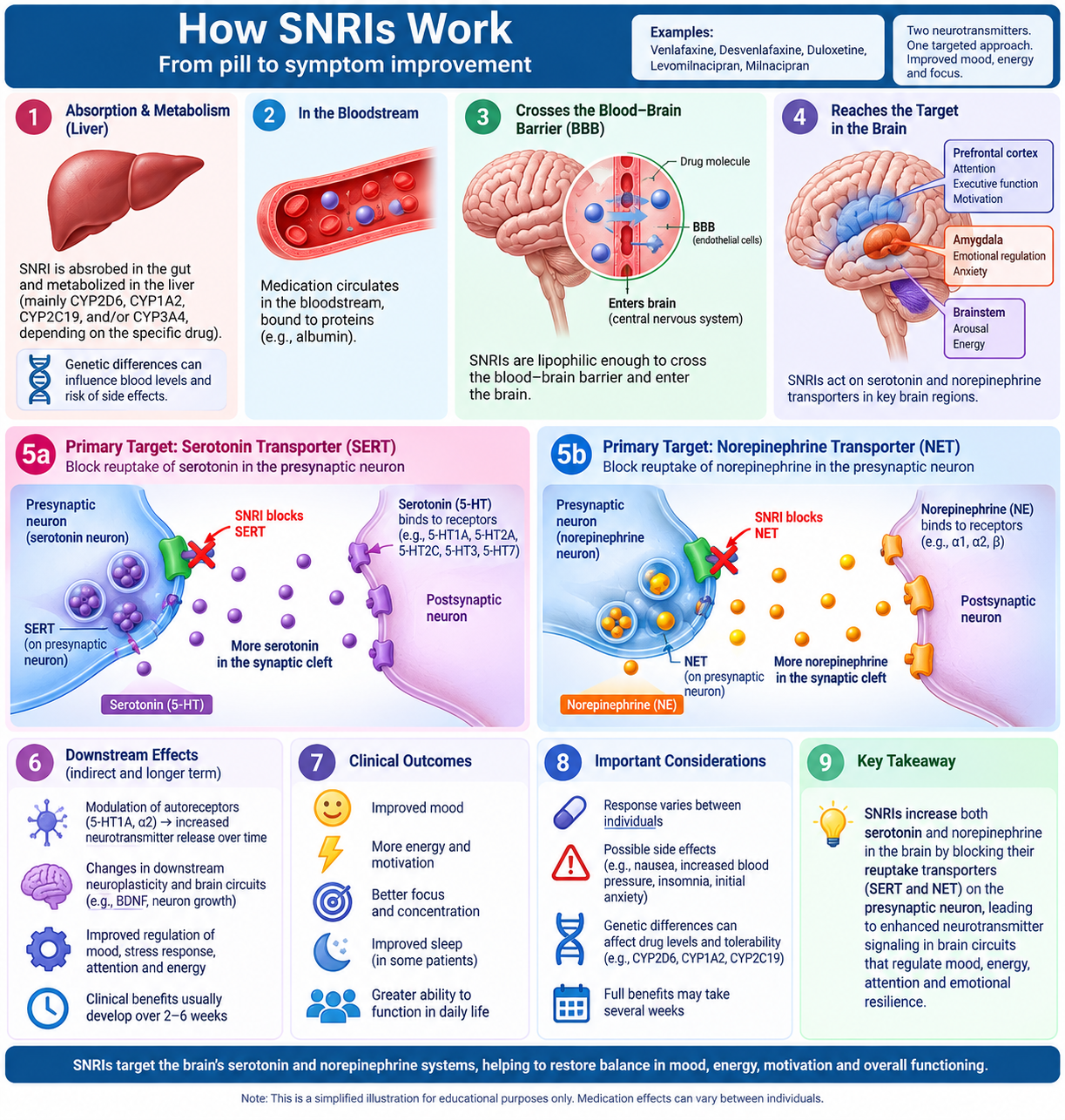
How Do Venlafaxine and Desvenlafaxine Work?
Both medications inhibit: SERT — Serotonin Transporter and: NET — Norepinephrine Transporter
Normally:
- Serotonin and norepinephrine are released
- They stimulate receptors
- SERT and NET transport them back into the neuron
Venlafaxine or desvenlafaxine interferes with this recycling:
- SNRI
- SERT inhibited + NET inhibited
- Serotonin reuptake decreases
- Norepinephrine reuptake decreases
- Serotonin and norepinephrine remain available longer
- Receptor signaling and neural networks gradually adapt
- Depressive or anxiety symptoms may improve
Venlafaxine and its active metabolite are potent inhibitors of serotonin and norepinephrine reuptake and only weak inhibitors of dopamine reuptake. They do not have significant direct affinity for muscarinic, histamine H1 or α1-adrenergic receptors.
Does Venlafaxine Work Differently at Different Doses?
To some extent:
Yes.
Venlafaxine inhibits serotonin reuptake more strongly than norepinephrine reuptake.
At lower exposures: Serotonin effects tend to predominate
As dose and exposure increase: Norepinephrine transporter inhibition becomes more prominent
Human PET and pharmacology studies support increasing NET occupancy with increasing venlafaxine exposure, although there is no exact dose at which a patient suddenly switches from an “SSRI effect” to an “SNRI effect.”
A useful clinical model is:
- Lower venlafaxine exposure
- Predominantly SERT inhibition
- As exposure increases:
- SERT + increasingly significant NET inhibition
This is one reason increasing venlafaxine may sometimes change not only the strength of the medication but also the balance of its serotonergic and noradrenergic pharmacology.
Does Desvenlafaxine Work the Same Way?
Desvenlafaxine is itself the active: O-Desmethylvenlafaxine — ODV produced when CYP2D6 metabolizes venlafaxine.
It directly inhibits: SERT and: NET without first requiring CYP2D6 conversion.
Therefore:
Venlafaxine
- Venlafaxine
- CYP2D6
- Desvenlafaxine
- SERT + NET inhibition
whereas:
Desvenlafaxine
- Desvenlafaxine taken directly
- SERT + NET inhibition
This difference becomes particularly important when considering CYP2D6 genetic variation or CYP2D6-inhibiting medications.
How Do Venlafaxine and Desvenlafaxine Work for Depression?
Depression should not be described simply as: “Low serotonin” or: “Low norepinephrine.”
Depression can involve dysregulation across neural systems controlling:
- Mood
- Motivation
- Reward
- Alertness
- Attention
- Emotional regulation
- Stress response
- Sleep
- Appetite Venlafaxine and desvenlafaxine alter two major monoamine systems simultaneously.
- SNRI
- SERT inhibition
- Serotonin signaling changes
- NET inhibition
- Norepinephrine signaling changes
- Prefrontal, limbic and emotional networks gradually adapt
- Depressive symptoms may improve
Serotonin may be particularly relevant to mood, anxiety and repetitive negative thinking, while norepinephrine contributes to alertness, attention, energy and stress regulation. These relationships are not one-to-one, however, because both neurotransmitters have different effects in different brain regions.
What Are the Common Side Effects?
Both medications have broadly similar SNRI adverse-effect profiles. Common or important effects include:
- Nausea
- Dizziness
- Dry mouth
- Sweating
- Insomnia
- Sleepiness
- Constipation
- Reduced appetite
- Headache
- Tremor
- Nervousness or activation
- Sexual dysfunction
- Increased heart rate in some patients
- Increased blood pressure in some patients For Effexor XR depression trials, nausea, dizziness, sleepiness, insomnia, dry mouth and sweating were among the prominent adverse effects. Nausea occurred in about 31% of XR-treated patients versus 12% with placebo in those trials.
At the recommended 50 mg Pristiq dose, short-term trials reported nausea in about 22%, dizziness in 13%, dry mouth in 11%, diarrhea in 11%, sweating in 10%, insomnia in 9%, constipation in 9% and fatigue in 7%. Trial rates should not be used to predict what an individual patient will experience.
Why Do Venlafaxine and Desvenlafaxine Cause Nausea?
Serotonin has major functions in the gastrointestinal system.
When an SNRI inhibits SERT:
- Serotonin reuptake decreases in the gut
- Serotonin signaling increases
- Gastrointestinal serotonin receptors are stimulated
- Possible:
Nausea, diarrhea or vomiting
Nausea is often most noticeable during the early stages of treatment and may decrease as the body adapts.
Can Venlafaxine or Desvenlafaxine Increase Blood Pressure?
Yes.
This is an important SNRI-specific consideration.
Norepinephrine helps regulate:
- Vascular tone
- Heart rate
- Sympathetic activity
- Blood pressure Therefore:
- NET inhibition
- Norepinephrine signaling increases
- Possible:
Heart rate and blood pressure increase
Venlafaxine-associated blood-pressure increases become more likely as dose increases, and sustained hypertension has been documented. Canadian labeling recommends monitoring blood pressure and considering dose reduction or discontinuation when sustained hypertension develops.
Desvenlafaxine can also increase blood pressure and heart rate. Canadian Pristiq labeling recommends controlling pre-existing hypertension before treatment and monitoring blood pressure regularly during therapy.
Do Venlafaxine and Desvenlafaxine Cause Sexual Dysfunction?
They can.
Possible effects include:
- Reduced libido
- Delayed ejaculation
- Erectile dysfunction
- Delayed or absent orgasm Increasing serotonin can suppress dopamine and other pathways involved in sexual motivation and sexual reflexes.
Conceptually:
- SERT inhibition
- Serotonin signaling increases
- 5-HT2 and related serotonergic pathways change
- Sexual-response pathways may be inhibited
Both Canadian monographs recognize sexual dysfunction, and persistent sexual symptoms after discontinuation have also been reported with serotonergic antidepressants.
Do Venlafaxine and Desvenlafaxine Cause Weight Gain?
Weight effects vary.
During early treatment, patients may experience: Reduced appetite or weight loss particularly when nausea is prominent.
During longer-term antidepressant treatment, some patients may instead gain weight.
Weight changes can reflect:
- Appetite
- Recovery from depression
- Activity
- Sleep
- Metabolic factors
- Treatment duration
- Other medications Neither drug should be assumed to cause the same weight effect in every patient.
Can They Initially Increase Anxiety?
Yes.
Early changes in serotonin and norepinephrine can temporarily produce:
- Jitteriness
- Anxiety
- Restlessness
- Tremor
- Insomnia This is one reason Effexor XR is commonly started at 37.5 mg/day before increasing to 75 mg/day in panic disorder and often in patients who are sensitive to antidepressant activation.
Can Venlafaxine or Desvenlafaxine Trigger Mania?
Yes.
Like other antidepressants, SNRIs can precipitate: Mania or: Hypomania in people vulnerable to bipolar disorder.
Possible warning symptoms include markedly reduced need for sleep, unusually elevated or irritable mood, racing thoughts, grandiosity, impulsivity and increased activity.
A history of bipolar disorder or previous antidepressant-induced activation is therefore clinically important.
Can They Cause Serotonin Syndrome?
Yes.
Serotonin toxicity becomes more likely when venlafaxine or desvenlafaxine is combined with other serotonergic medications.
Potential interacting medications include other antidepressants, tramadol, certain opioids, triptans, lithium, buspirone, dextromethorphan, amphetamine-type drugs and St. John’s Wort.
Symptoms can include agitation, confusion, sweating, fever, diarrhea, tremor, muscle twitching, clonus, overactive reflexes and rapid heart rate.
Combining either medication with an: MAO inhibitor can cause particularly dangerous serotonin toxicity and is contraindicated.
Can They Increase Bleeding Risk?
Yes.
Serotonin contributes to platelet function.
SERT inhibition can reduce the ability of platelets to accumulate serotonin, potentially increasing bleeding risk.
The risk may become greater with medications such as:
Aspirin, NSAIDs, warfarin, anticoagulants or antiplatelet medications.
Effexor XR labeling specifically reports altered anticoagulant effects and increased bleeding when serotonergic antidepressants are combined with drugs affecting coagulation.
Can They Cause Low Sodium?
Yes.
Both serotonergic antidepressants can rarely cause: Hyponatremia often through: SIADH
Risk is greater in older adults, patients taking diuretics and people who are volume depleted.
Symptoms can include headache, confusion, weakness, muscle symptoms and, in severe cases, seizures.
Why Is Venlafaxine Discontinuation Important?
Venlafaxine is particularly associated with: Antidepressant Discontinuation Symptoms because venlafaxine itself has a relatively short elimination half-life.
Possible symptoms include:
- Dizziness
- Nausea
- Anxiety
- Insomnia
- Vivid dreams
- Sweating
- Tremor
- Tingling
- Electric-shock sensations
- Irritability
- Flu-like symptoms The parent venlafaxine half-life is about 5 hours, while desvenlafaxine/ODV has a half-life of approximately 11 hours.
Canadian Effexor XR labeling recommends gradual individualized tapering. For treatment lasting longer than six weeks, the monograph gives at least two weeks as a general tapering framework but explicitly recognizes that some patients may require tapering over months or longer.
That should not be converted into a universal patient taper schedule.
Does Desvenlafaxine Also Need to Be Tapered?
Yes.
Abrupt desvenlafaxine discontinuation can also produce substantial symptoms.
Canadian Pristiq labeling specifically states: Do not discontinue abruptly and recommends gradual individualized tapering. It also recognizes that some patients may require tapering over:
Months or longer.
Discontinuation symptoms represent nervous-system adaptation and do not mean the medications are addictive.
Venlafaxine Drug Interactions
Venlafaxine’s metabolism makes drug interactions particularly important.
The principal pathway is:
- Venlafaxine
- CYP2D6
- Desvenlafaxine / ODV
CYP2D6 inhibitors such as paroxetine, fluoxetine or bupropion can reduce conversion of venlafaxine to desvenlafaxine.
This tends to produce:
- Higher parent venlafaxine
- Lower desvenlafaxine Because both compounds are active, the Canadian monograph does not require an automatic dose change solely because a CYP2D6 inhibitor is added. However, the altered parent-to-metabolite balance can still matter clinically, particularly when genotype and other interacting medications are considered together.
Strong CYP3A4 inhibitors can also increase venlafaxine exposure. Ketoconazole increased venlafaxine and ODV exposure in interaction studies, with larger effects in CYP2D6 Poor Metabolizers. The Canadian monograph advises caution with CYP3A4 inhibitors and recommends avoiding simultaneous inhibition of both CYP2D6 and CYP3A4 pathways where possible.
Desvenlafaxine Drug Interactions
Desvenlafaxine generally has: Fewer CYP-dependent pharmacokinetic interactions than venlafaxine.
It is primarily metabolized by: UGT-mediated conjugation and only to a minor extent by: CYP3A4
It is not meaningfully dependent on CYP2D6 metabolism.
Strong CYP3A4 inhibition can increase desvenlafaxine exposure, but CYP3A4 is a minor pathway.
In a ketoconazole interaction study, desvenlafaxine AUC increased by approximately 43%.
At therapeutic doses, desvenlafaxine also has relatively modest effects on CYP2D6 substrates compared with potent CYP2D6 inhibitors such as paroxetine.
This can make desvenlafaxine pharmacokinetically attractive in patients taking multiple CYP2D6-dependent medications.
Venlafaxine Dosage in Canada
Current Canadian Effexor XR dosing is once daily with food.
| Indication | Starting dose | Usual dose | Canadian maximum |
|---|---|---|---|
| Major depressive disorder | 75 mg/day; some begin 37.5 mg for 4–7 days | 75 mg/day or individualized upward | 225 mg/day |
| Generalized anxiety disorder | 37.5 mg/day for 4–7 days | Usually 75 mg/day | 225 mg/day |
| Social anxiety disorder | Usually 75 mg/day; 37.5 mg may be used initially | 75 mg/day or individualized | 225 mg/day |
| Panic disorder | 37.5 mg/day for 7 days | Usually 75 mg/day | 225 mg/day |
For depression, increases may be made in increments up to 75 mg/day, typically about two weeks apart when possible and not less than four days apart. Panic-disorder increases should generally be separated by at least seven days.
These are product-label ranges, not individual dosing instructions.
Desvenlafaxine Dosage in Canada
The recommended Pristiq dose is much simpler: 50 mg once daily with or without food.
Canadian clinical trials found: No additional demonstrated benefit above 50 mg/day while adverse effects and discontinuations became more frequent at higher doses.
If an increase is considered clinically necessary: 100 mg/day is the Canadian maximum recommended dose.
This is an important difference from venlafaxine, where a much wider dose range is routinely used.
Does Pristiq Need to Be Taken with Food?
No.
Desvenlafaxine can be taken: With or without food
and should generally be taken at approximately the same time each day.
The extended-release tablet must be swallowed whole and should not be: Crushed, chewed or divided.
Patients may occasionally see what looks like a tablet shell in the stool. This is the non-absorbable controlled-release matrix after the medication has already been released and absorbed.
Does Effexor XR Need to Be Taken with Food?
Yes.
Canadian Effexor XR labeling recommends: Once daily with food either in the: Morning or evening. The capsule should be swallowed whole and should not be crushed or chewed.
Venlafaxine and Kidney Function
Venlafaxine and its metabolites are substantially eliminated through the kidneys.
Approximately 87% of a venlafaxine dose is recovered in urine within 48 hours as venlafaxine, ODV and other metabolites.
For renal impairment with GFR approximately 10–70 mL/min, Canadian labeling recommends decreasing the total daily Effexor XR dose by: 25–50%
For hemodialysis: 50% dose reduction
is recommended, with the dose withheld until dialysis has been completed.
Desvenlafaxine and Kidney Function
Kidney function is even more directly relevant to desvenlafaxine.
Approximately: 45% is excreted unchanged in urine
with another approximately: 19% excreted as a glucuronide metabolite.
In severe renal impairment or end-stage renal disease, Canadian Pristiq labeling recommends:
50 mg every other day with no supplemental dose after dialysis.
Desvenlafaxine exposure approximately doubled in severe renal impairment in pharmacokinetic studies.
Venlafaxine and Liver Function
Venlafaxine undergoes substantial hepatic metabolism.
Canadian labeling recommends reducing the total daily dose by approximately: 50%
in mild-to-moderate hepatic impairment.
Some patients with more severe impairment may require even greater reductions because the decrease in clearance varies substantially between individuals.
Desvenlafaxine and Liver Function
Desvenlafaxine is less dependent on hepatic CYP metabolism.
The Canadian Pristiq monograph states that:
No dosage adjustment is required solely for hepatic impairment.
This is another major pharmacokinetic difference between venlafaxine and desvenlafaxine.
How Long Do Venlafaxine and Desvenlafaxine Stay in the Body?
Venlafaxine half-life ≈ 5 hours
Desvenlafaxine / ODV half-life ≈ 11 hours
After Effexor XR, absorption is deliberately slower, producing smoother concentration changes even though the intrinsic elimination characteristics of venlafaxine remain relatively short. Steady state for venlafaxine and ODV is reached within approximately three days.
For directly administered desvenlafaxine, the average terminal half-life in people with normal renal function is approximately: 11 hours.
Frequently Asked Questions About Venlafaxine and Desvenlafaxine
Is Desvenlafaxine the Same as Venlafaxine?
No.
They are separate medications, but desvenlafaxine is the major active metabolite produced from venlafaxine.
Does Venlafaxine Turn into Desvenlafaxine?
Yes.
The principal pathway is:
Venlafaxine → CYP2D6 → Desvenlafaxine
Both molecules remain pharmacologically active.
Are Venlafaxine and Desvenlafaxine SSRIs?
No.
They are classified as: SNRIs because they inhibit both serotonin and norepinephrine reuptake.
Venlafaxine can nevertheless behave predominantly serotonergically at lower exposure because SERT inhibition is stronger than NET inhibition.
Do They Increase Dopamine?
Only weakly through direct dopamine-transporter inhibition.
Their clinically important actions are:
SERT + NET inhibition.
Which Has Fewer CYP Drug Interactions?
Generally:
Desvenlafaxine because it does not require CYP2D6 metabolism and undergoes primarily UGT conjugation and renal elimination.
- Which Is More Affected by Genetics? Venlafaxine
CYP2D6 genotype changes the conversion of venlafaxine into desvenlafaxine.
Desvenlafaxine does not have an established CYP2D6 genotype-based dosing recommendation.
Can a CYP2D6 Poor Metabolizer Take Venlafaxine?
It is not an absolute contraindication, but formal pharmacogenomic guidance raises concern.
CPIC suggests considering an alternative for Poor Metabolizers, while DPWG recommends avoiding venlafaxine in CYP2D6 Poor and Intermediate Metabolizers when possible.
Would Desvenlafaxine Avoid the CYP2D6 Problem?
Pharmacokinetically: Largely yes.
Desvenlafaxine is already the active O-desmethyl metabolite, so it does not require CYP2D6 to produce that compound.
Its exposure depends more strongly on: Kidney function than on CYP2D6 genotype.
Which One Has More Withdrawal Symptoms?
Both can produce significant discontinuation symptoms.
Venlafaxine is particularly well known for this because of the relatively short half-life of the parent drug, but desvenlafaxine should also be tapered gradually and individually.
Can Venlafaxine or Desvenlafaxine Increase Blood Pressure?
Yes.
Both can increase blood pressure because of their noradrenergic activity. Blood pressure should be assessed before and monitored during treatment, particularly with higher exposure or pre-existing hypertension.
Can Venlafaxine and Desvenlafaxine Cause Sexual Dysfunction?
Yes.
Both can cause reduced libido, delayed orgasm, delayed ejaculation and erectile difficulties.
Can Someone Switch Directly from Venlafaxine to Desvenlafaxine?
The medications are closely related, but they are not milligram-for-milligram interchangeable.
The Canadian Pristiq monograph specifically notes that discontinuation symptoms have occurred when patients switch from other antidepressants, including venlafaxine, to desvenlafaxine and that tapering the original medication may be necessary.
The switching strategy should therefore be individualized.
References
- [https://health-products.canada.ca/dpd-bdpp/search-fast-recherche-rapide?code=16524&lang=eng&lang=eng)
- [https://health-products.canada.ca/dpd-bdpp/search-fast-recherche-rapide?lang=eng&no=0152509001&no=0152509001)
- [https://health-products.canada.ca/dpd-bdpp/search-fast-recherche-rapide?lang=eng&no=0152509002&no=0152509002)
- https://pdf.hres.ca/dpd_pm/00073109.PDF
- https://pdf.hres.ca/dpd_pm/00074568.PDF
- [https://pmc.ncbi.nlm.nih.gov/articles/PMC10806172/)
- https://pubmed.ncbi.nlm.nih.gov/30649319/
This article is educational. It does not diagnose, and it does not replace advice from your prescriber or pharmacist. Never start, stop or change a medication based on a web page.