
Medication profile
Olanzapine (Zyprexa)
Olanzapine is one of the established second-generation antipsychotics.
 Written by Sanjida Ahmed, PhD, Cellular and Molecular BiologyChief Operating Officer and Lead Scientist, Personalized Prescribing. Last reviewed October 2, 2026.
- Best-known brand name
- Zyprexa
- Orally disintegrating formulation
- Zyprexa Zydis
- Medication class
- Second-generation (atypical) antipsychotic
On this page
- What You Need to Know About Olanzapine
- What Is Olanzapine Used For?
- Schizophrenia and Related Psychotic Disorders
- Acute treatment
- Maintenance treatment
- What Are Positive Symptoms of Schizophrenia?
- D2 dopamine receptor blockade
- What Are Negative Symptoms of Schizophrenia?
- Olanzapine for Bipolar Disorder
- Acute Manic or Mixed Episodes in Bipolar I Disorder
- Alone — monotherapy
- Is Olanzapine Used for Depression?
- Rapid control of acute agitation
- How Does Olanzapine Work?
- Dopamine D2 antagonism
- “Lowering dopamine.”
- What Does Olanzapine Do to Dopamine?
- D2 receptors
- What Does Olanzapine Do to Serotonin?
- 5-HT2A antagonism
- 5-HT2A receptor occupancy
- D2 receptor occupancy
- Why Does Olanzapine Cause Weight Gain?
- Histamine H1
- How Common Is Significant Weight Gain with Olanzapine?
- 22.2% of olanzapine-treated patients
- 7% of their baseline body weight
- Can Olanzapine Increase Blood Sugar?
- Can Olanzapine Raise Cholesterol and Triglycerides?
- Blood glucose / HbA1c
- Fasting lipids
- Blood pressure
- Why Does Olanzapine Make You Sleepy?
- Histamine H1 Receptors
- Why Does Olanzapine Increase Appetite?
- Why Does Olanzapine Cause Dry Mouth and Constipation?
- Muscarinic Acetylcholine Receptors
- Can Olanzapine Cause Dizziness When Standing?
- Alpha-1 Adrenergic Receptors
- Orthostatic Hypotension
- Can Olanzapine Cause Movement Side Effects?
- Extrapyramidal Symptoms — EPS
- What Is Akathisia?
- Worsening agitation or anxiety
- Can Olanzapine Cause Tardive Dyskinesia?
- Tardive Dyskinesia — TD
- What Is Neuroleptic Malignant Syndrome?
- Neuroleptic Malignant Syndrome — NMS
- Can Olanzapine Increase Prolactin?
- Tuberoinfundibular pathway
- Can Olanzapine Affect the Liver?
- Can Olanzapine Cause Seizures?
- Can Olanzapine Cause DRESS?
- DRESS — Drug Reaction with Eosinophilia and Systemic Symptoms
- Olanzapine and Elderly Patients with Dementia
- Cerebrovascular events such as stroke and TIA
- Olanzapine Drug Interactions
- What Happens if Someone Stops Smoking While Taking Olanzapine?
- CYP1A2 Inhibitor
- Orthostatic hypotension
- Dopaminergic signaling
- Olanzapine Dosage for Schizophrenia
- 5–10 mg once daily
- 10 mg/day
- One week
- 5–20 mg/day
- Olanzapine Dosage for Bipolar Mania
- 15 mg once daily when used alone
- 10 mg once daily when used with another treatment
- Can Olanzapine Be Taken with Food?
- With or without food
- When Should Olanzapine Be Taken?
- Once daily
- What Is Zyprexa Zydis?
- Zyprexa Zydis
- How Long Does Olanzapine Stay in the Body?
- 21–54 hours
- 30 hours
- Once-daily dosing
- Does Olanzapine Need to Be Tapered?
- Frequently Asked Questions
Olanzapine is an antipsychotic medication used primarily to treat schizophrenia and related psychotic disorders and bipolar I disorder, particularly manic or mixed episodes.
Olanzapine has a broad pharmacological profile. Its most important therapeutic actions involve blocking:
and:
Serotonin 5-HT2A receptors
but it also interacts with:
- 5-HT2C serotonin receptors
- Dopamine D1, D3 and D4 receptors
- Histamine H1 receptors
- Muscarinic acetylcholine receptors
- Alpha-1 adrenergic receptors This broad receptor profile contributes both to olanzapine’s therapeutic effects and to side effects such as weight gain, increased appetite, sleepiness, constipation and dizziness when standing. Current pharmacological data show high affinity for 5-HT2A/2C, dopamine D1–D4, H1 and α1 receptors, with additional muscarinic activity.
A simplified mechanism is:
Olanzapine
- D2 dopamine receptor blockade
- 5-HT2A serotonin receptor blockade
- Dopamine and serotonin signaling are modified
- Psychosis- and mood-related neural circuits become better regulated
- Hallucinations, delusions, agitation or manic symptoms may improve
What You Need to Know About Olanzapine
Olanzapine is one of the established second-generation antipsychotics.
In Canada, Zyprexa remains marketed, with oral tablet strengths ranging from 2.5 mg to 20 mg. Zyprexa Zydis orally disintegrating tablets and generic olanzapine formulations are also available.
Olanzapine can be highly effective, but several issues deserve particular attention:
- Weight gain
- Increased appetite
- Blood glucose changes
- Cholesterol and triglyceride changes
- Sleepiness
- Constipation and dry mouth
- Orthostatic hypotension
- Movement-related side effects
- Smoking-related changes in drug concentration Among these, metabolic effects are especially important during long-term treatment.
What Is Olanzapine Used For?
Schizophrenia and Related Psychotic Disorders
In Canada, oral olanzapine is indicated for the:
Acute treatment
and:
Maintenance treatment
of schizophrenia and related psychotic disorders.
It can improve symptoms such as:
- Hallucinations
- Delusions
- Suspiciousness
- Disorganized thinking
- Severe agitation
- Behavioural disturbance Canadian labeling also recognizes improvement in both positive and negative symptom domains during schizophrenia treatment.
What Are Positive Symptoms of Schizophrenia?
Positive symptoms are experiences or behaviours added to normal functioning, including:
- Hallucinations
- Delusions
- Paranoia
- Disorganized speech
- Disorganized behaviour Olanzapine’s:
D2 dopamine receptor blockade
is thought to contribute importantly to reducing these symptoms.
What Are Negative Symptoms of Schizophrenia?
Negative symptoms can include:
- Reduced motivation
- Reduced emotional expression
- Social withdrawal
- Reduced speech
- Reduced ability to experience pleasure These symptoms are biologically more complex than positive symptoms.
Olanzapine may improve some negative symptoms, but negative and cognitive symptoms should not simply be considered consequences of excessive dopamine.
Olanzapine for Bipolar Disorder
Olanzapine is also approved in Canada for:
Acute Manic or Mixed Episodes in Bipolar I Disorder
It may be used:
Alone — monotherapy
or together with medications commonly used for acute bipolar disorder, including:
Lithium
or:
Divalproex
Olanzapine may also be continued as maintenance therapy in patients who responded to it during an acute manic or mixed episode.
Manic symptoms can include:
- Excessive energy
- Reduced need for sleep
- Racing thoughts
- Rapid speech
- Irritability
- Grandiosity
- Increased activity
- Poor judgment
- Impulsivity
- Agitation
Is Olanzapine Used for Depression?
Olanzapine is not a conventional antidepressant.
However, antipsychotics including olanzapine may sometimes be used in selected patients with:
- Bipolar depression
- Severe depression with psychotic features
- Difficult-to-treat depression depending on the overall clinical situation.
These uses should be distinguished from olanzapine’s principal Canadian indications for:
- Schizophrenia
- Bipolar mania and maintenance treatment.
Olanzapine for Severe Agitation
An intramuscular formulation of olanzapine is available for the:
Rapid control of acute agitation
- associated with schizophrenia or bipolar mania. Current Canadian labeling describes a usual initial intramuscular dose of 10 mg, with 5 mg or 7.5 mg sometimes selected according to the patient’s clinical condition.
Intramuscular olanzapine is a:
Clinician-administered acute treatment
and should not be confused with routine oral maintenance therapy.
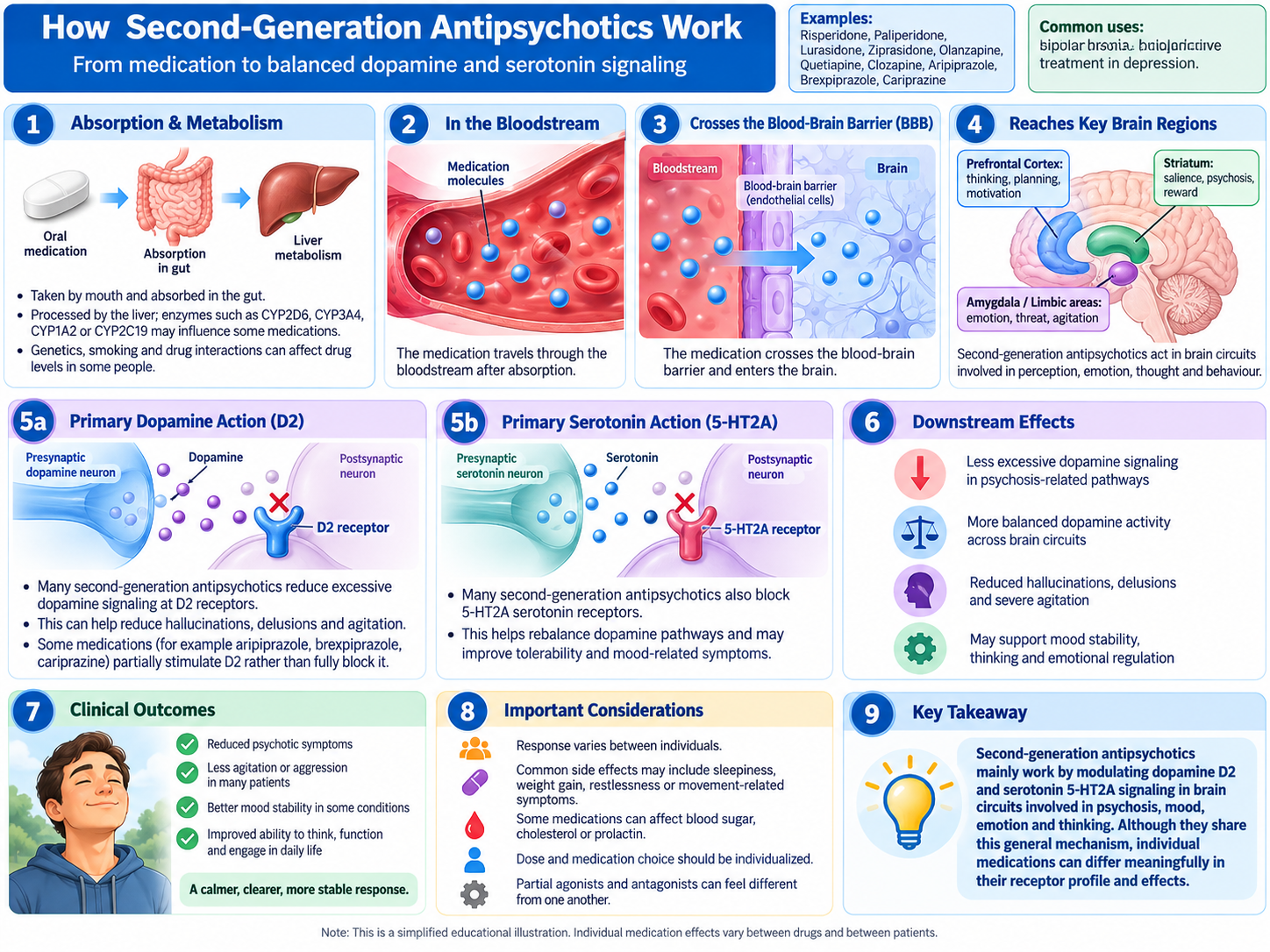
How Does Olanzapine Work?
The exact mechanism responsible for olanzapine’s clinical effectiveness is not fully understood.
However, its antipsychotic effect is thought to depend importantly on the combination of:
Dopamine D2 antagonism
and:
Serotonin 5-HT2A antagonism.
The simplified pathway is:
Olanzapine enters the brain
- Blocks D2 receptors
- Blocks 5-HT2A receptors
- Dopamine signaling is reduced in selected circuits
- Serotonin regulation of dopamine pathways changes Psychotic and manic symptoms may improve Olanzapine should not simply be described as:
“Lowering dopamine.”
Its effects depend heavily on:
- Brain region
- Dopamine pathway
- Receptor type
- Serotonin interactions
- Dose and receptor occupancy
What Does Olanzapine Do to Dopamine?
Olanzapine blocks several dopamine receptors, particularly:
D2 receptors
D2 blockade in mesolimbic and related striatal circuits is believed to contribute to:
- Reduced hallucinations
- Reduced delusions
- Reduced excessive salience
- Reduced agitation
- Antimanic effects Conceptually:
- Excessive or dysregulated dopamine signaling
- Olanzapine occupies D2 receptors
- Dopamine stimulation of D2 decreases
- Psychosis-related signaling becomes less excessive
- Positive symptoms may improve
This does not mean schizophrenia is simply caused by “too much dopamine.”
Dopamine dysregulation varies by neural circuit.
What Does Olanzapine Do to Serotonin?
Olanzapine has particularly strong affinity for:
5-HT2A and: 5-HT2C serotonin receptors.
Its:
5-HT2A antagonism
modifies serotonin’s control over dopamine pathways.
This contributes to olanzapine’s pharmacological differences from first-generation antipsychotics such as haloperidol.
Olanzapine generally produces relatively greater:
5-HT2A receptor occupancy
than:
D2 receptor occupancy
at therapeutic exposures.
Why Does Olanzapine Cause Weight Gain?
Weight gain is one of the most important adverse effects of olanzapine.
Several receptor systems probably contribute, particularly:
Histamine H1
and:
5-HT2C
receptors.
Both participate in:
- Appetite
- Satiety
- Food reward
- Energy regulation Therefore:
Olanzapine
- H1 blockade
- 5-HT2C blockade
- Appetite and satiety signaling change
- Hunger may increase
- Food intake may increase
- Weight gain can occur
Metabolic changes may also involve mechanisms beyond appetite alone.
How Common Is Significant Weight Gain with Olanzapine?
Weight gain is common and can be clinically substantial.
Across 13 placebo-controlled olanzapine monotherapy studies, approximately:
22.2% of olanzapine-treated patients
gained at least:
7% of their baseline body weight
compared with approximately:
3% receiving placebo.
The median time to that degree of weight gain was approximately eight weeks. Longer-term schizophrenia studies reported even greater cumulative weight gain.
This is why body weight should be monitored:
Before treatment and during treatment.
Can Olanzapine Increase Blood Sugar?
Yes.
Olanzapine can cause:
Hyperglycemia
and can worsen pre-existing diabetes.
Rare but serious cases involving:
- Diabetic ketoacidosis
- Diabetic coma have been reported, including in patients without previously recognized diabetes.
Possible warning symptoms of high blood glucose include:
- Excessive thirst
- Frequent urination
- Increased hunger
- Weakness
- Blurred vision
- Unexplained weight changes Blood glucose or:
HbA1c
should generally be assessed before treatment and periodically thereafter.
Can Olanzapine Raise Cholesterol and Triglycerides?
Yes.
Olanzapine treatment can increase:
- Total cholesterol
- LDL cholesterol
- Triglycerides and clinically significant changes may become more common with longer exposure.
For this reason, metabolic monitoring commonly includes:
Weight
Blood glucose / HbA1c
Fasting lipids
Blood pressure
The frequency should be individualized according to the patient’s baseline risk and treatment duration.
Why Does Olanzapine Make You Sleepy?
Olanzapine strongly blocks:
Histamine H1 Receptors
Histamine normally promotes:
- Wakefulness
- Alertness
- Arousal Therefore:
- Olanzapine
- H1 blockade
- Histamine-mediated wakefulness decreases
- Sleepiness or sedation
The H1 receptor is one of olanzapine’s high-affinity targets.
Sedation may be helpful when severe psychosis or mania is accompanied by agitation and insomnia, but excessive daytime sleepiness may impair functioning.
Why Does Olanzapine Increase Appetite?
The same receptor profile responsible for sedation also affects appetite.
Important targets include:
H1 and: 5-HT2C
Therefore:
H1 + 5-HT2C blockade
- Satiety signaling decreases
- Appetite signaling changes Food intake may increase This effect can begin relatively early in treatment.
Why Does Olanzapine Cause Dry Mouth and Constipation?
Olanzapine interacts with:
Muscarinic Acetylcholine Receptors
Acetylcholine helps regulate:
- Saliva production
- Intestinal movement
- Bladder function
- Eye focusing
- Memory and cognition Therefore:
- Olanzapine
- Muscarinic receptor blockade
- Possible:
-
Dry mouth
-
Constipation
-
Blurred vision
-
Urinary difficulty The anticholinergic burden becomes especially important in:
-
Older adults
-
People with constipation
-
People with urinary retention
-
Patients taking other anticholinergic medications Olanzapine’s muscarinic antagonism is recognized as the likely basis of its anticholinergic-like effects.
Can Olanzapine Cause Dizziness When Standing?
Yes.
Olanzapine blocks:
Alpha-1 Adrenergic Receptors
These receptors normally help maintain blood pressure when a person changes position.
Therefore:
- Olanzapine
- α1 blockade
- Blood vessels may not constrict as effectively
- Blood pressure falls when standing
- Dizziness or lightheadedness
This is called:
Orthostatic Hypotension
In placebo-controlled studies, significant orthostatic reductions in systolic blood pressure were observed more frequently with olanzapine than placebo.
Can Olanzapine Cause Movement Side Effects?
Yes.
Because olanzapine blocks dopamine D2 receptors, it can cause:
Extrapyramidal Symptoms — EPS
including:
-
Akathisia a distressing feeling of inner restlessness
-
Parkinsonism slowness, stiffness or tremor
-
Dystonia involuntary muscle contractions
These effects are generally less prominent than with potent first-generation D2 antagonists such as haloperidol, but they can still occur.
Akathisia was reported more frequently with olanzapine than placebo in schizophrenia trials.
What Is Akathisia?
Akathisia can cause:
- Inner restlessness
- Inability to remain seated
- Pacing
- Constant leg movement
- Severe discomfort
- Anxiety-like feelings It is important because akathisia may sometimes be mistaken for:
Worsening agitation or anxiety
If the underlying problem is medication-induced akathisia, increasing antipsychotic exposure may sometimes worsen it.
Can Olanzapine Cause Tardive Dyskinesia?
Yes.
Tardive Dyskinesia — TD
is a potentially persistent movement disorder associated with dopamine-receptor-blocking medications.
Symptoms can include involuntary:
-
Lip movements
-
Tongue movements
-
Facial movements
-
Chewing motions
-
Finger or limb movements The risk generally increases with:
-
Longer treatment duration
-
Greater cumulative antipsychotic exposure
-
Age
-
Individual susceptibility Tardive dyskinesia can occasionally persist even after the medication is stopped. Canadian labeling recommends using the lowest effective antipsychotic dose and periodically reassessing the need for continued treatment.
What Is Neuroleptic Malignant Syndrome?
Rarely, olanzapine and other antipsychotics can cause:
Neuroleptic Malignant Syndrome — NMS
This is a serious medical emergency.
Possible symptoms include:
- High fever
- Severe muscle rigidity
- Altered consciousness
- Confusion
- Sweating
- Rapid heart rate
- Blood-pressure instability Urgent medical assessment is required if NMS is suspected.
Can Olanzapine Increase Prolactin?
Yes.
Dopamine normally suppresses prolactin release through D2 receptors in the:
Tuberoinfundibular pathway
Therefore:
- Olanzapine
- D2 blockade
- Dopamine's inhibition of prolactin decreases
- Prolactin may rise
Canadian olanzapine data describe generally modest increases in serum prolactin that may decrease during continued treatment.
Possible symptoms of persistent elevated prolactin can include:
- Menstrual changes
- Breast milk production
- Breast enlargement
- Sexual dysfunction
- Reduced fertility Clinical significance varies considerably.
Can Olanzapine Affect the Liver?
Yes.
Olanzapine can cause elevations in liver enzymes such as:
- ALT
- AST
- GGT These elevations are often asymptomatic, but clinically important liver injury is possible.
Liver-function assessment may be appropriate before or during treatment in patients with:
- Existing liver disease
- Other hepatotoxic medications
- Symptoms suggestive of liver injury Canadian clinical trial data document elevations in hepatic aminotransferases during olanzapine therapy.
Can Olanzapine Cause Seizures?
Rarely.
Antipsychotics can lower the seizure threshold.
In the premarketing olanzapine database, seizures occurred in approximately 0.9% of exposed patients, although many had other contributing risk factors.
Caution is appropriate in people with:
- Epilepsy
- Previous seizures
- Brain injury
- Other seizure-risk factors
Can Olanzapine Cause DRESS?
Very rarely, olanzapine has been associated with:
DRESS — Drug Reaction with Eosinophilia and Systemic Symptoms
This is a serious immune-mediated drug reaction.
It can include:
- Rash
- Fever
- Swollen lymph nodes
- Facial swelling
- Blood-cell abnormalities
- Liver or other organ involvement DRESS has been reported with olanzapine exposure and requires prompt medical evaluation.
Olanzapine and Elderly Patients with Dementia
Olanzapine is:
Not approved for treating elderly patients with dementia-related psychosis.
Trials in elderly patients with dementia showed increased:
Mortality
and:
Cerebrovascular events such as stroke and TIA
compared with placebo.
In five placebo-controlled oral olanzapine dementia studies, mortality was approximately 3.5% with olanzapine versus 1.5% with placebo, and cerebrovascular events occurred more frequently as well.
This is an important class-level antipsychotic safety concern.
Olanzapine Drug Interactions
Several interactions are clinically important.
Cigarette Smoking
Smoking is one of the most important determinants of olanzapine concentration.
Olanzapine is metabolized partly through:
CYP1A2
Chemicals generated by cigarette smoke induce CYP1A2.
Therefore:
- Cigarette smoking
- CYP1A2 activity increases
- Olanzapine metabolism increases
- Olanzapine concentration decreases
Canadian pharmacokinetic data show substantially greater olanzapine clearance in smokers than nonsmokers.
What Happens if Someone Stops Smoking While Taking Olanzapine?
This is particularly important.
If a person stops smoking:
- CYP1A2 induction disappears
- Olanzapine metabolism slows
- Olanzapine blood concentration can rise
- Possible increase in:
- Sedation
- Dizziness
- Movement symptoms
- Other dose-related adverse effects Smoking cessation may therefore require:
Clinical reassessment and sometimes dose adjustment.
Importantly, this interaction is caused mainly by combustion products in cigarette smoke rather than nicotine itself. Switching from cigarettes to nicotine replacement or vaping can remove smoke-related CYP1A2 induction and therefore change olanzapine exposure.
This makes smoking status an essential part of personalized olanzapine prescribing.
Fluvoxamine
Fluvoxamine is a strong:
CYP1A2 Inhibitor
Olanzapine depends partly on CYP1A2 metabolism.
Therefore:
- Fluvoxamine
- CYP1A2 inhibited
- Olanzapine metabolism decreases
- Olanzapine concentration increases
Canadian interaction studies found substantial increases in olanzapine exposure during fluvoxamine treatment.
A lower olanzapine dose may therefore need consideration when a strong CYP1A2 inhibitor is introduced.
Ciprofloxacin
Ciprofloxacin
can also strongly inhibit CYP1A2 and may increase olanzapine concentrations.
This interaction is clinically important because ciprofloxacin may be prescribed temporarily for an infection, while olanzapine treatment continues.
A medication change lasting only a few days can therefore alter olanzapine exposure. Canadian labeling lists ciprofloxacin among CYP1A2 inhibitors requiring caution.
Carbamazepine
Carbamazepine increases drug-metabolizing enzyme activity.
Therefore:
- Carbamazepine
- Olanzapine metabolism increases
- Olanzapine concentration decreases
Canadian pharmacokinetic studies found lower olanzapine peak concentrations, exposure and half-life during carbamazepine treatment.
This can potentially reduce therapeutic effectiveness.
Alcohol and Other Sedating Medications
Because olanzapine can cause significant:
Sleepiness
combining it with other CNS depressants can increase:
-
Sedation
-
Dizziness
-
Impaired coordination
-
Falls
-
Cognitive impairment Examples include:
-
Alcohol
-
Benzodiazepines
-
Opioids
-
Sedating antihistamines
-
Other sedating psychiatric medications The combination should be considered clinically rather than assuming each medication’s sedative effect acts independently.
Blood-Pressure Medications
Because olanzapine can cause:
Orthostatic hypotension
it may enhance the effect of certain antihypertensive medications.
Canadian labeling advises caution with drugs capable of producing:
- Hypotension
- Bradycardia
- Respiratory depression.
Levodopa and Dopamine Agonists
Olanzapine blocks dopamine receptors.
Levodopa and dopamine agonists attempt to increase:
Dopaminergic signaling
Therefore, their pharmacology can oppose one another.
Conceptually:
Levodopa
→ increases dopamine availability
while:
Olanzapine
→ blocks dopamine receptors
Olanzapine may therefore reduce the clinical effect of levodopa or dopamine agonists and can worsen Parkinsonian symptoms in susceptible patients.
Olanzapine Dosage for Schizophrenia
For adults with schizophrenia, current Canadian Zyprexa labeling recommends beginning generally with:
5–10 mg once daily
with a target of:
10 mg/day
within several days.
If further adjustment is needed, changes generally occur at intervals of at least:
One week
because steady-state concentrations take approximately one week to develop.
The studied therapeutic range is:
5–20 mg/day
and efficacy above 20 mg/day has not been systematically established.
These are product-label ranges, not individualized prescribing instructions.
Olanzapine Dosage for Bipolar Mania
For acute bipolar mania, current Canadian labeling recommends an adult starting dose of:
15 mg once daily when used alone
or:
10 mg once daily when used with another treatment
such as lithium or divalproex.
The general labeled range is:
5–20 mg/day.
Maintenance dosing is individualized according to clinical response.
Can Olanzapine Be Taken with Food?
Yes.
Oral olanzapine can generally be taken:
With or without food
because food does not meaningfully alter its absorption.
Taking it at approximately the same time each day can help maintain consistent exposure.
When Should Olanzapine Be Taken?
Olanzapine is generally taken:
Once daily
Because it can be sedating, many patients take it in the:
Evening
However, timing should be individualized according to:
- Sedation
- Daily routine
- Clinical symptoms
- Other medications
What Is Zyprexa Zydis?
Zyprexa Zydis
is an orally disintegrating formulation of olanzapine.
It dissolves rapidly in the mouth and can be useful for patients who have difficulty swallowing conventional tablets.
However:
Zydis is not a fundamentally different antipsychotic drug and is not necessarily stronger or faster acting simply because it dissolves in the mouth.
Oral conventional and orally disintegrating olanzapine formulations are pharmacokinetically bioequivalent.
How Long Does Olanzapine Stay in the Body?
Olanzapine has a relatively long and variable half-life.
The reported range is approximately:
21–54 hours
with an average around:
30 hours
in typical adults.
This supports:
Once-daily dosing
and means changes in dose may take several days to be fully reflected in drug exposure.
Steady-state concentration is usually reached in approximately:
One week.
Does Olanzapine Need to Be Tapered?
In most non-emergency situations, olanzapine should not simply be stopped abruptly without discussing the change with the treating clinician.
Stopping suddenly may result in:
- Return of psychosis
- Return of mania
- Insomnia
- Anxiety or agitation
- Nausea
- Sweating
- Other withdrawal-like symptoms When clinically appropriate, the medication is generally reduced:
Gradually
with the rate individualized according to:
- Dose
- Duration of treatment
- Diagnosis
- Previous relapses
- Other medications
- Reason for stopping A serious adverse reaction may require a different approach under medical supervision.
Frequently Asked Questions
Is Olanzapine the Same as Zyprexa?
Yes.
Zyprexa is the best-known brand name for olanzapine and remains marketed in Canada.
Is Zyprexa Zydis the Same Medication?
Yes.
Zyprexa Zydis contains olanzapine in an orally disintegrating formulation.
It dissolves in the mouth but provides systemic olanzapine exposure comparable to the conventional oral tablet.
Is Olanzapine an Antipsychotic?
Yes.
It is classified as a:
Second-generation or atypical antipsychotic.
Does Olanzapine Block Dopamine?
Yes.
It blocks several dopamine receptors, particularly:
D2
which contributes importantly to its antipsychotic and antimanic effects.
Does Olanzapine Block Serotonin?
It blocks several serotonin receptor subtypes, particularly:
5-HT2A and: 5-HT2C.
It does not simply lower serotonin globally.
Does Olanzapine Increase Dopamine?
Olanzapine primarily blocks dopamine receptors, rather than increasing dopamine availability.
However, its strong 5-HT2A antagonism can indirectly modify dopamine release differently across different neural pathways.
Its effect should therefore be understood regionally rather than as a simple whole-brain dopamine decrease.
Does Olanzapine Cause Weight Gain?
Frequently.
Weight gain is one of its most important adverse effects and is associated with appetite- and metabolic-regulation pathways involving H1, 5-HT2C and other systems.
Does Olanzapine Increase Appetite?
It can.
H1 and 5-HT2C receptor blockade can increase appetite and alter satiety signaling.
Can Olanzapine Cause Diabetes?
Olanzapine can increase blood glucose and may worsen existing diabetes or contribute to development of diabetes in susceptible patients.
Rare cases of diabetic ketoacidosis and diabetic coma have been reported.
Does Olanzapine Increase Cholesterol?
It can increase:
- Cholesterol
- Triglycerides
- Other metabolic risk markers particularly during longer-term treatment.
Does Olanzapine Make You Sleepy?
Often.
Strong H1 histamine receptor antagonism is an important reason olanzapine causes sedation.
Does Olanzapine Cause Constipation?
It can.
Its muscarinic anticholinergic activity can reduce gastrointestinal motility.
Can Olanzapine Cause Parkinsonism or Akathisia?
Yes.
Because it blocks D2 receptors, olanzapine can cause extrapyramidal symptoms, although the risk profile differs from that of potent first-generation antipsychotics.
Can Olanzapine Cause Tardive Dyskinesia?
Yes.
The risk generally increases with longer cumulative dopamine-blocking exposure.
Can Olanzapine Be Taken with Lithium?
Yes.
Olanzapine is specifically approved in Canada for acute bipolar mania either:
alone
or:
in combination with treatments such as lithium or divalproex.
Does Smoking Affect Olanzapine?
Yes, substantially.
Cigarette smoke induces CYP1A2 and increases olanzapine clearance.
Smokers can therefore have lower olanzapine concentrations than nonsmokers taking the same dose.
What Happens if I Stop Smoking While Taking Olanzapine?
Olanzapine levels can rise.
Patients should tell their prescriber when they:
- Stop smoking
- Start smoking
- Substantially change cigarette consumption because the olanzapine dose may need reassessment.
Does Nicotine Cause the Olanzapine Interaction?
Not primarily.
The CYP1A2 induction comes mainly from combustion products in cigarette smoke, rather than nicotine.
Nicotine replacement therefore does not reproduce the same enzyme-inducing effect.
Which Enzyme Metabolizes Olanzapine?
Olanzapine metabolism involves:
Glucuronidation
and:
CYP1A2
with a smaller contribution from:
CYP2D6.
Does CYP1A2 Genotype Determine Olanzapine Dose?
No established genotype-based adjustment is currently recommended.
DPWG reviewed the evidence and concluded that no action is required for the CYP1A2–olanzapine gene-drug combination.
Does CYP2D6 Poor Metabolizer Status Require a Lower Olanzapine Dose?
No routine adjustment is recommended based solely on CYP2D6 genotype.
CYP2D6 contributes only modestly to olanzapine clearance, and DPWG recommends no CYP2D6-based therapy modification.
Can Pharmacogenomic Testing Predict Whether Olanzapine Will Work?
Not reliably from a single gene.
Potentially relevant pharmacodynamic genes include:
- DRD2
- HTR2A
- HTR2C
- DRD3
- HRH1
- MC4R but no one of these currently provides a validated stand-alone olanzapine prescribing recommendation.
References
This article is educational. It does not diagnose, and it does not replace advice from your prescriber or pharmacist. Never start, stop or change a medication based on a web page.