
Medication profile
Bupropion (Wellbutrin)
Bupropion is an antidepressant that primarily affects dopamine and norepinephrine rather than serotonin.
 Written by Sanjida Ahmed, PhD, Cellular and Molecular BiologyChief Operating Officer and Lead Scientist, Personalized Prescribing. Last reviewed October 2, 2026.
- Brand Names
- Wellbutrin, Wellbutrin SR, Wellbutrin XL, Zyban, Aplenzin and Forfivo XL.
- Other international names
- Elontril, Voxra, Zyntabac, Quomem, Quomen and Corzen. Brand availability varies by country. In Canada, Wellbutrin XL and Zyban are currently marketed, along with several generic bupropion products including Teva-Bupropion XL, Taro-Bupropion XL, Odan-Bupropion XL and Odan Bupropion SR.
- Important
- Some medications contain bupropion together with another drug. For example, Contrave contains naltrexone + bupropion, while Auvelity contains dextromethorphan + bupropion. These are combination medications and should not be confused with bupropion-only products.
- Class
- NDRI (norepinephrine-dopamine reuptake inhibitor)
On this page
- What You Need to Know
- What Is Bupropion Used For?
- How Does Bupropion Work?
- What Does Bupropion Do to Dopamine?
- What Does Bupropion Do to Norepinephrine?
- Does Bupropion Increase Serotonin?
- How Does Bupropion Help with Smoking Cessation?
- What Are the Common Side Effects of Bupropion?
- Drug Interactions
- Should Bupropion Be Stopped Suddenly?
- Frequently Asked Questions
What You Need to Know
Bupropion is an antidepressant that primarily affects dopamine and norepinephrine rather than serotonin.
It is sometimes described as a norepinephrine-dopamine reuptake inhibitor (NDRI) and differs from commonly prescribed antidepressants such as SSRIs.
Bupropion is used primarily to treat major depressive disorder and seasonal affective disorder. Under the brand name Zyban, bupropion is also used to help people stop smoking.
Because bupropion has relatively little direct effect on serotonin reuptake, its side-effect profile can differ from SSRIs and SNRIs.
What Is Bupropion Used For?
Bupropion may be prescribed for:
- Major depressive disorder
- Seasonal affective disorder
- Smoking cessation
- Depression associated with symptoms such as low energy, reduced motivation or poor concentration
- As an additional antidepressant when another medication has provided only a partial response Bupropion is also sometimes prescribed off-label for ADHD, particularly when stimulants are unsuitable or when ADHD occurs together with depression. Off-label means that the medication is being used for a condition that is not part of its formal approved indication.
Bupropion-containing combination medications may also be used for other conditions, but those products have different indications and should be considered separately. Wellbutrin XL is formally indicated for major depressive disorder and prevention of seasonal depressive episodes, while bupropion SR formulations marketed for smoking cessation are used to support quitting tobacco.
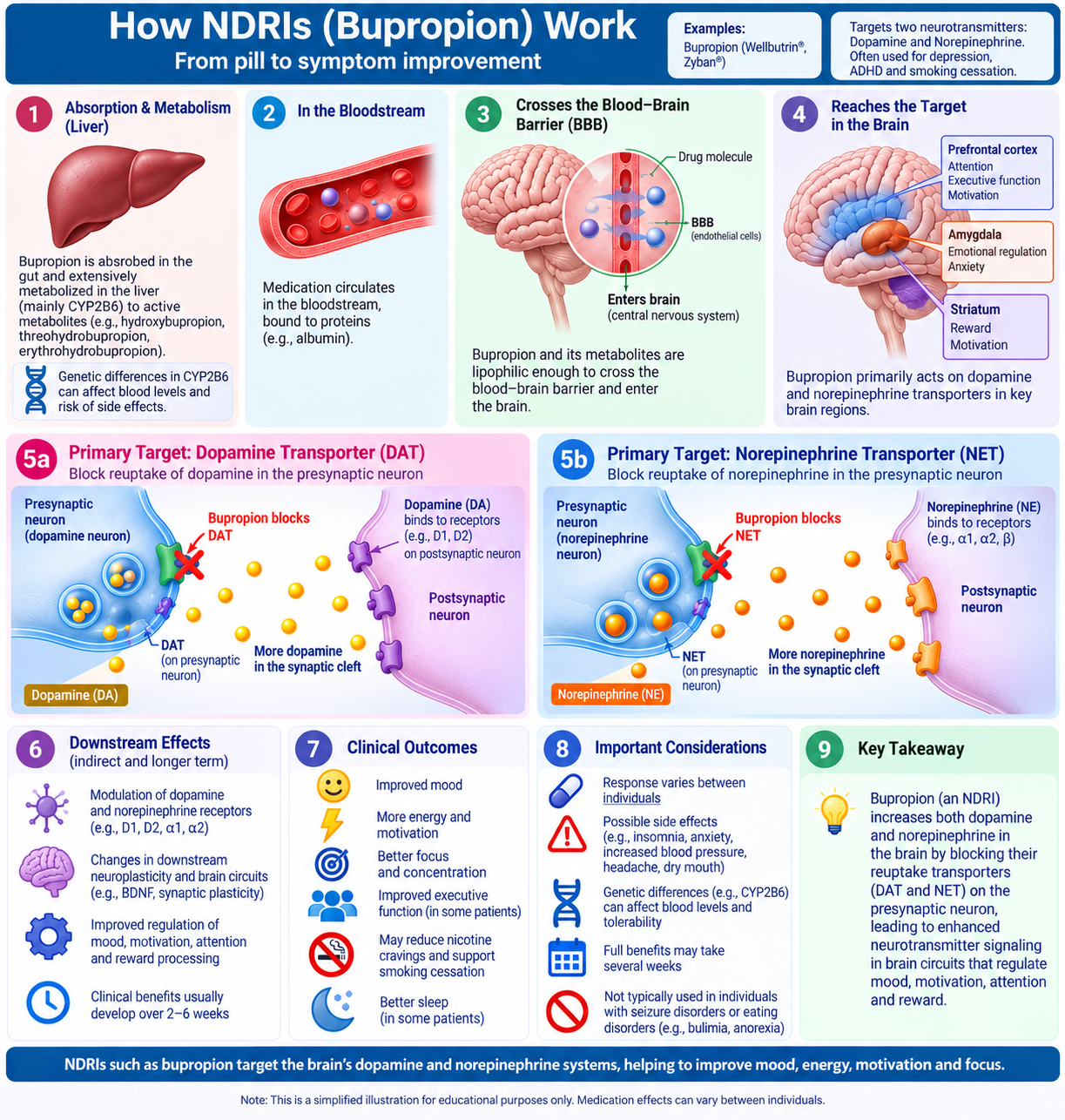
How Does Bupropion Work?
Bupropion works differently from SSRIs such as sertraline, escitalopram or fluoxetine.
It primarily influences two neurotransmitters:
- Norepinephrine
- Dopamine Bupropion reduces the reuptake of norepinephrine and dopamine by nerve cells. This allows these chemical messengers to remain available for signaling between neurons for longer.
The simplified pathway is:
- Bupropion
- Reduced norepinephrine and dopamine reuptake
- ↑ Norepinephrine and dopamine signaling
- Changes in brain circuits involved in mood, motivation, reward and attention
- Depressive symptoms may improve
The exact antidepressant mechanism is more complicated and is not completely understood. The official prescribing information describes bupropion as a relatively weak inhibitor of neuronal norepinephrine and dopamine uptake and notes that it does not inhibit serotonin reuptake.
What Does Bupropion Do to Dopamine?
Dopamine is involved in:
- Motivation
- Reward
- Pleasure
- Attention
- Concentration
- Goal-directed behaviour Bupropion reduces dopamine reuptake, helping maintain dopamine signaling in certain brain pathways.
This is one reason bupropion may be particularly useful for some people whose depression includes symptoms such as:
- Loss of motivation
- Reduced pleasure or enjoyment
- Mental sluggishness
- Difficulty concentrating
- Low drive However, depression is complex and these symptoms cannot be assumed to result simply from “low dopamine.”
What Does Bupropion Do to Norepinephrine?
Norepinephrine is involved in:
- Alertness
- Energy
- Attention
- Concentration
- Motivation
- Response to stress By reducing norepinephrine reuptake, bupropion can increase norepinephrine signaling.
This may contribute to improvements in:
- Energy
- Alertness
- Concentration
- Motivation For some people, however, increased norepinephrine or dopamine activity may also contribute to insomnia, agitation, tremor or anxiety, particularly early in treatment or after a dose increase.
Does Bupropion Increase Serotonin?
Bupropion is not an SSRI and does not significantly inhibit serotonin reuptake.
Its antidepressant effect is thought to occur primarily through norepinephrine and dopamine pathways, rather than directly increasing serotonin signaling.
This distinguishes bupropion from antidepressants such as:
- Sertraline
- Escitalopram
- Citalopram
- Fluoxetine
- Paroxetine which primarily act on the serotonin transporter.
How Does Bupropion Help with Smoking Cessation?
Bupropion can also reduce nicotine cravings and some symptoms associated with nicotine withdrawal.
Its effects on dopamine and norepinephrine appear to contribute, while bupropion and its metabolites also interact with certain nicotinic acetylcholine receptors involved in nicotine’s effects on the brain.
For smoking cessation, bupropion is commonly marketed as Zyban.
What Are the Common Side Effects of Bupropion?
Common side effects may include:
- Dry mouth
- Nausea
- Insomnia
- Dizziness
- Anxiety
- Agitation
- Tremor
- Increased sweating
- Reduced appetite
- Palpitations
- Headache in some patients Because bupropion can be activating, insomnia is particularly important. For this reason, once-daily extended-release bupropion is generally taken in the morning.
One of the most important risks associated with bupropion is seizure.
The risk is dose dependent, meaning that the likelihood increases as the dose and drug exposure increase.
For this reason:
- Bupropion doses should generally be increased gradually.
- Recommended maximum doses should not be exceeded.
- Different bupropion-containing products should not normally be taken together unless specifically directed by a healthcare professional. Bupropion is contraindicated in people with a seizure disorder and in people with a current or previous diagnosis of anorexia nervosa or bulimia nervosa because of increased seizure risk.
Bupropion is also contraindicated during abrupt withdrawal from alcohol, benzodiazepines, barbiturates or antiepileptic medications, because these situations can themselves increase seizure risk.
- Blood Pressure Bupropion can increase blood pressure in some people.
Blood pressure should therefore be considered before treatment and monitored when clinically appropriate, particularly in patients who already have hypertension or who are taking other medications that increase norepinephrine or dopamine activity.
- Mood Changes Like other antidepressants, bupropion carries warnings regarding worsening depression or the emergence of suicidal thoughts, particularly in children, adolescents and younger adults during the early stages of treatment or following dose changes.
Bupropion can also sometimes trigger mania or hypomania in susceptible individuals, particularly people with bipolar disorder.
Drug Interactions
Bupropion can interact with other medications.
A particularly important feature of bupropion is that:
Bupropion is metabolized/ broken mainly through liver enzyme CYP2B6, but bupropion itself can strongly inhibit another liver enzyme CYP2D6. These are two different drug-metabolizing enzymes.
MAO Inhibitors — Avoid/Contraindicated
Examples include:
- Phenelzine
- Tranylcypromine
- Isocarboxazid
- Selegiline at antidepressant doses Combining an MAOI with bupropion may cause serious reactions, including excessive increases in blood pressure.
At least 14 days should generally separate stopping an MAOI antidepressant and starting bupropion, or stopping bupropion and beginning an MAOI.
- Inhibit CYP2D6 This is one of the most clinically important bupropion drug interactions.
Bupropion and several of its metabolites inhibit the liver enzyme CYP2D6.
As a result:
- Bupropion
- CYP2D6 activity decreases
- Some CYP2D6 medications are metabolized more slowly
- Medication exposure may increase
This can affect antidepressants such as:
-
Venlafaxine
-
Nortriptyline
-
Imipramine
-
Desipramine
-
Paroxetine
-
Fluoxetine and antipsychotics such as:
-
Risperidone
-
Haloperidol It can also affect non-psychiatric medications such as metoprolol, flecainide and propafenone.
In one clinical interaction study, bupropion increased exposure to the CYP2D6 substrate desipramine by approximately five-fold, illustrating how clinically meaningful this inhibition can be.
Impact normal CYP2D6 activity
Bupropion can create an important pharmacogenomic situation known as phenoconversion.
For example, genetic testing may show:
CYP2D6 Normal Metabolizer
- But the patient begins bupropion.
- Bupropion inhibits CYP2D6
- The patient's actual CYP2D6 function may become substantially lower than their genetic result alone would predict.
This means that bupropion can affect the exposure of other CYP2D6 medications even when the patient has genetically normal CYP2D6 activity.
This can be particularly relevant when bupropion is combined with medications such as:
Amitriptyline, nortriptyline, venlafaxine, risperidone or aripiprazole.
- CYP2B6 Inhibitors Bupropion is converted into an important active metabolite called hydroxybupropion, primarily by the liver enzyme CYP2B6.
Medications that inhibit CYP2B6 can change the balance between bupropion and hydroxybupropion.
Examples include:
-
Clopidogrel
-
Ticlopidine Clinical studies have shown that these drugs can increase bupropion exposure while reducing formation of hydroxybupropion.
-
CYP2B6 Inducers Certain medications can increase CYP2B6 activity or otherwise increase bupropion metabolism.
Examples include:
- Carbamazepine
- Phenobarbital
- Phenytoin
- Efavirenz
- Ritonavir-containing regimens These interactions can alter concentrations of bupropion and its active metabolites and potentially influence treatment response.
Medications That Lower the Seizure Threshold
Because bupropion itself carries a dose-related seizure risk, additional caution is required with other medications that can lower the seizure threshold.
These can include certain:
-
Antidepressants
-
Antipsychotics
-
Systemic corticosteroids
-
Theophylline Treatment decisions should be individualized when these medications are used together.
-
Alcohol Alcohol can increase some of bupropion’s neurological risks.
The prescribing information recommends minimizing or avoiding alcohol during bupropion treatment. Abruptly stopping heavy alcohol use can also increase seizure risk and should be discussed with a healthcare professional.
Dosage
Bupropion comes in different formulations, including:
- Immediate release — IR
- Sustained release — SR
- Extended release — XL The dosing schedule depends on the formulation and the condition being treated.
Bupropion XL for Depression
For major depressive disorder, U.S. Wellbutrin XL prescribing information describes:
- Starting dose: 150 mg once daily in the morning
- After approximately 4 days, if appropriate:
300 mg once daily in the morning
The medication should be swallowed whole rather than crushed, divided or chewed.
Higher doses are used in certain circumstances and with specific bupropion formulations, but dosing should be determined by the prescribing healthcare professional because seizure risk increases with dose.
Bupropion for Seasonal Affective Disorder
For prevention of seasonal depressive episodes, extended-release bupropion is generally started before the person’s usual onset of seasonal symptoms.
The U.S. Wellbutrin XL label describes:
- 150 mg once daily
- After approximately one week if appropriate:
300 mg once daily
Treatment is generally continued through the season in which the person is at risk, with the timing individualized according to their history of seasonal depression.
Bupropion for Smoking Cessation
For smoking cessation, sustained-release bupropion is commonly given as:
- 150 mg once daily for the first 3 days
- 150 mg twice daily
with at least 8 hours between doses.
Treatment is generally started approximately one week before the planned quit date, allowing medication levels to build before smoking is stopped.
The actual dose and duration should be determined by a healthcare professional.
Should Bupropion Be Stopped Suddenly?
Bupropion generally produces fewer classic antidepressant discontinuation symptoms than many serotonergic antidepressants, but treatment should still be stopped in consultation with the prescribing healthcare professional.
For patients taking Wellbutrin XL 300 mg once daily, the U.S. product information recommends reducing the dose to 150 mg once daily before discontinuation.
The appropriate taper depends on:
- Current dose
- Formulation
- Duration of treatment
- Reason for treatment
- Previous withdrawal symptoms
- Risk of depressive symptoms returning There is therefore no single tapering schedule that is appropriate for everyone.
Frequently Asked Questions
Is Bupropion an antidepressant?
Yes. Bupropion is an antidepressant used primarily for major depressive disorder and seasonal affective disorder. It is also used under specific formulations for smoking cessation.
Is Bupropion an SSRI?
No.
Bupropion does not primarily work through serotonin. It mainly affects dopamine and norepinephrine signaling.
Does Bupropion increase dopamine?
Bupropion reduces dopamine reuptake, which can increase dopamine signaling in certain neural pathways. Dopamine is involved in motivation, reward, attention and pleasure.
Does Bupropion increase norepinephrine?
Bupropion reduces norepinephrine reuptake and thereby increases norepinephrine signaling. This may contribute to its effects on energy, alertness, concentration and motivation.
Does Bupropion increase serotonin?
Bupropion does not meaningfully inhibit serotonin reuptake and is not considered a serotonergic antidepressant in the same way as SSRIs.
Can Bupropion help with low motivation and low energy?
It may. Bupropion’s effects on dopamine and norepinephrine make it a commonly considered antidepressant when symptoms include low motivation, low energy or reduced concentration. Individual response varies considerably.
Does Bupropion cause sleepiness?
Bupropion is generally more activating than sedating. Insomnia is a common adverse effect, which is one reason extended-release bupropion is usually taken in the morning.
Can Bupropion cause anxiety?
It can in some people, particularly during the early stages of treatment or following dose increases. Others may experience improvement in anxiety as their depression improves.
Does Bupropion cause weight gain?
Bupropion is generally less associated with weight gain than many antidepressants and can reduce appetite in some people. However, individual responses vary.
Does Bupropion cause sexual side effects?
Bupropion generally has a lower likelihood of sexual dysfunction than many serotonergic antidepressants, although sexual side effects can still occur.
Can Bupropion help people stop smoking?
Yes. Bupropion is approved for smoking cessation and is marketed for this purpose under brands such as Zyban and Zyntabac.
Is Bupropion used for ADHD?
Bupropion is sometimes prescribed off-label for ADHD, particularly when ADHD occurs together with depression or when standard ADHD medications are not suitable.
How long does Bupropion take to work?
Some changes in energy, sleep or activation may occur earlier, but improvement in depression generally develops gradually over several weeks. Response time varies between individuals.
Why is Bupropion usually taken in the morning?
Because bupropion can be activating and can cause insomnia, extended-release formulations are generally taken in the morning.
Which liver enzyme metabolizes Bupropion?
CYP2B6 is the primary CYP enzyme responsible for converting bupropion into its active metabolite hydroxybupropion.
Is Bupropion metabolized by CYP2D6?
CYP2D6 is not the major metabolic pathway responsible for bupropion clearance.
Instead, bupropion is an important CYP2D6 inhibitor, meaning it can slow the metabolism of other medications that depend on CYP2D6.
Can Bupropion change my CYP2D6 status?
It does not change your genes, but it can substantially inhibit CYP2D6 activity.
Someone genetically classified as a CYP2D6 Normal Metabolizer may therefore function more like a slower metabolizer while taking bupropion.
Can genetics affect Bupropion side effects or effectiveness?
Genetic differences in CYP2B6 can alter how much bupropion is converted into hydroxybupropion. However, the connection between CYP2B6 genotype and clinical antidepressant response is still being studied and is not strong enough to reliably predict effectiveness for an individual patient.
Can Bupropion fail even if CYP2B6 metabolism is normal?
Yes.
Drug metabolism is only one part of antidepressant response. Bupropion must also produce appropriate changes in dopamine and norepinephrine pathways and those changes must address the biological mechanisms contributing to the person’s symptoms.
Should I change my Bupropion dose based on my genetic result?
No.
A CYP2B6 genetic result should not be used by a patient to change their own bupropion dose. Unlike some well-established pharmacogenomic drug-gene relationships, there is not currently a standard CYP2B6-based bupropion dosing algorithm endorsed by CPIC.
Can pharmacogenomic testing tell me whether Bupropion will work?
No pharmacogenomic test can guarantee whether bupropion will work.
PGx testing can provide information about drug metabolism and genetic factors that may influence treatment, but clinical response also depends on symptoms, diagnosis, drug interactions, other medications, dose, medical history and individual brain biology.
Why Pharmacogenomic Testing May Matter
Two people taking exactly the same dose of bupropion can have different concentrations of:
Bupropion and Hydroxybupropion. Genetic differences in CYP2B6 can contribute to these differences.
At the same time, because bupropion inhibits CYP2D6, it can substantially affect the metabolism of other psychiatric medications being taken at the same time.
A comprehensive pharmacogenomic assessment may therefore help a healthcare professional understand:
- How bupropion is likely to be metabolized
- Whether genetic differences may alter formation of hydroxybupropion
- Whether another medication may affect bupropion metabolism
- Whether bupropion may alter the metabolism of another medication
- Whether drug exposure may help explain side effects or treatment failure
- How metabolism fits with the patient’s overall medication strategy The genetic result should always be interpreted together with the patient’s symptoms, current medications, medical history, previous treatment response and side effects.
References
- [https://www.drugs.com/bupropion.html)
- https://www.accessdata.fda.gov/drugsatfda_docs/label/2022/021515s046lbl.pdf
- [https://dailymed.nlm.nih.gov/dailymed/drugInfo.cfm?setid=cbc8c074-f080-4489-a5ae-207b5fadeba3)
- [https://health-products.canada.ca/dpd-bdpp/search-fast-recherche-rapide?lang=eng&no=0131140003&no=0131140003)
This article is educational. It does not diagnose, and it does not replace advice from your prescriber or pharmacist. Never start, stop or change a medication based on a web page.