Medication profile
Sertraline (Zoloft)
Sertraline is one of the most widely used SSRIs.
 Written by Sanjida Ahmed, PhD, Cellular and Molecular BiologyChief Operating Officer and Lead Scientist, Personalized Prescribing. Last reviewed October 2, 2026.
- Best-known brand name
- Zoloft
- Medication class
- Selective Serotonin Reuptake Inhibitor — SSRI
- Canadian formulations
- Oral capsules, including 25 mg, 50 mg and 100 mg
On this page
- What You Need to Know About Sertraline
- Is Sertraline Available in Canada?
- What Is Sertraline Used For?
- Is Sertraline Used for Other Anxiety Disorders?
- Is Sertraline Approved for Children in Canada?
- How Does Sertraline Work?
- Does Sertraline Increase Dopamine?
- Does Sertraline Increase Norepinephrine?
- How Long Does Sertraline Take to Work?
- What Are the Common Side Effects of Sertraline?
- Why Does Sertraline Cause Nausea and Diarrhea?
- Does Sertraline Cause Sexual Side Effects?
- Why Does Sertraline Cause Sexual Dysfunction?
- Does Sertraline Cause Sleepiness or Insomnia?
- Does Sertraline Cause Weight Gain?
- Can Sertraline Initially Increase Anxiety?
- What Is Akathisia?
- Can Sertraline Cause Serotonin Syndrome?
- Serotonin Toxicity — Serotonin Syndrome
- Sertraline and MAO Inhibitors
- Why Is Pimozide Contraindicated with Sertraline?
- Can Sertraline Increase Bleeding Risk?
- Can Sertraline Cause Low Sodium?
- SIADH — Syndrome of Inappropriate Antidiuretic Hormone Secretion
- Can Sertraline Trigger Mania?
- Can Sertraline Affect the Heart?
- Can Sertraline Cause Angle-Closure Glaucoma?
- Sertraline and Seizures
- Sertraline and Pregnancy
- Potential risks
- Sertraline Drug Interactions
- Sertraline and CYP2D6 Drug Interactions
- Sertraline and Warfarin, Aspirin or NSAIDs
- Sertraline and Cimetidine
- Sertraline and Phenytoin
- Sertraline and Lithium
- Sertraline and QT-Prolonging Medications
- Sertraline and Alcohol
- Sertraline Dosage in Canada
- One week
- Why Is Sertraline Started at 25 mg for panic disorder?
- Should Sertraline Be Taken with Food?
- With food once daily
- With breakfast
- Can Sertraline Be Taken in the Morning or at Night?
- Morning with breakfast
- Sertraline and Liver Impairment
- A lower dose
- Less frequent dosing
- Sertraline and Kidney Impairment
- How Long Does Sertraline Stay in the Body?
- 26 hours
- 65 hours
- Does Sertraline Need to Be Tapered?
- Is Sertraline Addictive?
- Frequently Asked Questions About Sertraline
- Does Sertraline Cause Diarrhea?
- Slower titration
- Can SLC6A4 Predict Whether Sertraline Will Work?
Sertraline is an SSRI antidepressant used primarily to treat depression, panic disorder and obsessive-compulsive disorder (OCD). In Canada, these are the approved adult indications in the current Zoloft product monograph. Health Canada currently lists branded Zoloft and multiple generic sertraline products as marketed.
Sertraline works primarily by blocking:
SERT — Serotonin Transporter
SERT normally transports serotonin back into the neuron after it has been released.
The simplified mechanism is:
- Sertraline
- Blocks SERT
- Serotonin reuptake decreases
- More serotonin remains available between neurons
- Serotonin-receptor signaling changes
- Mood, anxiety and repetitive-thinking networks gradually adapt
- Depression, panic or OCD symptoms may improve
Sertraline is a potent serotonin-reuptake inhibitor and has only very weak direct effects on norepinephrine and dopamine reuptake at clinically relevant concentrations.
What You Need to Know About Sertraline
Sertraline is one of the most widely used SSRIs. Important characteristics include relatively selective serotonin-transporter inhibition, once-daily dosing, a half-life of about 26 hours, clinically important gastrointestinal and sexual side effects, and meaningful pharmacogenomic relationships with CYP2C19 and, to a lesser extent, CYP2B6.
Important issues to know about sertraline include:
- Nausea and diarrhea
- Insomnia or sleepiness
- Sexual dysfunction
- Tremor and sweating
- Initial activation or increased anxiety in some patients
- Serotonin toxicity
- Bleeding risk
- Hyponatremia
- Discontinuation symptoms
- Possible activation of mania or hypomania
- Drug interactions
- CYP2C19 and CYP2B6 pharmacogenomics
Is Sertraline Available in Canada?
Yes.
Health Canada currently lists Zoloft 25 mg, 50 mg and 100 mg as marketed, along with numerous generic sertraline products in the same strengths.
The current Canadian Zoloft product is supplied as:
- 25 mg capsules
- 50 mg capsules
- 100 mg capsules.
What Is Sertraline Used For?
Current Canadian Zoloft labeling authorizes sertraline for adults with: Depression
Sertraline is approved for symptomatic relief of depressive illness.
Symptoms of depression can include:
- Persistent low mood
- Loss of interest or pleasure
- Fatigue
- Reduced motivation
- Difficulty concentrating
- Sleep changes
- Appetite changes
- Negative or repetitive thinking Sertraline does not work by simply correcting a supposed “serotonin deficiency.” Depression involves dysregulation across multiple neural systems, with serotonin being one important component.
Sertraline for Panic Disorder
Sertraline is approved in Canada for: Panic disorder with or without agoraphobia.
Panic disorder can involve:
- Sudden panic attacks
- Rapid heartbeat
- Shortness of breath
- Trembling
- Dizziness
- Fear of losing control
- Anticipatory anxiety
- Avoidance of situations associated with previous attacks Sertraline is typically started more cautiously for panic disorder because SSRIs can temporarily increase anxiety or activation early in treatment.
Sertraline for Obsessive-Compulsive Disorder — OCD
Sertraline is also approved in Canada for: Obsessive-Compulsive Disorder
OCD commonly involves: Obsessions -recurrent intrusive thoughts, images or urges and: Compulsions- repetitive behaviours or mental rituals performed to reduce distress.
Sertraline changes serotonin signaling within brain circuits involved in repetitive thought and behavioural control, including cortico-striatal networks.
Is Sertraline Used for Other Anxiety Disorders?
Yes, clinicians may prescribe sertraline for other psychiatric conditions based on evidence and individual clinical judgment.
However, for a Canadian website, it is important to distinguish approved indications from off-label use.
The current Canadian Zoloft monograph specifically lists:
- Depression
- Panic disorder
- OCD as the approved adult indications.
Other uses should therefore be identified as off-label in Canada rather than automatically presented as Health Canada-approved indications.
Is Sertraline Approved for Children in Canada?
No.
Health Canada has not authorized a pediatric indication for Zoloft in patients under 18 years of age.
This differs from U.S. labeling, so Canadian and U.S. approved indications should not be assumed to be identical.
How Does Sertraline Work?
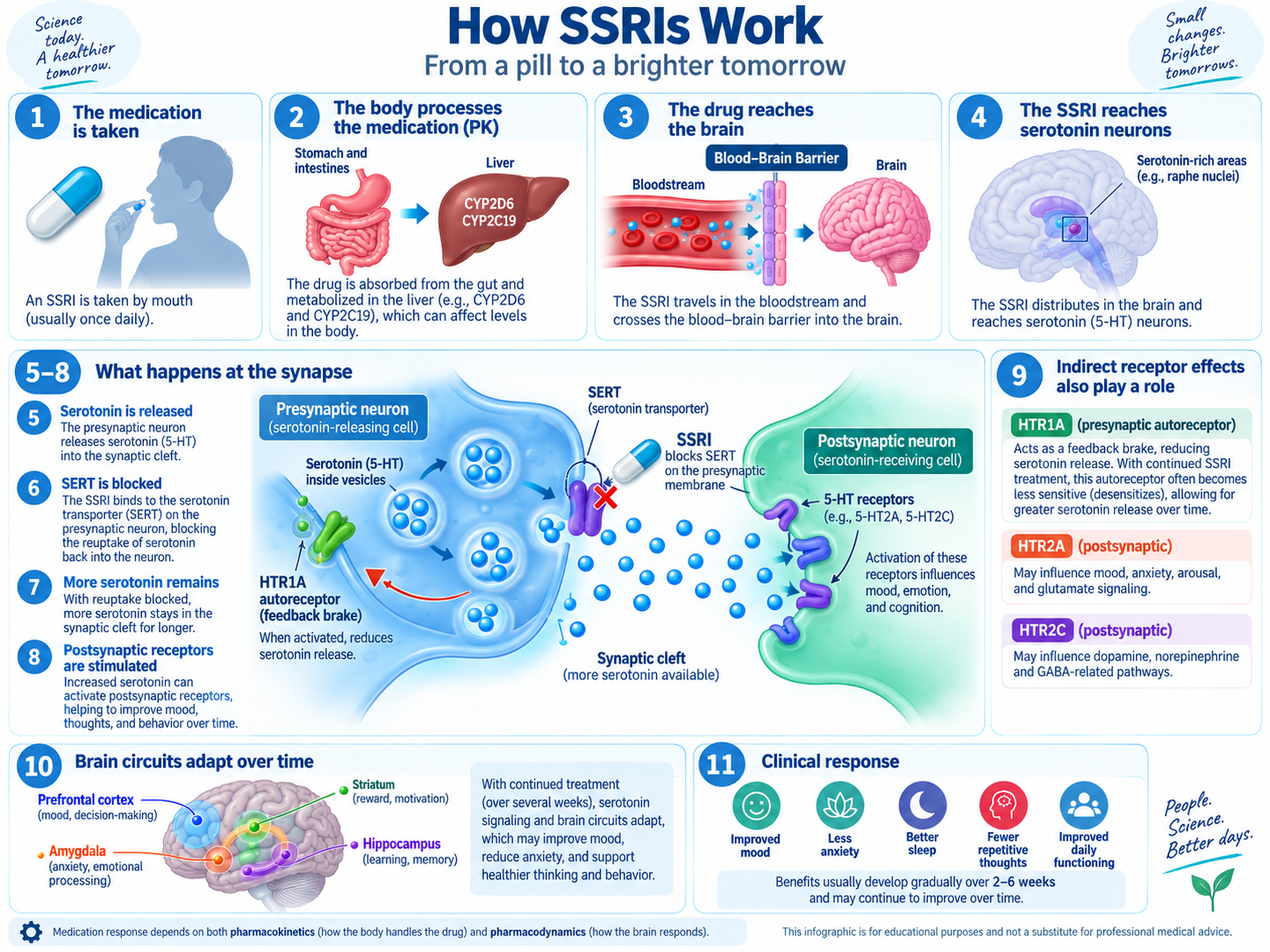
Sertraline primarily inhibits:
SERT — Serotonin Transporter which is encoded by: SLC6A4
Normally:
- Serotonin is released
- Serotonin activates receptors
- SERT transports serotonin back into the neuron
Sertraline blocks SERT.
Therefore:
- Sertraline
- SERT inhibition
- Serotonin reuptake decreases
- Extracellular serotonin remains available longer
- Serotonin-receptor signaling changes
- Neural networks gradually adapt
- Symptoms may improve
Sertraline has only weak direct effects on norepinephrine and dopamine transporters and does not significantly bind most adrenergic, muscarinic, histamine or dopamine receptors.
Does Sertraline Increase Dopamine?
Not significantly as its primary mechanism.
Sertraline has only: Very weak direct dopamine-reuptake inhibition compared with its strong SERT inhibition.
It is therefore more accurate to describe sertraline as: Predominantly serotonergic rather than as a serotonin-dopamine antidepressant.
Serotonin and dopamine systems interact, so indirect dopamine effects can occur downstream, but these are not sertraline’s principal therapeutic mechanism.
Does Sertraline Increase Norepinephrine?
Not substantially through direct transporter blockade.
Its effect on: NET — Norepinephrine Transporter is weak compared with its effect on SERT.
This distinguishes sertraline from SNRIs such as:
- Duloxetine
- Venlafaxine
- Levomilnacipran which directly inhibit both SERT and NET.
How Long Does Sertraline Take to Work?
Sertraline begins inhibiting SERT relatively quickly, but clinical improvement takes longer because downstream serotonin receptors and neural networks must adapt.
Canadian labeling notes that the full therapeutic response may take: 4 weeks or longer.
The process can be represented as:
- Sertraline blocks SERT
- Serotonin signaling changes
- Autoreceptor feedback changes
- Downstream receptor systems adapt
- Neural-network function changes
- Clinical improvement develops
Increasing the dose rapidly does not normally shorten this delay and may increase side effects.
What Are the Common Side Effects of Sertraline?
The most frequently reported effects in Canadian depression trials included gastrointestinal symptoms, sleep changes, sexual dysfunction, tremor, sweating and dizziness.
In placebo-controlled depression trials, reported rates included approximately:
| Side effect | Sertraline | Placebo |
|---|---|---|
| Nausea | 26.1% | 11.8% |
| Diarrhea / loose stools | 17.7% | 9.3% |
| Insomnia | 16.4% | 8.8% |
| Dry mouth | 16.3% | 9.3% |
| Male sexual dysfunction | 15.5% | 2.2% |
| Somnolence | 13.4% | 5.9% |
| Dizziness | 11.7% | 6.7% |
| Tremor | 10.7% | 2.7% |
| Fatigue | 10.6% | 8.1% |
| Increased sweating | 8.4% | 2.9% |
These percentages come from older controlled clinical trials and do not necessarily predict what an individual patient will experience.
Why Does Sertraline Cause Nausea and Diarrhea?
Much of the body’s serotonin system is located in the gastrointestinal tract.
When sertraline blocks SERT:
- Serotonin signaling increases in the gut
- GI serotonin receptors are stimulated
- Possible:
Nausea Diarrhea Indigestion
This is one reason gastrointestinal symptoms are especially common when sertraline is first started.
They often lessen as the body adapts.
Does Sertraline Cause Sexual Side Effects?
Yes.
Possible effects include:
- Reduced libido
- Delayed ejaculation
- Erectile dysfunction
- Difficulty reaching orgasm
- Reduced sexual arousal In Canadian depression trials, male sexual dysfunction was reported in approximately 15.5% of sertraline-treated men, including decreased libido, erectile difficulties and delayed ejaculation.
The actual frequency in clinical practice may be higher because sexual symptoms are often underreported.
The Canadian monograph also notes reports of long-lasting sexual dysfunction that continued after discontinuation of an SSRI.
Why Does Sertraline Cause Sexual Dysfunction?
Increasing serotonin can inhibit pathways involved in sexual function.
Conceptually:
- Sertraline
- SERT inhibition
- Serotonin signaling increases
- 5-HT2-related and other serotonin pathways change
- Dopamine and sexual reflex pathways may be inhibited
- Possible:
- Reduced desire
- Delayed ejaculation
- Delayed orgasm
- Erectile difficulty Sexual dysfunction can also be caused by depression or anxiety themselves, so the cause should be evaluated individually.
Does Sertraline Cause Sleepiness or Insomnia?
Either can occur.
Some patients experience: Somnolence while others experience: Insomnia
In Canadian depression trials, insomnia occurred in about 16.4% and somnolence in about 13.4% of sertraline-treated patients.
This is why the best time of day to take sertraline can vary according to individual response.
Canadian Zoloft labeling recommends taking it once daily with food, either with breakfast or the evening meal.
Does Sertraline Cause Weight Gain?
It can, particularly during longer-term treatment, but not everyone gains weight.
Early treatment may actually cause:
-
Nausea
-
Reduced appetite
-
Gastrointestinal symptoms while longer-term changes can reflect:
-
Appetite recovery
-
Serotonin signaling
-
Reduced or increased activity
-
Sleep changes
-
Improvement in depression
-
Individual metabolic susceptibility Weight change is therefore not predictable from sertraline use alone.
Can Sertraline Initially Increase Anxiety?
Yes.
Early in SSRI treatment, increased serotonin signaling can temporarily produce:
- Jitteriness
- Anxiety
- Restlessness
- Agitation
- Insomnia
- Tremor This can be particularly important in people with panic disorder.
That is why the Canadian starting dose for panic disorder is lower than for depression or OCD.
What Is Akathisia?
Sertraline can occasionally cause: Akathisia which is an uncomfortable sense of internal restlessness.
Symptoms may include:
- Feeling unable to sit still
- Pacing
- Repetitive movement
- Feeling compelled to move Canadian labeling notes that akathisia is most likely to occur during the first several weeks and that increasing the dose may be detrimental if akathisia develops.
Can Sertraline Cause Serotonin Syndrome?
Yes.
Serotonin Toxicity — Serotonin Syndrome
is a rare but potentially life-threatening condition caused by excessive serotonergic activity.
Symptoms may include:
- Agitation
- Confusion
- Sweating
- Fever
- Diarrhea
- Tremor
- Muscle twitching
- Clonus
- Hyperreflexia
- Muscle rigidity
- Rapid heart rate Risk increases when sertraline is combined with other serotonergic medications.
Sertraline and MAO Inhibitors
Sertraline must not be combined with: Monoamine Oxidase Inhibitors — MAOIs because of the risk of severe serotonin toxicity.
Canadian labeling requires at least: 14 days between stopping an MAOI and starting sertraline,
and at least: 14 days between stopping sertraline and starting an MAOI.
Relevant drugs can include:
- Phenelzine
- Tranylcypromine
- Selegiline
- Moclobemide
- Linezolid
- Intravenous methylene blue depending on dose and clinical circumstances.
Why Is Pimozide Contraindicated with Sertraline?
Sertraline can increase pimozide concentrations.
In an interaction study, sertraline increased pimozide exposure by approximately: 40% and pimozide has a narrow therapeutic index with clinically important QT-related cardiac risk.
Therefore:
Sertraline + pimozide is contraindicated.
Can Sertraline Increase Bleeding Risk?
Yes.
Platelets depend on serotonin for normal function.
When sertraline blocks SERT:
- Platelet serotonin uptake decreases
- Platelet aggregation can become less effective
- Bleeding risk may increase
Risk is greater when sertraline is combined with:
- Aspirin
- Ibuprofen
- Naproxen
- Other NSAIDs
- Warfarin
- Dabigatran
- Other anticoagulants
- Antiplatelet medications Canadian labeling warns that SSRI-associated bleeding can range from bruising and nosebleeds to serious gastrointestinal or other hemorrhage.
Can Sertraline Cause Low Sodium?
Yes.
Sertraline can cause:
Hyponatremia
often through:
SIADH — Syndrome of Inappropriate Antidiuretic Hormone Secretion
Risk is greater in:
-
Older adults
-
People taking diuretics
-
People who are dehydrated or volume depleted Possible symptoms include:
-
Headache
-
Confusion
-
Weakness
-
Difficulty concentrating
-
Unsteadiness Severe cases can cause seizures, coma and other serious complications.
Can Sertraline Trigger Mania?
Yes.
Antidepressants can sometimes precipitate: Mania or: Hypomania in people with bipolar vulnerability.
During clinical testing, mania or hypomania occurred in approximately 0.6% of sertraline-treated depressed patients.
Possible symptoms include:
- Reduced need for sleep
- Racing thoughts
- Increased energy
- Grandiosity
- Excessive activity
- Unusual impulsivity Bipolar disorder should therefore be considered when clinically appropriate.
Can Sertraline Affect the Heart?
Sertraline generally has relatively modest cardiac effects at normal therapeutic exposure, but:
QT prolongation and: Torsade de Pointes have been reported, including rarely at therapeutic doses.
Most reported cases involved additional risk factors such as:
- Other QT-prolonging medications
- Electrolyte abnormalities
- Cardiac disease
- Overdose Canadian labeling recommends caution in patients with significant QT risk.
Can Sertraline Cause Angle-Closure Glaucoma?
Rarely.
Sertraline can cause pupil dilation, which may trigger acute angle closure in someone with anatomically narrow drainage angles.
Urgent medical attention is needed for:
- Sudden eye pain
- Red eye
- Blurred vision
- Halos
- Sudden vision change Canadian labeling specifically warns about this risk.
Sertraline and Seizures
Sertraline should be used cautiously in people with a seizure disorder.
Canadian labeling recommends avoiding it in: Unstable epilepsy and closely monitoring patients with controlled epilepsy.
Sertraline and Pregnancy
Sertraline use during pregnancy requires individualized assessment of:
Benefits
versus:
Potential risks
The Canadian monograph identifies several considerations, including a possible small increase in certain neonatal risks, persistent pulmonary hypertension of the newborn (PPHN) with later pregnancy SSRI exposure, neonatal adaptation symptoms after late pregnancy exposure, and a higher risk of postpartum hemorrhage near delivery.
A patient should not abruptly stop sertraline after discovering a pregnancy, because sudden discontinuation can cause withdrawal symptoms and psychiatric relapse. Treatment decisions should be made with the treating clinician.
Sertraline Drug Interactions
Important interactions include: Other Serotonergic Medications
Combining sertraline with medications that increase serotonin can increase serotonin-toxicity risk.
Examples include:
- Other SSRIs or SNRIs
- Tricyclic antidepressants
- Tramadol
- Fentanyl
- Methadone
- Dextromethorphan
- Triptans
- Lithium
- Amphetamines
- St. John’s Wort The combination is not automatically prohibited in every case, but it requires medication-specific assessment and monitoring.
Sertraline and CYP2D6 Drug Interactions
Sertraline can inhibit: CYP2D6 but generally less strongly than paroxetine or fluoxetine.
In interaction studies, sertraline increased exposure to the CYP2D6 substrate desipramine by approximately: 23–37%
whereas comparator SSRIs produced several-fold larger increases.
Therefore, sertraline may increase concentrations of some CYP2D6 substrates, including certain:
- Tricyclic antidepressants
- Type Ic antiarrhythmics
- Other CYP2D6-dependent medications This can be particularly important with drugs that have a narrow therapeutic index.
Sertraline and Warfarin, Aspirin or NSAIDs
Combining sertraline with medications that affect clotting can increase bleeding risk.
Examples include:
- Warfarin
- Aspirin
- Ibuprofen
- Naproxen
- Other NSAIDs
- Anticoagulants Canadian interaction data also found a small increase in prothrombin time during warfarin coadministration, and careful monitoring is recommended when sertraline is started or stopped in someone taking warfarin.
Sertraline and Cimetidine
Cimetidine can inhibit sertraline metabolism.
In an interaction study:
- Cimetidine
- Sertraline metabolism decreased
- Sertraline Cmax and AUC increased
Long-term clinical significance is uncertain, but the interaction can be relevant in susceptible patients.
Sertraline and Phenytoin
The interaction is not completely characterized.
Canadian labeling recommends monitoring: Phenytoin concentrations after sertraline is initiated, with adjustment if clinically necessary.
Sertraline and Lithium
Sertraline does not appear to substantially change lithium pharmacokinetics, but the combination increased: Tremor in a controlled interaction study.
Because both can influence serotonergic pathways, clinical monitoring is recommended.
Sertraline and QT-Prolonging Medications
Combining sertraline with drugs that clearly prolong QT is discouraged when possible because additive QT effects cannot be excluded.
Examples can include selected:
- Antiarrhythmics
- Antipsychotics
- Antidepressants
- Macrolide antibiotics
- Fluoroquinolones
- Azole antifungals
- Methadone especially when other QT risk factors are present.
Sertraline and Alcohol
The Canadian patient information recommends: Avoiding alcohol while taking Zoloft.
Even when sertraline does not directly potentiate alcohol pharmacologically in controlled healthy-volunteer studies, alcohol can worsen:
- Depression
- Anxiety
- Sleep
- Judgment
- Dizziness
- Sedation and therefore, remains clinically important.
Sertraline Dosage in Canada
Canadian dosing differs according to indication.
| Condition | Starting dose | Typical range | Maximum |
|---|---|---|---|
| Depression | 50 mg once daily | 50–200 mg/day | 200 mg/day |
| OCD | 50 mg once daily | 50–200 mg/day | 200 mg/day |
| Panic disorder | 25 mg once daily for 1 week, then 50 mg/day | 50–200 mg/day | 200 mg/day |
Dose increases, when needed, should generally occur at intervals of at least:
One week
because sertraline reaches steady-state concentrations after approximately one week of once-daily dosing.
These are product-label recommendations, not individualized prescribing instructions.
Why Is Sertraline Started at 25 mg for panic disorder?
People with panic disorder can be particularly sensitive to early SSRI activation.
Starting too high may increase:
- Anxiety
- Jitteriness
- Restlessness
- Tremor
- Panic symptoms The Canadian product monograph therefore recommends: 25 mg once daily initially followed after one week by: 50 mg once daily depending on tolerability and clinical response.
Should Sertraline Be Taken with Food?
For Canadian Zoloft:
Yes
The current Canadian monograph recommends taking it:
With food once daily
either:
With breakfast
or:
With the evening meal.
Food increased sertraline bioavailability by approximately 40% in the Canadian pharmacokinetic data.
Can Sertraline Be Taken in the Morning or at Night?
Yes.
Canadian labeling allows either:
Morning with breakfast
or:
Evening with the evening meal.
The choice can be individualized.
For example:
- If sertraline causes insomnia, morning may be preferred.
- If it causes sleepiness, evening may be preferred.
Sertraline and Liver Impairment
Sertraline is extensively metabolized by the liver.
Liver impairment can cause:
- Longer half-life
- Higher drug exposure The Canadian monograph recommends caution and consideration of:
A lower dose
or:
Less frequent dosing
in hepatic impairment.
Moderate and severe hepatic impairment have not been adequately studied in the Canadian labeling.
Sertraline and Kidney Impairment
Kidney function has comparatively little effect on parent sertraline exposure because:
Very little unchanged sertraline is excreted in urine.
Studies in mild through severe renal impairment found no clinically meaningful difference in sertraline exposure.
Therefore:
Sertraline dosage generally does not need to be adjusted solely because of renal impairment.
How Long Does Sertraline Stay in the Body?
The average terminal half-life of sertraline is approximately:
26 hours
which supports:
Once-daily dosing.
The major metabolite:
N-Desmethylsertraline
has a longer half-life of approximately:
65 hours
but has negligible pharmacological activity compared with parent sertraline.
Steady state is generally reached in approximately:
One week.
Does Sertraline Need to Be Tapered?
Generally:
Yes.
Abrupt discontinuation can cause:
- Dizziness
- Abnormal dreams
- Tingling
- Electric-shock sensations
- Anxiety
- Agitation
- Headache
- Tremor
- Nausea
- Sweating
- Fatigue Canadian labeling recommends:
Gradually reducing the dose over several weeks whenever possible.
There is no single taper schedule appropriate for everyone.
The taper should depend on:
- Current dose
- Duration of treatment
- Previous withdrawal symptoms
- Diagnosis
- Other medications
- Individual sensitivity Withdrawal symptoms represent physiological adaptation and should not automatically be confused with addiction.
Is Sertraline Addictive?
Sertraline does not produce the characteristic:
- Euphoria
- Craving
- Drug-seeking behaviour associated with addictive substances.
Controlled studies did not show the abuse-liability profile seen with medications such as amphetamines or benzodiazepines.
However, physical adaptation can occur, which explains why abrupt withdrawal may produce discontinuation symptoms.
Frequently Asked Questions About Sertraline
Is Sertraline the Same as Zoloft?
Yes.
Zoloft is the original and best-known brand name for sertraline and remains marketed in Canada.
Is Sertraline an SSRI?
Yes.
It is a: Selective Serotonin Reuptake Inhibitor.
Does Sertraline Increase Serotonin?
Yes, indirectly.
It blocks SERT, reducing serotonin reuptake and allowing more serotonin to remain available between neurons.
Does Sertraline Increase Dopamine?
Only very weakly through direct dopamine-transporter effects. Its primary action is serotonin reuptake inhibition.
Does Sertraline Increase Norepinephrine?
Only very weakly through direct NET effects. It is not an SNRI.
Is Sertraline Used for Anxiety?
Yes. In Canada, panic disorder is an approved indication. Other anxiety-related uses may be prescribed off-label depending on the clinical situation.
Is Sertraline Used for OCD?
Yes.
OCD is a Health Canada-approved adult indication.
Does Sertraline Cause Diarrhea?
It can. Diarrhea or loose stools were reported in about 17.7% of sertraline-treated patients in Canadian depression trials.
Does Sertraline Cause Sexual Dysfunction?
Yes.
Reduced libido, erectile dysfunction, delayed ejaculation and orgasm difficulties can occur.
Does Sertraline Cause Weight Gain?
It can, especially with longer-term treatment, but weight responses vary considerably.
Does Sertraline Make You Sleepy?
It can cause either sleepiness or insomnia, depending on the individual.
Does Sertraline Need to Be Tapered?
Usually yes.
Canadian labeling recommends gradual reduction over several weeks rather than abrupt cessation whenever possible.
Which Gene Is Most Important for Sertraline?
For established pharmacokinetics: CYP2C19 is the principal actionable gene, with: CYP2B6 providing additional clinically relevant information.
Does CYP2C19 Poor Metabolizer Status Matter?
Yes.
CPIC recommends considering a lower starting dose, slower titration and approximately 50% lower maintenance dose, or an alternative antidepressant.
Does CYP2C19 Intermediate Metabolizer Status Matter?
Potentially.
CPIC recommends the standard starting dose but suggests considering:
Slower titration
and:
Lower maintenance dosing.
Do CYP2C19 Rapid or Ultrarapid Metabolizers Need a Higher Dose?
Not routinely.
CPIC recommends starting at the standard dose because the increase in sertraline metabolism is usually modest.
Does CYP2B6 Matter?
Yes, but generally less strongly than CYP2C19.
CYP2B6 Poor Metabolizers may warrant a lower starting dose, slower titration and approximately 25% lower maintenance dose, or an alternative medication.
Can SLC6A4 Predict Whether Sertraline Will Work?
Not reliably enough for routine prescribing.
SLC6A4 directly encodes sertraline’s SERT target, but CPIC concluded that current evidence is insufficient for genotype-guided antidepressant prescribing.
References
- https://pdf.hres.ca/dpd_pm/00072140.PDF
- [https://health-products.canada.ca/dpd-bdpp/search-fast-recherche-rapide?lang=eng&no=0123417001&no=0123417001)
- [https://health-products.canada.ca/dpd-bdpp/search-fast-recherche-rapide?lang=eng&no=0123417002&no=0123417002)
- [https://health-products.canada.ca/dpd-bdpp/search-fast-recherche-rapide?lang=eng&no=0123417003&no=0123417003)
- [https://dailymed.nlm.nih.gov/dailymed/drugInfo.cfm?setid=56442b06-c135-a035-e063-6394a90a171b)
This article is educational. It does not diagnose, and it does not replace advice from your prescriber or pharmacist. Never start, stop or change a medication based on a web page.