
Paroxetine · How it works
How Does Paroxetine Work?
Paroxetine, best known by the brand name Paxil, is a Selective Serotonin Reuptake Inhibitor (SSRI) used to treat depression and several anxiety-related condit
 Written by Sanjida Ahmed, PhD, Cellular and Molecular BiologyChief Operating Officer and Lead Scientist, Personalized Prescribing. Last reviewed October 2, 2026.
- Class
- SSRI (selective serotonin reuptake inhibitor)
On this page
- How Does Paroxetine Work for Depression?
- “Low serotonin.”
- What Is SERT?
- Does Paroxetine Increase Serotonin?
- Normal serotonin signaling
- With paroxetine
- Selective Serotonin Reuptake Inhibitor
- Why Doesn’t Paroxetine Work Immediately?
- Several weeks
- What is Serotonin Autoreceptors?
- 5-HT1A Autoreceptor
- Raphe nuclei
- Which Serotonin Receptors Does Paroxetine Affect?
- 5-HT1A-related signaling
- 5-HT2-related signaling
- 5-HT3 signaling
- Therapeutic effects
- Side effects
- How Does Paroxetine Work for Anxiety?
- How Does Paroxetine Affect the Amygdala?
- How Does Paroxetine Work for Panic Disorder?
- Fear circuits
- Sympathetic arousal
- How Does Paroxetine Work for Generalized Anxiety Disorder?
- How Does Paroxetine Work for Social Anxiety Disorder?
- How Does Paroxetine Work for OCD?
- Cortico-Striato-Thalamo-Cortical Circuits
- How Does Paroxetine Work for PTSD?
- SERT inhibition
- Serotonin signaling changes
- Threat + memory + emotional-control circuits adapt
- Hyperreactivity and intrusive symptoms may decrease
- Does Paroxetine Increase Dopamine?
- DAT — Dopamine Transporter
- Downstream effects
- Does Paroxetine Increase Norepinephrine?
- NET — Norepinephrine Transporter
- SERT + NET
- Why Can Paroxetine Initially Make Someone More Anxious?
- early pharmacological effects
- later therapeutic adaptation
- Why Can Paroxetine Cause Nausea?
- Why Can Paroxetine Cause Sexual Dysfunction?
- Why Can Paroxetine Cause Emotional Blunting?
- Positive emotional intensity may also decrease
- Why Can Paroxetine Cause Sleepiness?
- Why Can Paroxetine Cause Weight Gain?
- How Is Paroxetine Different from Fluoxetine?
- How Is Paroxetine Different from Escitalopram?
- How Is Paroxetine Different from Sertraline?
- CYP2D6 inhibition
- Why Does Paroxetine Cause More Discontinuation Symptoms Than Some SSRIs?
- 21 hours
- How Is Paroxetine Metabolized?
- What Is CYP2D6 Autoinhibition?
- A CYP2D6 substrate
- A strong CYP2D6 inhibitor
- Nonlinear Pharmacokinetics
- What Does Nonlinear Pharmacokinetics Mean?
- Double the dose
- Double the exposure
- What Is Phenoconversion with Paroxetine?
- Genetic CYP2D6 status
- Actual functional CYP2D6 activity
- CYP2D6 Normal Metabolizer
- Intermediate or Poor Metabolizer
- Why Does Paroxetine Interact with So Many Medications?
- Cleared more slowly
- Activated less effectively
- Why Is the Tamoxifen Interaction Important?
- How Does CYP2D6 Genotype Affect Paroxetine?
- Consider a lower starting dose and slower titration
- 50% lower starting dose
- 50% lower maintenance dose
- Slower titration
- CPIC CYP2D6 Recommendations for Paroxetine
- Does CYP2C19 Affect Paroxetine?
- What Is the Role of SLC6A4 Genetics?
- SLC6A4 is directly relevant to paroxetine pharmacology
- What Is the Role of HTR1A?
- 5-HT1A Receptor
- Presynaptic autoreceptors
- Postsynaptic receptors
- What Is the Role of HTR2A Genetics?
- 5-HT2A Serotonin Receptor
- What Is the Role of HTR2C?
- 5-HT2C receptor
- Can Pharmacogenomic Testing Predict Whether Paroxetine Will Work?
- Drug exposure
- CYP2D6 → Pharmacokinetics
- Can Paroxetine Fail Even When CYP2D6 Metabolism Is Normal?
- Pharmacokinetics — PK
- Pharmacodynamics — PD
- Normal paroxetine exposure
- Why Can Two People Taking the Same Paroxetine Dose Respond Differently?
- 20 mg of paroxetine
- Excellent improvement in anxiety and depression
- Nausea, sexual dysfunction and emotional blunting
- Almost no benefit
- Different Drug Exposure
- Different SERT Biology
- Different Serotonin Receptor Biology
- Different Symptom Biology
- Anxiety + repetitive thinking + threat reactivity
- Low motivation + anhedonia + fatigue
Paroxetine, best known by the brand name Paxil, is a Selective Serotonin Reuptake Inhibitor (SSRI) used to treat depression and several anxiety-related conditions, including panic disorder, generalized anxiety disorder, social anxiety disorder, obsessive-compulsive disorder (OCD) and posttraumatic stress disorder (PTSD).
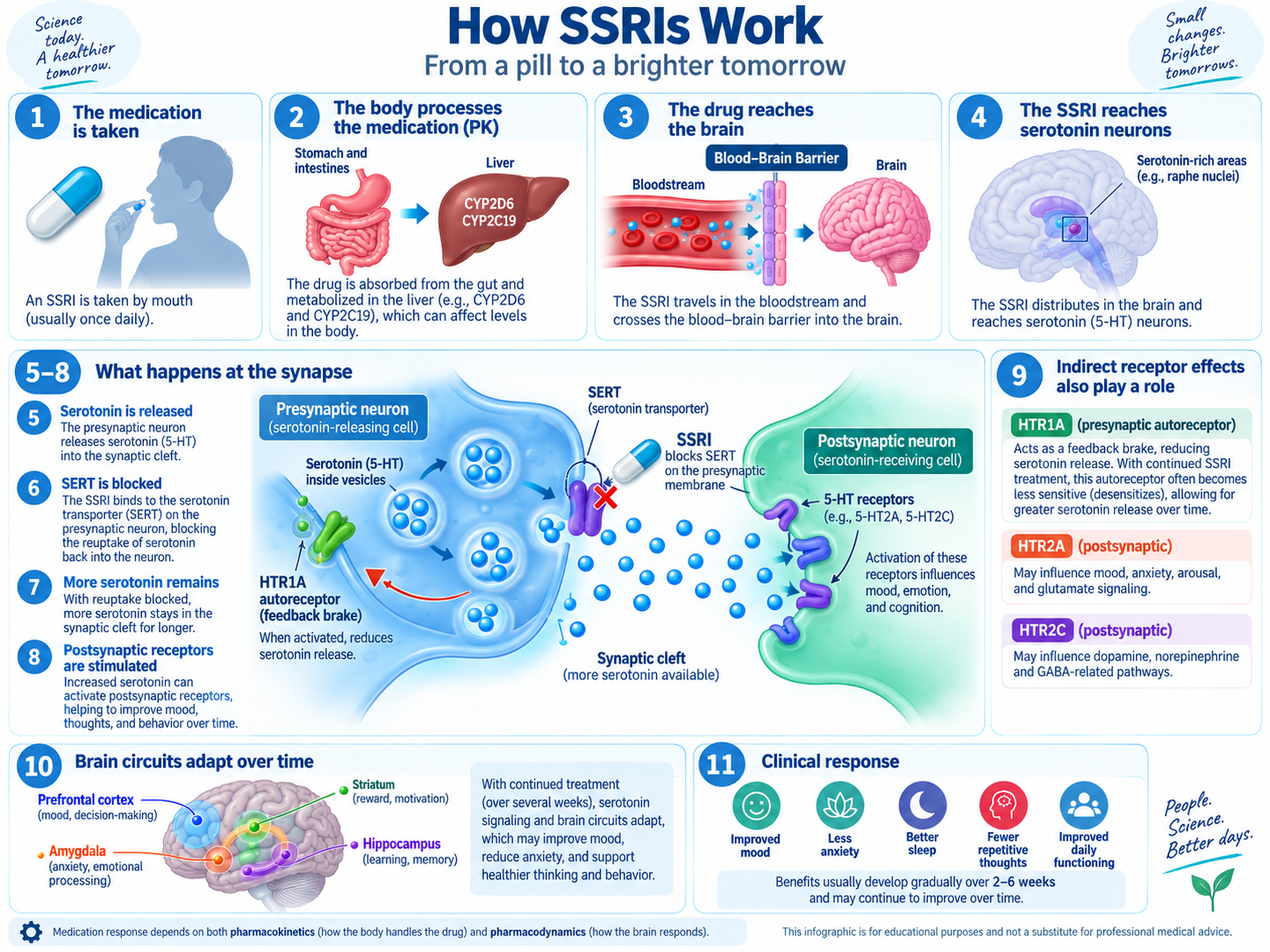
Paroxetine works primarily by blocking:
SERT — Serotonin Transporter
SERT normally removes serotonin from the space between nerve cells after serotonin has been released.
The basic mechanism is:
- Paroxetine
- Blocks SERT
- Serotonin reuptake decreases
- More serotonin remains available between neurons
- Serotonin receptor signaling changes
- Mood, anxiety and emotional-regulation networks gradually adapt
- Depression, anxiety, panic, OCD or PTSD symptoms may improve
Paroxetine is considered a potent and relatively selective serotonin-reuptake inhibitor, with only weak direct effects on norepinephrine and dopamine reuptake at therapeutic concentrations.
How Does Paroxetine Work for Depression?
Depression should not be described simply as:
“Low serotonin.”
Major depressive disorder is better understood as involving dysregulation across interacting systems responsible for:
- Mood
- Emotional regulation
- Stress response
- Motivation
- Reward
- Attention
- Sleep
- Appetite
- Repetitive negative thinking Serotonin is one of the neurotransmitters involved in regulating these networks.
Paroxetine changes serotonin signaling rather than simply “replacing” serotonin.
The process can be summarized as:
- Paroxetine
- SERT inhibition
- Serotonin clearance decreases
- Extracellular serotonin increases
- Serotonin receptors receive altered signaling
- Autoreceptors and downstream pathways adapt
- Emotional and cognitive networks gradually reorganize
- Depressive symptoms may improve
The official prescribing information appropriately states that the precise therapeutic mechanism is not fully established, but is believed to involve increased serotonergic activity resulting from inhibition of neuronal serotonin reuptake.
What Is SERT?
SERT stands for: Serotonin Transporter
It is coded by the: SLC6A4 gene
SERT is located on serotonergic nerve terminals and acts like a recycling system.
Normally:
- Serotonin is released
- Serotonin crosses the synapse
- Serotonin activates receptors
- SERT transports serotonin back into the presynaptic neuron
This helps terminate the serotonin signal.
Paroxetine blocks SERT.
Therefore:
- Paroxetine
- SERT blocked
- Serotonin is removed more slowly
- Serotonin remains available longer
- Serotonin receptors experience greater or more prolonged stimulation
This is the central pharmacodynamic action of paroxetine.
Does Paroxetine Increase Serotonin?
Yes, but indirectly.
Paroxetine does not primarily cause serotonin neurons to release large amounts of serotonin.
Instead, it reduces the rate at which serotonin is taken back up after release.
The difference is:
Normal serotonin signaling
- Serotonin released
- SERT removes serotonin
versus:
With paroxetine
- Serotonin released
- SERT inhibited
- Serotonin remains outside the neuron longer
- Extracellular serotonin signaling increases
This is why paroxetine is called a:
Selective Serotonin Reuptake Inhibitor
rather than a serotonin-releasing medication.
Why Doesn’t Paroxetine Work Immediately?
This is one of the most important concepts in antidepressant pharmacology.
Paroxetine blocks SERT relatively quickly.
Yet meaningful antidepressant benefit often takes:
Several weeks
Why?
Because SERT blockade is only the first step.
The pathway is better represented as:
- Paroxetine blocks SERT
- Serotonin increases around serotonergic neurons
- Serotonin autoreceptors detect the increase
- Serotonin-neuron firing may initially be restrained
- With continued treatment:
- Autoreceptor sensitivity changes
- Serotonergic transmission becomes more persistently altered
- Downstream receptors, intracellular signaling and neural networks adapt
- Clinical improvement gradually develops
This delayed adaptation helps explain why an SSRI can change serotonin concentrations quickly but take weeks to produce its full therapeutic effect.
What is Serotonin Autoreceptors?
Serotonin neurons have receptors that monitor their own serotonin output.
One of the most important is:
5-HT1A Autoreceptor
located particularly on serotonin neurons in the:
Raphe nuclei
These receptors function partly as a feedback brake.
Normally:
- Serotonin released
- 5-HT1A autoreceptor activated
- Serotonin-neuron firing decreases
When paroxetine initially increases serotonin around these neurons:
- SERT blocked
- Serotonin rises
- 5-HT1A autoreceptors activated
- Feedback inhibition increases
With continued SSRI treatment, this feedback system may become less restrictive through receptor adaptation.
The serotonin system can then support more sustained signaling to downstream brain regions.
This is one proposed reason antidepressant effects emerge gradually rather than immediately.
Which Serotonin Receptors Does Paroxetine Affect?
Paroxetine’s primary direct target is:
SERT
not an individual serotonin receptor.
Once extracellular serotonin increases, serotonin can act on many receptors, including:
5-HT1A 5-HT1B 5-HT2A 5-HT2C 5-HT3
and others.
Different receptors can produce different effects in different brain regions.
For example:
5-HT1A-related signaling
may contribute to mood regulation and anxiety reduction.
5-HT2-related signaling
can influence anxiety, sleep and sexual function.
5-HT3 signaling
can contribute to nausea and gastrointestinal effects.
This is why increasing serotonin can simultaneously produce:
Therapeutic effects
and:
Side effects
depending on which receptors and circuits are being affected.
How Does Paroxetine Work for Anxiety?
Anxiety disorders involve much more than serotonin alone.
Important brain systems include:
- Amygdala
- Prefrontal cortex
- Hippocampus
- Insula
- Brainstem arousal systems
- Serotonin
- Norepinephrine
- GABA
- Glutamate One useful model is that excessive threat signaling from the:
Amygdala
is not being adequately regulated by higher cortical networks.
Paroxetine gradually modifies serotonergic input into these circuits.
A simplified pathway is:
- Paroxetine
- SERT inhibition
- Serotonin signaling changes
- Amygdala + PFC + fear-network signaling gradually adapts
- Threat reactivity may decrease
- Possible improvement in:
- Excessive worry
- Fear
- Hypervigilance
- Panic
- Avoidance
- Emotional over-reactivity It is more accurate to describe this as modulation of fear and emotional-control networks than to say paroxetine simply “raises serotonin and calms anxiety.”
How Does Paroxetine Affect the Amygdala?
The:
Amygdala
plays an important role in:
- Threat detection
- Fear learning
- Emotional salience
- Stress responses In several anxiety disorders, amygdala responses can become excessively sensitive or persistent.
Serotonin helps regulate amygdala activity.
Therefore:
- Paroxetine
- Serotonin reuptake decreases
- Serotonergic input to emotional circuits changes
- Amygdala reactivity may become better regulated
while:
Prefrontal control of emotional responses may strengthen
The important concept is:
Paroxetine does not simply suppress the amygdala. It gradually changes the way serotonin participates in the regulation of threat and emotional-processing circuits.
How Does Paroxetine Work for Panic Disorder?
Panic disorder involves dysregulation of systems controlling:
- Threat detection
- Autonomic arousal
- Interoception
- Fear conditioning
- Anticipatory anxiety A panic attack may involve sudden activation of:
Fear circuits
Sympathetic arousal
producing:
- Racing heart
- Shortness of breath
- Trembling
- Dizziness
- Chest discomfort
- Fear of losing control
- Fear of dying Paroxetine gradually alters serotonin regulation of these systems.
The pathway can be represented as:
- Paroxetine
- SERT inhibition
- Serotonergic signaling changes
- Fear and brainstem arousal circuits adapt
- Panic threshold may increase
- Frequency and severity of panic attacks may decrease
Importantly, SSRIs can sometimes temporarily increase anxiety or jitteriness when first started, which helps explain why paroxetine is commonly started at a lower dose for panic disorder before gradual titration.
How Does Paroxetine Work for Generalized Anxiety Disorder?
Generalized anxiety disorder often involves:
- Persistent worry
- Difficulty controlling worry
- Mental overactivity
- Muscle tension
- Restlessness
- Poor concentration
- Sleep disturbance Paroxetine’s serotonergic effect may gradually reduce the tendency of threat-related networks to remain excessively active.
- Paroxetine
- SERT blockade
- Serotonin signaling changes
- PFC-amygdala regulation gradually improves
- Persistent threat anticipation may decrease
- Worry and physical anxiety symptoms may improve
Again, this is not a simple correction of “low serotonin.”
How Does Paroxetine Work for Social Anxiety Disorder?
Social anxiety can involve excessive activation of neural systems responding to:
- Social evaluation
- Embarrassment
- Rejection
- Being watched
- Public performance The amygdala and related salience networks can respond strongly to socially threatening cues.
With continued treatment:
- Paroxetine
- Serotonergic signaling changes
- Threat-processing networks adapt
- Emotional response to social threat may become less intense
- Possible reduction in:
- Fear of judgment
- Anticipatory anxiety
- Avoidance
- Physiological anxiety during social situations Paroxetine is approved in Canada for social anxiety disorder in adults.
How Does Paroxetine Work for OCD?
Obsessive-compulsive disorder involves dysregulation in circuits connecting the:
Cortex Striatum
and:
Thalamus
often called:
Cortico-Striato-Thalamo-Cortical Circuits
Serotonin is one of several neurotransmitters involved in these circuits.
OCD can involve:
Obsessions
persistent intrusive thoughts, images or urges
and:
Compulsions
repetitive actions or mental rituals used to reduce distress.
The therapeutic model is:
- Paroxetine
- SERT inhibition
- Serotonergic transmission changes
- Cortico-striatal circuit activity gradually adapts
- Obsessive thoughts may become less intrusive
and:
Compulsive urges may become easier to resist
OCD often requires a longer therapeutic trial and sometimes higher SSRI doses than uncomplicated depression, under medical supervision.
How Does Paroxetine Work for PTSD?
PTSD can involve dysregulation of:
-
Amygdala threat processing
-
Prefrontal emotional regulation
-
Hippocampal contextual memory
-
Stress-response systems
-
Norepinephrine and serotonin signaling Symptoms may include:
-
Intrusive memories
-
Hypervigilance
-
Avoidance
-
Emotional reactivity
-
Sleep disturbance
-
Exaggerated startle
-
Persistent sense of threat Paroxetine may help by gradually altering serotonergic regulation of these networks.
Paroxetine ↓
SERT inhibition
↓
Serotonin signaling changes
↓
Threat + memory + emotional-control circuits adapt
↓
Hyperreactivity and intrusive symptoms may decrease
Paroxetine does not erase traumatic memories.
Instead, it may reduce the intensity and persistence of the neural threat response associated with those memories.
Does Paroxetine Increase Dopamine?
Not directly.
Paroxetine has only weak direct effects on:
DAT — Dopamine Transporter
at clinically relevant concentrations.
Therefore:
Paroxetine is not a dopamine reuptake inhibitor.
However, serotonin and dopamine systems interact.
Changing serotonin signaling can indirectly influence dopamine in certain regions.
This may affect:
- Motivation
- Reward
- Sexual function
- Emotional responsiveness But those are:
Downstream effects
rather than paroxetine’s primary mechanism.
Does Paroxetine Increase Norepinephrine?
Not substantially through direct transporter inhibition.
Paroxetine has only weak direct activity at:
NET — Norepinephrine Transporter
compared with its strong effect on SERT.
This distinguishes it from:
SNRIs
such as:
- Duloxetine
- Venlafaxine
- Levomilnacipran which intentionally inhibit both:
SERT + NET
Paroxetine should therefore be considered primarily:
Serotonergic
rather than a serotonin-norepinephrine antidepressant.
Why Can Paroxetine Initially Make Someone More Anxious?
When SERT is first inhibited:
- Serotonin rises quickly
- Multiple serotonin receptors are stimulated before the system has adapted
- Possible temporary:
- Anxiety
- Jitteriness
- Restlessness
- Insomnia
- Nausea
- Increased awareness of bodily sensations Over time:
- Autoreceptor and downstream receptor adaptation occurs
- The initial activating effect may diminish
- Anxiolytic effects can emerge
This difference between:
early pharmacological effects
and:
later therapeutic adaptation
is important when explaining SSRI treatment to patients.
Why Can Paroxetine Cause Nausea?
Serotonin has major roles outside the brain, particularly in the gastrointestinal system.
SERT inhibition increases serotonergic signaling in the gut.
Increased serotonin can activate receptors including:
5-HT3
which participate in:
- Nausea
- Vomiting
- Gastrointestinal signaling Therefore:
- Paroxetine
- SERT inhibited
- GI serotonin signaling increases
- Nausea or diarrhea may occur
These effects are often most noticeable early in treatment and may lessen as the body adapts.
Why Can Paroxetine Cause Sexual Dysfunction?
Sexual function depends partly on:
- Dopamine
- Norepinephrine
- Serotonin
- Nitric oxide
- Hormones
- Autonomic reflexes Increasing serotonin can inhibit several components of sexual function.
Conceptually:
- Paroxetine
- SERT inhibition
- Serotonin signaling increases
- 5-HT2 and other serotonergic pathways become more active
- Dopamine and spinal sexual-response pathways may be inhibited
- Possible:
- Reduced libido
- Erectile difficulty
- Delayed ejaculation
- Delayed orgasm
- Difficulty reaching orgasm This is one of paroxetine’s most clinically important adverse effects.
Why Can Paroxetine Cause Emotional Blunting?
Some patients taking SSRIs describe:
- Feeling less emotionally reactive
- Reduced intensity of positive emotions
- Reduced intensity of negative emotions
- Feeling emotionally “flat” The mechanism is not fully established.
One hypothesis is:
- Sustained serotonergic enhancement
- Emotional salience networks become less reactive
- Negative emotional responses decrease
but in some individuals:
Positive emotional intensity may also decrease
This can be therapeutic when overwhelming anxiety or emotional reactivity is reduced, but undesirable if the person feels excessively detached.
Emotional blunting should therefore be evaluated clinically rather than automatically interpreted as recovery.
Why Can Paroxetine Cause Sleepiness?
Paroxetine can cause:
Somnolence
in some patients.
Unlike medications such as mirtazapine or olanzapine, paroxetine does not strongly block H1 histamine receptors as its primary mechanism. Product information describes low affinity for histamine, muscarinic and adrenergic receptors.
Its sedating effect therefore likely reflects:
- Changes in serotonergic arousal networks
- Individual CNS sensitivity
- Downstream sleep regulation rather than strong direct antihistamine activity.
Other patients experience:
Insomnia
instead.
Why Can Paroxetine Cause Weight Gain?
Weight regulation involves:
- Appetite
- Satiety
- Reward
- Metabolism
- Activity
- Sleep
- Hypothalamic signaling Long-term serotonergic changes may affect some of these pathways.
In addition:
- Depression recovery can restore appetite
- Sedation may reduce activity in some patients
- Individual metabolic susceptibility varies Therefore paroxetine-associated weight gain is probably:
Multifactorial
rather than the consequence of a single receptor.
How Is Paroxetine Different from Fluoxetine?
Both are SSRIs and primarily block SERT.
However, they differ substantially in pharmacokinetics.
Paroxetine
-
Strong CYP2D6 inhibitor
-
CYP2D6 substrate
-
Relatively short half-life
-
No long-lived clinically important active metabolite
-
More prone to discontinuation symptoms Fluoxetine
-
Strong CYP2D6 inhibitor
-
Very long half-life
-
Active metabolite norfluoxetine
-
Much slower decline after discontinuation Therefore:
Paroxetine
concentrations fall relatively quickly after stopping,
whereas:
Fluoxetine
can remain pharmacologically active for weeks.
How Is Paroxetine Different from Escitalopram?
Both primarily inhibit:
SERT
but their pharmacokinetics differ.
Escitalopram
is strongly influenced by:
CYP2C19
whereas:
Paroxetine
is strongly influenced by:
CYP2D6
Paroxetine also strongly inhibits CYP2D6 itself.
Therefore:
Paroxetine has greater potential for clinically important CYP2D6 drug interactions.
How Is Paroxetine Different from Sertraline?
Both are SSRIs.
Sertraline and paroxetine both inhibit SERT strongly, but:
Paroxetine
has particularly strong:
CYP2D6 inhibition
and relatively prominent discontinuation symptoms.
Sertraline has a different metabolic profile and generally has less CYP2D6 inhibition at usual doses.
Therefore the medications should not be considered pharmacologically interchangeable even though they belong to the same class.
Why Does Paroxetine Cause More Discontinuation Symptoms Than Some SSRIs?
Paroxetine has a relatively short elimination half-life of approximately:
21 hours
and does not have a long-lived active metabolite.
Therefore:
- Paroxetine stopped
- Blood concentration falls relatively quickly
- SERT inhibition decreases quickly
- Serotonin signaling changes abruptly
- The nervous system has insufficient time to adapt
- Discontinuation symptoms may occur
Possible symptoms include:
- Dizziness
- Nausea
- Anxiety
- Irritability
- Insomnia
- Vivid dreams
- Tingling
- Electric-shock sensations
- Sweating This is why paroxetine is generally:
Tapered rather than abruptly stopped.
How Is Paroxetine Metabolized?
The most clinically important metabolic enzyme for paroxetine is:
CYP2D6
Paroxetine is extensively metabolized into compounds with much weaker serotonin-reuptake activity than the parent drug.
The pathway can be simplified as:
- Paroxetine
- CYP2D6
- Less active metabolites
- Conjugation
- Elimination
However, paroxetine has an unusual property:
It inhibits the same CYP2D6 enzyme that metabolizes it.
What Is CYP2D6 Autoinhibition?
Paroxetine is both:
A CYP2D6 substrate
and:
A strong CYP2D6 inhibitor
Therefore:
- Paroxetine enters the body
- CYP2D6 metabolizes paroxetine
but then:
- Paroxetine inhibits CYP2D6
- CYP2D6 activity falls
- Paroxetine clearance decreases
- Paroxetine concentration can increase disproportionately
This contributes to paroxetine’s:
Nonlinear Pharmacokinetics
Official prescribing information notes that CYP2D6 saturation at clinical doses contributes to the nonlinear relationship between paroxetine dose and exposure.
What Does Nonlinear Pharmacokinetics Mean?
For some medications:
Double the dose
produces approximately:
Double the exposure
But paroxetine does not always behave this predictably.
Because paroxetine inhibits and saturates CYP2D6:
- Dose increases
- CYP2D6 metabolism becomes more limited
- Clearance falls
- Drug exposure may rise more than expected
Therefore:
A dose increase can sometimes produce a disproportionately large increase in paroxetine concentration.
This is one reason careful titration is important.
What Is Phenoconversion with Paroxetine?
Phenoconversion occurs when:
Genetic CYP2D6 status
does not match:
Actual functional CYP2D6 activity
For example, a patient may genetically be:
CYP2D6 Normal Metabolizer
But paroxetine itself strongly inhibits CYP2D6.
Therefore:
- Genetic Normal Metabolizer
- Paroxetine started
- CYP2D6 inhibited
- Actual CYP2D6 function decreases
- The person may function more like an:
Intermediate or Poor Metabolizer
CPIC specifically recognizes this dose-dependent paroxetine-associated phenoconversion, especially at steady-state concentrations.
Why Does Paroxetine Interact with So Many Medications?
Because many medications depend on:
CYP2D6
for metabolism or activation.
Paroxetine strongly inhibits CYP2D6.
Therefore:
- Paroxetine
- CYP2D6 inhibited
- Another drug may be:
Cleared more slowly
or:
Activated less effectively
depending on what CYP2D6 normally does to that medication.
This distinction is important.
Why Is the Tamoxifen Interaction Important?
Tamoxifen is used in hormone-sensitive breast cancer.
Tamoxifen is converted partly by:
CYP2D6
into:
Endoxifen
an important active metabolite.
Therefore:
- Tamoxifen
- CYP2D6
- Endoxifen
But:
- Paroxetine
- CYP2D6 strongly inhibited
- Endoxifen formation decreases
This is why paroxetine is generally a poor antidepressant choice when a patient taking tamoxifen has a suitable alternative with little CYP2D6 inhibition.
The issue is pharmacokinetic:
Paroxetine does not block tamoxifen’s receptor—it interferes with its metabolic activation.
How Does CYP2D6 Genotype Affect Paroxetine?
CYP2D6 activity varies substantially between individuals because of inherited genetic variation.
Patients can be classified as:
- Ultrarapid Metabolizers
- Normal Metabolizers
- Intermediate Metabolizers
- Poor Metabolizers For paroxetine, this is clinically actionable enough that:
CPIC provides specific recommendations.
CYP2D6 Normal Metabolizer and Paroxetine
A Normal Metabolizer has expected baseline CYP2D6 activity.
The expected pathway is:
- Paroxetine
- Normal CYP2D6 metabolism
- Expected initial drug exposure
CPIC recommends:
Use the recommended starting dose.
However, even a genetically Normal Metabolizer can experience reduced CYP2D6 activity after paroxetine reaches steady state because paroxetine inhibits CYP2D6 itself.
CYP2D6 Intermediate Metabolizer and Paroxetine
An Intermediate Metabolizer has reduced CYP2D6 activity.
Therefore:
- Reduced CYP2D6
- Paroxetine clearance decreases
- Paroxetine exposure may increase
- Potential:
- More nausea
- Greater sedation
- More sexual side effects
- Other concentration-related adverse effects CPIC recommends:
Consider a lower starting dose and slower titration
than for a Normal Metabolizer. This is an optional recommendation because the magnitude of the effect varies.
CYP2D6 Poor Metabolizer and Paroxetine
A Poor Metabolizer has very low or absent functional CYP2D6 activity.
Therefore:
- Very low CYP2D6
- Paroxetine metabolism decreases
- Drug concentration increases
- Side-effect probability may increase
CPIC recommends considering approximately:
50% lower starting dose
and:
50% lower maintenance dose
with:
Slower titration
than in Normal Metabolizers.
This is clinician-level guidance and should not be used to self-adjust medication.
CYP2D6 Ultrarapid Metabolizer and Paroxetine
An Ultrarapid Metabolizer has unusually high CYP2D6 activity.
Initially:
- High CYP2D6 activity
- Paroxetine is metabolized more rapidly
- Paroxetine concentration may be lower
- Probability of clinical benefit may decrease
CPIC recommends:
Select an alternative antidepressant not predominantly metabolized by CYP2D6.
Paroxetine’s own CYP2D6 inhibition makes the eventual phenotype somewhat complex, but CPIC still recommends an alternative for genetically predicted Ultrarapid Metabolizers.
CPIC CYP2D6 Recommendations for Paroxetine
| CYP2D6 phenotype | Expected effect | CPIC approach |
|---|---|---|
| Ultrarapid Metabolizer | Increased metabolism, potentially lower exposure | Prefer alternative not predominantly metabolized by CYP2D6 |
| Normal Metabolizer | Expected initial exposure | Standard starting dose |
| Intermediate Metabolizer | Higher exposure possible | Consider lower starting dose + slower titration |
| Poor Metabolizer | Significantly higher exposure | Consider ~50% lower starting and maintenance dose + slower titration |
Paroxetine-associated CYP2D6 autoinhibition and other drug interactions must also be considered.
Does CYP2C19 Affect Paroxetine?
CYP2C19 is not the primary actionable gene for paroxetine.
This differs from:
Citalopram
and:
Escitalopram
where CYP2C19 is clinically important.
For paroxetine:
CYP2D6
is the primary established pharmacokinetic gene.
What Is the Role of SLC6A4 Genetics?
SLC6A4
encodes:
SERT
which is paroxetine’s direct pharmacodynamic target.
The pathway is:
- SLC6A4
- SERT expression/function
- Paroxetine inhibits SERT
- Serotonin signaling changes
- Clinical response may differ
Important SLC6A4 variants studied in antidepressant pharmacogenomics include:
5-HTTLPR
and:
rs25531
Because they may influence SERT expression, there is a strong biological rationale for studying them.
However, biological plausibility is not the same as validated clinical actionability.
CPIC reviewed SLC6A4 evidence and concluded that it is currently insufficient to support genotype-based antidepressant prescribing recommendations.
Therefore:
SLC6A4 is directly relevant to paroxetine pharmacology
but:
SLC6A4 genotype should not currently be used alone to determine whether paroxetine will work.
What Is the Role of HTR1A?
HTR1A
encodes the:
5-HT1A Receptor
5-HT1A receptors exist both as:
Presynaptic autoreceptors
and:
Postsynaptic receptors
The autoreceptor form regulates serotonin-neuron firing.
Therefore:
- Paroxetine increases serotonin
- 5-HT1A autoreceptors initially respond
- Serotonin firing is regulated
- With repeated treatment:
- Autoreceptor adaptation may occur
- Serotonergic transmission changes over time
HTR1A variation is therefore biologically relevant to SSRI response.
However:
There is no validated HTR1A genotype-based paroxetine dosing recommendation.
What Is the Role of HTR2A Genetics?
HTR2A
encodes the:
5-HT2A Serotonin Receptor
Paroxetine does not primarily bind 5-HT2A.
Instead:
- Paroxetine blocks SERT
- Serotonin increases
- Serotonin stimulates 5-HT2A and other receptors
HTR2A variants have been studied in relation to:
- Antidepressant efficacy
- Side effects
- Sexual dysfunction But CPIC concluded that the evidence is insufficient to support HTR2A-based antidepressant prescribing.
What Is the Role of HTR2C?
HTR2C
encodes the:
5-HT2C receptor
5-HT2C signaling can influence:
- Anxiety
- Appetite
- Dopamine
- Norepinephrine
- Sexual function
- Reward circuitry When paroxetine increases serotonin, 5-HT2C signaling may be altered downstream.
HTR2C is therefore biologically interesting for understanding:
- Weight change
- Activation
- Sexual effects
- Individual serotonergic response However:
HTR2C is not currently a validated paroxetine prescribing marker.
Can Pharmacogenomic Testing Predict Whether Paroxetine Will Work?
It can provide useful information, particularly about:
Drug exposure
but cannot reliably guarantee therapeutic response.
The strongest established relationship is:
CYP2D6 → Pharmacokinetics
CYP2D6 can help predict whether paroxetine exposure may be:
- Too low
- Typical
- Higher than expected and CPIC provides prescribing recommendations based on phenotype.
But paroxetine efficacy also depends on:
Pharmacodynamics
including:
- SERT function
- Serotonin receptor function
- Baseline symptom biology
- Brain-region-specific serotonin signaling
- Anxiety versus depressive symptom patterns
- Other neurotransmitters
- Comorbid conditions Therefore:
CYP2D6 can help determine whether paroxetine exposure is likely to be appropriate, but it cannot by itself determine whether paroxetine’s serotonergic mechanism is the right biological match for a particular patient.
Can Paroxetine Fail Even When CYP2D6 Metabolism Is Normal?
Absolutely.
This illustrates the difference between:
Pharmacokinetics — PK
and:
Pharmacodynamics — PD
A patient can have:
Normal paroxetine exposure
but still experience:
- Poor antidepressant response
- Persistent anxiety
- Emotional blunting
- Sexual dysfunction
- Excessive sedation
- Activation because the patient’s brain may respond differently to increased serotonin signaling.
Paroxetine Pharmacokinetics — PK
PK asks: Does an appropriate amount of paroxetine reach the brain?
The pathway is:
- Paroxetine dose
- Absorption
- CYP2D6 metabolism
- CYP2D6 autoinhibition
- Drug interactions + age + liver/kidney function
- Paroxetine concentration
- Medication reaches the brain
Important PK factors include:
- CYP2D6 genotype
- Paroxetine dose
- CYP2D6 autoinhibition
- Other CYP2D6 inhibitors
- Age
- Liver function
- Kidney function Paroxetine displays nonlinear pharmacokinetics partly because CYP2D6 metabolism becomes saturated as exposure increases.
Paroxetine Pharmacodynamics — PD
PD asks: What happens once paroxetine reaches the brain?
- Paroxetine
- SERT / SLC6A4 inhibition
- Serotonin reuptake decreases
- Extracellular serotonin increases
- 5-HT1A + 5-HT2A + 5-HT2C + other receptor systems respond
- Autoreceptor + intracellular + neural-network adaptation
- Mood and anxiety symptoms may improve
Potential pharmacodynamic genes include:
- SLC6A4
- HTR1A
- HTR2A
- HTR2C but these remain non-actionable for routine individual paroxetine prescribing.
Therefore:
Normal paroxetine metabolism does not automatically mean optimal paroxetine response.
Paroxetine Requires Both Appropriate Exposure and Brain Compatibility
The complete process can be summarized as:
- Paroxetine is taken
- PK — Pharmacokinetics
- Absorption
- CYP2D6 metabolism
- CYP2D6 autoinhibition / phenoconversion
- Appropriate paroxetine exposure
- PD — Pharmacodynamics
- SERT inhibition
- Serotonin availability increases
- Serotonin receptors respond
- PFC + amygdala + cortico-striatal + emotional networks adapt
- Depression, anxiety, panic, OCD or PTSD symptoms may improve
Both matter.
Why Can Two People Taking the Same Paroxetine Dose Respond Differently?
Imagine two people each taking:
20 mg of paroxetine
One experiences:
Excellent improvement in anxiety and depression
Another experiences:
Nausea, sexual dysfunction and emotional blunting
Another experiences:
Almost no benefit
Several factors can explain this.
Different Drug Exposure
CYP2D6 can cause different blood concentrations.
Different SERT Biology
SLC6A4 expression and regulation may differ.
Different Serotonin Receptor Biology
5-HT1A, 5-HT2A and 5-HT2C signaling can differ.
Different Symptom Biology
One patient may have predominantly serotonin-responsive:
Anxiety + repetitive thinking + threat reactivity
while another may have prominent:
Low motivation + anhedonia + fatigue
involving stronger dopamine or norepinephrine components.
Therefore:
The diagnosis tells us what disorder the patient has. It does not necessarily tell us which neurotransmitter pathway is most important in that individual’s symptoms.
This article is educational. It does not diagnose, and it does not replace advice from your prescriber or pharmacist. Never start, stop or change a medication based on a web page.