
Medication profile
Fluoxetine (Prozac)
Fluoxetine is a selective serotonin reuptake inhibitor, or SSRI, used primarily to treat depression, obsessive-compulsive disorder and bulimia nervosa.
 Written by Sanjida Ahmed, PhD, Cellular and Molecular BiologyChief Operating Officer and Lead Scientist, Personalized Prescribing. Last reviewed October 2, 2026.
- Best-known brand name
- Prozac
- Class
- SSRI (selective serotonin reuptake inhibitor)
On this page
- What You Need to Know
- What Is Fluoxetine Used For?
- What Are the Common Side Effects of Fluoxetine?
- Drug Interactions
- Fluoxetine Dosage
- Canadian Adult Dosage
- Starting dose: 20 mg once daily in the morning
- A lower dose or less frequent dosing
- Does Fluoxetine Stay in the Body for Long?
- Tapering and Stopping Fluoxetine
- Dose tapering is unnecessary in most patients
- Why Is Fluoxetine Withdrawal Different from Other SSRIs?
- Frequently Asked Questions
- Selective Serotonin Reuptake Inhibitor — SSRI
- 4 weeks or longer
- 4–6 days
- 5 weeks
- No gene-based fluoxetine dosing recommendation
- CYP2D6 Normal Metabolizer
- CYP2D6 Poor Metabolizer
- Can Pharmacogenomic Testing Tell Me Whether Fluoxetine Will Work?
Fluoxetine is also available as many generic products. In Canada, the original Prozac capsules were discontinued from sale in 2024, but generic fluoxetine products remain marketed, including capsule and oral-solution formulations. Prozac remains the best-known international brand name and is an important search term for website SEO.
Other international brand names have included Sarafem and numerous country-specific fluoxetine brands. Brand names, strengths and approved indications vary by country.
What You Need to Know
Fluoxetine is a selective serotonin reuptake inhibitor, or SSRI, used primarily to treat depression, obsessive-compulsive disorder and bulimia nervosa.
It was one of the first widely used SSRIs and remains one of the best-known antidepressants.
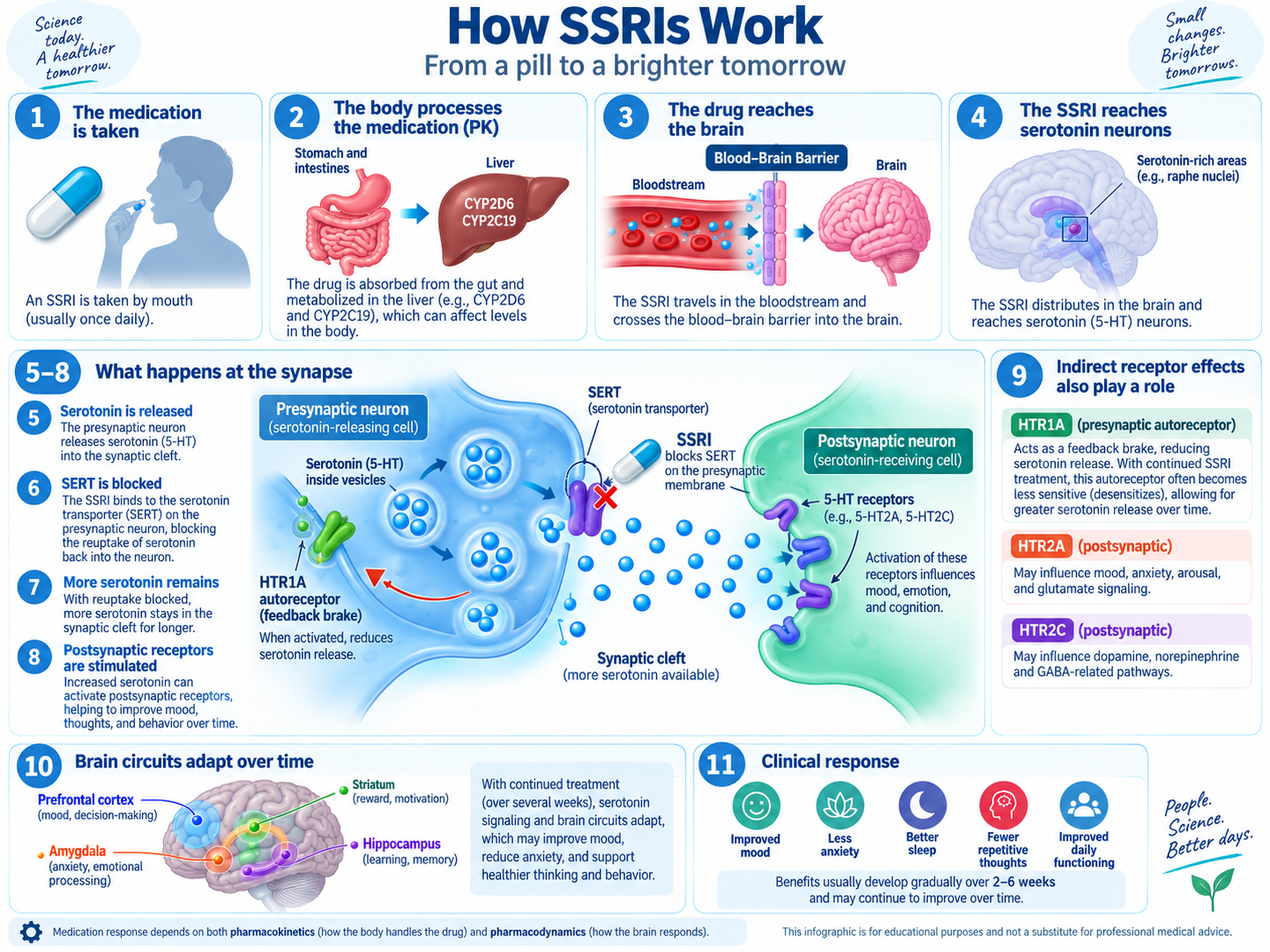
Fluoxetine works mainly by increasing the availability of: Serotonin
It does this by blocking the: Serotonin Transporter — SERT
SERT normally transports serotonin back into the nerve cell after it has been released.
Therefore:
- Fluoxetine
- Blocks SERT
- Serotonin reuptake decreases
- More serotonin remains available between nerve cells
- Serotonin receptor signaling changes
- Brain circuits gradually adapt
- Depression, OCD or other symptoms may improve
The Canadian product monograph identifies inhibition of neuronal serotonin reuptake as the presumed basis for fluoxetine’s antidepressant, anti-obsessional and antibulimic effects.
One of the most important characteristics of fluoxetine is its very long duration in the body. Both fluoxetine and its active metabolite, norfluoxetine, remain present for days to weeks after a dose is taken. This affects dose changes, drug interactions and discontinuation.
What Is Fluoxetine Used For?
In Canada, fluoxetine is approved in adults for:
- Major depressive disorder — MDD
- Obsessive-compulsive disorder — OCD
- Bulimia nervosa Health Canada’s current Prozac monograph does not authorize a pediatric indication.
Approved indications differ internationally. In the United States, fluoxetine is also approved for panic disorder, and certain U.S. formulations/labels include pediatric treatment of depression and OCD.
Fluoxetine for Depression
Fluoxetine is used for major depressive disorder.
Depression can involve symptoms such as:
- Persistent low mood
- Loss of interest or pleasure
- Reduced motivation
- Negative or repetitive thinking
- Changes in sleep
- Changes in appetite
- Difficulty concentrating
- Fatigue
- Anxiety or emotional distress Fluoxetine changes serotonin signaling rather than simply “replacing low serotonin.”
The pathway is more accurately described as:
- Fluoxetine blocks SERT
- Serotonin availability changes
- Serotonin receptors and feedback systems respond
- Mood and emotional-regulation networks gradually adapt
- Depressive symptoms may improve
The full antidepressant effect may take several weeks. The long half-life also means changes in dose are not fully reflected in blood concentrations immediately.
Fluoxetine for OCD
Fluoxetine is approved in Canada for obsessive-compulsive disorder.
OCD involves:
Obsessions
recurrent, unwanted or intrusive thoughts, images or urges
and/or:
Compulsions
repetitive behaviours or mental acts performed in response to distress or perceived threat.
Serotonin signaling is involved in brain networks regulating:
- Repetitive thinking
- Cognitive flexibility
- Threat processing
- Behavioural inhibition Fluoxetine’s inhibition of serotonin reuptake can gradually modify these pathways.
OCD often requires a different dose range and may take longer to respond than uncomplicated depression.
The Canadian recommended dose range for OCD is: 20–60 mg/day.
Fluoxetine for Bulimia Nervosa
Fluoxetine is also approved for bulimia nervosa.
Bulimia nervosa is characterized by recurrent episodes of binge eating followed by behaviours intended to compensate for the binge, such as self-induced vomiting.
Fluoxetine has been shown to reduce:
- Binge-eating episodes
- Purging behaviour The Canadian recommended adult dose for bulimia nervosa is: 60 mg/day.
Its benefit is believed to involve serotonin pathways regulating:
- Impulse control
- Appetite
- Reward
- Compulsive behaviour
- Emotional regulation
What Are the Common Side Effects of Fluoxetine?
Common side effects can include:
- Nausea
- Diarrhea
- Headache
- Insomnia
- Nervousness or anxiety
- Restlessness
- Tremor
- Increased sweating
- Fatigue
- Dizziness
- Sleepiness in some people
- Reduced appetite
- Weight loss in some people
- Sexual side effects Fluoxetine can feel somewhat activating compared with some other SSRIs, particularly when treatment first begins.
This may cause:
- Increased energy
- Restlessness
- Trouble sleeping
- Temporary worsening of anxiety For this reason, fluoxetine is commonly taken in the morning, although dosing should be individualized.
Fluoxetine and Sexual Side Effects
Like other SSRIs, fluoxetine can affect sexual function.
Possible effects include:
- Reduced libido
- Difficulty becoming sexually aroused
- Erectile difficulties
- Delayed ejaculation
- Delayed orgasm
- Difficulty reaching orgasm The Canadian monograph notes that sexual adverse effects are probably under-reported because patients and healthcare professionals do not always discuss them. It also notes post-marketing reports of sexual symptoms persisting after discontinuation in some patients.
Patients experiencing sexual side effects should discuss them with their healthcare professional rather than abruptly stopping the medication.
Antidepressants, including fluoxetine, carry warnings concerning the emergence or worsening of:
-
Suicidal thoughts
-
Self-harm
-
Severe agitation
-
Unusual behavioural changes Monitoring is especially important:
-
Early in treatment
-
After a dose change
-
In younger patients The current Canadian Prozac monograph includes a serious warning to monitor antidepressant-treated patients for clinical worsening, agitation and suicidal thoughts or behaviours.
-
Serotonin Syndrome Fluoxetine increases serotonin signaling.
Combining it with other serotonergic medications can rarely produce serotonin syndrome, which can become medically serious.
Symptoms may include:
- Agitation
- Confusion
- Restlessness
- Fever
- Heavy sweating
- Rapid heart rate
- Tremor
- Muscle twitching
- Muscle rigidity
- Overactive reflexes
- Diarrhea
- Nausea or vomiting Fluoxetine should not be combined with an MAO inhibitor because of the risk of serious serotonergic reactions.
Mania or Hypomania
Antidepressants can sometimes trigger mania or hypomania, particularly in people with bipolar disorder.
Symptoms can include:
-
Unusually elevated or irritable mood
-
Excessive energy
-
Reduced need for sleep
-
Racing thoughts
-
Increased activity
-
Impulsive or risky behaviour A history of bipolar disorder should therefore be considered when an antidepressant is prescribed.
-
Bleeding Risk SSRIs can interfere with normal platelet function.
Fluoxetine may therefore increase bleeding risk, particularly when combined with:
- Aspirin
- Ibuprofen
- Naproxen
- Other NSAIDs
- Warfarin
- Apixaban
- Rivaroxaban
- Other anticoagulants or antiplatelet medications Reported bleeding has ranged from bruising and nosebleeds to gastrointestinal and more serious bleeding.
Low Sodium — Hyponatremia
Fluoxetine and other SSRIs can occasionally cause: Hyponatremia — low blood sodium
Sometimes this occurs through SIADH, or inappropriate antidiuretic hormone secretion.
Risk may be greater in:
-
Older adults
-
People taking diuretics
-
People who are dehydrated
-
Patients with certain medical conditions Symptoms can include:
-
Headache
-
Weakness
-
Confusion
-
Difficulty concentrating
-
Unsteadiness Severe cases can cause seizures or other serious complications.
Fluoxetine and Heart Rhythm — QT Prolongation
Fluoxetine can prolong the heart’s QT interval.
Rare post-marketing reports have included:
-
Torsades de pointes
-
Ventricular arrhythmias
-
Cardiac arrest
-
Sudden death The absolute risk for most patients is low, but caution is particularly important in people with:
-
Congenital long-QT syndrome
-
Previous arrhythmias
-
Significant heart disease
-
Low potassium
-
Low magnesium
-
Other QT-prolonging medications
-
Conditions that substantially increase fluoxetine exposure The Canadian product monograph specifically recognizes QT prolongation and recommends additional caution or ECG monitoring in higher-risk patients.
-
Seizures Fluoxetine should be used cautiously in people with:
-
A seizure disorder
-
Previous seizures
-
Other medications that lower seizure threshold New seizures require medical evaluation.
-
Weight Changes Fluoxetine can reduce appetite and cause weight loss in some people, especially during early treatment.
The Canadian monograph specifically cautions that significant weight loss may be undesirable in:
- Underweight patients
- Older adults
- People with anorexia nervosa Weight gain can also occur during longer-term antidepressant treatment, and individual response varies considerably.
Drug Interactions
Fluoxetine has an unusually important interaction profile because it is both:
Metabolized partly through CYP2D6 and A potent inhibitor of CYP2D6
Its active metabolite:
Norfluoxetine
also remains in the body for a long time.
As a result, some fluoxetine interactions can persist for weeks after fluoxetine has been discontinued.
MAO Inhibitors — Contraindicated
Examples include:
- Phenelzine
- Tranylcypromine
- Isocarboxazid
- Linezolid
- Methylene blue in relevant systemic use An MAOI should generally be stopped for at least:
14 days before starting fluoxetine
But because fluoxetine remains in the body much longer:
At least 5 weeks should generally pass after stopping fluoxetine before starting an MAOI.
In some circumstances, an even longer interval may be appropriate.
This unusually long washout period is one of the most important practical differences between fluoxetine and shorter-acting SSRIs.
Other Serotonergic Medications
Examples include:
- SSRIs
- SNRIs
- Tricyclic antidepressants
- Buspirone
- Tramadol
- Fentanyl
- Methadone
- Dextromethorphan
- Triptans
- Lithium
- Tryptophan
- St. John’s Wort The combination may increase serotonin activity and the risk of serotonin syndrome.
Some combinations are used clinically when appropriate, but they require consideration of total serotonergic burden.
Tricyclic Antidepressants
Examples include:
- Amitriptyline
- Nortriptyline
- Imipramine
- Desipramine
- Clomipramine Many TCAs depend substantially on CYP2D6 for metabolism.
Fluoxetine inhibits CYP2D6.
Therefore:
- Fluoxetine
- CYP2D6 inhibition
- TCA metabolism decreases
- TCA concentration increases
- Side-effect or toxicity risk may increase
Studies cited in the Canadian monograph found that imipramine and desipramine concentrations increased more than 2- to 10-fold when combined with fluoxetine. The effect can persist for weeks after fluoxetine is stopped.
Antipsychotics
Fluoxetine’s CYP2D6 inhibition can affect several antipsychotic medications.
Potentially affected medications include drugs such as:
- Aripiprazole
- Brexpiprazole
- Risperidone
- Perphenazine
- Haloperidol The exact interaction differs by medication.
Canadian fluoxetine information specifically reports increased blood levels of haloperidol and clozapine in some patients receiving fluoxetine.
Dose adjustment or closer monitoring may therefore be appropriate for certain combinations.
Thioridazine — Contraindicated
Fluoxetine strongly inhibits CYP2D6, which can substantially increase thioridazine exposure.
Thioridazine itself can significantly prolong the QT interval.
Therefore the combination can increase the risk of serious arrhythmias.
The Canadian monograph states that thioridazine should not be taken:
Together with fluoxetine
or:
For at least 5 weeks after fluoxetine is stopped.
Tamoxifen — Particularly Important
This interaction deserves special attention.
Tamoxifen is used in the treatment and prevention of certain estrogen-receptor-positive breast cancers.
Tamoxifen is a prodrug and requires:
CYP2D6
to help convert it into its important active metabolite:
Endoxifen
Fluoxetine strongly inhibits CYP2D6.
Therefore:
- Tamoxifen
- Needs CYP2D6 activation
but:
- Fluoxetine inhibits CYP2D6
- Endoxifen formation decreases
- Tamoxifen effectiveness may potentially be reduced
The Canadian Prozac monograph states that coadministration of tamoxifen with potent CYP2D6 inhibitors such as fluoxetine should whenever possible be avoided, and an antidepressant with little or no CYP2D6 inhibition should be considered.
This is one of the most clinically important fluoxetine drug interactions.
Flecainide, Propafenone and Other CYP2D6 Substrates
Fluoxetine can increase concentrations of medications metabolized predominantly by CYP2D6.
Particular caution is needed for medications with a narrow therapeutic index, where relatively small concentration changes can have significant clinical consequences.
The Canadian product monograph specifically identifies:
- Flecainide
- Propafenone
- Tricyclic antidepressants among the medications requiring additional caution.
Benzodiazepines
Fluoxetine can interact with certain benzodiazepines.
For example:
-
Alprazolam Fluoxetine can increase alprazolam concentrations and increase impairment of psychomotor performance.
-
Diazepam Its half-life may be prolonged in some patients.
The clinical importance depends on dose, other medications and individual sensitivity.
Lithium
Fluoxetine and lithium are sometimes used together, but both can influence serotonin signaling.
Reports have also described changes in lithium concentrations and cases of lithium toxicity.
Lithium levels and clinical status may therefore need monitoring when the combination is used.
Drugs That Prolong the QT Interval
Extra caution is appropriate when fluoxetine is combined with another medication that can prolong the QT interval.
Examples can include certain:
- Antipsychotics
- Antiarrhythmics
- Antibiotics
- Antidepressants
- Methadone
- Antifungal medications The Canadian monograph discourages combinations with medications having a clear QT-prolonging effect when avoidable.
Alcohol
Combining alcohol with fluoxetine is not recommended in the Canadian product monograph because the combined effects on cognition and psychomotor performance are not predictable.
Fluoxetine Dosage
The appropriate dose depends on:
- Diagnosis
- Symptoms
- Age
- Response
- Side effects
- Liver function
- Other medications Because fluoxetine and norfluoxetine accumulate slowly, clinicians generally allow enough time between dose increases to assess the effect.
Canadian Adult Dosage
| Condition | Typical dose |
|---|---|
| Major depressive disorder | 20 mg once daily initially |
| OCD | 20–60 mg/day |
| Bulimia nervosa | 60 mg/day |
For depression, the current Canadian Prozac monograph gives:
Starting dose: 20 mg once daily in the morning
with a:
Maximum: 60 mg/day.
The maximum differs from some U.S. fluoxetine labels, which permit up to 80 mg/day for certain indications. For a Canadian website, I would use 60 mg/day as the primary Prozac depression maximum and identify higher U.S. limits only when necessary.
Fluoxetine Dosage for Depression
For adults:
20 mg once daily in the morning
is the usual initial Canadian dose.
If improvement is inadequate, an increase can be considered after several weeks.
Because fluoxetine accumulates slowly:
Increasing the dose too quickly may make it difficult to judge the eventual effect of the previous dose.
The Canadian maximum for depression is:
60 mg/day.
Fluoxetine Dosage for OCD
The Canadian recommended range is:
20–60 mg/day
Because steady-state concentrations can take approximately 4–5 weeks, sufficient time should generally be allowed before increasing the dose.
Fluoxetine Dosage for Bulimia Nervosa
The recommended Canadian dose is:
60 mg/day.
Lower doses have been studied, but 60 mg/day is the established recommended dose for this indication.
Fluoxetine Dosage for Panic Disorder
Panic disorder is not an approved Canadian Prozac indication, but it is an approved U.S. indication for fluoxetine.
The U.S. regimen generally begins with:
10 mg/day
and then increases to:
20 mg/day
after approximately one week, with further adjustments when clinically necessary.
For a Canadian patient-facing website, this should be clearly labelled as U.S. labeling/off-label Canadian context, rather than presented as a Canadian indication.
Fluoxetine and Liver Function
Fluoxetine and norfluoxetine can remain in the body substantially longer in people with impaired liver function.
The Canadian monograph recommends:
A lower dose or less frequent dosing
in patients with hepatic impairment.
Does Fluoxetine Stay in the Body for Long?
Fluoxetine has one of the longest half-lives among commonly used SSRIs.
After repeated treatment, the approximate elimination half-life is:
Fluoxetine: 4–6 days
while its active metabolite:
Norfluoxetine: approximately 4–16 days.
Steady-state concentrations may take approximately:
4–5 weeks
to develop.
This has several important consequences:
- Dose changes take time
- Interactions can persist after stopping
- Discontinuation symptoms are often less abrupt
- A long washout is required before an MAOI
Tapering and Stopping Fluoxetine
Fluoxetine is unusual among SSRIs because its very long half-life causes the medication concentration to decline naturally and gradually.
The Canadian product monograph states that:
Dose tapering is unnecessary in most patients
because fluoxetine and norfluoxetine concentrations decrease gradually after treatment is stopped.
However, this does not mean every patient should simply stop fluoxetine without discussing it with a healthcare professional.
Discontinuation symptoms have still been reported, including:
- Headache
- Insomnia
- Anxiety
- Nervousness
- Dizziness
- Nausea
- Sweating
- Tingling sensations
- Fatigue
- Jitteriness They are generally less common with fluoxetine than with shorter-acting SSRIs because the drug effectively self-tapers through its slow elimination.
A gradual reduction may still be appropriate when:
- The dose is high
- Treatment has continued for years
- The patient has previously experienced withdrawal symptoms
- The underlying condition has a high relapse risk
- The clinician wants to distinguish withdrawal from return of symptoms
Why Is Fluoxetine Withdrawal Different from Other SSRIs?
Compare:
Shorter-acting SSRI
- Medication concentration can fall rapidly
- Neurotransmitter signaling changes quickly
- Greater likelihood of abrupt discontinuation symptoms
With fluoxetine:
- Treatment stops
- Fluoxetine remains for days
- Norfluoxetine remains for even longer
- Medication concentration decreases gradually
- Natural pharmacological taper
This is one reason fluoxetine generally has a lower risk of severe discontinuation symptoms than medications such as paroxetine.
But its long half-life also means unwanted effects or drug interactions can take longer to disappear.
Frequently Asked Questions
Is Fluoxetine the Same as Prozac?
Yes.
Prozac is the original and best-known brand name for fluoxetine.
The original Prozac capsules have been discontinued from the Canadian market, but generic fluoxetine remains available.
Is Fluoxetine an SSRI?
Yes.
Fluoxetine is a:
Selective Serotonin Reuptake Inhibitor — SSRI
Its main pharmacological action is inhibition of the serotonin transporter.
Does Fluoxetine Increase Serotonin?
Indirectly, yes.
Fluoxetine blocks SERT, reducing serotonin reuptake.
This allows more serotonin to remain available between nerve cells.
However, treatment response depends on subsequent changes in serotonin receptors and neural networks, not simply on having “more serotonin.”
Is Fluoxetine Used for Anxiety?
Fluoxetine is frequently used internationally for certain anxiety-related conditions.
In the United States it is approved for panic disorder.
In Canada, the current Prozac indications are depression, OCD and bulimia nervosa.
Is Fluoxetine Used for OCD?
Yes.
Fluoxetine is approved in Canada for obsessive-compulsive disorder, typically at:
20–60 mg/day.
Is Fluoxetine Used for Bulimia?
Yes.
Fluoxetine is approved for bulimia nervosa.
The recommended Canadian dose is:
60 mg/day.
How Long Does Fluoxetine Take to Work?
Some changes may be noticed within the first few weeks, but fuller improvement commonly takes:
4 weeks or longer
depending on the condition and individual response. Current U.S. labeling specifically notes that full antidepressant effect may be delayed for four weeks or longer.
OCD may require an even longer period before maximum benefit becomes apparent.
Why Does Fluoxetine Take So Long to Leave the Body?
Both fluoxetine and its metabolite norfluoxetine have unusually long half-lives.
Fluoxetine may have a half-life of approximately:
4–6 days
after chronic treatment,
while norfluoxetine may persist for:
4–16 days.
Therefore, active medication can remain in the body for weeks after treatment ends.
Does Fluoxetine Cause Weight Gain?
It can, particularly over longer treatment, but early treatment more commonly causes:
- Reduced appetite
- Modest weight loss in some patients Individual responses vary.
Does Fluoxetine Make You Sleepy?
It can, but fluoxetine is often considered one of the more activating SSRIs.
Some people experience:
-
Insomnia
-
Nervousness
-
Increased energy
-
Restlessness while others experience:
-
Fatigue
-
Sleepiness This is why morning dosing is commonly used.
Can Fluoxetine Initially Make Anxiety Worse?
Yes.
Some people experience temporary:
- Anxiety
- Restlessness
- Jitteriness
- Insomnia during early treatment.
These symptoms may improve as the serotonin system adapts.
Persistent or severe activation should be discussed with the healthcare professional.
Can Fluoxetine Cause Sexual Side Effects?
Yes.
Sexual dysfunction is a recognized SSRI adverse effect and can include reduced libido, delayed orgasm, anorgasmia, delayed ejaculation and erectile difficulties.
Can Fluoxetine Be Taken with Bupropion?
The combination is sometimes prescribed clinically, but both medications inhibit CYP2D6.
This can substantially reduce CYP2D6 activity and alter the metabolism of other medications.
Both medications can also be activating, so:
- Anxiety
- Insomnia
- Agitation
- Seizure-risk factors should be considered.
Can Fluoxetine Be Taken with Buspirone?
Sometimes, but both influence serotonin signaling.
The combination can increase the risk of serotonin syndrome, so it should be clinically supervised.
Can Fluoxetine Affect Aripiprazole?
Yes.
Fluoxetine strongly inhibits CYP2D6, an important metabolic pathway for aripiprazole.
The result can be:
- CYP2D6 inhibition
- Slower aripiprazole metabolism
- Higher aripiprazole exposure
A dose adjustment may therefore be required.
Can Fluoxetine Affect Brexpiprazole?
Yes.
Brexpiprazole is metabolized partly by CYP2D6, so fluoxetine can increase brexpiprazole exposure.
The clinical dosing implications depend on the indication and other interacting medications.
Can Fluoxetine Affect Atomoxetine?
Yes—significantly.
Atomoxetine depends heavily on:
CYP2D6
for metabolism.
Fluoxetine inhibits CYP2D6 and can therefore make someone metabolize atomoxetine much more slowly, increasing atomoxetine exposure.
Can Fluoxetine Be Used with Tamoxifen?
This combination deserves careful consideration.
Tamoxifen requires CYP2D6 to produce endoxifen, an important active metabolite.
Fluoxetine strongly inhibits CYP2D6 and can reduce endoxifen formation.
The Canadian Prozac monograph recommends avoiding potent CYP2D6 inhibitors such as fluoxetine with tamoxifen whenever possible.
Does Fluoxetine Need to Be Tapered?
Not always.
Unlike most SSRIs, fluoxetine and norfluoxetine leave the body very slowly.
The Canadian product monograph states that tapering is unnecessary in most patients.
However, medication discontinuation should still be discussed with the healthcare professional, particularly after long-term or high-dose treatment.
Why Must I Wait Five Weeks After Fluoxetine Before Taking an MAOI?
Because fluoxetine and norfluoxetine remain in the body for weeks.
Taking an MAOI while substantial fluoxetine remains can cause dangerous serotonin toxicity.
Therefore at least:
5 weeks
should generally separate stopping fluoxetine and starting an MAOI.
Which Liver Enzyme Metabolizes Fluoxetine?
Several enzymes contribute, but:
CYP2D6
is particularly important.
The situation is complex because fluoxetine produces the active metabolite norfluoxetine and also strongly inhibits CYP2D6 itself.
Can CYP2D6 Genetics Affect Fluoxetine?
Yes biologically.
CYP2D6 Poor Metabolizers can have higher parent fluoxetine concentrations.
However, because both fluoxetine and norfluoxetine are active and metabolism involves multiple pathways, CYP2D6 genotype does not consistently predict total active exposure or treatment outcome.
Does CPIC Recommend a Fluoxetine Dose Based on CYP2D6?
No.
Current CPIC guidance provides:
No gene-based fluoxetine dosing recommendation
because the available evidence linking CYP2D6 genotype with fluoxetine outcome is insufficient or inconsistent.
Can Fluoxetine Change My CYP2D6 Metabolizer Status?
Functionally, yes.
Fluoxetine strongly inhibits CYP2D6.
A person who is genetically a:
CYP2D6 Normal Metabolizer
may temporarily function more like a:
CYP2D6 Poor Metabolizer
for another CYP2D6-dependent medication.
This is called:
Phenoconversion.
Because fluoxetine remains in the body for a long time, this inhibitory effect may continue after the medication is stopped.
Can Pharmacogenomic Testing Tell Me Whether Fluoxetine Will Work?
Not with certainty.
Fluoxetine response depends on:
- Drug exposure
- CYP2D6 and other metabolic pathways
- Other medications
- Serotonin transporter function
- Serotonin receptor signaling
- Symptoms
- Diagnosis
- Dose
- Treatment duration
- Previous medication response
- Individual brain biology CYP2D6, SLC6A4 and HTR2A are biologically relevant, but current CPIC guidance does not provide genotype-based fluoxetine dosing recommendations, nor does it recommend SLC6A4 or HTR2A for routine antidepressant prescribing.
References
- [https://health-products.canada.ca/dpd-bdpp/search-fast-recherche-rapide?lang=eng&no=0116847001&no=0116847001)
- [https://health-products.canada.ca/dpd-bdpp/info?code=9703&lang=eng&lang=eng)
- [https://files.cpicpgx.org/data/guideline/publication/serotonin_reuptake_inhibitor_antidepressants/2023/37032427.pdf)
- https://pdf.hres.ca/dpd_pm/00074396.PDF
- [https://dailymed.nlm.nih.gov/dailymed/drugInfo.cfm?setid=23899405-007b-48d9-82a9-a530b8e90784)
This article is educational. It does not diagnose, and it does not replace advice from your prescriber or pharmacist. Never start, stop or change a medication based on a web page.