
Medication profile
Haloperidol
Haloperidol belongs to the older group of antipsychotics called: First-Generation Antipsychotics — FGAs or Typical Antipsychotics
 Written by Sanjida Ahmed, PhD, Cellular and Molecular BiologyChief Operating Officer and Lead Scientist, Personalized Prescribing. Last reviewed October 2, 2026.
- Class
- Antipsychotic
On this page
- What You Need to Know
- What Is Haloperidol Used For?
- Haloperidol for Schizophrenia
- How Does Haloperidol Work?
- Why Does Brain Region Matter?
- What Are the Common Side Effects of Haloperidol?
- Does Haloperidol Cause Weight Gain?
- Does Haloperidol Make You Sleepy?
- Haloperidol and Parkinson’s Disease
- Older Adults with Dementia
- Drug Interactions
- Haloperidol Dosage
- Tapering and Stopping Haloperidol
- Frequently Asked Questions
Best-known brand name: Haldol
Haloperidol is a first-generation, or typical, antipsychotic medication used primarily to treat schizophrenia and other psychotic states. It is a potent dopamine D2 receptor antagonist, which makes it effective for hallucinations, delusions, severe agitation and other symptoms associated with excessive dopamine signaling in certain brain pathways.
In Canada, oral generic haloperidol remains available, including TEVA-HALOPERIDOL, and injectable haloperidol products are marketed. Long-acting haloperidol decanoate is also available for maintenance treatment of chronic schizophrenia. The original Haldol name remains the best-known international and SEO brand term.
What You Need to Know
Haloperidol belongs to the older group of antipsychotics called: First-Generation Antipsychotics — FGAs or Typical Antipsychotics
Its most important pharmacodynamic action is: Dopamine D2 receptor blockade
A simplified pathway is:
- Haloperidol
- Blocks D2 dopamine receptors
- Excessive dopamine signaling is reduced in certain brain pathways
- Psychosis-related neural activity decreases
- Hallucinations, delusions, agitation and other symptoms may improve
Haloperidol is particularly potent at D2 receptors. This can make it effective for psychosis, but strong D2 blockade also explains many of its most important side effects, particularly:
- Muscle stiffness
- Tremor
- Restlessness
- Parkinson-like symptoms
- Tardive dyskinesia
- Increased prolactin Haloperidol can also affect cardiac electrical conduction and has an important QT-prolongation risk, especially at higher doses, with interacting medications or in people with other cardiac risk factors.
What Is Haloperidol Used For?
Canadian oral haloperidol labeling includes management of manifestations of:
- Acute psychosis
- Chronic psychosis
- Schizophrenia
- Manic states
- Severe aggressive or agitated behaviour in selected clinical circumstances
- Gilles de la Tourette syndrome for symptomatic control The long-acting injectable formulation:
Haloperidol decanoate
is used primarily for:
Maintenance treatment of chronic schizophrenia
particularly when a long-acting injectable antipsychotic is appropriate.
Specific approved indications depend on the formulation and country.
Haloperidol for Schizophrenia
Schizophrenia can involve symptoms such as:
- Hallucinations
- Delusions
- Paranoia
- Disorganized thoughts
- Agitation
- Disorganized behaviour
- Reduced motivation
- Social withdrawal
- Cognitive difficulties One of the most established biological findings in schizophrenia involves excessive dopamine signaling within certain pathways—particularly the:
Mesolimbic / striatal dopamine system
Haloperidol blocks dopamine D2 receptors.
Therefore:
- Excessive dopamine activity
- Haloperidol blocks D2 receptors
- Dopamine signaling is reduced
- Positive psychotic symptoms may improve
Haloperidol’s effect is strongest on symptoms such as:
- Hallucinations
- Delusions
- Paranoia
- Severe agitation Its effects on negative symptoms and cognitive symptoms are generally less prominent.
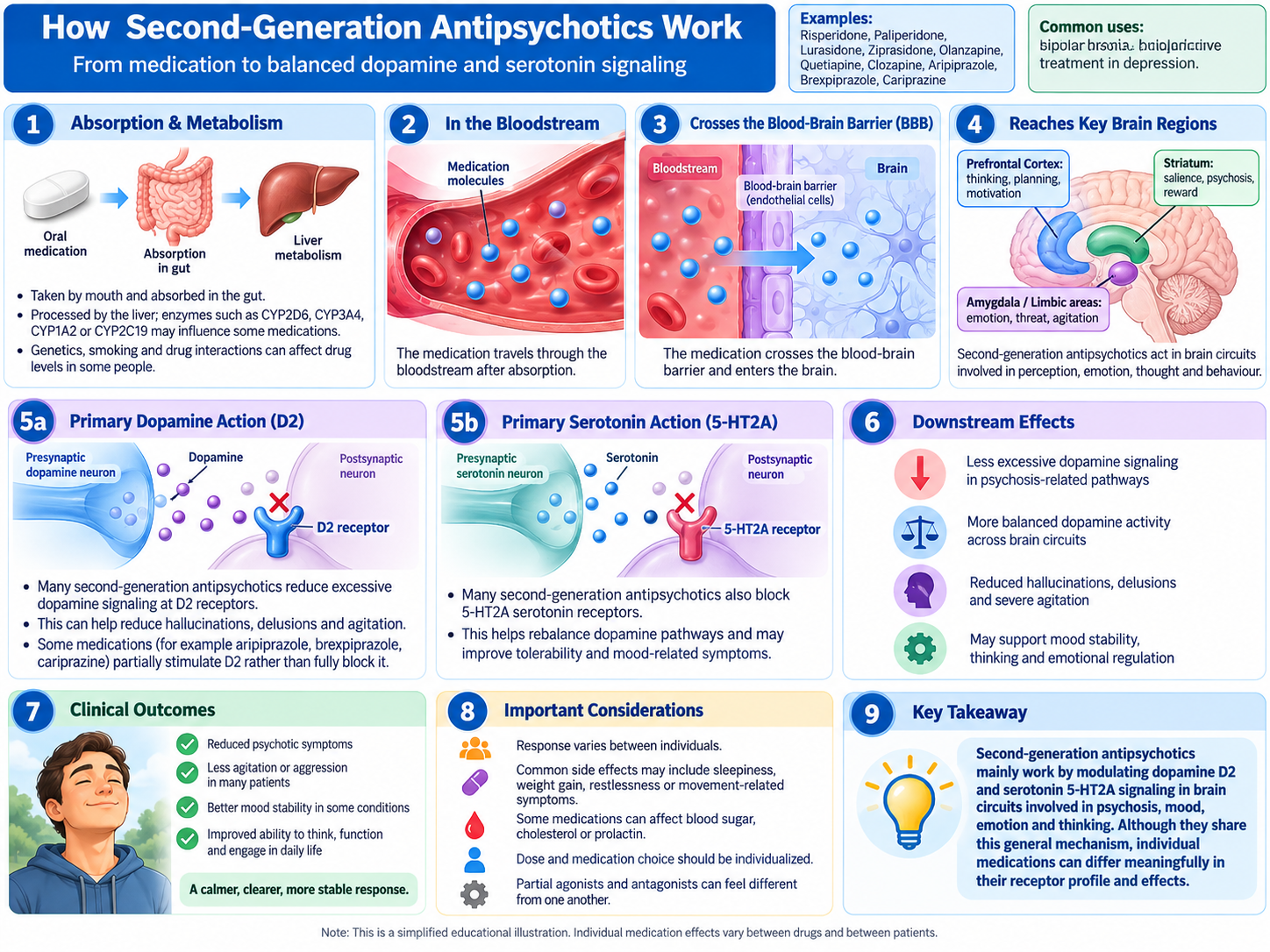
How Does Haloperidol Work?
Haloperidol is primarily:
A Dopamine D2 Receptor Antagonist
Dopamine normally binds to D2 receptors and activates them.
Haloperidol occupies these receptors and prevents dopamine from producing its usual signal.
The pathway is:
- Dopamine
- D2 receptor
- Dopamine signal
Haloperidol intervenes:
- Haloperidol
- D2 receptor blockade
- Reduced dopamine signaling
- Reduced psychosis-related activity
However, dopamine performs different functions in different parts of the brain.
This explains both haloperidol’s therapeutic effects and many of its side effects.
Why Does Brain Region Matter?
Haloperidol does not block D2 receptors only in the brain pathway causing psychosis.
It can block D2 receptors throughout the brain.
That means the effect depends on the region.
Mesolimbic / Striatal Pathways
D2 blockade can reduce excessive dopamine signaling associated with:
- Hallucinations
- Delusions
- Psychosis Nigrostriatal Pathway
D2 blockade can interfere with dopamine involved in movement.
This can cause:
- Tremor
- Rigidity
- Slowness
- Akathisia
- Dystonia Tuberoinfundibular Pathway
Dopamine normally suppresses prolactin.
D2 blockade can therefore increase:
Prolactin
which can lead to hormonal and sexual side effects.
This regional difference is fundamental to understanding haloperidol.
What Are the Common Side Effects of Haloperidol?
Common or clinically important side effects can include:
- Restlessness — akathisia
- Muscle stiffness
- Tremor
- Parkinson-like symptoms
- Muscle spasms
- Sleepiness
- Dizziness
- Dry mouth
- Constipation
- Blurred vision
- Increased saliva
- Low blood pressure
- Increased prolactin
- Sexual or reproductive side effects Movement-related adverse effects are particularly important with haloperidol because of its strong dopamine D2 blockade.
Extrapyramidal Symptoms — EPS
One of the most characteristic side effects of haloperidol is: Extrapyramidal Symptoms — EPS
These occur when dopamine signaling is excessively blocked in motor pathways.
EPS can include several different syndromes.
Akathisia
Akathisia is a feeling of intense inner restlessness.
Patients may:
-
Pace
-
Be unable to sit still
-
Constantly move their legs
-
Feel uncomfortable or agitated Akathisia can sometimes be mistaken for worsening psychiatric agitation.
-
Acute Dystonia Dystonia involves involuntary sustained muscle contractions.
Symptoms can include:
- Neck twisting
- Jaw spasm
- Eye deviation
- Facial muscle contractions
- Difficulty swallowing Severe dystonia involving the throat can be a medical emergency.
Acute dystonia can occur relatively early after starting or increasing a strong D2-blocking medication.
- Drug-Induced Parkinsonism Strong D2 blockade can produce symptoms resembling Parkinson’s disease.
These can include:
-
Tremor
-
Muscle rigidity
-
Slowed movement
-
Reduced facial expression
-
Shuffling gait This does not mean haloperidol causes Parkinson’s disease itself. The symptoms result from reduced dopamine signaling in the nigrostriatal motor pathway.
-
Tardive Dyskinesia One of the most important long-term risks is:
Tardive Dyskinesia — TD
TD consists of involuntary repetitive movements that can include:
- Tongue movements
- Lip smacking
- Chewing movements
- Facial grimacing
- Finger or hand movements
- Limb or trunk movements Tardive dyskinesia can sometimes persist even after the medication is discontinued.
Risk generally increases with:
- Longer treatment duration
- Greater cumulative exposure
- Older age although it can occasionally occur after shorter or lower-dose exposure.
Regular monitoring for abnormal involuntary movements is therefore important during long-term treatment.
Neuroleptic Malignant Syndrome — NMS
Haloperidol can rarely cause: Neuroleptic Malignant Syndrome
NMS is uncommon but potentially life-threatening.
Symptoms can include:
- High fever
- Severe muscle rigidity
- Confusion
- Altered consciousness
- Rapid heart rate
- Sweating
- Unstable blood pressure Laboratory abnormalities may include elevated creatine kinase and evidence of muscle breakdown.
NMS requires immediate medical assessment and discontinuation of antipsychotic treatment under medical supervision.
Haloperidol and QT Prolongation
Haloperidol can prolong the:
QT interval
on the electrocardiogram.
Excessive QT prolongation can increase the risk of a dangerous heart rhythm called:
Torsades de Pointes
and, rarely:
-
Ventricular arrhythmias
-
Sudden cardiac death The risk is greater with:
-
Higher doses
-
High haloperidol concentrations
-
Other QT-prolonging medications
-
Low potassium
-
Low magnesium
-
Significant heart disease
-
Congenital long-QT syndrome Canadian haloperidol decanoate labeling specifically warns of QT prolongation, torsades de pointes and sudden death, with higher doses associated with greater risk.
An ECG and electrolyte assessment may be appropriate in higher-risk patients.
Haloperidol and Prolactin
Dopamine normally inhibits release of: Prolactin from the pituitary gland.
Haloperidol blocks D2 receptors in the tuberoinfundibular pathway.
Therefore:
- Haloperidol
- D2 blockade
- Dopamine's inhibition of prolactin decreases
- Prolactin increases
Possible effects include:
- Breast enlargement
- Milk production
- Menstrual changes
- Reduced testosterone
- Reduced libido
- Erectile difficulties
- Fertility changes Long-term hyperprolactinemia associated with low sex-hormone levels may also contribute to reduced bone density. Canadian oral haloperidol labeling recognizes persistent hyperprolactinemia as a clinical concern.
Does Haloperidol Cause Weight Gain?
Weight gain can occur, but haloperidol is generally less strongly associated with weight gain and metabolic effects than antipsychotics such as olanzapine or clozapine.
Nonetheless, changes in:
- Weight
- Blood glucose
- Appetite can occur, and Canadian product information recommends monitoring weight and blood glucose during antipsychotic therapy.
Does Haloperidol Make You Sleepy?
It can.
Possible effects include:
- Sleepiness
- Reduced alertness
- Dizziness
- Slower reaction time Haloperidol is not among the most strongly antihistaminergic antipsychotics, but clinically significant sedation can still occur.
Patients should know how the medication affects them before:
- Driving
- Operating machinery
- Performing hazardous tasks.
Haloperidol and Parkinson’s Disease
Haloperidol generally should not be used in Parkinson’s disease, because it blocks dopamine D2 receptors and can worsen:
- Rigidity
- Tremor
- Bradykinesia
- Mobility Haloperidol can also interfere with the effects of:
Levodopa
and other:
Dopamine agonists
because the medications are pharmacologically working in opposite directions.
Older Adults with Dementia
Antipsychotic medications, including haloperidol, are associated with increased mortality when used in elderly patients with dementia-related psychosis.
Haloperidol is not approved for dementia-related psychosis.
Treatment decisions in dementia require careful assessment of potential benefits and risks.
Drug Interactions
Haloperidol has important pharmacodynamic and pharmacokinetic interactions.
Its metabolism involves several pathways, including:
- Glucuronidation
- Ketone reduction
- CYP3A4
- CYP2D6 CYP3A4 is an important CYP pathway, while CYP2D6 also contributes and has pharmacogenomic relevance.
Fluoxetine and Paroxetine
Fluoxetine and paroxetine inhibit:
CYP2D6
Fluoxetine also has effects on additional metabolic pathways.
The result can be:
- CYP2D6 inhibition
- Haloperidol metabolism decreases
- Haloperidol concentration increases
- Possible increase in:
- EPS
- Sedation
- QT prolongation
- Other concentration-related adverse effects Fluoxetine is specifically identified as an inhibitor capable of increasing haloperidol exposure.
Fluvoxamine
Fluvoxamine inhibits several metabolic enzymes and can increase haloperidol concentrations.
Current interaction information specifically identifies fluvoxamine among combined CYP3A4/CYP2D6 inhibitors capable of raising haloperidol levels.
Ketoconazole, Itraconazole and Other CYP3A4 Inhibitors
Strong CYP3A4 inhibitors can slow haloperidol metabolism.
Examples include:
- Ketoconazole
- Itraconazole
- Ritonavir Therefore:
- CYP3A4 inhibition
- Haloperidol concentration increases
- Adverse-effect and QT risk may increase
The effect can be greater when CYP2D6 is also inhibited.
Carbamazepine, Rifampin and Other Enzyme Inducers
Strong CYP3A4-inducing medications can reduce haloperidol concentrations.
Examples include:
- Carbamazepine
- Rifampin
- Phenytoin
- Phenobarbital
- St. John’s Wort The pathway is:
- CYP3A4 induction
- Haloperidol metabolism increases
- Haloperidol concentration decreases
- Antipsychotic effectiveness may decrease
In one study, rifampin reduced haloperidol concentrations by an average of approximately 70%. When the inducer is discontinued, haloperidol concentrations can rise again.
Other QT-Prolonging Medications
Combining haloperidol with another medication that prolongs QT can increase cardiac risk.
Examples include certain:
- Antiarrhythmics
- Antidepressants
- Antipsychotics
- Antibiotics
- Methadone Current labeling specifically identifies medications such as citalopram, methadone, erythromycin, levofloxacin and ziprasidone as examples requiring caution.
Medications That Lower Potassium or Magnesium
Drugs that cause electrolyte abnormalities can indirectly increase QT risk.
Examples include some:
-
Diuretics
-
Corticosteroids Low:
-
Potassium
-
Magnesium
-
Calcium can make cardiac repolarization more vulnerable to QT-prolonging medications.
Alcohol, Opioids and Other Sedating Medications
Haloperidol can increase the central nervous system effects of:
-
Alcohol
-
Opioids
-
Anesthetics
-
Other sedating medications The combination may increase:
-
Sedation
-
Dizziness
-
Impaired coordination
-
Low blood pressure. Alcohol should generally be avoided during haloperidol treatment.
Levodopa and Dopamine Agonists
Haloperidol blocks dopamine receptors.
Levodopa and dopamine agonists increase dopamine signaling.
Therefore, the medications can oppose one another.
Haloperidol may reduce the effectiveness of Parkinson’s medications such as levodopa.
Lithium
Lithium and haloperidol are sometimes used together, particularly in severe mood disorders.
Rare reports have described a neurological toxicity syndrome involving:
- Weakness
- Tremor
- Confusion
- Rigidity
- Fever
- Extrapyramidal symptoms with combined lithium and haloperidol treatment.
A causal relationship has not been definitively established, but current labeling advises close monitoring for neurological toxicity when the combination is used.
Haloperidol Dosage
Haloperidol dosing varies considerably according to:
- Diagnosis
- Severity
- Age
- Previous antipsychotic exposure
- Side effects
- Other medications
- Formulation The goal is to use the lowest effective dose.
Canadian oral product information describes a traditional adult starting dose of:
1–2 mg two or three times daily
with subsequent adjustment according to response and tolerability. Lower doses are recommended for elderly or more sensitive patients.
The Canadian monograph also describes much higher doses historically used for severely disturbed or treatment-resistant patients, but explicitly notes that the safety of prolonged high-dose administration has not been established.
Haloperidol dosing is highly individualized. Higher doses increase the probability of movement-related and cardiac adverse effects, and the lowest effective dose should be used.
Haloperidol Decanoate — Long-Acting Injection
Haloperidol is also available as:
Haloperidol Decanoate
This is a long-acting intramuscular formulation.
Haloperidol decanoate itself acts as a prodrug.
After injection:
- Haloperidol decanoate
- Slow release from the muscle depot
- Enzymatic conversion to active haloperidol
- Haloperidol is gradually released over several weeks
The Canadian long-acting monograph estimates a half-life of approximately three weeks, with injections commonly administered around every four weeks, although the interval and dose are individualized.
Conversion from oral treatment is normally supervised carefully. Canadian labeling discusses initial depot doses based on approximately 10–20 times the daily oral haloperidol maintenance dose, followed by individual adjustment.
Long-acting haloperidol should be administered only by the appropriate healthcare professional.
Tapering and Stopping Haloperidol
Haloperidol should generally not be stopped abruptly after long-term regular treatment unless an urgent medical situation requires it.
Abrupt withdrawal can sometimes produce:
- Return of psychotic symptoms
- Agitation
- Insomnia
- Nausea
- Abnormal involuntary movements
- Withdrawal-emergent dyskinesia Canadian labeling notes that abrupt withdrawal in maintenance patients can produce temporary dyskinetic movements and states that gradual withdrawal is advisable.
The taper should be individualized according to:
- Current dose
- Duration of treatment
- Diagnosis
- Relapse history
- Formulation
- Previous withdrawal effects Long-acting haloperidol decanoate naturally leaves the body more gradually because of its depot formulation.
Frequently Asked Questions
Is Haloperidol the Same as Haldol?
Yes.
Haldol is the best-known original brand name for haloperidol.
Generic haloperidol products are now widely used.
Is Haloperidol an Antipsychotic?
Yes.
Haloperidol is a:
First-generation — typical — antipsychotic
and a potent dopamine D2 receptor antagonist.
What Does Haloperidol Do to Dopamine?
Haloperidol blocks:
Dopamine D2 receptors
This reduces dopamine signaling.
In pathways where dopamine activity is excessive, this may reduce psychosis.
In motor pathways, however, excessive D2 blockade can cause movement-related side effects.
Does Haloperidol Lower Dopamine?
Not exactly.
Haloperidol does not primarily prevent dopamine from being produced.
Instead, it:
Blocks dopamine from activating D2 receptors.
The amount of dopamine and the amount of dopamine signaling through D2 receptors are different concepts.
Does Haloperidol Help Hallucinations?
Yes.
Haloperidol is an established antipsychotic treatment and can reduce hallucinations and delusions, particularly when these symptoms are associated with schizophrenia or another psychotic disorder.
Does Haloperidol Help Agitation?
Yes, it is sometimes used in the management of severe agitation, particularly when agitation occurs with psychosis or mania.
The indication, route and dose depend on the clinical situation.
Is Haloperidol Used for Schizophrenia?
Yes.
Schizophrenia is one of haloperidol’s principal indications.
Long-acting haloperidol decanoate is specifically used for maintenance management of chronic schizophrenia in Canada.
Does Haloperidol Cause Parkinson-Like Symptoms?
It can.
Strong D2 blockade in the nigrostriatal pathway can cause:
- Tremor
- Rigidity
- Slowed movement These are called drug-induced parkinsonian symptoms.
Can Haloperidol Cause Akathisia?
Yes.
Akathisia—severe inner restlessness—is one of the important extrapyramidal adverse effects associated with haloperidol.
Can Haloperidol Cause Tardive Dyskinesia?
Yes.
Long-term exposure can cause tardive dyskinesia, which may sometimes be persistent or irreversible.
Can Haloperidol Affect Prolactin?
Yes.
D2 blockade can increase prolactin.
This may lead to:
- Menstrual changes
- Milk production
- Sexual dysfunction
- Fertility problems
- Reduced sex-hormone levels
Does Haloperidol Cause Weight Gain?
It can, although the risk is generally less pronounced than with strongly metabolically active antipsychotics such as olanzapine or clozapine.
Can Haloperidol Affect the Heart?
Yes.
Haloperidol can prolong the QT interval and has been associated with torsades de pointes and other serious ventricular arrhythmias.
Risk increases with higher exposure and other QT-risk factors.
Can Fluoxetine Affect Haloperidol?
Yes.
Fluoxetine can inhibit haloperidol metabolism and increase haloperidol concentrations, potentially increasing adverse effects.
Can Carbamazepine Affect Haloperidol?
Yes.
Carbamazepine induces CYP3A4 and can reduce haloperidol concentrations, potentially reducing treatment effectiveness.
Can Haloperidol Be Taken with Lithium?
The combination is sometimes used, but rare neurological toxicity has been reported.
Patients receiving both medications should be monitored for symptoms such as:
- Confusion
- Rigidity
- Tremor
- Weakness
- Fever.
Does Haloperidol Need to Be Tapered?
For regular maintenance treatment, gradual reduction is generally preferred when clinically appropriate.
Abrupt withdrawal can sometimes cause transient abnormal movements or rapid recurrence of symptoms.
Which Gene Is Most Important for Haloperidol Pharmacogenomics?
The most clinically actionable gene currently is:
CYP2D6
The DPWG provides dosing recommendations for:
- CYP2D6 Poor Metabolizers
- CYP2D6 Ultrarapid Metabolizers.
What Does DPWG Recommend for CYP2D6 Poor Metabolizers?
The DPWG recommends approximately:
60% of the normal haloperidol dose
for CYP2D6 Poor Metabolizers.
What Does DPWG Recommend for CYP2D6 Ultrarapid Metabolizers?
The DPWG recommends:
1.5 times the usual dose
or:
Choosing an alternative antipsychotic less dependent on CYP2D6.
These are clinician-level recommendations and should not be used for self-adjustment.
Can Pharmacogenomic Testing Tell Whether Haloperidol Will Work?
Not with certainty.
Pharmacogenomics can provide clinically useful information about:
CYP2D6 metabolism
but clinical response also depends on:
- D2 receptor biology
- Baseline dopamine signaling
- Brain region involved
- Symptoms
- Dose
- Other medications
- CYP3A4 activity
- Side-effect sensitivity
- Previous antipsychotic response Genetics is therefore one component of personalized prescribing rather than a stand-alone prediction of success.
References
- [https://health-products.canada.ca/dpd-bdpp/search-fast-recherche-rapide?lang=eng&no=0101774001&no=0101774001)
- [https://health-products.canada.ca/dpd-bdpp/info?code=16902&lang=eng&wbdisable=true&lang=eng&wbdisable=true)
- https://pdf.hres.ca/dpd_pm/00083937.PDF
- https://dailymed.nlm.nih.gov/dailymed/drugInfo.cfm?setid=e702b2f0-d464-41c3-977a-d37bb22c0ab0
This article is educational. It does not diagnose, and it does not replace advice from your prescriber or pharmacist. Never start, stop or change a medication based on a web page.