Haloperidol · How it works
How Does Haloperidol Work?
Haloperidol, best known by the brand name Haldol, is a first-generation or typical antipsychotic medication used primarily to treat schizophrenia, psychosis a
 Written by Sanjida Ahmed, PhD, Cellular and Molecular BiologyChief Operating Officer and Lead Scientist, Personalized Prescribing. Last reviewed October 2, 2026.
- Class
- Typical antipsychotic
On this page
- Dopamine D2 Receptor
- What Does Haloperidol Do to Dopamine?
- D2 receptors
- Haloperidol reduces dopamine signaling through D2 receptors
- How Does Haloperidol Work for Schizophrenia?
- What Is “Abnormal Salience”?
- What deserves attention?
- What is important?
- What should be learned or remembered?
- personally significant
- deliberately connected
- threatening or highly important
- Why Does Brain Region Matter with Haloperidol?
- “Lowering dopamine everywhere.”
- How Much D2 Blockade Is Needed?
- Why Can Increasing Haloperidol Sometimes Increase Side Effects More Than Benefit?
- Why Does Haloperidol Cause Akathisia?
- Worsening agitation
- Why Does Haloperidol Cause Parkinson-Like Symptoms?
- Drug-Induced Parkinsonism
- Why Can Haloperidol Cause Tardive Dyskinesia?
- Why Does Haloperidol Cause Less Weight Gain Than Some Atypical Antipsychotics?
- D2 receptor antagonism
- How Is Haloperidol Different from Clozapine?
- Strong D2 antagonism
- How Is Haloperidol Different from Aripiprazole?
- Haloperidol is a D2 antagonist
- Aripiprazole is a D2 partial agonist
- When Might a Strong D2 Antagonist Make Biological Sense?
- Excessive striatal dopamine signaling appears to be driving psychosis
- Why Can the Same Haloperidol Dose Affect Two People Differently?
- How Is Haloperidol Metabolized?
- Ketone reduction
- Why Is CYP2D6 Important for Haloperidol?
- CYP2D6 gene
- 60% of the usual haloperidol dose
- Can Other Medications Change CYP2D6 Activity?
- CYP2D6 Normal Metabolizer
- Why Is CYP3A4 Important?
- CYP3A4 inhibitor
- CYP3A4 inducers
- Can Haloperidol Fail Even If Metabolism Is Normal?
- Pharmacokinetics — PK
- Pharmacodynamics — PD
- What Is the Role of the DRD2 Gene?
- “Haloperidol will work”
- “Haloperidol will fail.”
- What About DRD3 Genetics?
- DRD3 gene
- Does Serotonin Genetics Matter for Haloperidol?
- D2 antagonism
- 5-HT2A antagonism
- Dopamine D2 signaling
- Haloperidol Needs Both Drug Exposure and Brain Compatibility
- Can Pharmacogenomic Testing Tell Whether Haloperidol Will Work?
- CYP2D6 metabolism
- Why Might Haloperidol Work Very Well for One Person but Poorly for Another?
- Prominent excessive striatal dopamine signaling
- More side effects with less benefit
Haloperidol, best known by the brand name Haldol, is a first-generation or typical antipsychotic medication used primarily to treat schizophrenia, psychosis and severe agitation associated with certain psychiatric conditions.
Haloperidol works mainly by blocking one type of dopamine receptor:
Dopamine D2 Receptor
Dopamine is an important neurotransmitter involved in:
-
Motivation
-
Reward
-
Movement
-
Attention
-
Learning
-
Emotional processing
-
Salience—how important or meaningful something feels In psychosis, excessive dopamine signaling in certain brain pathways, particularly within the striatum and mesolimbic system, is strongly associated with symptoms such as:
-
Hallucinations
-
Delusions
-
Paranoia
-
Abnormally assigning importance to neutral events Haloperidol reduces this signaling by preventing dopamine from activating D2 receptors.
The simplified mechanism is:
- Haloperidol
- Blocks dopamine D2 receptors
- Dopamine produces less signaling through D2
- Excessive dopamine activity in psychosis-related pathways is reduced
- Hallucinations, delusions and other psychotic symptoms may improve
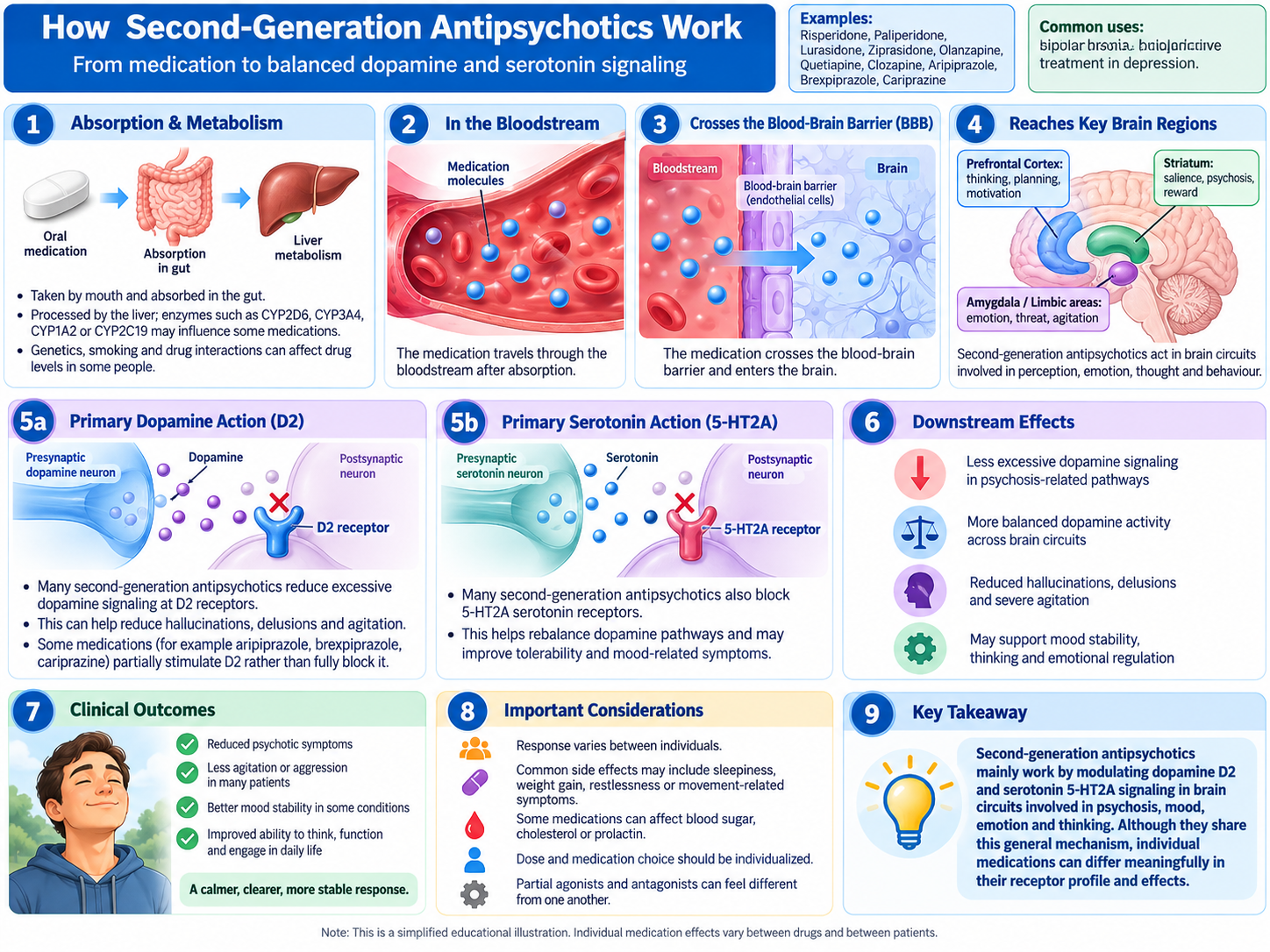
The complete mechanism of haloperidol is not fully established, but strong D2 receptor antagonism is considered central to both its antipsychotic effects and many of its side effects. Current prescribing information likewise notes that the precise mechanism is not fully established.
What Does Haloperidol Do to Dopamine?
Haloperidol does not primarily reduce the amount of dopamine being produced in the brain.
Instead, it blocks dopamine from activating:
D2 receptors
Normally:
- Dopamine is released
- Dopamine binds to D2 receptor
- D2 signaling occurs
With haloperidol:
- Dopamine is released
- Haloperidol occupies the D2 receptor
- Dopamine cannot activate the receptor as effectively
- D2 signaling decreases
This distinction is important.
It is more accurate to say:
Haloperidol reduces dopamine signaling through D2 receptors
rather than simply:
Haloperidol lowers dopamine.
How Does Haloperidol Work for Schizophrenia?
Schizophrenia is biologically complex and cannot be explained by dopamine alone.
However, one of the strongest biological findings in schizophrenia involves excessive dopamine synthesis and signaling in parts of the:
Striatum
particularly in patients experiencing positive psychotic symptoms.
These symptoms include:
- Hallucinations
- Delusions
- Paranoia
- Disorganized thinking A simplified pathway is:
- Excessive striatal dopamine signaling
- Excessive D2 receptor stimulation
- Neutral thoughts, sensations or events may acquire abnormal significance
- Psychotic experiences can emerge
Haloperidol intervenes by blocking D2 receptors:
- Haloperidol
- D2 receptor blockade
- Excessive dopamine signaling is reduced
- Psychotic symptoms may decrease
This is why haloperidol is generally more effective for positive symptoms of schizophrenia than for symptoms such as reduced motivation, social withdrawal or cognitive difficulty.
What Is “Abnormal Salience”?
Dopamine helps the brain decide:
What deserves attention?
What is important?
What should be learned or remembered?
This process is sometimes called:
Salience
In psychosis, dopamine signaling may cause ordinary events to feel unusually meaningful.
For example:
- A casual comment
- may feel:
personally significant
or:
- A coincidence
- may seem:
deliberately connected
or:
- A neutral event
- may feel:
threatening or highly important
Haloperidol’s D2 blockade may reduce the excessive dopamine signaling that contributes to this abnormal assignment of significance.
This can help reduce:
- Paranoid interpretations
- Delusional beliefs
- Hallucinatory experiences as treatment progresses.
Why Does Brain Region Matter with Haloperidol?
Dopamine does not perform the same function everywhere in the brain.
Haloperidol cannot selectively block D2 receptors only in the pathway causing psychosis.
It also blocks D2 receptors in other dopamine pathways.
This explains many of its side effects.
Four dopamine systems are especially useful for understanding haloperidol.
Mesolimbic and Striatal Dopamine — Antipsychotic Benefit
Excessive dopamine signaling in mesolimbic and striatal pathways is associated with positive psychotic symptoms.
Therefore:
- High dopamine signaling
- Haloperidol blocks D2
- Psychotic symptoms may improve
This is the therapeutic effect clinicians are seeking.
Nigrostriatal Dopamine — Movement Side Effects
The: Nigrostriatal pathway
helps regulate movement.
Dopamine normally activates receptors within this system to support smooth motor control.
Haloperidol also blocks D2 receptors here.
Therefore:
- Haloperidol
- Nigrostriatal D2 blockade
- Motor dopamine signaling decreases
- Possible:
- Muscle stiffness
- Tremor
- Slowed movement
- Akathisia
- Dystonia Extrapyramidal Symptoms — EPS This is one of the major limitations of strong D2-blocking antipsychotics.
Tuberoinfundibular Dopamine — Increased Prolactin
Dopamine normally acts as a brake on: Prolactin release from the pituitary gland.
Dopamine activates D2 receptors and suppresses prolactin.
Haloperidol blocks these receptors.
Therefore:
- Haloperidol
- D2 blockade
- Dopamine can no longer suppress prolactin as effectively
- Prolactin increases
This can potentially cause:
- Menstrual changes
- Breast enlargement
- Milk production
- Reduced libido
- Erectile difficulties
- Reduced testosterone
- Fertility problems Thus, increased prolactin is directly related to haloperidol’s principal mechanism.
Prefrontal Dopamine — Cognition and Motivation
The prefrontal cortex requires appropriately regulated dopamine signaling for:
- Working memory
- Motivation
- Planning
- Decision-making
- Cognitive flexibility Some patients with schizophrenia may already have relatively reduced or dysregulated prefrontal dopamine function.
Strong D2 blockade is therefore not necessarily advantageous in this region.
This helps illustrate why treating schizophrenia is not simply a matter of:
“Lowering dopamine everywhere.”
A more accurate therapeutic goal is:
Reduce excessive dopamine signaling in psychosis-related pathways while preserving normal dopamine function elsewhere as much as possible.
Haloperidol is very effective at D2 blockade, but it is less selective by brain region.
How Much D2 Blockade Is Needed?
Antipsychotic treatment involves a balance between: Enough D2 blockade to reduce psychosis
and: Too much D2 blockade, which increases side effects
PET imaging studies have demonstrated a relationship between D2 receptor occupancy, treatment response and adverse effects.
An influential haloperidol study found that the probability of clinical response increased as D2 occupancy rose above roughly 65%, while prolactin elevation and extrapyramidal symptoms became more likely at higher occupancies. A more recent systematic review found that EPS risk rises substantially once D2 occupancy reaches approximately the 75–85% range.
This is often described conceptually as a:
D2 Therapeutic Window
- Too little D2 occupancy
- Insufficient antipsychotic effect
- Intermediate occupancy
- Greater likelihood of therapeutic benefit
- Very high occupancy
- Increasing risk of EPS and prolactin-related effects
These percentages should not be interpreted as an exact target for every patient. They illustrate why higher haloperidol doses do not necessarily produce better outcomes.
Why Can Increasing Haloperidol Sometimes Increase Side Effects More Than Benefit?
D2 receptors become progressively occupied as haloperidol exposure increases.
At first:
- Increasing haloperidol concentration
- More D2 blockade
- Greater antipsychotic effect may occur
But once sufficient D2 blockade has already been achieved:
- Additional haloperidol
- Further D2 occupancy
- Limited additional antipsychotic benefit
but:
More EPS + prolactin effects + other adverse effects
Dose-response research confirms that haloperidol’s risk of extrapyramidal symptoms rises with increasing dose and receptor occupancy.
The goal is therefore generally:
The lowest effective exposure that provides adequate symptom control.
Why Does Haloperidol Cause Akathisia?
Akathisia is a particularly important haloperidol side effect.
It can feel like:
- Severe inner restlessness
- Inability to sit still
- Constant need to move
- Pacing
- Intense physical discomfort The mechanism is strongly associated with dopamine D2 blockade within motor-related pathways.
Therefore:
- High D2 blockade
- Nigrostriatal dopamine signaling becomes too low
- Akathisia may develop
An important clinical issue is that akathisia can look like:
Worsening agitation
If it is mistakenly interpreted as worsening psychosis, increasing the haloperidol dose could potentially make the akathisia worse.
Why Does Haloperidol Cause Parkinson-Like Symptoms?
Parkinson’s disease involves reduced dopamine function within the nigrostriatal pathway.
Haloperidol can temporarily create a similar functional situation by blocking D2 receptors.
Therefore: Dopamine may still be present
but:
- D2 receptors are blocked
- Dopamine signaling decreases
- Possible:
- Tremor
- Muscle rigidity
- Slowed movement
- Shuffling gait
- Reduced facial expression This is called:
Drug-Induced Parkinsonism
It does not mean the medication has necessarily caused Parkinson’s disease.
Why Can Haloperidol Cause Tardive Dyskinesia?
Long-term dopamine receptor blockade can cause the nervous system to adapt.
One proposed mechanism involves increased sensitivity or altered regulation of dopamine receptors after prolonged D2 blockade.
Simplified:
- Long-term D2 blockade
- Dopamine system compensates
- Receptor signaling and motor circuits adapt
- Abnormal involuntary movements may develop
Tardive dyskinesia can include:
- Lip smacking
- Tongue movements
- Facial movements
- Chewing movements
- Finger movements
- Limb or trunk movements Unlike many acute EPS symptoms, tardive dyskinesia can sometimes persist after haloperidol is discontinued.
Why Does Haloperidol Cause Less Weight Gain Than Some Atypical Antipsychotics?
Haloperidol’s receptor profile is dominated by:
D2 receptor antagonism
It has much less of the strong combined:
- Histamine H1 antagonism
- 5-HT2C antagonism seen with highly metabolically active antipsychotics such as clozapine and olanzapine.
H1 and 5-HT2C blockade can strongly influence:
- Appetite
- Satiety
- Weight
- Metabolic regulation Haloperidol can still cause weight changes, but its metabolic profile is generally less pronounced than that of some second-generation antipsychotics.
The trade-off is that its strong D2 action produces a comparatively greater tendency toward:
Movement-related side effects and prolactin elevation.
How Is Haloperidol Different from Clozapine?
The two medications are very different pharmacodynamically.
Haloperidol
works predominantly through:
Strong D2 antagonism
while:
Clozapine
has:
- Relatively weaker D2 blockade
- Strong serotonin receptor effects
- Muscarinic effects
- Histamine effects
- Adrenergic effects
- A much broader receptor profile Therefore:
Haloperidol
→ primarily dopamine-D2 focused
while:
Clozapine
→ multi-receptor pharmacology.
This helps explain their very different:
- Side effects
- Clinical uses
- Movement-disorder risks
- Effectiveness in treatment-resistant schizophrenia
How Is Haloperidol Different from Aripiprazole?
This difference is especially important.
Haloperidol is a D2 antagonist
It blocks D2 receptor activation.
Aripiprazole is a D2 partial agonist
It binds to the same receptor but provides partial receptor stimulation.
Therefore:
Haloperidol
- Dopamine
- D2 receptor blocked
- D2 signaling decreases strongly
while:
Aripiprazole
- D2 receptor occupied
- Partial receptor activity remains
- Dopamine signaling is modulated rather than completely blocked
This helps explain why the medications have different effects on:
- Prolactin
- Movement symptoms
- Dopamine signaling in lower-dopamine brain regions
When Might a Strong D2 Antagonist Make Biological Sense?
A strong D2 antagonist such as haloperidol is particularly aligned with a situation in which:
Excessive striatal dopamine signaling appears to be driving psychosis
Conceptually:
- High striatal dopamine activity
- Excessive D2 signaling
- Hallucinations / delusions / psychosis
- D2 antagonist
- Dopamine signaling decreases
- Symptoms may improve
However, if a patient’s problem includes substantial low prefrontal dopamine function, strong D2 blockade does not directly correct that deficit.
This helps explain why two people with the same schizophrenia diagnosis may respond differently to different antipsychotic mechanisms.
Why Can the Same Haloperidol Dose Affect Two People Differently?
Two people receiving exactly the same dose can experience very different outcomes.
One might have:
-
Strong improvement
-
Minimal movement side effects Another might have:
-
Severe akathisia
-
Prolactin elevation
-
QT concerns
-
Excessive D2 blockade And another might receive:
-
Insufficient benefit There are two broad explanations:
Pharmacokinetics — PK
People can have different haloperidol concentrations from the same dose.
Pharmacodynamics — PD
People can have different biological responses to the same brain concentration.
How Is Haloperidol Metabolized?
Haloperidol is metabolized through several pathways.
The major pathways include:
Glucuronidation
and:
Ketone reduction
Cytochrome P450 metabolism also contributes, particularly:
CYP3A4
and, to a lesser extent:
CYP2D6
Current prescribing information specifically identifies CYP3A4 and CYP2D6 as relevant CYP pathways and warns that inhibition can increase haloperidol concentrations.
The simplified pathway is:
Haloperidol
- Glucuronidation + ketone reduction
- CYP3A4 + CYP2D6
- Metabolites
- Elimination
Why Is CYP2D6 Important for Haloperidol?
CYP2D6 contributes to haloperidol clearance.
The:
CYP2D6 gene
varies considerably between people.
Depending on inherited variants, a person may be:
- Poor Metabolizer
- Intermediate Metabolizer
- Normal Metabolizer
- Ultrarapid Metabolizer This can alter haloperidol exposure.
CYP2D6 Poor Metabolizer and Haloperidol
A CYP2D6 Poor Metabolizer has little or no functional CYP2D6 activity.
Therefore:
- Reduced CYP2D6 activity
- Haloperidol clearance may decrease
- Haloperidol concentration may increase
- D2 occupancy may increase
- Potential increase in:
- Akathisia
- Parkinsonism
- Other EPS
- Prolactin effects
- QT-related risk The Dutch Pharmacogenetics Working Group (DPWG) recommends approximately:
60% of the usual haloperidol dose
for CYP2D6 Poor Metabolizers.
This is clinician-level guidance and should not be used for self-adjustment.
CYP2D6 Ultrarapid Metabolizer and Haloperidol
At the opposite extreme:
- Very high CYP2D6 activity
- Haloperidol may be cleared faster
- Haloperidol exposure may decrease
- D2 receptor occupancy may be inadequate
- Treatment response may be reduced
The DPWG recommends either:
Approximately 1.5 times the usual dose
or:
Choosing an alternative antipsychotic less dependent on CYP2D6
for CYP2D6 Ultrarapid Metabolizers.
Because higher haloperidol doses can increase EPS and QT risk, any adjustment requires professional clinical interpretation.
Can Other Medications Change CYP2D6 Activity?
Yes.
This is particularly important with haloperidol.
For example:
Fluoxetine
or:
Paroxetine
can inhibit CYP2D6.
Therefore, someone may genetically be:
CYP2D6 Normal Metabolizer
but after starting a strong CYP2D6 inhibitor:
- CYP2D6 activity falls
- Haloperidol metabolism slows
- Haloperidol concentration rises
- Side-effect risk may increase
This is an example of:
Phenoconversion
The patient’s DNA has not changed—their functional metabolic status has changed because of another medication.
Current haloperidol prescribing information specifically identifies CYP2D6 and/or CYP3A4 inhibitors as capable of raising haloperidol concentrations and potentially increasing QT-related adverse effects.
Why Is CYP3A4 Important?
CYP3A4 also contributes to haloperidol metabolism.
A:
CYP3A4 inhibitor
can slow metabolism.
Therefore:
- CYP3A4 inhibition
- Haloperidol concentration increases
- Adverse-effect risk may increase
Conversely:
CYP3A4 inducers
such as certain anticonvulsants or rifampin can increase metabolism:
- CYP3A4 induction
- Haloperidol concentration decreases
- Treatment effectiveness may decrease
Unlike CYP2D6, however, there is currently no established CYP3A4 genotype-based haloperidol dosing guideline. The clinically important issue is usually drug interaction, not CYP3A4 genetic testing.
Can Haloperidol Fail Even If Metabolism Is Normal?
Yes.
Normal metabolism does not mean haloperidol is automatically the right antipsychotic for a particular patient.
This is where the difference between:
Pharmacokinetics — PK
and:
Pharmacodynamics — PD
becomes important.
Pharmacokinetics: Does Enough Haloperidol Reach the Brain?
PK includes:
- Dose
- Absorption
- Glucuronidation + ketone reduction
- CYP3A4 + CYP2D6
- Drug interactions
- Haloperidol exposure
PK determines how much medication is available to occupy D2 receptors.
But it does not tell us whether that receptor mechanism is well matched to the patient’s biology.
Pharmacodynamics: How Does the Brain Respond to Haloperidol?
Once haloperidol reaches the brain:
- Haloperidol
- D2 receptor binding
- Dopamine signaling decreases
- Different dopamine pathways respond
- Therapeutic effect or side effects
The main pharmacodynamic gene is:
DRD2
DRD2 encodes the:
Dopamine D2 receptor
which is haloperidol’s primary therapeutic target.
What Is the Role of the DRD2 Gene?
The biological relationship is direct:
- DRD2 gene
- D2 receptor expression and function
- Haloperidol binds the D2 receptor
- Dopamine signaling changes
- Clinical response and side effects
Variants in DRD2 have been studied in relation to:
- Antipsychotic response
- D2 receptor availability
- Extrapyramidal symptoms
- Prolactin elevation
- Tardive dyskinesia This makes DRD2 biologically relevant to haloperidol pharmacodynamics.
However:
There is currently no validated DRD2 genotype-based haloperidol dosing guideline.
A DRD2 result therefore should not be interpreted alone as:
“Haloperidol will work”
or:
“Haloperidol will fail.”
What About DRD3 Genetics?
Haloperidol can also interact indirectly or less prominently with other dopamine receptor pathways.
The:
DRD3 gene
encodes the dopamine D3 receptor.
DRD3 variants have been investigated particularly in relation to:
- Antipsychotic response
- Tardive dyskinesia
- Movement-related side effects However:
There is currently no established DRD3-based haloperidol prescribing guideline.
DRD3 should therefore be considered part of the broader pharmacodynamic picture rather than a validated dosing marker.
Does Serotonin Genetics Matter for Haloperidol?
Haloperidol is fundamentally different from atypical antipsychotics such as clozapine, risperidone or olanzapine because it relies much more strongly on:
D2 antagonism
and much less on:
5-HT2A antagonism
Therefore serotonin receptor genetics such as:
- HTR2A
- HTR2C may be biologically interesting in antipsychotic response generally, but they are not principal validated haloperidol prescribing markers.
For haloperidol, the most direct pharmacodynamic focus is:
Dopamine D2 signaling
Haloperidol Needs Both Drug Exposure and Brain Compatibility
The complete process can be represented as:
- Haloperidol is taken
- PK — Pharmacokinetics
- Glucuronidation + ketone reduction + CYP3A4 + CYP2D6
- Appropriate haloperidol exposure
- PD — Pharmacodynamics
- Haloperidol blocks D2 receptors
- Striatal dopamine signaling decreases
- Psychosis-related activity may decrease
- Hallucinations and delusions may improve
But simultaneously:
- Nigrostriatal D2 blockade
- EPS risk
and:
- Tuberoinfundibular D2 blockade
- Prolactin elevation
Therefore:
An appropriate haloperidol concentration is necessary, but it does not guarantee an optimal response.
The medication must also be pharmacodynamically compatible with the patient’s underlying dopamine pattern and receptor biology.
Can Pharmacogenomic Testing Tell Whether Haloperidol Will Work?
Pharmacogenomics can provide clinically actionable information about:
CYP2D6 metabolism
The DPWG specifically provides recommendations for CYP2D6 Poor and Ultrarapid Metabolizers.
However, clinical response also depends on:
- Baseline striatal dopamine activity
- D2 receptor biology
- Symptom pattern
- Dose
- D2 receptor occupancy
- Other medications
- CYP3A4 activity
- Side-effect sensitivity
- Previous antipsychotic response
- Individual brain circuitry Pharmacogenomics should therefore be considered one component of a broader personalized antipsychotic assessment.
Why Might Haloperidol Work Very Well for One Person but Poorly for Another?
Two people may both be diagnosed with schizophrenia but have different underlying neurobiological patterns.
One patient may have:
Prominent excessive striatal dopamine signaling
with:
- Hallucinations
- Delusions
- Severe positive symptoms Strong D2 antagonism may be particularly effective.
Another patient may have:
- Less prominent dopamine-driven psychosis
- Significant cognitive symptoms
- Low motivation
- Greater sensitivity to D2 blockade That person may experience:
More side effects with less benefit
Response can also differ because one patient may achieve much greater D2 receptor occupancy than another at the same dose due to differences in:
- CYP2D6
- CYP3A4
- Drug interactions
- Drug concentration
- Receptor biology This helps explain why antipsychotic treatment cannot be optimized from diagnosis alone.
This article is educational. It does not diagnose, and it does not replace advice from your prescriber or pharmacist. Never start, stop or change a medication based on a web page.