
Medication profile
Quetiapine (Seroquel)
Quetiapine is a second-generation antipsychotic used to treat schizophrenia and bipolar disorder.
 Written by Sanjida Ahmed, PhD, Cellular and Molecular BiologyChief Operating Officer and Lead Scientist, Personalized Prescribing. Last reviewed October 2, 2026.
- Best-known brand name
- Seroquel
- Extended-release formulation
- Seroquel XR
- Medication class
- Second-generation (atypical) antipsychotic
On this page
- What Is Quetiapine Used For?
- Is Quetiapine Approved for Children in Canada?
- How Does Quetiapine Work?
- “Lowering dopamine.”
- What Does Quetiapine Do to Dopamine?
- Why Does Quetiapine Cause Fewer Movement Side Effects Than Some Older Antipsychotics?
- D2 receptor occupancy
- Lower-affinity and more transient D2 binding
- 5-HT2A antagonism
- What Does Quetiapine Do to Serotonin?
- 5-HT2A Serotonin Receptors
- What Is Norquetiapine?
- Inhibits NET — Norepinephrine Transporter
- Partially stimulates 5-HT1A receptors
- How Does Quetiapine Work for Bipolar Depression?
- Does Quetiapine Increase Norepinephrine?
- Does Quetiapine Increase Dopamine in the Prefrontal Cortex?
- How Does Quetiapine Work for Mania?
- D2 antagonism
- Why Does Quetiapine Make You Sleepy?
- Histamine H1 Receptors
- Is Quetiapine a Sleeping Pill?
- An antipsychotic medication
- Why Can Low-Dose Quetiapine Feel Different from Higher Doses?
- H1 histamine
- α1 adrenergic
- Sedation + dizziness
- Why Does Quetiapine Cause Dizziness When Standing?
- Alpha-1 Adrenergic Receptors
- Orthostatic Hypotension
- What Are the Common Side Effects of Quetiapine?
- Does Quetiapine Cause Weight Gain?
- Can Quetiapine Increase Blood Sugar?
- Can Quetiapine Increase Cholesterol and Triglycerides?
- Does Quetiapine Cause Dry Mouth and Constipation?
- Intestinal obstruction
- Can Quetiapine Cause Movement Side Effects?
- Extrapyramidal Symptoms — EPS
- Can Quetiapine Cause Tardive Dyskinesia?
- Tardive Dyskinesia — TD
- What Is Neuroleptic Malignant Syndrome?
- Neuroleptic Malignant Syndrome — NMS
- Medical emergency
- Can Quetiapine Affect Prolactin?
- Can Quetiapine Affect the Heart?
- Can Quetiapine Cause Low White Blood Cells?
- Can Quetiapine Affect Thyroid Function?
- Quetiapine and Elderly Patients with Dementia
- Quetiapine and Pregnancy
- Quetiapine Drug Interactions
- α1 receptors
- Quetiapine Immediate-Release vs Extended-Release
- Seroquel — Immediate Release
- One or divided daily doses
- Seroquel XR — Extended Release
- Once daily
- Swallowed whole
- Quetiapine Dosage
- 25 mg twice daily
- 300 mg/day
- 300–600 mg/day
- Schizophrenia and Bipolar Mania
- Bipolar Depression
- Major Depressive Disorder
- 50–300 mg/day
- Higher quetiapine exposure
- How Long Does Quetiapine Stay in the Body?
- 6–7 hours for quetiapine
- How quickly the medication is released and absorbed
- Does Quetiapine Need to Be Tapered?
- Is Quetiapine Addictive?
- Withdrawal symptoms can occur after abrupt discontinuation
- How Is Quetiapine Metabolized?
- Drug exposure
- Does CYP2D6 Matter for Quetiapine?
- CYP2D6 Poor Metabolizer
- CYP2D6 Ultrarapid Metabolizer
- Does CYP3A4 Genotype Affect Quetiapine?
- CYP3A4 Poor Metabolizer
- 3.2-fold higher dose-adjusted quetiapine concentrations
- DPWG CYP3A4 Recommendations for Quetiapine
- CYP3A4 Poor Metabolizer
- If quetiapine is being used for depression
- Choose an alternative medication
- Increase parent quetiapine exposure
- Reduce formation of norquetiapine
- For indications other than depression
- 30% of the normal quetiapine dose
- How Strong Is the CYP3A4 Pharmacogenomic Evidence?
- CYP3A4 Drug Interactions May Matter More Than CYP3A4 Genetics
- Frequently Asked Questions About Quetiapine
- Does Quetiapine Block Dopamine?
- Does Quetiapine Increase Norepinephrine?
- Immediate-release quetiapine
- Seroquel XR
- H1 receptor blockade
- Does Quetiapine Increase Prolactin?
Quetiapine is a second-generation antipsychotic used to treat schizophrenia and bipolar disorder. The extended-release formulation, Seroquel XR, is also approved in Canada for selected adults with major depressive disorder when approved antidepressant treatments have failed because of inadequate effectiveness or tolerability.
Quetiapine has an unusually broad pharmacological profile. Its principal antipsychotic actions involve:
Dopamine D2 receptor antagonism
and:
Serotonin 5-HT2A receptor antagonism
but quetiapine and its active metabolite norquetiapine also affect:
- Histamine H1 receptors
- Alpha-1 adrenergic receptors
- 5-HT1A serotonin receptors
- 5-HT2C serotonin receptors
- Muscarinic acetylcholine receptors
- Norepinephrine transport, particularly through norquetiapine The official mechanism is not completely established, but D2 and 5-HT2A antagonism are considered central to its antipsychotic effects.
A simplified mechanism is:
Quetiapine
- D2 dopamine receptor blockade
- 5-HT2A serotonin receptor blockade
- Dopamine-serotonin signaling changes
- Psychosis and mania may improve
while:
- Quetiapine → CYP3A4 → Norquetiapine
- NET inhibition + 5-HT1A partial agonist activity
- Potential contribution to antidepressant and anxiolytic effects
Norquetiapine’s norepinephrine transporter inhibition and 5-HT1A activity are considered plausible contributors to quetiapine’s antidepressant effects.
What Is Quetiapine Used For?
In Canada, immediate-release Seroquel is approved in adults for:
- Schizophrenia
- Acute bipolar mania
Acute bipolar depression
including depressive episodes associated with bipolar I and bipolar II disorder.
The extended-release formulation:
Seroquel XR
is approved for:
- Schizophrenia
- Acute bipolar mania
- Acute bipolar depression
- Major depressive disorder after previous approved antidepressants have failed because of lack of efficacy and/or tolerability. Health Canada currently lists both Seroquel and Seroquel XR as marketed in Canada.
Is Quetiapine Approved for Children in Canada?
No.
Current Canadian labeling does not authorize Seroquel or Seroquel XR for patients under 18 years of age, because Health Canada has not established sufficient safety and efficacy for pediatric use in the Canadian indications.
This differs from some U.S. indications, so Canadian and American prescribing information should not be assumed to be identical.
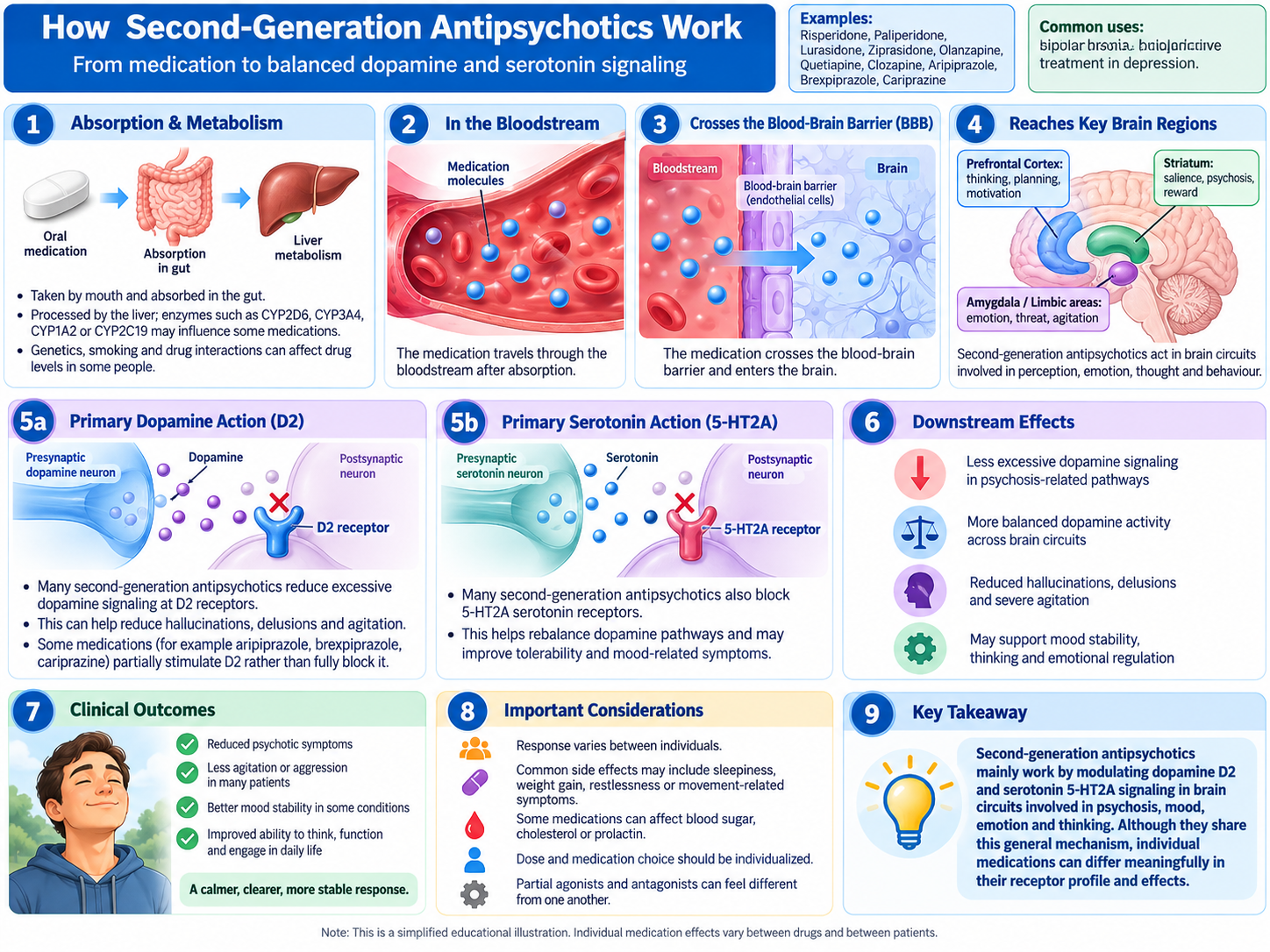
How Does Quetiapine Work?
Quetiapine primarily works by changing signaling through:
Dopamine and Serotonin receptors.
The parent medication principally acts as an antagonist at:
D2 and: 5-HT2A receptors.
The pathway is:
- Quetiapine enters the brain
- Blocks D2 receptors
- Dopamine produces less D2 signaling
- Blocks 5-HT2A receptors
- Serotonin regulation of dopamine pathways changes
- Psychosis, mania and agitation may improve
Quetiapine should therefore not simply be described as:
“Lowering dopamine.”
Its effects differ depending on the brain region and receptor involved.
What Does Quetiapine Do to Dopamine?
Quetiapine is a:
D2 Dopamine Receptor Antagonist
It does not remove dopamine from the brain.
Instead:
- Dopamine is released
- Normally:
- Dopamine → D2 receptor
- D2 signaling
With quetiapine:
- D2 receptor partially occupied by quetiapine
- Dopamine has less ability to activate D2
- D2-mediated signaling decreases
Reducing excessive dopamine signaling in psychosis-related striatal and limbic pathways is believed to contribute to improvement in:
- Hallucinations
- Delusions
- Paranoia
- Severe agitation
- Disorganized thinking Schizophrenia should not, however, be described simply as a disease of “too much dopamine.” Dopamine signaling differs across brain regions and symptom domains.
Why Does Quetiapine Cause Fewer Movement Side Effects Than Some Older Antipsychotics?
Potent first-generation antipsychotics such as haloperidol can maintain substantial:
D2 receptor occupancy
within movement-related dopamine pathways.
Quetiapine has relatively:
Lower-affinity and more transient D2 binding
and substantial:
5-HT2A antagonism
This contributes to a generally lower tendency toward:
- Parkinsonism
- Rigidity
- Tremor
- Dystonia
- Akathisia than some strong first-generation D2 blockers.
Movement symptoms can still occur, particularly with higher exposure or individual sensitivity.
What Does Quetiapine Do to Serotonin?
Quetiapine strongly antagonizes:
5-HT2A Serotonin Receptors
Serotonin 5-HT2A receptors regulate dopamine release in several brain pathways.
Therefore:
- Quetiapine
- 5-HT2A blockade
- Serotonin's regulation of dopamine changes
- Regional dopamine signaling is modified
This serotonergic component is one reason quetiapine is considered an:
Atypical or second-generation antipsychotic
rather than simply a conventional dopamine blocker.
What Is Norquetiapine?
Quetiapine has an important active metabolite called:
Norquetiapine also known as: N-desalkylquetiapine
The liver converts part of quetiapine into norquetiapine, principally through: CYP3A4
Norquetiapine has pharmacological effects that are somewhat different from the parent medication.
Research indicates that norquetiapine:
Inhibits NET — Norepinephrine Transporter
and:
Partially stimulates 5-HT1A receptors
while also interacting with:
- 5-HT2A
- 5-HT2C
- H1
- Muscarinic receptors
- Adrenergic receptors. This active metabolite is especially important when trying to understand:
Quetiapine’s antidepressant effects.
How Does Quetiapine Work for Bipolar Depression?
Quetiapine’s antidepressant effect appears to involve more than D2 blockade.
One proposed pathway is:
- Quetiapine
- CYP3A4 metabolism
- Norquetiapine
- NET inhibition
- Norepinephrine availability increases
and:
- 5-HT1A partial agonism
- Serotonin signaling changes
- Prefrontal and mood-related networks respond
- Depressive symptoms may improve
Norquetiapine’s NET inhibition and 5-HT1A partial agonism are believed to contribute substantially to the antidepressant component of quetiapine’s pharmacology, although the complete mechanism remains uncertain.
Does Quetiapine Increase Norepinephrine?
The parent drug does not substantially inhibit the norepinephrine transporter.
Its active metabolite: Norquetiapine does.
Therefore:
- Norquetiapine
- NET inhibited
- Norepinephrine reuptake decreases
- Norepinephrine remains available longer
This may contribute to effects on:
- Mood
- Energy
- Motivation
- Attention
- Anxiety Norquetiapine’s NET inhibition is substantially more potent than that of quetiapine itself.
Does Quetiapine Increase Dopamine in the Prefrontal Cortex?
Indirectly, it may.
The prefrontal cortex has relatively low DAT activity, and dopamine in this region can also be cleared through: NET
Therefore:
- Norquetiapine blocks NET
- Norepinephrine clearance decreases
and:
- Prefrontal dopamine clearance may also decrease
- PFC dopamine availability may increase indirectly
In addition, 5-HT2A receptor blockade can alter cortical dopamine release.
This may contribute to effects on:
- Motivation
- Cognitive function
- Mood However, quetiapine should not be described as a direct dopamine-enhancing drug.
How Does Quetiapine Work for Mania?
Bipolar mania involves dysregulation across several systems, including:
- Dopamine
- Serotonin
- Glutamate
- GABA
- Reward circuits
- Arousal systems
- Sleep and circadian networks Quetiapine may reduce excessive dopaminergic activation through:
D2 antagonism
while its serotonergic and sedative receptor effects influence other aspects of mania.
The simplified pathway is:
- Quetiapine
- D2 blockade
- Excessive dopamine-related activation decreases
- 5-HT2A blockade Serotonin-dopamine regulation changes
- H1 blockade
- Arousal decreases
- Agitation, racing thoughts, overactivity and manic symptoms may improve
Quetiapine’s antimanic effect is not simply the result of making someone sleepy.
Why Does Quetiapine Make You Sleepy?
Quetiapine has very strong affinity for:
Histamine H1 Receptors
Histamine helps maintain:
- Wakefulness
- Alertness
- Arousal Therefore:
- Quetiapine
- H1 blockade
- Histamine-mediated wakefulness decreases
- Sleepiness and sedation
H1 is one of quetiapine’s highest-affinity receptor targets.
Sedation can occur even at relatively low doses.
Is Quetiapine a Sleeping Pill?
No.
Quetiapine is:
An antipsychotic medication
not a conventional sleep medication.
It is sometimes prescribed off-label for insomnia, largely because of its potent H1 antihistamine effect.
At relatively low doses, sedation may occur before substantial D2 receptor blockade develops.
However, even low-dose quetiapine can still cause:
- Daytime sedation
- Dizziness
- Orthostatic hypotension
- Increased appetite
- Weight gain
- Metabolic changes For this reason, using quetiapine solely for uncomplicated insomnia requires careful consideration of risks and alternatives.
Why Can Low-Dose Quetiapine Feel Different from Higher Doses?
Quetiapine’s effects change as exposure increases because its receptors have different binding affinities.
At relatively low exposures:
H1 histamine
and:
α1 adrenergic
effects can dominate.
This produces:
Sedation + dizziness
At progressively higher exposures, additional:
5-HT2A
and:
D2
receptor occupation becomes more important.
Therefore, quetiapine cannot be understood as producing the exact same pharmacological effect at every dose.
However, this should not be converted into rigid dose categories because receptor occupancy varies between people.
Why Does Quetiapine Cause Dizziness When Standing?
Quetiapine blocks:
Alpha-1 Adrenergic Receptors
These receptors normally help blood vessels constrict when a person stands.
Therefore:
- Quetiapine
- α1 blockade
- Vascular constriction decreases
- Blood pressure may fall on standing
- Dizziness, lightheadedness or fainting
This is called:
Orthostatic Hypotension
It is especially important:
- During treatment initiation
- During rapid dose increases
- In older adults
- With antihypertensive drugs
- In people who are dehydrated
What Are the Common Side Effects of Quetiapine?
Common adverse effects include:
- Sleepiness
- Sedation
- Dizziness
- Dry mouth
- Constipation
- Fatigue
- Headache
- Increased appetite
- Weight gain
- Orthostatic hypotension
- Faster heart rate
- Indigestion
- Abnormal dreams in some patients In Canadian XR studies, prominent adverse effects included sedation, somnolence, dry mouth and dizziness; increased appetite, constipation and weight gain were also prominent in some indications.
Does Quetiapine Cause Weight Gain?
Yes, it can.
Quetiapine is associated with:
Increased appetite and: Weight gain
although the magnitude varies considerably between individuals.
Likely mechanisms include antagonism of:
H1
and:
5-HT2C
receptors.
These systems participate in:
- Appetite
- Satiety
- Food reward
- Energy regulation Therefore:
- Quetiapine / norquetiapine
- H1 + 5-HT2C signaling altered
- Hunger and satiety regulation change
- Food intake may increase
- Weight gain may occur
Can Quetiapine Increase Blood Sugar?
Yes.
Second-generation antipsychotics including quetiapine can cause:
Hyperglycemia
and may contribute to:
- Insulin resistance
- New diabetes
- Worsening of existing diabetes The risk is one reason metabolic monitoring is important during treatment.
Monitoring may include:
- Weight / BMI
- Blood glucose or HbA1c
- Lipids
- Blood pressure particularly during longer-term use.
Canadian labeling for quetiapine specifically highlights weight gain, hyperglycemia and hyperlipidemia as important antipsychotic safety concerns.
Can Quetiapine Increase Cholesterol and Triglycerides?
Yes.
Quetiapine can contribute to:
- Increased triglycerides
- Increased LDL cholesterol
- Increased total cholesterol
- Decreased HDL in some patients These effects may occur together with or independently of substantial weight gain.
Periodic lipid monitoring may therefore be appropriate.
Does Quetiapine Cause Dry Mouth and Constipation?
Yes.
Quetiapine itself has relatively modest muscarinic affinity, but:
Norquetiapine has substantially greater affinity for several muscarinic receptor subtypes.
This can contribute to:
- Dry mouth
- Constipation
- Blurred vision
- Urinary difficulty Severe constipation should not be ignored because antipsychotic-associated gastrointestinal hypomotility can occasionally progress to:
Intestinal obstruction
particularly when quetiapine is combined with other anticholinergic medications. Canadian labeling has reported constipation, intestinal obstruction and severe gastrointestinal hypomotility.
Can Quetiapine Cause Movement Side Effects?
Yes, although generally less frequently than many strong D2-blocking antipsychotics.
Possible:
Extrapyramidal Symptoms — EPS
include:
- Akathisia
- Tremor
- Parkinsonism
- Rigidity
- Dystonia
- Restlessness Canadian trials generally found relatively low rates of individual EPS symptoms, although rates vary by diagnosis and dose.
Can Quetiapine Cause Tardive Dyskinesia?
Yes.
Tardive Dyskinesia — TD
is a potentially persistent movement disorder associated with long-term dopamine-receptor blockade.
Symptoms can include involuntary:
-
Mouth movements
-
Tongue movements
-
Facial movements
-
Finger movements
-
Limb movements Risk generally increases with:
-
Treatment duration
-
Cumulative antipsychotic exposure
-
Age
-
Individual susceptibility The lowest effective dose and ongoing reassessment of treatment remain important.
What Is Neuroleptic Malignant Syndrome?
Rarely, quetiapine can cause:
Neuroleptic Malignant Syndrome — NMS
Possible symptoms include:
- High fever
- Severe muscle rigidity
- Confusion
- Altered consciousness
- Rapid heart rate
- Sweating
- Blood-pressure instability NMS is a:
Medical emergency
and requires urgent assessment.
Can Quetiapine Affect Prolactin?
Yes, but quetiapine generally produces relatively modest prolactin effects compared with strong sustained D2 antagonists such as risperidone.
Dopamine normally suppresses prolactin.
Therefore:
- D2 blockade
- Dopamine's inhibition of prolactin decreases
- Prolactin may increase
Possible symptoms can include:
- Menstrual changes
- Breast milk production
- Sexual dysfunction
- Breast changes
- Fertility effects Clinical importance varies.
Can Quetiapine Affect the Heart?
Yes.
Quetiapine can cause:
-
Increased heart rate
-
Orthostatic hypotension
-
Rare cardiac rhythm abnormalities QT prolongation has been reported particularly in:
-
Overdose
-
Patients with other medical risk factors
-
People taking other QT-prolonging medications
-
Patients with electrolyte abnormalities Large clinical trials have not shown a persistent major QT effect in typical use, but post-marketing QT prolongation has occurred.
Can Quetiapine Cause Low White Blood Cells?
Rarely.
Cases of:
Leukopenia Neutropenia
and:
Agranulocytosis
have been reported with quetiapine.
Canadian quetiapine labeling recommends particular attention to patients with:
- Pre-existing low white-cell counts
- Previous drug-induced neutropenia
- Unexplained fever
- Signs of infection. Unexpected fever or infection should therefore be reported promptly.
Can Quetiapine Affect Thyroid Function?
Yes.
Quetiapine has been associated with changes in:
T4
and sometimes:
TSH
A small proportion of patients may develop clinically relevant thyroid abnormalities.
Thyroid testing may therefore be appropriate:
- Before or during longer-term treatment in selected patients
- If symptoms suggest hypothyroidism
- If there is pre-existing thyroid disease.
Quetiapine and Elderly Patients with Dementia
Quetiapine is:
Not approved for dementia-related psychosis.
Atypical antipsychotics are associated with an increased mortality risk when used in elderly patients with dementia.
Canadian quetiapine labeling contains a serious warning that elderly dementia patients treated with atypical antipsychotics experienced approximately a: 1.6-fold increased mortality risk
compared with placebo across pooled trials of the class.
This is an important distinction from treating schizophrenia or bipolar disorder in an older adult.
Quetiapine and Pregnancy
Antipsychotic treatment during pregnancy requires individualized benefit-risk assessment.
Exposure during the third trimester can be associated with neonatal:
- Extrapyramidal symptoms
- Withdrawal-like symptoms
- Feeding problems
- Agitation
- Tremor
- Abnormal muscle tone A patient should not abruptly discontinue quetiapine simply because pregnancy is discovered; relapse of bipolar disorder or psychosis can itself be serious.
Quetiapine Drug Interactions
The most important metabolic interactions involve: CYP3A4 because CYP3A4 is the principal enzyme responsible for quetiapine metabolism.
Strong CYP3A4 Inhibitors
Strong CYP3A4 inhibitors can markedly increase quetiapine exposure.
Examples include some:
- Azole antifungals
- Macrolide antibiotics
- HIV antiviral medications
- Other potent CYP3A4 inhibitors A study with:
Ketoconazole
increased quetiapine exposure by more than five-fold. Canadian labeling therefore recommends substantial caution and dose reduction when potent CYP3A4 inhibitors are combined with quetiapine.
The pathway is:
- Strong CYP3A4 inhibitor
- Quetiapine metabolism decreases
- Quetiapine concentration rises
- Possible increased:
- Sedation
- Dizziness
- Orthostatic hypotension
- Other concentration-dependent effects
CYP3A4 Inducers
Strong CYP3A4 inducers can have the opposite effect.
Examples include:
- Carbamazepine
- Phenytoin
- Rifampin
- Some barbiturates
- St. John’s Wort Phenytoin has been shown to increase quetiapine clearance approximately:
Five-fold.
Therefore:
- CYP3A4 inducer
- Quetiapine metabolism increases
- Quetiapine concentration falls
- Possible:
Reduced clinical effect
When a strong inducer is stopped, quetiapine concentrations can subsequently increase, so the quetiapine dose may need reassessment.
Alcohol and Other Sedatives
Quetiapine can cause substantial sedation.
Combining it with:
-
Alcohol
-
Benzodiazepines
-
Opioids
-
Sedating antihistamines
-
Other sedating psychiatric medications may increase:
-
Drowsiness
-
Falls
-
Impaired coordination
-
Cognitive impairment Alcohol should therefore be used cautiously or avoided according to clinical advice.
Blood-Pressure Medications
Because quetiapine blocks:
α1 receptors
it can enhance the blood-pressure-lowering effect of antihypertensive medications.
Possible consequences include:
- Lightheadedness
- Orthostatic hypotension
- Fainting
Levodopa and Dopamine Agonists
Quetiapine blocks dopamine receptors.
Levodopa and dopamine agonists are intended to increase dopamine signaling.
Therefore:
Quetiapine may oppose some of their effects.
The interaction can be particularly relevant in people with Parkinson’s disease.
Other Anticholinergic Medications
Combining quetiapine with medications that reduce muscarinic signaling can increase:
- Constipation
- Dry mouth
- Urinary retention
- Confusion
- Gastrointestinal hypomotility The risk may be particularly important in older adults.
Quetiapine Immediate-Release vs Extended-Release
There are two main formulations.
Seroquel — Immediate Release
Releases quetiapine relatively quickly and is often administered in:
One or divided daily doses
depending on indication and treatment stage.
Seroquel XR — Extended Release
Releases the medication more gradually and is generally taken:
Once daily
Seroquel XR should be:
Swallowed whole
and not:
- Crushed
- Chewed
- Split because doing so can interfere with the extended-release system.
Health Canada currently lists Seroquel IR in 25, 100, 200 and 300 mg tablets, and Seroquel XR in 50, 150, 200, 300 and 400 mg extended-release tablets.
Quetiapine Dosage
Quetiapine dosing differs substantially by:
- Diagnosis
- Formulation
- Age
- Liver function
- Tolerability
- Other medications
- CYP3A4 interactions The following are Canadian product-label examples, not individualized prescribing instructions.
Immediate-Release Seroquel — Schizophrenia
The usual starting dose is:
25 mg twice daily
with gradual titration toward approximately:
300 mg/day
over about four to seven days.
The usual effective range is generally:
300–600 mg/day
although some patients may respond to lower doses. Safety above 800 mg/day has not been established in Canadian labeling.
Immediate-Release Quetiapine — Bipolar Mania
A typical Canadian titration is approximately:
Day 1: 100 mg/day
Day 2: 200 mg/day
Day 3: 300 mg/day
Day 4: 400 mg/day
with further increases according to clinical response, potentially up to:
800 mg/day.
Immediate-Release Quetiapine — Bipolar Depression
A common Canadian titration is:
Day 1: 50 mg
Day 2: 100 mg
Day 3: 200 mg
Day 4 onward: 300 mg
Studies demonstrated antidepressant benefit at both 300 and 600 mg/day, but 600 mg did not demonstrate additional benefit over 300 mg in the pivotal bipolar-depression trials.
Seroquel XR Dosage
Canadian Seroquel XR patient information gives examples such as:
Schizophrenia and Bipolar Mania
300 mg on day 1, 600 mg on day 2, with further adjustment up to 800 mg/day.
Bipolar Depression
50 mg on day 1100 mg on day 2
200 mg on day 3
300 mg on day 4 onward
Major Depressive Disorder
50 mg on days 1–2150 mg on day 3
with a labelled range of:
50–300 mg/day
according to response and tolerability.
Again, these schedules are product-label examples and should not be used for self-titration.
Quetiapine and Liver Impairment
Quetiapine is extensively metabolized by the liver.
Patients with hepatic impairment may therefore have:
Higher quetiapine exposure
and typically require:
Lower starting doses and slower titration.
Canadian labeling for immediate-release products commonly begins hepatic-impaired patients at 25 mg/day, with gradual increases depending on response and tolerability.
How Long Does Quetiapine Stay in the Body?
The approximate terminal half-life is:
6–7 hours for quetiapine
and approximately:
12 hours for norquetiapine.
The XR formulation changes:
How quickly the medication is released and absorbed
rather than dramatically changing the intrinsic elimination half-life of quetiapine.
Does Quetiapine Need to Be Tapered?
Generally:
Yes, when clinically appropriate.
Abrupt discontinuation can produce symptoms including:
- Insomnia
- Nausea
- Vomiting
- Headache
- Diarrhea
- Dizziness
- Irritability Canadian labeling advises gradual withdrawal rather than abrupt cessation when possible.
The rate should be individualized according to:
- Current dose
- Treatment duration
- Diagnosis
- Previous relapse
- Withdrawal sensitivity
- Other medications Someone taking quetiapine for schizophrenia or bipolar disorder should not discontinue it simply because they feel better without discussing the change with their clinician.
Is Quetiapine Addictive?
Quetiapine is not considered addictive in the same way as:
- Opioids
- Benzodiazepines
- Stimulants However, the body and nervous system can adapt to regular quetiapine exposure.
This explains why:
Withdrawal symptoms can occur after abrupt discontinuation
without implying classical addiction.
How Is Quetiapine Metabolized?
Quetiapine is extensively metabolized in the liver.
The most important enzyme is: CYP3A4
A key pathway is:
- Quetiapine
- CYP3A4
- Norquetiapine
- Other metabolites Further metabolism and elimination CYP3A4 is therefore especially important for both:
Drug exposure
and:
Formation of active norquetiapine.
Strong CYP3A4 inhibitors and inducers can produce large changes in quetiapine concentrations.
Does CYP2D6 Matter for Quetiapine?
Not substantially for routine prescribing.
The Dutch Pharmacogenetics Working Group — DPWG reviewed CYP2D6 and quetiapine and found no convincing pharmacokinetic or clinical effect requiring a genotype-based treatment adjustment.
Therefore:
CYP2D6 Poor Metabolizer
does not require a routine quetiapine dose reduction,
and:
CYP2D6 Ultrarapid Metabolizer
does not require a routine dose increase.
This makes quetiapine potentially useful when a patient has problematic CYP2D6 variation affecting other antipsychotics.
Does CYP3A4 Genotype Affect Quetiapine?
Yes, this is more interesting.
The DPWG has identified a clinically relevant relationship between:
CYP3A4
and:
Quetiapine
particularly for the reduced function:
CYP3A4*22 allele
A person with two reduced function *22 alleles may be classified as a:
CYP3A4 Poor Metabolizer
In the study underlying the DPWG recommendation, CYP3A4 Poor Metabolizers had approximately:
3.2-fold higher dose-adjusted quetiapine concentrations
than Normal Metabolizers.
DPWG CYP3A4 Recommendations for Quetiapine
For a confirmed:
CYP3A4 Poor Metabolizer
the DPWG makes different recommendations depending on the indication.
If quetiapine is being used for depression
DPWG recommends:
Choose an alternative medication
The reasoning is unusual but important: reduced CYP3A4 activity can both:
Increase parent quetiapine exposure
and:
Reduce formation of norquetiapine
which may be particularly relevant to the antidepressant mechanism.
For indications other than depression
DPWG recommends approximately:
30% of the normal quetiapine dose
for CYP3A4 Poor Metabolizers.
For CYP3A4 Intermediate and Normal Metabolizers, DPWG does not recommend a routine genotype-based adjustment.
How Strong Is the CYP3A4 Pharmacogenomic Evidence?
The recommendation should be interpreted carefully.
The DPWG itself notes that the CYP3A4-quetiapine evidence is based on:
Limited pharmacokinetic data
including a relatively small number of CYP3A4*22 carriers.
The pharmacokinetic effect in *22/*22 Poor Metabolizers was sufficiently large for DPWG to consider it actionable, but DPWG does not recommend universal pre-treatment CYP3A4 genotyping for every patient. Testing is considered on an individual basis.
This is different from saying CYP3A4 genotype is irrelevant.
It is better described as:
Potentially actionable when the genotype is already known but supported by more limited evidence than some established CYP2D6 or CYP2C19 drug relationships.
CYP3A4 Drug Interactions May Matter More Than CYP3A4 Genetics
Even when genotype is normal, CYP3A4 activity can change dramatically because of medications.
For example:
- Strong CYP3A4 inhibitor
- Quetiapine metabolism falls
- Quetiapine concentration rises substantially
while:
- Strong CYP3A4 inducer
- Quetiapine metabolism rises
- Quetiapine concentration falls
Therefore:
For quetiapine, current medication interactions can sometimes have a much larger effect on exposure than inherited CYP3A4 variation.
A pharmacogenomic interpretation should therefore always consider:
Genotype + medications + liver function
rather than genotype alone.
Frequently Asked Questions About Quetiapine
Is Quetiapine the Same as Seroquel?
Yes.
Seroquel is the original and best-known brand name for quetiapine.
Seroquel and Seroquel XR remain marketed in Canada.
Is Quetiapine an Antipsychotic?
Yes.
It is classified as a:
Second-generation atypical antipsychotic.
Does Quetiapine Block Dopamine?
It blocks dopamine receptors, particularly:
D2
rather than removing dopamine from the brain.
Does Quetiapine Block Serotonin?
It antagonizes several serotonin receptors, particularly:
5-HT2A
while its metabolite norquetiapine also has significant serotonergic activity.
Does Quetiapine Increase Norepinephrine?
Its active metabolite:
Norquetiapine
inhibits NET and can therefore increase norepinephrine availability.
Is Quetiapine an Antidepressant?
Quetiapine is fundamentally an antipsychotic, but it has established antidepressant properties.
In Canada:
Immediate-release quetiapine
is approved for bipolar depression,
while:
Seroquel XR
is additionally approved for MDD after prior approved antidepressants have failed because of poor efficacy or tolerability.
Does Quetiapine Help Sleep?
It commonly causes sedation because of strong:
H1 receptor blockade
but it is not primarily a sleeping pill.
Does Quetiapine Cause Weight Gain?
It can, particularly through appetite- and metabolic-regulation pathways involving:
H1 and 5-HT2C receptors.
Does Quetiapine Cause Diabetes?
It can increase blood glucose and contribute to metabolic risk in susceptible patients. Weight, glucose and lipid monitoring are important during longer-term treatment.
Does Quetiapine Cause EPS?
It can, but generally has lower EPS liability than many potent D2-blocking antipsychotics.
Does Quetiapine Increase Prolactin?
It can, although prolactin elevation is generally less prominent than with several other antipsychotics.
Does Quetiapine Need to Be Tapered?
Usually yes when clinically appropriate. Abrupt cessation can cause insomnia, nausea, vomiting, dizziness and irritability.
Which Enzyme Metabolizes Quetiapine?
The most important enzyme is:
CYP3A4
Does CYP2D6 Poor Metabolizer Status Matter?
Not significantly for routine quetiapine dosing. DPWG recommends no CYP2D6-based adjustment.
Does CYP3A4 Genotype Matter?
Potentially.
DPWG considers CYP3A4 Poor Metabolizer status actionable: for indications other than depression, approximately 30% of the normal dose is recommended; for depression, an alternative is recommended.
Does Quetiapine Have an Active Metabolite?
Yes:
Norquetiapine
which has pharmacologically important NET and 5-HT1A effects.
References
This article is educational. It does not diagnose, and it does not replace advice from your prescriber or pharmacist. Never start, stop or change a medication based on a web page.