
Olanzapine · How it works
How Does Olanzapine Work?
Olanzapine, best known by the brand name Zyprexa, is a second-generation or atypical antipsychotic used primarily to treat schizophrenia, psychosis and bipola
 Written by Sanjida Ahmed, PhD, Cellular and Molecular BiologyChief Operating Officer and Lead Scientist, Personalized Prescribing. Last reviewed October 2, 2026.
- Class
- Atypical antipsychotic
On this page
- How Does Olanzapine Work for Schizophrenia?
- “Too much dopamine.”
- D2 Receptors
- What Is Abnormal Salience in Psychosis?
- What is important?
- What deserves attention?
- What predicts reward or danger?
- Delusions or paranoid interpretations
- What Does Olanzapine Do to Dopamine?
- Blocks dopamine receptors
- D2 antagonist
- Does Olanzapine Block Dopamine Everywhere in the Brain?
- Brain pathway
- Nigrostriatal pathway
- Extrapyramidal Symptoms — EPS
- Prefrontal Cortex — PFC
- Region by region
- “Dopamine should be lower.”
- Why Is 5-HT2A Blockade Important with Olanzapine?
- 5-HT2A Serotonin Receptors
- 5-HT2A: D2
- Does 5-HT2A Blockade Increase Dopamine?
- Block dopamine D2 receptors
- Modifying regional dopamine release through serotonin receptors
- Why Does Olanzapine Cause Fewer Movement Effects Than Haloperidol?
- D2 receptor blockade
- D2 blockade
- 5-HT2A blockade
- What Is D2 Receptor Occupancy?
- Too little D2 occupancy
- Moderate D2 occupancy
- Very high D2 occupancy
- How Does Olanzapine Work for Mania?
- Dopamine-serotonin modulation
- Does Olanzapine Work Simply by Sedating Someone?
- Histamine H1 receptor blockade
- D2 + 5-HT2A receptor antagonism
- H1 blockade
- D2 + 5-HT2A blockade
- Why Does Olanzapine Make You Sleepy?
- H1 Histamine Receptors
- Why Does Olanzapine Increase Appetite?
- Histamine H1
- Serotonin 5-HT2C
- What Does 5-HT2C Have to Do with Weight Gain?
- 5-HT2C receptor
- Why Can Olanzapine Affect Blood Sugar Even Beyond Weight Gain?
- Why Does Olanzapine Cause Dry Mouth and Constipation?
- Muscarinic Acetylcholine Receptors
- Anticholinergic Effects
- Why Can Olanzapine Cause Dizziness When Standing?
- Alpha-1 Adrenergic Receptors
- Orthostatic Hypotension
- Why Can Olanzapine Cause Akathisia?
- Inner restlessness
- D2 blockade in motor-related dopamine circuits
- Worsening agitation
- Why Can Olanzapine Cause Parkinsonism?
- Nigrostriatal Pathway
- Drug-Induced Parkinsonism
- Why Can Olanzapine Cause Tardive Dyskinesia?
- How Is Olanzapine Different from Haloperidol?
- D2 dopamine receptors
- D2 blockade
- D2 + 5-HT2A + 5-HT2C + H1 + muscarinic + α1 activity
- How Is Olanzapine Different from Aripiprazole?
- D2 antagonist
- D2 partial agonist
- How Is Olanzapine Different from Clozapine?
- 5-HT2A/2C + H1 + muscarinic activity
- Treatment-resistant schizophrenia
- Does Olanzapine Help Negative Symptoms?
- How Quickly Does Olanzapine Work?
- Hallucinations, delusions and disorganized thinking
- How Is Olanzapine Metabolized?
- UGT-mediated glucuronidation
- CYP1A2-mediated oxidation
- What Is the Role of UGT1A4?
- Why Is CYP1A2 Important for Olanzapine?
- Environment and other medications
- Cigarette smoking
- Why Does Cigarette Smoking Affect Olanzapine?
- Polycyclic aromatic hydrocarbons
- What Happens if Someone Stops Smoking While Taking Olanzapine?
- Is Nicotine Responsible for the Olanzapine-Smoking Interaction?
- Combustion products in tobacco smoke
- Smoking behaviour
- What Happens if Fluvoxamine Is Added to Olanzapine?
- Does CYP1A2 Genotype Determine the Olanzapine Dose?
- CYP1A2 genotype is biologically relevant
- Does CYP2D6 Genotype Affect Olanzapine?
- CYP2D6 Poor Metabolizer
- CYP2D6 Ultrarapid Metabolizer
- For Olanzapine, Can Environment Matter More Than CYP Genetics?
- Inherited genotype
- Cigarette smoking
- Can Olanzapine Fail Even When Metabolism Is Normal?
- Pharmacokinetics — PK
- Pharmacodynamics — PD
- Does an appropriate amount of olanzapine reach the brain?
- What happens once olanzapine reaches those receptors?
- 5-HT2C blockade
- H1 blockade
- Muscarinic blockade
- α1 blockade
- Olanzapine Requires Both Appropriate Exposure and Brain Compatibility
- Dopamine + serotonin signaling changes
- Psychosis or mania may improve
- 5-HT2C + H1
- Muscarinic receptors
- α1 receptors
- Does an appropriate amount of olanzapine reach the brain?
- What Is the Role of DRD2 Genetics?
- Dopamine D2 Receptor
- “Olanzapine will work”
- “Olanzapine will fail.”
- What Is the Role of HTR2A Genetics?
- 5-HT2A Receptor
- HTR2A rs6311
- What Is the Role of HTR2C Genetics?
- 5-HT2C Receptor
- What About DRD3?
- Dopamine D3 Receptor
- What About MC4R and Weight Gain?
- MC4R — Melanocortin-4 Receptor
- MC4R testing does not currently replace clinical metabolic monitoring
- Can Genetics Predict Olanzapine Weight Gain?
- Can Pharmacogenomic Testing Predict Whether Olanzapine Will Work?
- Pharmacokinetic genetics
- Pharmacodynamic genetics
- Why Might Olanzapine Work Very Well for One Patient but Poorly for Another?
- Marked striatal dopamine activation
- Psychosis together with substantial prefrontal dopamine dysfunction
- D2 blockade
- H1 / 5-HT2C blockade
- CYP1A2 induction
Olanzapine, best known by the brand name Zyprexa, is a second-generation or atypical antipsychotic used primarily to treat schizophrenia, psychosis and bipolar I disorder, including acute mania.
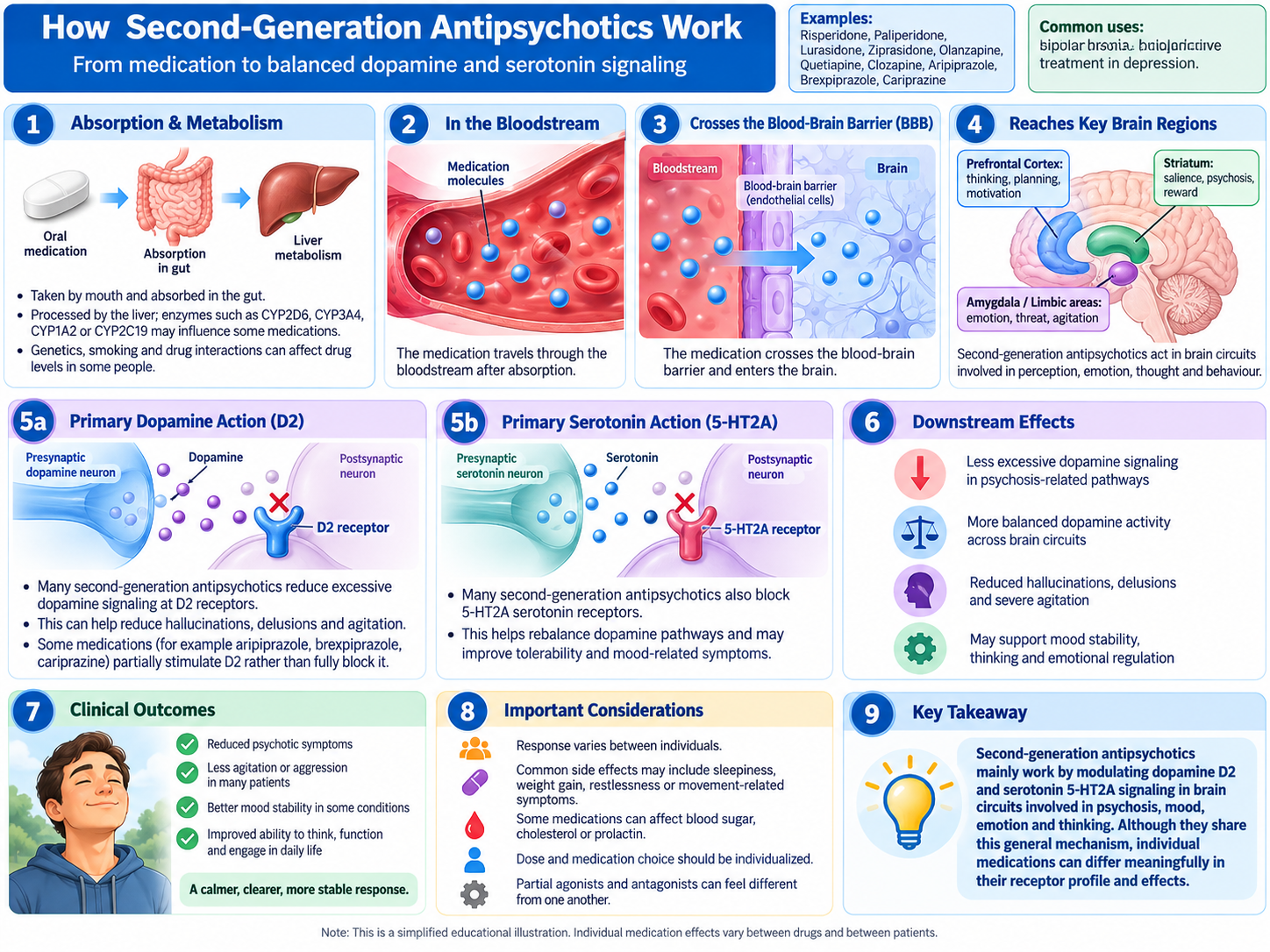
Olanzapine works by interacting with several neurotransmitter receptors in the brain. Its two most important therapeutic actions are:
Dopamine D2 Receptor Blockade
and:
Serotonin 5-HT2A Receptor Blockade
Olanzapine also blocks several other receptors, particularly:
- 5-HT2C serotonin receptors
- Histamine H1 receptors
- Muscarinic acetylcholine receptors
- Alpha-1 adrenergic receptors
- Other dopamine and serotonin receptors This broad receptor profile helps explain both its effectiveness and its characteristic side effects. The Canadian Zyprexa monograph describes high affinity for D2/D3/D4, 5-HT2A/2C, 5-HT3, 5-HT6, muscarinic M1–M5, α1-adrenergic and H1 receptors.
A simplified mechanism is:
Olanzapine
- Blocks D2 dopamine receptors
- Blocks 5-HT2A serotonin receptors
- Dopamine and serotonin signaling are modified
- Psychosis- and mood-related neural circuits become better regulated
- Hallucinations, delusions, agitation and manic symptoms may improve
At the same time:
5-HT2C + H1 blockade
→ increased appetite and weight gain
-
H1 blockade → sedation
-
Muscarinic blockade → dry mouth and constipation
-
α1 blockade → dizziness and orthostatic hypotension
This combination of therapeutic and side-effect mechanisms is central to understanding how olanzapine works.
How Does Olanzapine Work for Schizophrenia?
Schizophrenia is not simply caused by:
“Too much dopamine.”
Dopamine activity differs between brain regions.
One of the strongest neurobiological findings in schizophrenia is abnormal dopamine signaling in striatal pathways, particularly during psychosis. Other systems involving glutamate, serotonin, cognition and cortical function are also involved.
Olanzapine reduces dopamine signaling by blocking:
D2 Receptors
The general pathway is:
- Dysregulated dopamine activity in striatal/mesolimbic circuits
- Excessive stimulation of D2 receptors
- Abnormal salience may increase
- Neutral experiences may acquire excessive significance
- Potential:
- Hallucinations
- Delusions
- Paranoia
- Disorganized thinking Olanzapine intervenes:
- Olanzapine
- D2 receptor antagonism
- Dopamine has less ability to activate D2 receptors
- Excessive dopamine-related signaling decreases
- Positive psychotic symptoms may improve
D2 receptor blockade is considered a major component of olanzapine’s antipsychotic effect.
What Is Abnormal Salience in Psychosis?
Dopamine contributes to deciding:
What is important?
What deserves attention?
What predicts reward or danger?
Normally, dopamine helps the brain assign significance to important events.
During psychosis, abnormal dopamine activity may cause ordinary experiences to feel unusually:
- Important
- Threatening
- Meaningful
- Personally relevant A neutral glance from another person, for example, might acquire excessive significance.
This can be conceptualized as:
- Abnormally elevated dopamine signaling
- Incorrect importance assigned to ordinary events
- Abnormal salience
- The brain attempts to explain the experience
- Potential:
Delusions or paranoid interpretations
By reducing excessive D2 signaling, olanzapine may reduce this abnormal assignment of salience.
What Does Olanzapine Do to Dopamine?
Olanzapine does not remove dopamine from the brain.
Instead, it:
Blocks dopamine receptors
particularly:
D2
Dopamine may still be present, but it cannot activate a blocked D2 receptor as effectively.
Therefore:
- Dopamine released
- Normally:
- Dopamine → D2 receptor
- Cellular signaling
With olanzapine:
- Olanzapine occupies D2
- Dopamine signaling through D2 decreases
This distinction is important.
Olanzapine is a:
D2 antagonist
not a dopamine-depleting medication.
Does Olanzapine Block Dopamine Everywhere in the Brain?
Olanzapine reaches dopamine receptors throughout the brain, but the clinical consequences differ by:
Brain pathway
This is extremely important for understanding both benefit and side effects.
Four dopamine pathways are particularly useful.
Mesolimbic and Striatal Dopamine — Antipsychotic Benefit
Psychotic positive symptoms are strongly associated with abnormal dopamine signaling in striatal and related limbic circuitry.
Therefore:
- Olanzapine
- D2 blockade in psychosis-related pathways
- Excessive dopamine signaling decreases
- Hallucinations and delusions may improve
This is the therapeutic dopamine effect clinicians generally want.
Nigrostriatal Dopamine — Movement Side Effects
The:
Nigrostriatal pathway
helps regulate movement.
Dopamine is required for normal motor control.
If D2 blockade becomes excessive in this pathway:
- Olanzapine
- D2 blockade in motor circuits
- Dopamine signaling becomes too low
- Possible:
- Stiffness
- Tremor
- Slowed movement
- Akathisia
- Dystonia These are called:
Extrapyramidal Symptoms — EPS
Olanzapine generally produces fewer EPS at usual therapeutic exposures than potent first-generation antipsychotics such as haloperidol, although EPS can still occur. A systematic review found that olanzapine generally remains below the very high D2 occupancy associated with greater EPS risk at standard recommended doses.
Tuberoinfundibular Dopamine — Prolactin
Dopamine normally suppresses:
Prolactin
release from the pituitary gland.
Therefore:
- Normal dopamine
- D2 stimulation in pituitary pathway
- Prolactin release suppressed
Olanzapine blocks D2:
- D2 blockade
- Dopamine's inhibitory signal decreases
- Prolactin may rise
Possible consequences can include:
- Menstrual changes
- Breast milk production
- Breast enlargement
- Sexual dysfunction
- Fertility changes Olanzapine can increase prolactin, although its effect is often less pronounced than with medications such as risperidone.
Prefrontal Dopamine — Cognition and Motivation
The:
Prefrontal Cortex — PFC
helps regulate:
- Working memory
- Attention
- Planning
- Motivation
- Executive control
- Emotional regulation Schizophrenia can involve reduced or inefficient dopamine signaling in some cortical networks.
Therefore:
Simply blocking dopamine everywhere would not be an ideal treatment strategy.
Strong D2 blockade in already underactive cortical dopamine networks could theoretically worsen:
- Motivation
- Emotional expression
- Cognitive function This helps explain why antipsychotic pharmacology must be interpreted:
Region by region
rather than saying:
“Dopamine should be lower.”
Why Is 5-HT2A Blockade Important with Olanzapine?
Olanzapine has very high affinity for:
5-HT2A Serotonin Receptors
The Canadian product monograph reports that a PET study after a 10 mg dose showed:
Greater 5-HT2A receptor occupancy than D2 receptor occupancy.
This high:
5-HT2A: D2
relationship is one characteristic associated with second-generation antipsychotic pharmacology.
Serotonin regulates dopamine neurons.
Therefore:
- Olanzapine blocks 5-HT2A
- Serotonin's regulation of dopamine release changes
- Dopamine signaling may be affected differently across neural pathways
This can modify the overall effect of D2 blockade.
Does 5-HT2A Blockade Increase Dopamine?
In certain pathways, it can indirectly facilitate dopamine release.
5-HT2A signaling can restrain dopamine release in some cortical and nigrostriatal networks.
Therefore:
- 5-HT2A blocked
- Serotonergic restraint on dopamine may decrease
- Dopamine release may increase locally
This does not mean olanzapine globally increases dopamine.
Instead, olanzapine can simultaneously:
Block dopamine D2 receptors
while:
Modifying regional dopamine release through serotonin receptors
This regional interaction is one reason atypical antipsychotics cannot be understood as simple dopamine suppressors.
Why Does Olanzapine Cause Fewer Movement Effects Than Haloperidol?
Haloperidol is dominated pharmacologically by strong:
D2 receptor blockade
Olanzapine combines:
D2 blockade
with strong:
5-HT2A blockade
and typically does not maintain extremely high striatal D2 occupancy at standard therapeutic doses.
Therefore:
Haloperidol
- Strong D2 blockade
- Greater potential for:
- Nigrostriatal dopamine suppression
- EPS
Whereas:
Olanzapine
- D2 blockade + strong 5-HT2A blockade
- Different dopamine-serotonin balance
- Generally lower EPS liability at usual doses
Olanzapine nevertheless remains a D2 antagonist, so movement symptoms can still occur.
What Is D2 Receptor Occupancy?
Receptor occupancy describes the proportion of available D2 receptors occupied by an antipsychotic.
Antipsychotic treatment is often conceptualized as requiring a therapeutic window.
Approximately:
Too little D2 occupancy
may produce inadequate antipsychotic effect.
Moderate D2 occupancy
may provide therapeutic benefit.
Very high D2 occupancy
increases the probability of EPS and prolactin-related effects.
A broad antipsychotic framework often places useful D2 occupancy around approximately:
60–80%
although this is not an individual dosing target and varies by medication, patient and imaging method.
Clinical-review data suggest olanzapine doses around or above 12 mg/day can achieve approximately 65% or greater striatal D2 occupancy, while doses above 20 mg can push occupancy beyond 80% in some individuals.
The important principle is:
More D2 blockade is not automatically better.
Once sufficient antipsychotic activity has been achieved, additional D2 blockade may increase adverse effects without proportionally improving symptoms.
How Does Olanzapine Work for Mania?
Bipolar mania can involve dysregulation across several neural systems, including:
-
Dopamine
-
Serotonin
-
Glutamate
-
GABA
-
Arousal networks
-
Reward circuitry
-
Sleep and circadian systems During mania, excessive dopaminergic and arousal-related signaling may contribute to:
-
Increased activity
-
Grandiosity
-
Reduced need for sleep
-
Racing thoughts
-
Impulsivity
-
Increased reward seeking
-
Agitation Olanzapine can reduce this excessive activation.
- Olanzapine
- D2 blockade
- Dopamine-driven activation decreases
- 5-HT2A/5-HT2C blockade
- Serotonin-dopamine regulation changes
- H1 blockade
- Arousal decreases
- Manic agitation, overactivity and thought acceleration may improve
Olanzapine’s antimanic effect should therefore not be described purely as sedation.
The core treatment involves:
Dopamine-serotonin modulation
while sedation can provide an additional early benefit when severe insomnia or agitation is present.
Does Olanzapine Work Simply by Sedating Someone?
No.
Olanzapine can be sedating, but sedation is not its primary antipsychotic mechanism.
Sedation largely comes from:
Histamine H1 receptor blockade
whereas antipsychotic activity is more closely related to:
D2 + 5-HT2A receptor antagonism
Therefore:
H1 blockade
→ sleepiness
is different from:
D2 + 5-HT2A blockade
→ antipsychotic activity.
A person may become sleepy before hallucinations or delusions have substantially improved.
Why Does Olanzapine Make You Sleepy?
Histamine is an important neurotransmitter in:
Wakefulness
Histamine neurons arising from the hypothalamus help maintain:
- Alertness
- Arousal
- Wakefulness Olanzapine strongly blocks:
H1 Histamine Receptors
Therefore:
- Olanzapine
- H1 blockade
- Histamine-mediated wakefulness decreases
- Sedation and sleepiness
Olanzapine has high H1 receptor affinity, which contributes substantially to its sedating profile.
Why Does Olanzapine Increase Appetite?
Olanzapine blocks two receptor systems particularly relevant to appetite:
Histamine H1
and:
Serotonin 5-HT2C
Both participate in:
- Hunger
- Satiety
- Food reward
- Energy regulation Therefore:
Olanzapine
- H1 blockade
- 5-HT2C blockade
- Satiety and appetite-control signaling change
- Hunger may increase
- Food intake may increase
- Weight gain may occur
This is an important pharmacodynamic consequence of olanzapine’s receptor profile.
What Does 5-HT2C Have to Do with Weight Gain?
The:
5-HT2C receptor
helps regulate appetite and energy balance, including through hypothalamic circuits.
Serotonin signaling through 5-HT2C contributes to:
Satiety
When olanzapine blocks this receptor:
- 5-HT2C signaling decreases
- Satiety regulation weakens
- Food intake may increase
5-HT2C also interacts with dopamine and norepinephrine systems, meaning its effects extend beyond appetite alone.
However:
Olanzapine-associated weight gain cannot be explained by a single receptor.
H1 signaling, 5-HT2C signaling, food intake, metabolic biology and individual susceptibility all contribute.
Why Can Olanzapine Affect Blood Sugar Even Beyond Weight Gain?
Weight gain contributes importantly to insulin resistance, but metabolic changes during olanzapine treatment are not necessarily explained entirely by increased body weight.
Olanzapine can influence:
- Appetite regulation
- Insulin sensitivity
- Glucose handling
- Lipid metabolism
- Hypothalamic metabolic signaling The exact mechanisms remain complex.
Therefore:
- Olanzapine
- Appetite + metabolic regulatory systems change
- Potential:
- Weight gain
- Insulin resistance
- Higher glucose
- Higher triglycerides/cholesterol This is why metabolic monitoring remains important even if the patient does not initially gain large amounts of weight.
Why Does Olanzapine Cause Dry Mouth and Constipation?
Olanzapine blocks:
Muscarinic Acetylcholine Receptors
Acetylcholine helps control:
- Saliva
- Intestinal movement
- Bladder contraction
- Eye focusing
- Memory and attention Therefore:
- Olanzapine
- Muscarinic receptor blockade
- Possible:
- Dry mouth
- Constipation
- Blurred vision
- Urinary difficulty These are called:
Anticholinergic Effects
Olanzapine has significant affinity for several muscarinic receptor subtypes.
Why Can Olanzapine Cause Dizziness When Standing?
Olanzapine also blocks:
Alpha-1 Adrenergic Receptors
Alpha-1 receptors help constrict blood vessels when a person stands.
Normally:
- Standing
- α1 activation
- Blood vessels constrict
- Blood pressure maintained
With olanzapine:
- α1 blocked
- Compensatory vasoconstriction may be weaker
- Blood pressure can fall
- Possible:
- Dizziness
- Lightheadedness
- Faintness This is called:
Orthostatic Hypotension
Why Can Olanzapine Cause Akathisia?
Akathisia is an uncomfortable sensation of:
Inner restlessness
People may:
- Pace
- Move their legs constantly
- Feel unable to sit still
- Describe intense internal agitation One contributor is:
D2 blockade in motor-related dopamine circuits
Therefore:
- Excessive motor D2 blockade
- Dopamine signaling disrupted
- Akathisia may occur
An important clinical point is that akathisia can sometimes resemble:
Anxiety
or:
Worsening agitation
If the problem is medication-induced akathisia, assuming the psychosis is worsening and simply increasing the dose can potentially make the restlessness worse.
Why Can Olanzapine Cause Parkinsonism?
Normal movement requires dopamine signaling within the:
Nigrostriatal Pathway
Olanzapine blocks D2 receptors within this system.
Therefore:
- D2 blockade
- Dopamine-mediated movement signaling decreases
- Possible:
- Stiffness
- Slowness
- Tremor
- Reduced facial expression This is called:
Drug-Induced Parkinsonism
It is not the same condition as Parkinson’s disease, even though the symptoms can look similar.
Why Can Olanzapine Cause Tardive Dyskinesia?
Tardive dyskinesia can develop after long-term exposure to dopamine-receptor-blocking medications.
The mechanism is not completely established, but chronic D2 blockade may cause adaptations involving:
- Dopamine receptor sensitivity
- Basal ganglia circuitry
- Synaptic plasticity
- Oxidative and cellular processes Conceptually:
- Long-term D2 blockade
- Motor dopamine pathways adapt
- Abnormal involuntary movement circuits may emerge
TD can sometimes persist after the medication is stopped.
How Is Olanzapine Different from Haloperidol?
Both block:
D2 dopamine receptors
But their overall pharmacology is very different.
Haloperidol
is strongly dominated by:
D2 blockade
while:
Olanzapine
has broad:
D2 + 5-HT2A + 5-HT2C + H1 + muscarinic + α1 activity
Therefore:
Haloperidol
tends to have greater:
- EPS risk
- Parkinsonism
- Prolactin-related concerns while:
Olanzapine
tends to have greater:
- Weight gain
- Appetite increase
- Sedation
- Metabolic burden
- Anticholinergic effects This is not an absolute comparison for every patient, but it reflects their different receptor profiles.
How Is Olanzapine Different from Aripiprazole?
This is another important distinction.
Olanzapine
is a:
D2 antagonist
It blocks D2 receptor activation.
Aripiprazole
is primarily a:
D2 partial agonist
It activates the D2 receptor, but less strongly than dopamine itself.
Therefore:
Olanzapine
- D2 receptor
- Blocked
while:
Aripiprazole
- D2 receptor
- Partially stimulated
This creates very different effects on:
- Dopamine signaling
- Prolactin
- Movement symptoms
- Activation
- Metabolic effects
How Is Olanzapine Different from Clozapine?
Both are broad second-generation antipsychotics, but their receptor pharmacology differs.
Clozapine
has relatively weaker and more transient D2 receptor occupancy and extensive activity across multiple:
- Serotonin
- Dopamine
- Muscarinic
- Adrenergic
- Histamine receptors Olanzapine
has stronger conventional D2 antagonism while retaining broad:
5-HT2A/2C + H1 + muscarinic activity
Clozapine remains uniquely effective for:
Treatment-resistant schizophrenia
but has distinctive serious risks such as severe neutropenia, myocarditis and severe gastrointestinal hypomotility.
Olanzapine has a major metabolic burden but does not share clozapine’s unique treatment-resistant indication and monitoring profile.
Does Olanzapine Help Negative Symptoms?
It may help some negative symptoms, but this requires careful interpretation.
Negative symptoms include:
-
Low motivation
-
Reduced emotional expression
-
Social withdrawal
-
Reduced speech
-
Reduced pleasure Some apparent negative symptoms are actually secondary to:
-
Psychosis
-
Anxiety
-
Depression
-
Severe agitation
-
Poor sleep and may improve when the illness improves.
Primary negative symptoms have more complex biology involving:
- Prefrontal dopamine
- Glutamate
- Neural circuitry
- Cognitive networks They generally respond less robustly to D2 antagonism than hallucinations and delusions do.
Therefore, olanzapine should not be described as correcting all schizophrenia symptoms through dopamine blockade.
How Quickly Does Olanzapine Work?
Some effects can appear relatively quickly.
Sedation
may occur after the first doses because H1 receptor blockade happens quickly.
Agitation
may begin improving relatively early.
But:
Hallucinations, delusions and disorganized thinking
often require days to weeks of continued treatment for substantial improvement.
The sequence can be thought of as:
- Olanzapine reaches brain receptors
- D2 + 5-HT2A blockade begins
- Neural signaling changes immediately
- Downstream circuits and behaviour gradually adapt
- Clinical antipsychotic improvement develops
Therefore, receptor binding is rapid, while full clinical response can be slower.
How Is Olanzapine Metabolized?
Olanzapine undergoes extensive liver metabolism.
Important pathways include:
UGT-mediated glucuronidation
and:
CYP1A2-mediated oxidation
with a much smaller contribution from:
CYP2D6
and other pathways.
The DPWG review describes olanzapine as being metabolized primarily by UGT pathways and CYP1A2, with CYP2D6 and CYP3A4 contributing far less.
The simplified pathway is:
Olanzapine
- UGT glucuronidation
- CYP1A2
- Minor CYP2D6 / other metabolism
- Metabolites
- Elimination
What Is the Role of UGT1A4?
UGT1A4
is one of the principal glucuronidation enzymes involved in olanzapine metabolism.
Therefore:
- Olanzapine
- UGT1A4
- Olanzapine glucuronides
- Elimination
UGT1A4 genetic variation has been investigated as a possible source of differences in olanzapine concentration.
However:
There is currently no validated UGT1A4 genotype-based olanzapine dosing guideline.
The gene is pharmacokinetically interesting but not yet routinely actionable.
Why Is CYP1A2 Important for Olanzapine?
CYP1A2 contributes significantly to olanzapine oxidation.
Therefore:
- Higher CYP1A2 activity
- Olanzapine is cleared faster
- Drug concentration may decrease
while:
- Lower CYP1A2 activity
- Olanzapine clearance decreases
- Drug concentration may increase
However, an important point is that CYP1A2 activity is heavily influenced by:
Environment and other medications
not just genetics.
This is particularly important with:
Cigarette smoking
Why Does Cigarette Smoking Affect Olanzapine?
Cigarette smoke contains combustion products called:
Polycyclic aromatic hydrocarbons
that can induce:
CYP1A2
Therefore:
- Cigarette smoking
- CYP1A2 activity increases
- Olanzapine metabolism increases
- Olanzapine concentration decreases
This means a smoker and nonsmoker taking exactly the same dose may have quite different olanzapine exposures.
What Happens if Someone Stops Smoking While Taking Olanzapine?
When smoking stops:
- Smoke-related CYP1A2 induction disappears
- CYP1A2 activity decreases
- Olanzapine clearance decreases
- Olanzapine concentration can rise
Possible consequences include increased:
- Sedation
- Dizziness
- Movement symptoms
- Other concentration-related adverse effects Therefore, a substantial change in smoking should prompt:
Clinical review of olanzapine treatment.
This issue is particularly important during hospitalization, because someone who normally smokes may abruptly stop while admitted.
Is Nicotine Responsible for the Olanzapine-Smoking Interaction?
Primarily:
No.
The clinically important CYP1A2 induction comes predominantly from:
Combustion products in tobacco smoke
rather than nicotine itself.
Therefore changing from cigarette smoking to:
- Nicotine patches
- Nicotine gum
- Other non-combustible nicotine products can remove the CYP1A2 induction even though the person continues receiving nicotine.
This is why prescribers should ask about:
Smoking behaviour
not simply:
Nicotine use.
What Happens if Fluvoxamine Is Added to Olanzapine?
Fluvoxamine is a potent:
CYP1A2 Inhibitor
Therefore:
- Fluvoxamine
- CYP1A2 inhibited
- Olanzapine metabolism decreases
- Olanzapine concentration can increase
This can potentially increase concentration-related adverse effects.
The interaction is particularly notable because fluvoxamine is also a psychiatric medication, making co-prescribing possible in clinical practice.
Does CYP1A2 Genotype Determine the Olanzapine Dose?
Currently:
No.
Although CYP1A2 is an important metabolic pathway, the DPWG reviewed available CYP1A2 genetic evidence and concluded that there is no clinically actionable CYP1A2–olanzapine gene-drug interaction requiring dose adjustment.
Studies have generally not demonstrated sufficiently consistent differences in:
- Olanzapine exposure
- Response
- Side effects across CYP1A2 genotype groups.
Therefore:
CYP1A2 genotype is biologically relevant
but:
CYP1A2 genotype alone does not determine olanzapine dosing.
Does CYP2D6 Genotype Affect Olanzapine?
CYP2D6 contributes only a relatively small proportion of olanzapine clearance.
The DPWG found no convincing clinically meaningful effect of CYP2D6 phenotype on olanzapine treatment and recommends:
No therapy adjustment based on CYP2D6 genotype.
Therefore a:
CYP2D6 Poor Metabolizer
does not automatically require a lower olanzapine dose,
and a:
CYP2D6 Ultrarapid Metabolizer
does not automatically require a higher dose.
This is very different from medications such as:
- Nortriptyline
- Atomoxetine
- Aripiprazole where CYP2D6 can have greater clinical importance.
For Olanzapine, Can Environment Matter More Than CYP Genetics?
Yes.
This is one of the clearest examples in psychiatric pharmacology.
For CYP1A2:
Inherited genotype
may have only a modest or inconsistent influence.
But:
Cigarette smoking
Fluvoxamine Ciprofloxacin
and other environmental or medication factors can alter enzyme activity much more dramatically.
Therefore:
- Genotype
- Smoking
- Current medications
Age / physiology
- Actual CYP1A2 activity
- Olanzapine exposure
This is why actual clinical pharmacokinetics cannot be inferred from genotype alone.
Can Olanzapine Fail Even When Metabolism Is Normal?
Absolutely.
This illustrates the distinction between:
Pharmacokinetics — PK
and:
Pharmacodynamics — PD
A patient can have completely normal olanzapine metabolism but still experience:
- Poor antipsychotic response
- Excessive weight gain
- Excessive sedation
- Akathisia
- Cognitive dulling
- Inadequate control of mania because having the correct concentration does not guarantee that the patient’s receptor biology is ideally matched to the medication.
Olanzapine Pharmacokinetics — PK
PK asks:
Does an appropriate amount of olanzapine reach the brain?
The pathway is:
- Olanzapine dose
- Absorption
- UGT-mediated glucuronidation
- CYP1A2 metabolism
- Smoking + CYP inhibitors/inducers
- Olanzapine concentration
- Medication reaches the brain
Important influences include:
- Dose
- Smoking status
- Smoking cessation
- Fluvoxamine
- Ciprofloxacin
- Carbamazepine
- Age
- Liver function
- Other medications PK determines:
How much olanzapine is available to occupy receptors.
Olanzapine Pharmacodynamics — PD
PD asks:
What happens once olanzapine reaches those receptors?
Olanzapine
- D2 antagonism
- 5-HT2A antagonism
- Dopamine-serotonin signaling changes
- Psychosis or mania may improve
Meanwhile:
5-HT2C blockade
→ appetite and metabolic effects
H1 blockade
→ sedation + appetite
Muscarinic blockade
→ dry mouth + constipation
α1 blockade
→ orthostatic hypotension
Therefore:
Normal olanzapine PK does not automatically mean optimal olanzapine PD.
Olanzapine Requires Both Appropriate Exposure and Brain Compatibility
The complete process can be summarized as:
- Olanzapine is taken
- PK — Pharmacokinetics
- Absorption
- UGT glucuronidation + CYP1A2
- Smoking + drug interactions + individual physiology
- Olanzapine concentration
- PD — Pharmacodynamics
- D2 blockade
- 5-HT2A blockade ↓
Dopamine + serotonin signaling changes
↓
Psychosis or mania may improve
while:
5-HT2C + H1
influence appetite and weight
H1
influences sedation
Muscarinic receptors
influence anticholinergic effects
α1 receptors
influence blood pressure
This creates two separate personalized-prescribing questions:
PK asks:
Does an appropriate amount of olanzapine reach the brain?
PD asks: Is olanzapine’s D2/5-HT2A and broader receptor profile compatible with this patient’s neurobiology and symptom pattern?
Both matter.
What Is the Role of DRD2 Genetics?
DRD2
encodes:
Dopamine D2 Receptor
This is one of olanzapine’s principal therapeutic targets.
The biological relationship is direct:
- DRD2 gene
- D2 receptor expression and signaling
- Olanzapine blocks D2
- Dopamine signaling changes
- Antipsychotic response and movement effects may vary
Variations in DRD2 have been studied for associations with:
- Antipsychotic response
- EPS
- Prolactin
- Treatment resistance But:
There is currently no validated DRD2 genotype-based olanzapine dosing guideline.
Therefore, a DRD2 variant should not be interpreted alone as:
“Olanzapine will work”
or:
“Olanzapine will fail.”
What Is the Role of HTR2A Genetics?
HTR2A
encodes:
5-HT2A Receptor
Olanzapine has very high affinity for 5-HT2A.
Therefore:
- HTR2A
- 5-HT2A receptor expression/function
- Olanzapine antagonizes 5-HT2A
- Serotonin-dopamine regulation changes
- Clinical response may differ
Variants such as:
HTR2A rs6311
and:
rs7997012
have been studied in psychiatric medication response.
However:
No HTR2A genotype currently provides a validated olanzapine treatment recommendation.
What Is the Role of HTR2C Genetics?
HTR2C
encodes:
5-HT2C Receptor
Olanzapine strongly blocks 5-HT2C.
The pathway is particularly relevant to:
- Appetite
- Satiety
- Weight regulation
- Dopamine modulation
- Norepinephrine modulation Therefore:
- HTR2C
- 5-HT2C signaling
- Olanzapine blocks 5-HT2C
- Appetite + metabolic signaling changes
HTR2C variants, including:
rs3813929
and:
rs1414334
have been investigated in relation to antipsychotic-associated weight gain and metabolic effects.
However:
No HTR2C genotype currently provides a sufficiently validated individual prediction of olanzapine weight gain or a recognized genotype-based dose recommendation.
They are best regarded as pharmacodynamic research markers, not deterministic clinical rules.
What About DRD3?
DRD3
encodes:
Dopamine D3 Receptor
Olanzapine also binds D3 receptors.
DRD3 variants have been studied in relation to:
- Antipsychotic response
- Movement symptoms
- Tardive dyskinesia However:
There is currently no validated DRD3-guided olanzapine prescribing recommendation.
What About MC4R and Weight Gain?
MC4R — Melanocortin-4 Receptor
plays an important role in:
- Appetite
- Energy expenditure
- Body-weight regulation Variants near or within the MC4R pathway have been associated in pharmacogenomic studies with susceptibility to antipsychotic-associated weight gain.
This makes MC4R particularly interesting for medications such as olanzapine.
However:
MC4R testing does not currently replace clinical metabolic monitoring
and does not provide an established olanzapine dosing rule.
Weight gain remains:
Polygenic + environmental + medication-dependent.
Can Genetics Predict Olanzapine Weight Gain?
Not reliably enough for routine individual prediction.
Potential genetic contributors include:
-
HTR2C
-
MC4R
-
Histamine-related pathways
-
Dopamine pathways
-
Metabolic genes But body-weight response also depends on:
-
Baseline weight
-
Age
-
Sex
-
Diet
-
Activity
-
Treatment duration
-
Dose
-
Other medications
-
Individual metabolic physiology Therefore:
Genetic susceptibility may contribute to risk, but weight, glucose and lipids still need to be monitored directly.
Can Pharmacogenomic Testing Predict Whether Olanzapine Will Work?
Not with certainty.
There are two very different levels of olanzapine pharmacogenomics.
Pharmacokinetic genetics
Potentially relevant genes include:
- CYP1A2
- UGT1A4
- CYP2D6 But current DPWG guidance recommends no CYP1A2- or CYP2D6-based therapy adjustment for olanzapine.
Pharmacodynamic genetics
Biologically relevant candidate genes include:
- DRD2
- DRD3
- HTR2A
- HTR2C
- HRH1
- MC4R These pathways are highly relevant to olanzapine pharmacology but remain investigational for determining individual drug selection or dose.
Therefore pharmacogenomic information may contribute to a broader biological assessment, but it should not be interpreted as a stand-alone prediction of response.
Why Might Olanzapine Work Very Well for One Patient but Poorly for Another?
Two patients with schizophrenia may have different underlying patterns.
One may have:
Marked striatal dopamine activation
with relatively preserved cortical function.
Another may have:
Psychosis together with substantial prefrontal dopamine dysfunction
Another may be particularly sensitive to:
D2 blockade
and develop movement symptoms.
Another may be especially sensitive to:
H1 / 5-HT2C blockade
and gain substantial weight.
Another may smoke heavily and therefore clear olanzapine quickly through:
CYP1A2 induction
These differences help explain why the same diagnosis and even the same dose can produce very different outcomes.
Top of Form
Bottom of Form
This article is educational. It does not diagnose, and it does not replace advice from your prescriber or pharmacist. Never start, stop or change a medication based on a web page.