
Clozapine · How it works
How Does Clozapine Work?
Clozapine, commonly known by the brand name Clozaril, is an atypical antipsychotic used primarily for treatment-resistant schizophrenia—schizophrenia that has
 Written by Sanjida Ahmed, PhD, Cellular and Molecular BiologyChief Operating Officer and Lead Scientist, Personalized Prescribing. Last reviewed October 2, 2026.
- Class
- Atypical antipsychotic
On this page
- How Does Clozapine Work for Schizophrenia?
- Dopamine D2 receptor signaling
- What Does Clozapine Do to Dopamine?
- Why Is Clozapine Different from Other Dopamine-Blocking Antipsychotics?
- How Does Clozapine Affect Serotonin?
- What Is the Role of the 5-HT2A Receptor?
- What Is the Role of the 5-HT2C Receptor?
- 5-HT2C receptors
- Does Clozapine Affect Acetylcholine?
- Does Clozapine Affect Glutamate?
- Why Can Clozapine Work When Other Antipsychotics Fail?
- D2 receptor blockade
- Does Clozapine Simply Lower Dopamine Everywhere in the Brain?
- Mesolimbic dopamine
- Prefrontal dopamine
- Nigrostriatal dopamine
- “Reduce dopamine.”
- Why Does Clozapine Cause Fewer Movement Side Effects Than Some Antipsychotics?
- Why Does Clozapine Cause Sleepiness?
- Why Does Clozapine Cause Weight Gain?
- Histamine H1
- Serotonin 5-HT2C
- Why Does Clozapine Cause Constipation?
- Why Can Clozapine Cause Low Blood Pressure and Dizziness?
- Why Does Clozapine Cause Excessive Saliva?
- Why Can the Same Clozapine Dose Affect Two People Differently?
- How Is Clozapine Metabolized?
- Why Is CYP1A2 So Important for Clozapine?
- Cigarette smoking
- Fluvoxamine or ciprofloxacin
- How Does Smoking Affect Clozapine?
- Can Infection Affect Clozapine Levels?
- Can Clozapine Fail Even If It Is Metabolized Normally?
- Why Are Clozapine Blood Levels Sometimes Measured?
- Therapeutic Drug Monitoring — TDM
- Can Genetics Affect Clozapine Metabolism?
- Can Pharmacodynamic Genes Affect Clozapine Response?
- Can Pharmacogenomic Testing Tell Whether Clozapine Will Work?
- Why Is Clozapine So Different from Aripiprazole or Brexpiprazole?
Clozapine, commonly known by the brand name Clozaril, is an atypical antipsychotic used primarily for treatment-resistant schizophrenia—schizophrenia that has not responded adequately to other antipsychotic medications.
Clozapine is unusual because its mechanism is much broader than simply blocking dopamine.
It interacts with several neurotransmitter systems, including:
- Dopamine
- Serotonin
- Acetylcholine
- Histamine
- Norepinephrine Its exact mechanism of therapeutic action is still not completely understood. Current prescribing information proposes that antagonism of dopamine D2 and serotonin 5-HT2A receptors contributes to its antipsychotic effects, but clozapine also binds strongly to several other serotonin, dopamine, muscarinic, histamine and adrenergic receptors.
A simplified pathway is:
- Clozapine
- Reaches the brain
- Modifies dopamine + serotonin + acetylcholine + other receptor systems
- Activity within psychosis-related brain networks changes
- Hallucinations, delusions and other schizophrenia symptoms may improve
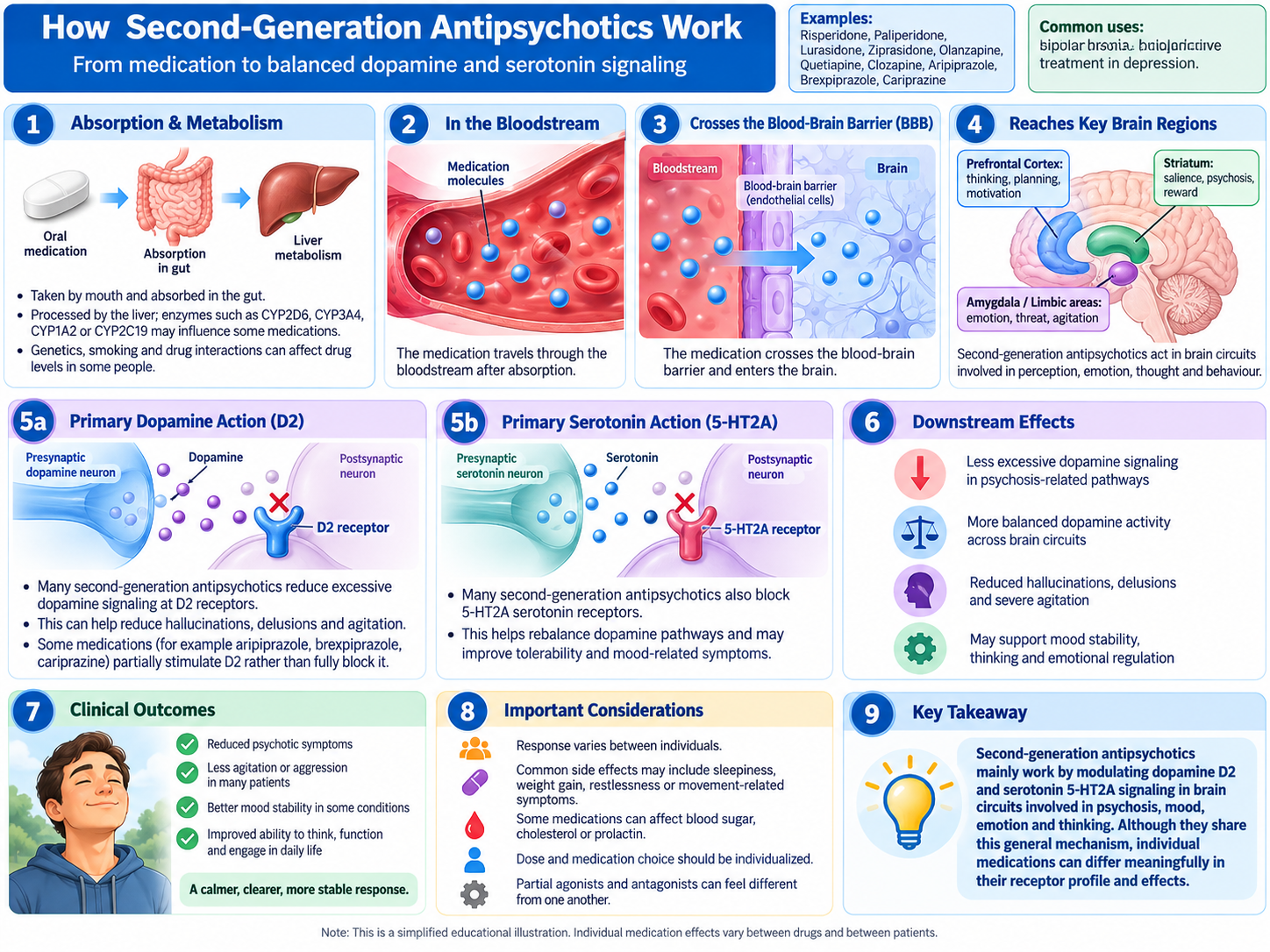
How Does Clozapine Work for Schizophrenia?
Schizophrenia involves abnormalities across several interacting brain systems.
One of the best-established findings involves excessive dopamine activity in certain pathways, particularly those connecting to the striatum.
Excessive dopamine signaling through D2 receptors has been associated with positive symptoms such as:
- Hallucinations
- Delusions
- Paranoia
- Disorganized thinking Most antipsychotic medications therefore work largely by reducing:
Dopamine D2 receptor signaling
Clozapine also influences D2 receptors—but it does so differently from many other antipsychotics.
Clozapine has relatively low affinity for D2 receptors compared with medications such as haloperidol or risperidone, while having substantial activity at serotonin and several other receptor systems.
This broader pharmacology may be one reason clozapine can work in patients who have not responded to conventional D2-blocking antipsychotics.
What Does Clozapine Do to Dopamine?
Clozapine is generally described as a dopamine receptor antagonist, but the phrase “dopamine blocker” does not fully capture its pharmacology.
Clozapine interacts with several dopamine receptor subtypes, including:
- D1
- D2
- D3
- D4
- D5 Its affinity for D2 is relatively modest compared with many other antipsychotics, whereas it binds more strongly to D4 receptors. Current receptor-binding data show substantially greater affinity for D4 than for D2.
The simplified effect is:
- Excessive dopamine signaling
- Clozapine occupies dopamine receptors
- Dopamine receptor signaling is reduced or modified
- Psychosis-related neural activity may decrease
However, D4 blockade alone does not explain clozapine’s unique effectiveness. Selective D4 antagonists have not reproduced clozapine’s clinical efficacy, suggesting that its benefit comes from the combination of several pharmacological actions rather than one receptor alone.
Why Is Clozapine Different from Other Dopamine-Blocking Antipsychotics?
Many conventional antipsychotics bind strongly and persistently to dopamine D2 receptors.
Clozapine has:
Lower D2 affinity
plus:
Strong activity at multiple non-D2 receptors
including serotonin, muscarinic, histamine and adrenergic receptors.
This results in a substantially different pharmacological profile.
Rather than relying primarily on:
Strong D2 blockade
clozapine produces:
- Moderate D2 effects
- Strong serotonin effects
- Muscarinic effects
- Adrenergic effects
- Histamine effects A much broader change in neural signaling The exact reason this makes clozapine uniquely effective in treatment-resistant schizophrenia remains an active area of research.
How Does Clozapine Affect Serotonin?
Serotonin is involved in:
- Mood
- Anxiety
- Perception
- Cognition
- Emotional processing
- Sleep
- Appetite
- Dopamine regulation Clozapine interacts with several serotonin receptors.
Important ones include:
- 5-HT2A
- 5-HT2C
- 5-HT6
- 5-HT7
- 5-HT3
- 5-HT1A Among these, 5-HT2A antagonism is considered particularly relevant to clozapine’s atypical antipsychotic profile.
A simplified pathway is:
- Clozapine
- Blocks 5-HT2A receptors
- Serotonin signaling changes
- Dopamine activity in several brain pathways is indirectly modified
- Effects on psychosis, mood, cognition and movement pathways may occur
This serotonin-dopamine interaction helps distinguish atypical antipsychotics such as clozapine from older medications that act predominantly through D2 blockade.
What Is the Role of the 5-HT2A Receptor?
The 5-HT2A receptor, encoded by the HTR2A gene, influences:
- Perception
- Cognition
- Emotional processing
- Cortical activity
- Dopamine release Clozapine has considerably greater affinity for 5-HT2A receptors than for D2 receptors.
Therefore:
- Clozapine blocks 5-HT2A
- Serotonin-dopamine interactions change
- Dopamine signaling can be modified differently across brain regions
This may contribute to clozapine’s antipsychotic effects and its lower tendency than strong D2 blockers to produce some extrapyramidal movement effects.
What Is the Role of the 5-HT2C Receptor?
Clozapine also antagonizes:
5-HT2C receptors
5-HT2C receptors influence:
-
Appetite
-
Weight regulation
-
Dopamine signaling
-
Norepinephrine signaling
-
Mood
-
Anxiety Blocking 5-HT2C receptors may contribute to some of clozapine’s therapeutic effects, but it may also contribute to:
-
Increased appetite
-
Weight gain
-
Metabolic changes This illustrates an important concept:
The same receptor action that contributes to a medication’s overall brain effects may also contribute to side effects.
Does Clozapine Affect Acetylcholine?
Yes—and this is one of the most distinctive aspects of clozapine.
Clozapine has substantial activity at muscarinic acetylcholine receptors, including:
M1
and other muscarinic receptor subtypes.
Muscarinic receptors are involved in:
- Cognition
- Memory
- Attention
- Salivation
- Bowel movement
- Bladder function
- Autonomic regulation Clozapine’s muscarinic effects are thought to contribute both to its unusual therapeutic profile and to several important side effects.
Does Clozapine Affect Glutamate?
Possibly.
Glutamate is the brain’s major excitatory neurotransmitter and is involved in:
- Learning
- Memory
- Cognition
- Neural plasticity
- Communication between cortical brain regions Research into treatment-resistant schizophrenia suggests that its biology may sometimes differ from schizophrenia that responds well to conventional dopamine-blocking medications.
Some studies suggest that abnormal glutamate signaling may be more important in certain treatment-resistant patients.
Clozapine may indirectly influence glutamate and NMDA receptor signaling, and this has been proposed as one possible contributor to its unique effectiveness.
However, this remains an area of ongoing research.
It would therefore be too strong to say:
“Clozapine works because it corrects glutamate.”
A more accurate statement is:
Clozapine may influence glutamatergic signaling as part of its broader pharmacological effects.
Why Can Clozapine Work When Other Antipsychotics Fail?
This is one of the most important questions about clozapine.
The exact answer is still unknown.
Many antipsychotic medications rely heavily on:
D2 receptor blockade
But treatment-resistant schizophrenia may not always be driven predominantly by the same dopamine abnormalities as treatment-responsive schizophrenia.
Research suggests that some treatment-resistant patients may have different combinations of:
-
Dopamine abnormalities
-
Glutamate abnormalities
-
Cortical network dysfunction
-
Receptor differences
-
Neurotransmitter interactions Clozapine has an unusually broad receptor profile involving:
-
Dopamine
-
Serotonin
-
Muscarinic acetylcholine
-
Adrenergic signaling
-
Histamine possibly downstream:
- Glutamate pathways
- Multiple neural systems are affected simultaneously
This broader mechanism is one plausible explanation for why clozapine can work when medications based mainly on stronger D2 blockade have failed.
Does Clozapine Simply Lower Dopamine Everywhere in the Brain?
No.
This would be an oversimplification.
Dopamine pathways perform very different functions in different parts of the brain.
For example:
Mesolimbic dopamine
Excessive activity may contribute to:
- Hallucinations
- Delusions
- Paranoia
Prefrontal dopamine
Reduced or poorly regulated activity may contribute to:
- Cognitive difficulties
- Reduced motivation
- Executive dysfunction
- Negative symptoms
Nigrostriatal dopamine
Important for:
- Movement
- Motor control The goal of antipsychotic treatment is therefore not simply:
“Reduce dopamine.”
The more useful concept is:
Modify abnormal dopamine signaling while preserving as much normal dopamine function as possible.
Clozapine’s relatively low D2 affinity and broader receptor actions contribute to its distinct clinical profile.
Why Does Clozapine Cause Fewer Movement Side Effects Than Some Antipsychotics?
Strong, sustained blockade of D2 receptors in the nigrostriatal pathway can cause movement-related adverse effects such as:
- Rigidity
- Tremor
- Bradykinesia
- Dystonia Clozapine binds less strongly to D2 receptors than many conventional antipsychotics and has substantial serotonergic and other receptor activity.
This helps explain why clozapine generally a relatively low tendency has to cause:
- Parkinsonism
- Acute dystonia
- Persistent prolactin elevation compared with stronger D2-blocking medications.
This does not mean clozapine is safer overall. Its unique risks—such as severe neutropenia, myocarditis, gastrointestinal hypomotility and seizures—are why it requires careful monitoring.
Why Does Clozapine Cause Sleepiness?
Clozapine binds very strongly to: Histamine H1 receptors
Histamine is important for maintaining:
- Wakefulness
- Alertness
- Arousal Blocking H1 receptors can produce:
- Reduced histamine signaling
- Sleepiness and sedation
Clozapine’s very high affinity for H1 receptors helps explain why sedation is such a common side effect. Current receptor-binding data show H1 among clozapine’s highest-affinity targets.
Why Does Clozapine Cause Weight Gain?
Weight gain is likely caused by several interacting mechanisms.
Two important receptor systems are:
Histamine H1
and
Serotonin 5-HT2C
Both help regulate:
- Appetite
- Satiety
- Energy balance
- Metabolic signaling Clozapine blocks both receptor systems.
Therefore:
- H1 antagonism
- 5-HT2C antagonism
- Appetite and satiety signaling change
- Food intake and metabolic regulation may change
- Weight gain may occur
Other metabolic mechanisms also contribute, which is why clozapine can affect:
- Blood glucose
- Insulin sensitivity
- Cholesterol
- Triglycerides
Why Does Clozapine Cause Constipation?
This is especially important because clozapine-related constipation can become medically serious.
Clozapine blocks muscarinic acetylcholine receptors.
Acetylcholine normally helps stimulate gastrointestinal movement.
Therefore:
- Clozapine
- Muscarinic receptor blockade
- Reduced intestinal contractions
- Slower movement of material through the bowel
- Constipation
In severe cases:
- Gastrointestinal hypomotility
- Impaction / ileus / obstruction
- Potentially serious complications
This is why constipation during clozapine treatment should not be dismissed as a minor inconvenience.
Why Can Clozapine Cause Low Blood Pressure and Dizziness?
Clozapine strongly blocks: α1 adrenergic receptors
Alpha-1 receptors normally help blood vessels constrict when needed, including when a person stands up.
Clozapine can interfere with that response.
Therefore:
- α1 blockade
- Blood vessels do not constrict as effectively
- Blood pressure falls when standing
- Dizziness or fainting
This is called:
Orthostatic hypotension
It is particularly important when clozapine treatment is first started or the dose is increased.
Why Does Clozapine Cause Excessive Saliva?
Clozapine-induced hypersalivation is unusual because clozapine also has strong anticholinergic effects, which might normally be expected to cause dry mouth.
The explanation is complex.
Clozapine and its metabolites interact differently with several muscarinic and adrenergic receptors.
This combination can result in:
- Increased salivary secretion
- Reduced swallowing of saliva
- Particularly prominent nighttime drooling The exact mechanism is not fully established.
Why Can the Same Clozapine Dose Affect Two People Differently?
Two people taking exactly the same dose of clozapine can have very different blood concentrations.
One may have:
-
An appropriate concentration
-
Good symptom improvement
-
Acceptable side effects Another may develop:
-
Severe sedation
-
Dizziness
-
Seizures
-
Excessive salivation
-
Constipation while another may have inadequate treatment response.
One major reason is that clozapine metabolism varies considerably between people.
Important metabolic enzymes include:
- CYP1A2
- CYP3A4
- CYP2D6 CYP1A2 is particularly important clinically. Current labeling identifies clozapine as a substrate of all three pathways.
How Is Clozapine Metabolized?
A simplified pathway is:
- Clozapine
- CYP1A2 + CYP3A4 + CYP2D6
- Several metabolites
including:
- Norclozapine — N-desmethylclozapine
- Further metabolism and elimination
The current label describes norclozapine as having limited pharmacological activity, while other major metabolites have little or no relevant activity.
Clozapine blood concentrations can therefore be strongly influenced by anything that changes these metabolic pathways.
Why Is CYP1A2 So Important for Clozapine?
CYP1A2 is particularly important because its activity can change dramatically due to environmental and medication factors.
Important examples include:
Cigarette smoking
which induces CYP1A2
and:
Fluvoxamine or ciprofloxacin
which inhibit CYP1A2.
This can produce very different clozapine exposures.
How Does Smoking Affect Clozapine?
Cigarette smoke stimulates CYP1A2 activity.
Therefore:
- Regular cigarette smoking
- CYP1A2 activity increases
- Clozapine metabolism increases
- Clozapine concentration decreases
But if the patient suddenly stops smoking:
- Smoking stops
- CYP1A2 induction disappears
- Clozapine metabolism decreases
- Clozapine concentration rises
- Risk of concentration-related toxicity may increase
Current labeling specifically identifies tobacco smoke as a CYP1A2 inducer and advises patients to tell their healthcare provider if they smoke or intend to stop smoking.
Importantly:
It is tobacco smoke—not nicotine itself—that produces most of this CYP1A2 induction.
Therefore, switching from cigarettes to a nicotine patch does not necessarily preserve the same clozapine metabolism.
Can Infection Affect Clozapine Levels?
Yes.
This is a particularly important feature of clozapine.
Pneumonia and other significant inflammatory conditions have been reported to increase clozapine concentrations.
Inflammation can reduce CYP1A2 activity, slowing clozapine metabolism.
Therefore:
- Significant infection / inflammation
- CYP1A2 activity may decrease
- Clozapine metabolism slows
- Clozapine concentration may rise
The current prescribing information specifically notes reports of increased clozapine concentrations during pneumonia and other inflammatory conditions.
This is one reason unexpectedly severe:
- Sedation
- Confusion
- Seizures
- Excessive salivation
- Other clozapine adverse effects during an acute illness deserve clinical attention.
Can Clozapine Fail Even If It Is Metabolized Normally?
Yes.
Normal clozapine exposure does not guarantee treatment response.
There are two major parts to medication response.
Pharmacokinetics: How the Body Handles Clozapine
Pharmacokinetics, or PK, includes:
- Absorption
- CYP1A2 metabolism
- CYP3A4 metabolism
- CYP2D6 metabolism
- Drug interactions
- Smoking
- Inflammation
- Elimination The goal is ultimately to achieve an appropriate amount of active medication in the brain.
But that is only the first step.
Pharmacodynamics: How the Brain Responds to Clozapine
Pharmacodynamics, or PD, describes what happens when clozapine reaches its receptors and brain pathways.
Important biological targets include:
DRD2 — Dopamine D2 receptor
Important in psychosis and antipsychotic effects.
DRD4 — Dopamine D4 receptor
Clozapine has substantially greater affinity for D4 than D2, although D4 alone does not explain its unique effectiveness.
HTR2A — Serotonin 5-HT2A receptor
One of clozapine’s important serotonin targets.
HTR2C — Serotonin 5-HT2C receptor
Influences serotonin, dopamine, appetite and metabolic pathways.
- Muscarinic receptors Potentially relevant to cognition and clozapine’s distinctive therapeutic profile.
Histamine H1 receptors
Important particularly for sedation and metabolic effects.
- Adrenergic receptors Important for blood pressure and autonomic effects.
Clozapine’s effect therefore depends on a network of receptors rather than a single dopamine target.
Clozapine Needs Both Drug Exposure and Brain Response
A useful way to understand clozapine treatment is:
- Clozapine is taken
- The body absorbs and metabolizes clozapine — PK
- CYP1A2 + CYP3A4 + CYP2D6
- Smoking + drug interactions + inflammation can alter exposure
- An appropriate amount reaches the brain
- Clozapine interacts with its receptors — PD
- D2 + D4
- 5-HT2A + 5-HT2C and other serotonin receptors
- Muscarinic + adrenergic + histamine receptors
- Multiple neurotransmitter systems change
- Psychosis-related brain circuits respond
- Symptoms may improve
This illustrates an important principle:
Normal PK does not automatically mean optimal PD response.
A person can have an appropriate clozapine blood concentration but still have limited benefit because the relevant brain pathways may respond differently.
Why Are Clozapine Blood Levels Sometimes Measured?
Because clozapine exposure varies substantially between patients, clinicians may measure the actual amount of clozapine in the blood.
This is called:
Therapeutic Drug Monitoring — TDM
It may be particularly useful when:
- Symptoms are not improving
- Side effects are unexpectedly severe
- Smoking habits change
- An interacting medication is started or stopped
- Infection or inflammation occurs
- Adherence is uncertain
- The dose appears unusually high or low for the clinical response For clozapine, measuring actual drug concentration can often provide clinically useful information because environmental effects on CYP1A2 can be large.
Can Genetics Affect Clozapine Metabolism?
Genetics can contribute to individual variation, but clozapine is different from medications such as atomoxetine or citalopram.
Genes of potential pharmacokinetic interest include:
- CYP1A2
- CYP2D6
- CYP3A4 However, current DPWG guidance does not recommend a clozapine dose adjustment based on CYP1A2 or CYP2D6 genotype, because genetic phenotype has not shown a sufficiently consistent clinical effect. Non-genetic influences on CYP1A2—especially smoking, medications and inflammation—are often much more important.
Therefore:
CYP1A2 is extremely important for clozapine metabolism, but CYP1A2 genotype is not currently an established clozapine dosing test.
Can Pharmacodynamic Genes Affect Clozapine Response?
Several genes encode receptors that clozapine interacts with, including:
-
DRD2
-
DRD3
-
DRD4
-
HTR2A
-
HTR2C
-
Other serotonin, muscarinic and adrenergic receptor genes Variants in these pathways have been studied in relation to:
-
Antipsychotic response
-
Weight gain
-
Metabolic adverse effects
-
Movement-related effects
-
Treatment-resistant schizophrenia However:
There is currently no single pharmacodynamic genetic variant that reliably determines whether clozapine will work.
Current evidence is more consistent with clozapine response being polygenic and biologically complex rather than determined by one receptor variant.
Can Pharmacogenomic Testing Tell Whether Clozapine Will Work?
Not with certainty.
The response to clozapine can depend on:
-
Clozapine concentration
-
Smoking status
-
Drug interactions
-
Inflammation
-
Diagnosis
-
Symptoms
-
Dopamine signaling
-
Serotonin signaling
-
Muscarinic signaling
-
Glutamate biology
-
Receptor characteristics
-
Previous treatment history
-
Individual brain biology Pharmacogenomic information may contribute to a broader personalized assessment, but it should not replace:
-
Clinical monitoring
-
Blood-cell monitoring
-
Drug-interaction review
-
Smoking assessment
-
Clozapine concentration monitoring when appropriate
Why Is Clozapine So Different from Aripiprazole or Brexpiprazole?
Aripiprazole and brexpiprazole are primarily: D2/D3 partial agonists with serotonin receptor activity.
Clozapine is different. It is not a D2 partial agonist.
Instead, it has:
-
Relatively weak D2 antagonism
-
D4 antagonism
-
Strong 5-HT2A and other serotonin receptor activity
-
Muscarinic receptor activity
-
Histamine receptor activity
-
Adrenergic receptor activity A much broader pharmacodynamic profile This helps explain why the medications can have very different:
-
Therapeutic effects
-
Side-effect profiles
-
Uses
-
Response patterns
This article is educational. It does not diagnose, and it does not replace advice from your prescriber or pharmacist. Never start, stop or change a medication based on a web page.