
Duloxetine · How it works
How Does Duloxetine Work?
Duloxetine, commonly known by the brand name Cymbalta, is a serotonin-norepinephrine reuptake inhibitor (SNRI) used to treat depression, generalized anxiety d
 Written by Sanjida Ahmed, PhD, Cellular and Molecular BiologyChief Operating Officer and Lead Scientist, Personalized Prescribing. Last reviewed October 2, 2026.
- Class
- SNRI (serotonin-norepinephrine reuptake inhibitor)
On this page
- How Does Duloxetine Work for Depression?
- What Does Duloxetine Do to Serotonin?
- What Does Duloxetine Do to Norepinephrine?
- If Norepinephrine Can Cause Anxiety, Why Does Duloxetine Treat Anxiety?
- How Does Duloxetine Work for Generalized Anxiety Disorder?
- How Does Duloxetine Work for Pain?
- Why Is Duloxetine Used for Nerve Pain?
- How Does Duloxetine Work for Fibromyalgia?
- Does Duloxetine Affect Dopamine?
- How Is Duloxetine Different from Venlafaxine?
- Why Does Duloxetine Take Time to Work?
- Why Can Duloxetine Initially Cause Anxiety or Restlessness?
- Why Can Duloxetine Increase Blood Pressure or Heart Rate?
- Why Can Duloxetine Cause Sexual Side Effects?
- Why Can the Same Duloxetine Dose Affect Two People Differently?
- How Is Duloxetine Metabolized?
- Why Is CYP1A2 Important for Duloxetine?
- Why Is CYP2D6 Important for Duloxetine?
- Can Duloxetine Fail Even If You Metabolize It Normally?
- Can Genetics Affect Duloxetine Metabolism?
- Can Pharmacodynamic Genes Affect Duloxetine Response?
- Can Pharmacogenomic Testing Tell Whether Duloxetine Will Work?
- Why Might Duloxetine Work Better for Some Symptom Patterns Than Others?
- Why Can Duloxetine Be Particularly Useful When Depression and Pain Occur Together?
Duloxetine, commonly known by the brand name Cymbalta, is a serotonin-norepinephrine reuptake inhibitor (SNRI) used to treat depression, generalized anxiety disorder and several chronic pain conditions.
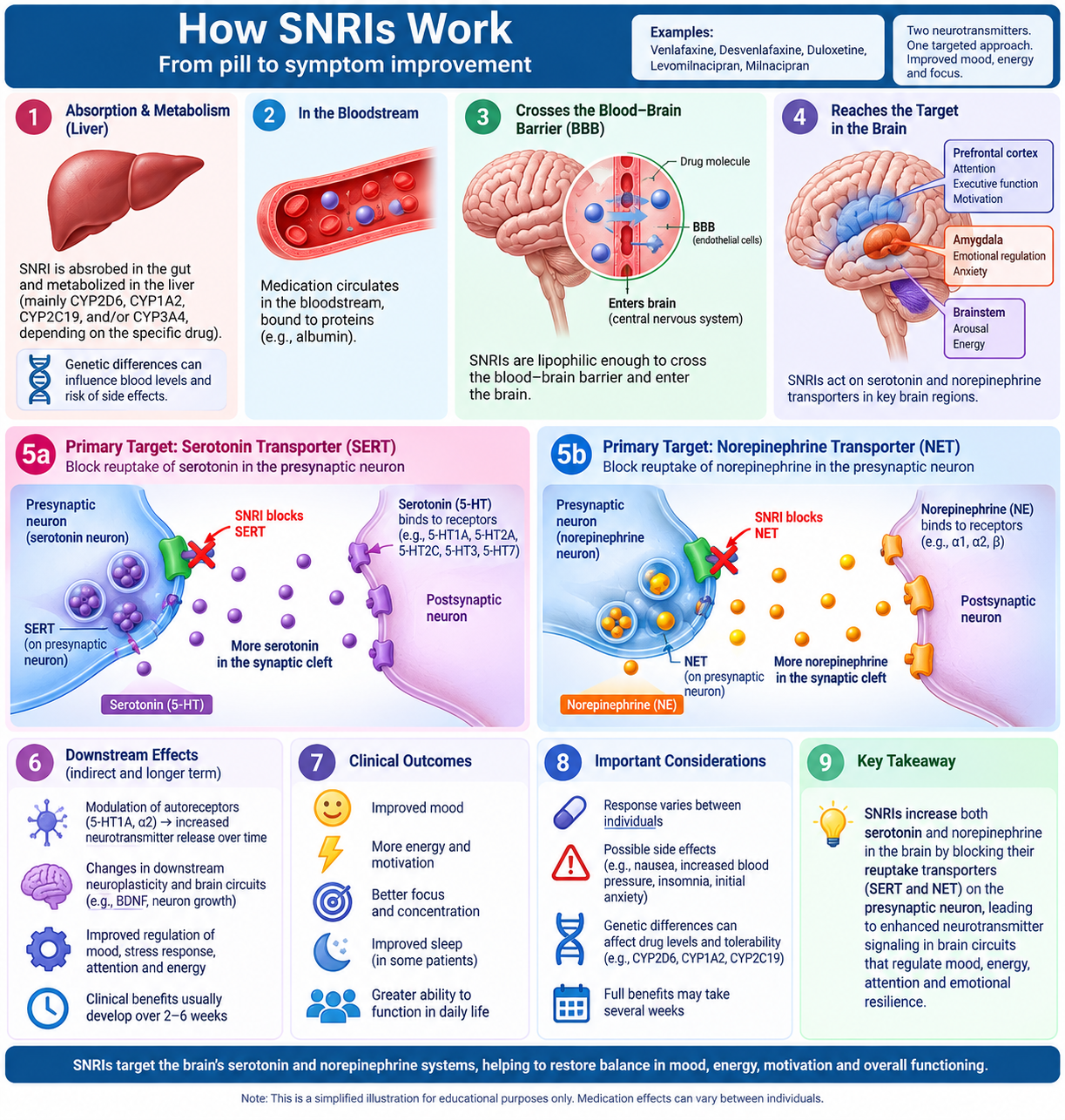
Duloxetine works mainly by increasing the availability of two important neurotransmitters in the brain and spinal cord: Serotonin and Norepinephrine
It does this by blocking two transporter proteins:
- SERT — Serotonin Transporter
- NET — Norepinephrine Transporter These transporters normally recycle serotonin and norepinephrine after they have been released from nerve cells.
The basic pathway is:
- Duloxetine
- Blocks SERT + NET
- Less serotonin and norepinephrine are immediately recycled
- More serotonin and norepinephrine remain available between nerve cells
- Neurotransmitter signaling changes
- Mood, anxiety and pain-processing networks gradually adapt
- Depression, anxiety or pain symptoms may improve
Current prescribing information describes duloxetine as a potent inhibitor of neuronal serotonin and norepinephrine reuptake. Its exact antidepressant, anti-anxiety and pain-relieving mechanisms in humans are not completely understood, but they are believed to result largely from increased serotonergic and noradrenergic activity in the central nervous system.
How Does Duloxetine Work for Depression?
Depression is not simply caused by having “low serotonin” or “low norepinephrine.”
Instead, depression can involve dysregulation across several brain systems involved in:
- Mood
- Motivation
- Stress response
- Concentration
- Emotional regulation
- Sleep
- Energy
- Reward and pleasure Duloxetine changes communication within these systems by increasing the availability of both serotonin and norepinephrine.
Normally:
- Serotonin and norepinephrine are released
- They activate receptors on nearby neurons
- SERT and NET transport them back into the nerve cell
Duloxetine interrupts this recycling process:
- Duloxetine
- SERT + NET inhibition
- Serotonin and norepinephrine remain available longer
- Multiple receptors receive altered signaling
- Neural circuits gradually adapt
- Depressive symptoms may improve
The important point is that duloxetine does not simply “replace missing neurotransmitters.” It changes neurotransmitter signaling, after which receptors and brain networks adapt over time.
What Does Duloxetine Do to Serotonin?
Serotonin helps regulate:
- Mood
- Anxiety
- Emotional responses
- Repetitive thinking
- Stress response
- Sleep
- Appetite
- Sexual function The serotonin transporter is called:
SERT
and is encoded by the:
SLC6A4 gene
SERT normally transports serotonin out of the space between neurons and back into the serotonin-releasing neuron.
Duloxetine blocks SERT.
Therefore:
- Serotonin is released
- Duloxetine inhibits SERT
- Serotonin reuptake decreases
- More serotonin remains available for signaling
The brain then responds through several different serotonin receptors.
These include receptors such as:
5-HT1A
5-HT2A
5-HT2C
and many others.
The eventual clinical effect depends on how these receptor systems and the larger neural network respond—not simply on the amount of serotonin present.
What Does Duloxetine Do to Norepinephrine?
Norepinephrine plays an important role in:
- Alertness
- Energy
- Attention
- Working memory
- Stress response
- Motivation
- Pain regulation
- Autonomic function The norepinephrine transporter is called:
NET
and is encoded by the:
SLC6A2 gene
NET normally transports norepinephrine back into nerve cells after it has been released.
Duloxetine inhibits NET.
Therefore:
- Norepinephrine is released
- Duloxetine blocks NET
- Norepinephrine reuptake decreases
- More norepinephrine remains available for signaling
This contributes to duloxetine’s effects on:
- Mood
- Energy
- concentration and alertness in some patients
- Stress-processing pathways
- Pain-control pathways However, just as with serotonin:
More norepinephrine is not automatically better.
The effect depends on where in the brain the norepinephrine is acting, which receptors are stimulated and the person’s baseline neurobiology.
If Norepinephrine Can Cause Anxiety, Why Does Duloxetine Treat Anxiety?
This is an important question.
Excessive norepinephrine activity—particularly within threat and sympathetic-arousal pathways—can contribute to:
- Hypervigilance
- Racing heart
- Trembling
- Feeling “on edge”
- Increased sensitivity to stress So why would a medication that increases norepinephrine help generalized anxiety disorder?
Because norepinephrine does not have the same function everywhere in the brain.
In areas such as the prefrontal cortex, appropriately regulated norepinephrine signaling can support:
- Cognitive control
- Attention
- Emotional regulation
- Top-down control of threat responses At the same time, chronic SNRI treatment leads to adaptation in receptors and neural networks.
Therefore, duloxetine’s anti-anxiety effect is not adequately explained by saying:
“Duloxetine increases norepinephrine.”
A better description is:
Duloxetine changes serotonin and norepinephrine signaling, after which anxiety-regulating brain circuits adapt.
This is also why some people can initially experience activation, nervousness or increased anxiety before experiencing an anti-anxiety benefit.
How Does Duloxetine Work for Generalized Anxiety Disorder?
Generalized anxiety disorder can involve persistent dysregulation of systems involved in:
- Worry
- Threat perception
- Emotional reactivity
- Stress
- Physical tension
- Autonomic arousal Important brain regions include the:
Amygdala
which contributes to threat detection and emotional responses,
and the:
Prefrontal cortex
which helps regulate those responses.
Duloxetine changes both serotonin and norepinephrine signaling within these interconnected networks.
A simplified model is:
- Duloxetine
- ↑ serotonin + norepinephrine availability
- Serotonin and adrenergic receptor signaling changes
- Prefrontal, limbic and stress-response networks gradually adapt
- Threat responses become better regulated
- Persistent anxiety and excessive worry may improve
It is therefore more accurate to describe duloxetine as helping correct dysregulated signaling than as simply correcting a neurotransmitter “deficiency.”
How Does Duloxetine Work for Pain?
One of the most interesting features of duloxetine is that it can reduce certain types of pain even when the person is not depressed.
This is because serotonin and norepinephrine participate in the brain’s natural system for suppressing pain.
These pathways are called:
Descending pain-inhibitory pathways
Pain signals travel from the body through the spinal cord toward the brain.
But the brain can also send signals downward through the spinal cord to regulate how strongly those incoming pain messages are transmitted.
Serotonin and norepinephrine are important neurotransmitters within these descending pain-control pathways.
The simplified pathway is:
- Pain signal enters the spinal cord
- Brainstem pain-control pathways send inhibitory signals downward
- Serotonin + norepinephrine help suppress pain transmission
Duloxetine can strengthen this system by increasing the availability of both neurotransmitters.
Therefore:
- Duloxetine
- SERT + NET inhibition
- ↑ serotonin + ↑ norepinephrine
- Descending inhibitory pain pathways become more effective
- Less pain signaling is transmitted upward
- Pain may decrease
Canadian and U.S. prescribing information identifies potentiation of these descending inhibitory pain pathways as an important proposed explanation for duloxetine’s analgesic effect.
Why Is Duloxetine Used for Nerve Pain?
Neuropathic pain occurs when the nerves themselves—or the nervous system processing those signals—become abnormal or overly sensitive.
Symptoms can include:
- Burning
- Tingling
- Shooting pain
- Electric-like pain
- Pain from normally mild stimulation Duloxetine does not repair the damaged nerve directly.
Instead, it changes how the central nervous system processes and suppresses pain signals.
Therefore:
- Abnormal pain signal
- Spinal cord
- Brain receives excessive pain information
but:
- Duloxetine strengthens descending serotonin/norepinephrine inhibition
- Some of the incoming pain signal is dampened
This is why duloxetine can be useful in diabetic neuropathic pain, fibromyalgia and some forms of chronic musculoskeletal pain.
How Does Duloxetine Work for Fibromyalgia?
Fibromyalgia is associated with altered processing of sensory and pain information within the nervous system.
The problem is not simply inflammation or damaged tissue.
One component may involve insufficient ability of the brain and spinal cord to dampen incoming pain signals.
Duloxetine may help strengthen the:
Descending pain-inhibitory system
through increased serotonin and norepinephrine signaling.
Therefore:
- Pain amplification
- Duloxetine strengthens central pain inhibition
- Pain sensitivity may decrease
This mechanism is separate from duloxetine’s antidepressant effect, although mood and pain pathways interact closely.
Does Duloxetine Affect Dopamine?
Yes, but dopamine is not considered one of duloxetine’s principal clinical targets.
Preclinical studies show duloxetine can inhibit dopamine reuptake, but it does so substantially less potently than serotonin or norepinephrine reuptake. Current prescribing information therefore characterizes duloxetine primarily as a serotonin and norepinephrine reuptake inhibitor, not as a dopamine reuptake inhibitor.
There can also be indirect interactions between norepinephrine and dopamine, particularly in the prefrontal cortex.
However, for patient-facing purposes, duloxetine is best described as acting primarily on:
Serotonin + norepinephrine
rather than dopamine.
How Is Duloxetine Different From an SSRI?
An SSRI such as escitalopram primarily blocks:
SERT
Therefore:
- SSRI
- ↑ serotonin signaling
Duloxetine blocks:
SERT + NET
Therefore:
Duloxetine
- ↑ serotonin
- ↑ norepinephrine This broader mechanism helps explain why duloxetine can be useful not only for depression and anxiety but also for neuropathic and chronic pain.
How Is Duloxetine Different from Venlafaxine?
Both duloxetine and venlafaxine are SNRIs.
Both increase:
Serotonin + norepinephrine
However, they have:
- Different relative effects on SERT and NET
- Different metabolism
- Different drug interactions
- Different approved indications
- Different pharmacogenomic considerations Duloxetine is particularly notable for having several established chronic pain indications, while its metabolism depends on both CYP1A2 and CYP2D6.
Venlafaxine relies more prominently on CYP2D6 conversion to its active metabolite, desvenlafaxine.
They should therefore not be considered interchangeable simply because both are SNRIs.
Why Does Duloxetine Take Time to Work?
Duloxetine begins blocking serotonin and norepinephrine transporters relatively soon after a dose.
Yet depression and anxiety generally do not disappear immediately.
Why?
Because transporter inhibition is only the first step.
The process is more like:
- SERT + NET inhibited
- Serotonin and norepinephrine availability changes
- Receptors detect the change
- Feedback systems adapt
- Intracellular signaling changes
- Neural circuits gradually reorganize
- Clinical improvement develops
This adaptation can take several weeks.
So:
Duloxetine can change neurotransmitter levels quickly, but the therapeutic response develops more slowly because the brain itself must adapt.
Why Can Duloxetine Initially Cause Anxiety or Restlessness?
During early treatment, serotonin and norepinephrine signaling can change before the rest of the nervous system has adapted.
This can temporarily produce:
- Nervousness
- Restlessness
- Increased sweating
- Trouble sleeping
- Increased heart rate
- Feeling activated For many patients these effects diminish as neural systems adapt.
This is another example of why the therapeutic effect cannot be understood simply as:
“More neurotransmitter = better.”
The brain needs time to adjust to the altered signaling.
Why Can Duloxetine Increase Blood Pressure or Heart Rate?
Norepinephrine is involved in the sympathetic nervous system, which helps regulate:
- Heart rate
- Blood-vessel tone
- Blood pressure By increasing norepinephrine signaling, duloxetine can cause modest increases in blood pressure or pulse in some patients. Current prescribing information recommends measuring blood pressure before treatment and periodically during treatment.
This effect illustrates an important point:
The same norepinephrine mechanism that may contribute to therapeutic benefit can also contribute to certain side effects.
Why Can Duloxetine Cause Sexual Side Effects?
Increasing serotonin signaling can interfere with pathways involved in:
-
Sexual desire
-
Dopamine-mediated reward
-
Arousal
-
Orgasm
-
Ejaculation Therefore, some people taking duloxetine experience:
-
Reduced libido
-
Delayed orgasm
-
Difficulty reaching orgasm
-
Delayed ejaculation
-
Erectile difficulties This is largely related to duloxetine’s serotonergic activity rather than its norepinephrine effect.
Why Can the Same Duloxetine Dose Affect Two People Differently?
Two people can take the same dose of duloxetine and have very different experiences.
One person may have: Good response + few side effects while another may experience:
Nausea + sweating + activation and another may experience: Little therapeutic benefit.
There are two major reasons.
They may have different drug exposure
Duloxetine is metabolized mainly by: CYP1A2 and CYP2D6 and these pathways can be influenced by other medications. Current labeling confirms that both CYP1A2 and CYP2D6 contribute to duloxetine metabolism.
Their brains may respond differently
Even if two people have similar duloxetine concentrations, their:
- Serotonin transporters
- Norepinephrine transporters
- Receptors
- Baseline neurotransmitter activity
- Symptoms
- Brain circuits may differ.
How Is Duloxetine Metabolized?
After duloxetine is absorbed, it is extensively metabolized in the liver.
The two most important liver enzymes are:
CYP1A2
and
CYP2D6
The simplified pathway is:
- Duloxetine
- CYP1A2 + CYP2D6
- Inactive or minimally active metabolites
- Elimination
The major circulating duloxetine metabolites do not appear to contribute substantially to its therapeutic activity.
The therapeutic effect therefore comes primarily from the parent duloxetine molecule.
Why Is CYP1A2 Important for Duloxetine?
CYP1A2 can have a major effect on duloxetine metabolism.
For example, the strong CYP1A2 inhibitor:
Fluvoxamine
substantially slows duloxetine metabolism.
In an interaction study, fluvoxamine increased duloxetine exposure approximately six-fold.
The pathway is:
- CYP1A2 inhibitor
- Duloxetine metabolism decreases
- Duloxetine concentration increases
- Side effects or toxicity may become more likely
Other CYP1A2 inhibitors include some quinolone antibiotics such as ciprofloxacin.
This means medication review can be particularly important for duloxetine.
Why Is CYP2D6 Important for Duloxetine?
CYP2D6 also contributes to duloxetine metabolism.
A strong CYP2D6 inhibitor can decrease this pathway.
For example:
- Paroxetine
- CYP2D6 inhibition
- Duloxetine metabolism decreases
- Duloxetine exposure increases
Paroxetine increased duloxetine exposure by approximately 60% in a clinical interaction study.
Other clinically important CYP2D6 inhibitors can include:
- Fluoxetine
- Bupropion
- Quinidine But CYP2D6 is only one of multiple duloxetine pathways, which is important when considering pharmacogenomics.
Duloxetine Can Also Affect Other Medications
Duloxetine is not only metabolized by CYP2D6.
It is also a:
Moderate CYP2D6 inhibitor
This means duloxetine itself can slow the metabolism of other medications that depend on CYP2D6.
For example, duloxetine increased exposure to the CYP2D6 substrate desipramine approximately three-fold in a clinical interaction study.
Therefore:
- Duloxetine
- CYP2D6 inhibition
- Another CYP2D6 medication is metabolized more slowly
- Its concentration may increase
This may be clinically relevant for some antidepressants, antipsychotics, cardiac medications and other CYP2D6 substrates.
Can Duloxetine Fail Even If You Metabolize It Normally?
Yes.
Normal duloxetine metabolism does not guarantee that duloxetine will work.
Medication response has two major components.
Pharmacokinetics — How the Body Handles Duloxetine
PK includes:
- Absorption
- CYP1A2 + CYP2D6 metabolism
- Drug interactions
- Elimination
- Duloxetine exposure
The goal is to achieve an appropriate amount of active medication in the brain.
But that is only the first part.
Pharmacodynamics — How the Brain Responds to Duloxetine
Once duloxetine reaches the brain, it must interact with its targets.
The two most important are:
SERT — Serotonin Transporter
encoded by:
SLC6A4
and:
NET — Norepinephrine Transporter
encoded by:
SLC6A2
Duloxetine inhibits both.
Then serotonin and norepinephrine act through multiple downstream receptors and pathways.
The response can therefore depend on:
- SERT + NET
- Serotonin and norepinephrine availability
- Serotonin receptors + adrenergic receptors
- Neural network response
- Clinical benefit or side effects
This means:
Normal PK does not automatically mean optimal PD response.
Duloxetine Needs Both Drug Exposure and Brain Response
A useful way to visualize the complete process is:
- Duloxetine is taken
- Body absorbs and metabolizes duloxetine — PK
- CYP1A2 + CYP2D6
- An appropriate amount reaches the brain
- Duloxetine blocks SERT + NET — PD
- ↑ Serotonin + ↑ norepinephrine
- Serotonin and adrenergic receptors respond
- Mood, anxiety and pain-processing circuits adapt
- Symptoms may improve
So there are two fundamental questions.
PK asks:
Does the right amount of duloxetine reach the brain?
PD asks:
Does the brain respond appropriately once duloxetine gets there?
Both can influence treatment outcome.
Can Genetics Affect Duloxetine Metabolism?
Yes biologically, but the clinical significance requires an important qualification.
Duloxetine is metabolized partly by CYP2D6, and CYP2D6 activity varies genetically.
However, duloxetine also has other important metabolic pathways, particularly CYP1A2.
After reviewing the available evidence, CPIC concluded that current data do not demonstrate a sufficiently clinically meaningful CYP2D6 genotype effect to support duloxetine genotype-based prescribing. Duloxetine is therefore classified as CPIC Level C—no gene-based dosing recommendation for CYP2D6.
So, CYP2D6 is involved in duloxetine metabolism but CYP2D6 genotype should not currently be used by itself to determine the duloxetine dose.
This is different from medications such as atomoxetine, where CYP2D6 has an established genotype-based prescribing guideline.
CYP1A2 is highly important for duloxetine metabolism, particularly for drug interactions.
But there is currently no established CYP1A2 genotype-based duloxetine dosing guideline.
CYP1A2 activity can also be influenced substantially by environmental and medication factors.
For duloxetine, known CYP1A2 inhibitors such as fluvoxamine or ciprofloxacin currently have clearer clinical importance than CYP1A2 genetic testing.
Can Pharmacodynamic Genes Affect Duloxetine Response?
Duloxetine acts directly on proteins encoded by pharmacodynamic genes.
The most obvious include:
SLC6A4
which encodes:
SERT — serotonin transporter
and:
SLC6A2
which encodes:
NET — norepinephrine transporter
Other downstream genes may influence:
- Serotonin receptor signaling
- Adrenergic receptor signaling
- Neurotransmitter regulation
- Neural response For example, HTR2A has been investigated in relation to antidepressant response.
However, the pharmacodynamic genetics of antidepressant response remains complex and polygenic.
CPIC specifically reviewed SLC6A4 and HTR2A and concluded that current evidence is mixed or insufficient to support their use for genotype-guided antidepressant prescribing.
This means these genes may be biologically relevant, but they should not be presented as validated stand-alone predictors of duloxetine response.
Can Pharmacogenomic Testing Tell Whether Duloxetine Will Work?
Not with certainty.
Duloxetine response can depend on:
- Drug exposure
- CYP1A2 activity
- CYP2D6 activity
- Other medications
- Serotonin signaling
- Norepinephrine signaling
- SERT and NET function
- Symptoms
- Diagnosis
- Pain-processing biology
- Previous medication response
- Individual brain biology Pharmacogenomic testing can therefore provide part of the picture, but there is currently no single genetic result that can reliably say:
“Duloxetine will work”
or:
“Duloxetine will not work.”
The most informative approach is to consider genetics together with drug interactions, symptoms, previous treatment response and the medication’s pharmacodynamic mechanism.
Why Might Duloxetine Work Better for Some Symptom Patterns Than Others?
Because duloxetine affects both serotonin and norepinephrine, its mechanism may be particularly relevant when symptoms involve several systems at once.
For example, depression may include varying combinations of:
- Low mood
- Anxiety or repetitive thinking
- Low mental energy
- Poor concentration
- Physical pain Another patient with the same diagnosis may have a completely different symptom profile.
This is why antidepressant selection cannot be based only on the diagnosis of “depression.”
The relevant question is also:
Which neurotransmitter and neural pathways appear most important for this patient’s symptoms?
Duloxetine’s dual serotonin-norepinephrine mechanism distinguishes it from medications that act primarily on serotonin alone.
Why Can Duloxetine Be Particularly Useful When Depression and Pain Occur Together?
Depression and chronic pain frequently involve overlapping brain systems.
Serotonin and norepinephrine participate in both:
Mood-regulation pathways
and:
Pain-inhibitory pathways
Duloxetine therefore acts on two biological problems at once:
Serotonin + norepinephrine signaling in mood networks
and:
- Serotonin + norepinephrine signaling in descending pain-control pathways
- Potential improvement in both emotional and physical symptoms
This does not mean pain in depression is purely “chemical” or that duloxetine works for every form of pain.
Its pain benefit is particularly associated with conditions in which central or neuropathic pain processing is important.
This article is educational. It does not diagnose, and it does not replace advice from your prescriber or pharmacist. Never start, stop or change a medication based on a web page.