
Venlafaxine and Desvenlafaxine · How it works
How Do Venlafaxine and Desvenlafaxine Work?
Venlafaxine, best known by the brand name Effexor XR, and desvenlafaxine, best known as Pristiq, are closely related antidepressants classified as: Serotonin-
 Written by Sanjida Ahmed, PhD, Cellular and Molecular BiologyChief Operating Officer and Lead Scientist, Personalized Prescribing. Last reviewed October 2, 2026.
- Class
- SNRI (serotonin-norepinephrine reuptake inhibitor)
On this page
- What Is SERT?
- What Is NET?
- How Do Venlafaxine and Desvenlafaxine Work for Depression?
- What Does Increased Serotonin Signaling Do?
- What Does Increased Norepinephrine Signaling Do?
- Mental energy, concentration and executive function
- Can NET Inhibition Also Affect Dopamine?
- Prefrontal Cortex
- Does Venlafaxine Work Differently at Lower and Higher Doses?
- How much effect occurs
- The serotonergic-to-noradrenergic balance of that effect
- Is 150 mg the Exact Dose Where Venlafaxine Becomes an SNRI?
- 149 mg = SSRI
- 150 mg = SNRI
- Does Desvenlafaxine Also Inhibit SERT and NET?
- Why Is Desvenlafaxine Not Simply “Stronger Venlafaxine”?
- Why Doesn’t an SNRI Work Immediately?
- How Do Venlafaxine and Desvenlafaxine Affect Serotonin Autoreceptors?
- 5-HT1A Autoreceptors
- How Do Venlafaxine and Desvenlafaxine Affect Norepinephrine Autoreceptors?
- Alpha-2 Adrenergic Autoreceptors
- How Do Venlafaxine and Desvenlafaxine Work for Anxiety?
- If Norepinephrine Can Cause Anxiety, Why Can an SNRI Treat Anxiety?
- Brain region + receptor + baseline neurotransmission
- Why Can Venlafaxine Initially Increase Anxiety?
- Why Can Venlafaxine and Desvenlafaxine Increase Blood Pressure?
- Increased blood pressure
- Increased heart rate
- Why Do Venlafaxine and Desvenlafaxine Cause Sweating?
- Why Do They Cause Nausea?
- Why Can They Cause Sexual Dysfunction?
- Why Can They Cause Insomnia or Activation?
- Insomnia, restlessness or activation
- Fatigue or sleepiness
- Does Venlafaxine Increase Dopamine?
- How Is Venlafaxine Metabolized?
- What Is the Venlafaxine-to-Desvenlafaxine Ratio?
- ODV: Venlafaxine Ratio
- How Does CYP2D6 Poor Metabolizer Status Affect Venlafaxine?
- What About CYP2D6 Intermediate Metabolizers?
- What About CYP2D6 Ultrarapid Metabolizers?
- Can Medications Change CYP2D6 Function?
- Why Is Desvenlafaxine Less Affected by CYP2D6 Genetics?
- Does Desvenlafaxine Have an Actionable Pharmacogenomic Gene?
- What Is the Role of SLC6A4?
- What Is the Role of SLC6A2?
- What Is the Role of HTR1A?
- What Is the Role of HTR2A?
- What About ADRA2A?
- Alpha-2 Adrenergic Receptors
- NET inhibition
- Why Might an SNRI Work Better Than an SSRI for Some Patients?
- Low energy, mental fatigue, concentration difficulty or reduced alertness
- “Low norepinephrine”
- Venlafaxine vs Desvenlafaxine — How Do Their Mechanisms Differ?
- Kidney function
- NET inhibition in the PFC
- Can Venlafaxine Fail Even if CYP2D6 Metabolism Is Normal?
- “What drug concentrations does the patient produce?”
- “Is SERT + NET inhibition the right biological mechanism for this patient’s symptoms?”
- Why Might Venlafaxine Work Well for One Patient but Desvenlafaxine Work Better for Another?
Venlafaxine, best known by the brand name Effexor XR, and desvenlafaxine, best known as Pristiq, are closely related antidepressants classified as: Serotonin-Norepinephrine Reuptake Inhibitors — SNRIs
Both medications primarily work by inhibiting two neurotransmitter transporters: SERT — Serotonin Transporter and: NET — Norepinephrine Transporter
The relationship between the two medications is unusually close because desvenlafaxine is the major active metabolite of venlafaxine:
- Venlafaxine
- CYP2D6
- O-Desmethylvenlafaxine
- Desvenlafaxine
Both venlafaxine and desvenlafaxine inhibit serotonin and norepinephrine reuptake. Venlafaxine and its active metabolite also have only weak direct effects on dopamine reuptake and little significant affinity for muscarinic, H1 histamine or α1-adrenergic receptors.
The basic mechanism is:
Venlafaxine or Desvenlafaxine
- SERT inhibition
- NET inhibition Serotonin reuptake decreases
- Norepinephrine reuptake decreases
- Serotonin and norepinephrine remain available longer between neurons
- Receptors and neural networks gradually adapt
- Depressive or anxiety symptoms may improve
Importantly, neither medication should be described simply as correcting a: “Serotonin and norepinephrine deficiency.”
Depression and anxiety involve dysregulation across multiple neurotransmitters, brain regions and neural networks. SNRIs alter the regulation of serotonin and norepinephrine signaling rather than simply replacing missing neurotransmitters.
What Is SERT?
SERT stands for: Serotonin Transporter and is encoded by: SLC6A4
After serotonin is released into a synapse, SERT transports much of it back into the presynaptic neuron.
Normally:
- Serotonin released
- Serotonin activates receptors
- SERT transports serotonin back into the neuron
- Serotonin signal decreases
Venlafaxine and desvenlafaxine inhibit SERT:
- SNRI
- SERT blocked
- Serotonin reuptake slows
- Extracellular serotonin remains available longer
This produces increased or prolonged serotonergic signaling.
What Is NET?
NET stands for: Norepinephrine Transporter and is encoded by: SLC6A2
NET performs a similar recycling function for norepinephrine.
Normally:
- Norepinephrine released
- Norepinephrine activates receptors
- NET transports norepinephrine back into the neuron
With an SNRI:
- Venlafaxine / Desvenlafaxine
- NET inhibited
- Norepinephrine reuptake slows
- Extracellular norepinephrine remains available longer
This can change neural systems involved in:
Alertness, attention, energy, stress response, motivation and executive function.
The clinical effect depends heavily on where in the brain norepinephrine signaling is being changed.
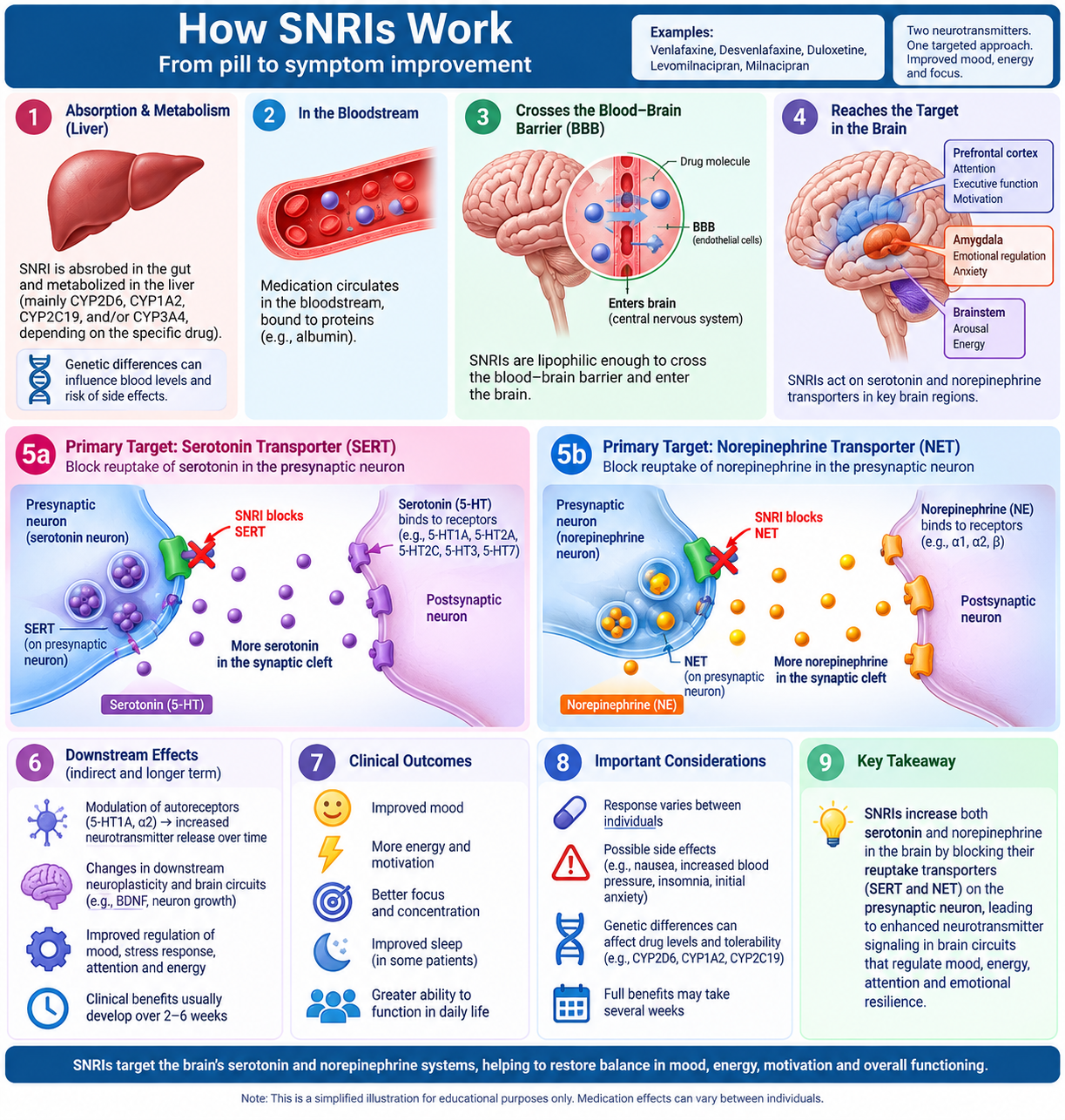
How Do Venlafaxine and Desvenlafaxine Work for Depression?
Depression can involve dysfunction across neural systems responsible for:
Mood, emotional regulation, motivation, pleasure, energy, concentration, stress response and sleep.
Serotonin and norepinephrine participate in several of these systems.
The simplified antidepressant pathway is:
Venlafaxine / Desvenlafaxine
- SERT inhibited Serotonin signaling increases
- NET inhibited
- Norepinephrine signaling increases
- Serotonin and norepinephrine receptors receive altered input
- Intracellular signaling and neural networks gradually adapt
- Depressive symptoms may improve
The exact antidepressant mechanism is not completely known, but both drugs are considered potent serotonin- and norepinephrine-reuptake inhibitors.
What Does Increased Serotonin Signaling Do?
Serotonin participates in regulation of:
Mood, anxiety, emotional reactivity, repetitive thinking, stress responses, sleep, appetite and sexual function.
When SERT is inhibited:
- Serotonin availability increases
- Different serotonin receptors respond, including:
- 5-HT1A
- 5-HT2A
- 5-HT2C
- 5-HT3
- and others. This helps explain why enhancing serotonin can produce both: Therapeutic effects and: Side effects.
For example, serotonergic changes may reduce anxiety and repetitive negative thinking, while increased 5-HT-related signaling can also contribute to nausea and sexual dysfunction.
What Does Increased Norepinephrine Signaling Do?
Norepinephrine is important for: Alertness, attention, mental energy, executive function and stress regulation.
One particularly important region is the: Prefrontal Cortex — PFC
The PFC helps regulate:
Concentration, working memory, planning, motivation, decision-making and top-down emotional control.
Therefore:
- NET inhibition
- Norepinephrine remains available longer in the PFC
- Noradrenergic signaling may increase
- Potential improvement in:
Mental energy, concentration and executive function
when low or inefficient catecholamine signaling contributes to symptoms.
However, norepinephrine follows an important principle:
More norepinephrine is not always better.
Excessive norepinephrine signaling, particularly in stress and arousal circuits, can contribute to:
Anxiety, hyperarousal, sweating, tremor, insomnia and increased blood pressure.
This is why the same noradrenergic mechanism that benefits one patient can produce activation in another.
Can NET Inhibition Also Affect Dopamine?
Yes, particularly in the:
Prefrontal Cortex
This is an important but often overlooked aspect of SNRIs.
The prefrontal cortex has relatively low dopamine-transporter density. As a result, NET contributes substantially to dopamine clearance in this region. Blocking NET can therefore increase both norepinephrine and dopamine availability in the PFC.
Conceptually:
- Venlafaxine / Desvenlafaxine
- NET inhibited
- Norepinephrine clearance decreases
- Some prefrontal dopamine clearance decreases PFC norepinephrine and dopamine signaling may increase This may contribute to effects on:
Attention, motivation, cognitive effort and executive function.
However, venlafaxine and desvenlafaxine should not be described as primarily dopaminergic medications.
Their direct action remains predominantly: SERT + NET inhibition
Does Venlafaxine Work Differently at Lower and Higher Doses?
To an extent:
Yes.
Venlafaxine inhibits SERT more strongly than NET.
At lower exposures, its pharmacology tends to be: More strongly serotonergic
As exposure rises: NET inhibition becomes increasingly important
Human PET studies demonstrate measurable brain NET occupancy with venlafaxine XR, particularly in patients taking approximately 150–300 mg/day, and NET occupancy rises with increasing exposure. Importantly, this is a continuum rather than a sharp dose threshold.
A useful model is:
- Lower venlafaxine exposure
- SERT effect predominates
- As exposure increases:
- SERT + progressively more NET inhibition
Therefore, increasing venlafaxine can potentially change both:
How much effect occurs
and:
The serotonergic-to-noradrenergic balance of that effect
This is one reason patients may experience a somewhat different clinical effect at higher venlafaxine doses.
Is 150 mg the Exact Dose Where Venlafaxine Becomes an SNRI?
No.
That is an overly rigid interpretation.
Venlafaxine has pharmacological activity at both transporters, and individuals differ in:
- Drug concentration
- CYP2D6 metabolism
- Body physiology
- Transporter biology
- Concomitant medications PET evidence shows meaningful NET engagement at higher clinical exposures, but there is no universal switch where:
149 mg = SSRI
and:
150 mg = SNRI
The better description is:
Venlafaxine is strongly serotonergic across its therapeutic range, while norepinephrine-transporter inhibition generally becomes more prominent as exposure increases.
Does Desvenlafaxine Also Inhibit SERT and NET?
Yes.
Desvenlafaxine is itself a potent Serotonin-Norepinephrine Reuptake Inhibitor
It does not need CYP2D6 conversion before it can produce its antidepressant effect.
Therefore:
- Venlafaxine
- CYP2D6
- Desvenlafaxine
- SERT + NET inhibition
whereas:
- Desvenlafaxine taken directly
- SERT + NET inhibition
This is one of the most important differences between the medications.
Why Is Desvenlafaxine Not Simply “Stronger Venlafaxine”?
Because potency and clinical effect cannot be reduced to the fact that one medication is the metabolite of another.
When venlafaxine is taken, the patient is exposed to:
Venlafaxine plus Desvenlafaxine. Both are active.
When desvenlafaxine is taken directly, the patient receives:
Desvenlafaxine without relying on CYP2D6 to create it.
Therefore, the medications differ substantially in:
Parent-to-metabolite exposure, CYP dependence, drug interactions, renal handling and pharmacogenomic variability.
They are related medications, but they are not milligram-for-milligram interchangeable.
Why Doesn’t an SNRI Work Immediately?
SERT and NET inhibition begin relatively quickly after therapeutic drug concentrations are achieved.
But improving depression generally takes longer.
Why?
Because increasing neurotransmitter availability is only the first step.
The process is better represented as:
- SERT + NET blocked
- Serotonin + norepinephrine availability changes
- Autoreceptors and postsynaptic receptors respond
- Feedback systems adapt
- Intracellular signaling changes
- Neural circuits and neuroplasticity gradually adapt
- Clinical improvement develops
Therefore:
Transporter inhibition occurs quickly, while therapeutic network adaptation can take weeks.
This is the same reason simply increasing neurotransmitter concentrations does not produce an immediate antidepressant effect.
How Do Venlafaxine and Desvenlafaxine Affect Serotonin Autoreceptors?
Serotonin neurons contain regulatory receptors, particularly:
5-HT1A Autoreceptors
These act partly as feedback brakes.
Early in treatment:
- SERT inhibition
- Serotonin increases around serotonin neurons
- 5-HT1A autoreceptors activated
- Serotonin-neuron firing may initially be restrained
With continued treatment:
- Feedback signaling gradually adapts
- Serotonergic transmission becomes reorganized
This adaptation is one proposed contributor to the delayed therapeutic effects of serotonin-reuptake inhibitors.
How Do Venlafaxine and Desvenlafaxine Affect Norepinephrine Autoreceptors?
Norepinephrine neurons also have feedback mechanisms, particularly:
Alpha-2 Adrenergic Autoreceptors
When norepinephrine increases:
- NET inhibition
- Extracellular norepinephrine rises
- α2 autoreceptors detect norepinephrine
- Norepinephrine release is regulated
Repeated treatment can lead to broader downstream adaptation.
Therefore, SNRI treatment should not be conceptualized simply as: “NET blocked = norepinephrine permanently high.”
The nervous system continually adjusts transmitter release, receptor sensitivity and intracellular signaling.
How Do Venlafaxine and Desvenlafaxine Work for Anxiety?
Anxiety disorders involve interacting systems such as the: Amygdala, prefrontal cortex, hippocampus, insula and brainstem arousal networks.
Serotonin and norepinephrine can have very different effects within these circuits.
Serotonin can help regulate: Threat reactivity and emotional processing while norepinephrine helps regulate: Attention, vigilance and stress responses
The therapeutic pathway can therefore be represented as:
- SNRI
- Serotonin signaling changes
- Threat-related circuits gradually become better regulated
- Norepinephrine signaling changes
- Attention and stress-response networks adapt
- Anxiety symptoms may improve
Venlafaxine XR has Canadian-approved indications that include generalized anxiety disorder, social anxiety disorder and panic disorder in addition to depression; desvenlafaxine’s Canadian indication is major depressive disorder.
If Norepinephrine Can Cause Anxiety, Why Can an SNRI Treat Anxiety?
Because norepinephrine does not have a single effect throughout the brain.
In the:
Prefrontal Cortex appropriate norepinephrine signaling can improve: Attention, executive control and regulation of emotional responses.
But excessive norepinephrine in: Amygdala and arousal-related circuits can contribute to:
Hypervigilance, autonomic activation and anxiety.
Therefore:
Norepinephrine can be therapeutic in one circuit while excessive signaling is undesirable in another.
This is why describing an SNRI simply as “increasing norepinephrine” misses the importance of:
Brain region + receptor + baseline neurotransmission
Why Can Venlafaxine Initially Increase Anxiety?
Early in treatment, rapid serotonin and norepinephrine changes can occur before the nervous system has adapted.
The sequence may be:
- SNRI started
- Serotonin and norepinephrine signaling change
- Arousal pathways respond immediately
- Possible temporary:
- Anxiety, jitteriness, restlessness, tremor or insomnia
- With continued treatment:
- Receptor and circuit adaptation occurs
- Anxiolytic effects may emerge
This helps explain why patients with panic disorder can be particularly sensitive during initiation.
Why Can Venlafaxine and Desvenlafaxine Increase Blood Pressure?
This is primarily related to: NET inhibition
Norepinephrine helps regulate sympathetic nervous-system activity.
Therefore:
- NET blocked
- Norepinephrine signaling increases
- Sympathetic vascular signaling may increase
- Possible:
Increased blood pressure
and sometimes:
Increased heart rate
The effect can become more important with greater noradrenergic exposure.
This is why blood-pressure monitoring is clinically relevant during SNRI treatment, especially in patients with hypertension or higher venlafaxine exposure.
Why Do Venlafaxine and Desvenlafaxine Cause Sweating?
Serotonin and norepinephrine both participate in: Autonomic regulation and: Thermoregulation
Enhancing monoamine signaling can therefore stimulate pathways involved in sweating.
Conceptually:
- SERT + NET inhibition
- Serotonergic + sympathetic activity changes
- Sweat-gland regulation changes
- Increased sweating
This is a common class-related SNRI effect.
Why Do They Cause Nausea?
Serotonin plays a major role in the gastrointestinal system.
Therefore:
- SERT inhibition
- GI serotonin signaling increases
- 5-HT3 and other serotonin receptors activated
- Possible:
- Nausea
- Vomiting
- Diarrhea These symptoms are often most prominent when treatment begins or after a dose increase.
Why Can They Cause Sexual Dysfunction?
Sexual function depends on a balance among: Serotonin, dopamine, norepinephrine, nitric oxide, hormones and autonomic pathways.
Increased serotonin can inhibit several components of sexual response.
The simplified pathway is:
- SERT inhibited
- Serotonin signaling increases
- 5-HT2-related and other serotonin pathways change
- Dopamine and sexual-reflex pathways may be inhibited
- Possible: Reduced libido, delayed orgasm, delayed ejaculation or erectile difficulty
The noradrenergic component does not necessarily prevent serotonergic sexual side effects.
Why Can They Cause Insomnia or Activation?
Both serotonin and norepinephrine participate in arousal.
NET inhibition can particularly contribute to:
- Alertness
- Wakefulness
- Sympathetic activation Therefore:
- SNRI
- Serotonin + norepinephrine signaling increases
- Possible:
Insomnia, restlessness or activation
Other patients can experience:
Fatigue or sleepiness
because responses differ across individuals and neural circuits.
Does Venlafaxine Increase Dopamine?
Only indirectly to an important extent.
Venlafaxine and desvenlafaxine are only weak direct inhibitors of dopamine reuptake.
However, because NET clears a meaningful amount of dopamine in the prefrontal cortex:
- NET inhibition
- PFC dopamine clearance may decrease
- PFC dopamine availability may increase
This is an indirect regional effect, not evidence that venlafaxine acts like:
- Amphetamine
- Methylphenidate
- Bupropion Its primary pharmacology remains:
Serotonin + norepinephrine reuptake inhibition.
How Is Venlafaxine Metabolized?
The major pharmacogenetically important pathway is: CYP2D6
The pathway is:
- Venlafaxine
- CYP2D6
- O-Desmethylvenlafaxine
- Desvenlafaxine
Both parent medication and metabolite are active SNRIs.
This means CYP2D6 does not simply: Deactivate venlafaxine.
Instead, it changes the balance between: One active compound and: Another active compound.
CPIC specifically recognizes this parent-to-active-metabolite relationship.
What Is the Venlafaxine-to-Desvenlafaxine Ratio?
The relative amounts of:
Venlafaxine
and:
Desvenlafaxine
can provide information about CYP2D6 activity.
High CYP2D6 activity tends to produce: Less venlafaxine
More desvenlafaxine relative to parent drug
Low CYP2D6 activity tends to produce: More venlafaxine
Less desvenlafaxine relative to parent drug
Therefore:
ODV: Venlafaxine Ratio
can differ substantially between patients.
This is important because two patients can receive the same venlafaxine dose yet have very different mixtures of the two active compounds.
How Does CYP2D6 Poor Metabolizer Status Affect Venlafaxine?
A CYP2D6 Poor Metabolizer has very little functional CYP2D6 activity.
Therefore:
- Venlafaxine
- Slow CYP2D6 conversion
- Venlafaxine concentration increases
while:
- Desvenlafaxine formation decreases
- Low desvenlafaxine: venlafaxine ratio
CPIC notes that CYP2D6 Poor Metabolizer status has been associated with adverse effects and recommends considering an alternative antidepressant not predominantly metabolized by CYP2D6. This is an optional recommendation because the clinical relationship remains imperfect.
The DPWG takes a stronger position and recommends avoiding venlafaxine in CYP2D6 Poor Metabolizers when a suitable alternative is available.
What About CYP2D6 Intermediate Metabolizers?
Intermediate Metabolizers also produce less desvenlafaxine relative to venlafaxine.
However, the major pharmacogenomic organizations interpret the evidence differently.
CPIC does not recommend a genotype-based treatment change for CYP2D6 Intermediate Metabolizers because evidence for clinically meaningful outcome differences is insufficient.
DPWG recommends avoiding venlafaxine in CYP2D6 Intermediate as well as Poor Metabolizers when a suitable alternative is available.
For website content, this distinction is important:
The CYP2D6–venlafaxine relationship is clinically relevant, but guideline organizations differ in how aggressively they recommend acting on Intermediate Metabolizer status.
What About CYP2D6 Ultrarapid Metabolizers?
An Ultrarapid Metabolizer converts venlafaxine to desvenlafaxine more rapidly.
Therefore:
- High CYP2D6 activity
- Venlafaxine decreases
- Desvenlafaxine: venlafaxine ratio increases
However, because desvenlafaxine remains an active SNRI, this does not necessarily mean the treatment will fail.
CPIC currently finds insufficient evidence for a genotype-based venlafaxine treatment change in CYP2D6 Ultrarapid Metabolizers.
Can Medications Change CYP2D6 Function?
Yes.
This is called: Phenoconversion
For example, a patient may genetically be: CYP2D6 Normal Metabolizer but take a strong CYP2D6 inhibitor such as: Paroxetine, fluoxetine or bupropion
The result can be:
- Normal CYP2D6 genotype
- CYP2D6 inhibitor added
- Functional CYP2D6 activity decreases
- Venlafaxine → desvenlafaxine conversion slows
- Parent venlafaxine increases
Therefore:
Venlafaxine pharmacogenomics should be interpreted using both genotype and the patient’s current medication list.
Why Is Desvenlafaxine Less Affected by CYP2D6 Genetics?
Because desvenlafaxine has already bypassed the conversion step.
With venlafaxine:
Venlafaxine ↓
- CYP2D6 required
- Desvenlafaxine
With Pristiq:
- Desvenlafaxine taken directly
- No CYP2D6 conversion required
Desvenlafaxine is cleared mainly through glucuronidation and renal elimination, with CYP3A4 providing a smaller oxidative pathway. Its disposition therefore has much less dependence on CYP2D6 than venlafaxine.
This can make desvenlafaxine’s pharmacokinetics more predictable across different CYP2D6 phenotypes.
Does Desvenlafaxine Have an Actionable Pharmacogenomic Gene?
At present: No established CPIC or DPWG genotype-based dosing recommendation exists for desvenlafaxine.
CPIC reviewed desvenlafaxine among serotonin-reuptake-inhibitor antidepressants but does not provide a clinically actionable genotype-based recommendation comparable with the CYP2D6 recommendation for venlafaxine.
For desvenlafaxine, factors such as: Kidney function can be more important than CYP2D6 genetics.
What Is the Role of SLC6A4?
SLC6A4 encodes: SERT, a direct target of both venlafaxine and desvenlafaxine.
Conceptually:
- SLC6A4
- SERT expression and function
- Venlafaxine / Desvenlafaxine inhibits SERT
- Serotonin signaling changes
Commonly studied variants include: 5-HTTLPR and: rs25531
Because SLC6A4 directly encodes the drug target, it has a strong biological rationale as a potential pharmacodynamic marker.
However, CPIC concluded that current evidence involving SLC6A4 is insufficient to support genotype-guided antidepressant prescribing.
Therefore: SLC6A4 is mechanistically relevant but: not currently an independently actionable venlafaxine or desvenlafaxine marker.
What Is the Role of SLC6A2?
SLC6A2 encodes: NET — Norepinephrine Transporter which is the second major pharmacodynamic target of these SNRIs.
The pathway is direct:
- SLC6A2
- NET expression/function
- Venlafaxine / Desvenlafaxine blocks NET
- Norepinephrine reuptake decreases
- Norepinephrine signaling changes
Potentially, variation in NET expression or function could influence how strongly a patient responds to an SNRI’s noradrenergic component.
This is particularly interesting when considering symptoms such as:
- Low energy
- Poor concentration
- Reduced alertness
- Executive dysfunction However: There is currently no validated SLC6A2 genotype-based venlafaxine or desvenlafaxine prescribing guideline.
SLC6A2 should therefore be considered a pharmacodynamically relevant but emerging marker, rather than a deterministic predictor of treatment response.
What Is the Role of HTR1A?
HTR1A encodes: 5-HT1A Serotonin Receptor, 5-HT1A receptors function both as: Presynaptic autoreceptors and: Postsynaptic receptors.
Because SNRIs increase serotonin availability, the activity of this receptor system can influence the way serotonin neurons adapt.
Conceptually:
- SNRI
- SERT inhibited
- Serotonin increases
- 5-HT1A autoreceptors respond
- Serotonin-neuron firing changes
- With repeated treatment:
Autoreceptor regulation adapts
HTR1A therefore has a plausible relationship with antidepressant response, but no validated HTR1A-guided venlafaxine or desvenlafaxine treatment recommendation currently exists.
What Is the Role of HTR2A?
HTR2A encodes: 5-HT2A Receptor
Venlafaxine and desvenlafaxine do not primarily bind 5-HT2A.
Instead:
- SERT inhibited
- Serotonin availability increases
- Serotonin stimulates 5-HT2A and other receptors
HTR2A variants have been investigated in antidepressant response and adverse effects.
However, CPIC concluded that the existing evidence is insufficient to support routine HTR2A genotype-guided antidepressant selection or dosing.
What About ADRA2A?
Norepinephrine released into the synapse eventually acts on adrenergic receptors, including:
Alpha-2 Adrenergic Receptors
ADRA2A therefore has a plausible downstream relationship with medications that increase norepinephrine signaling.
However, venlafaxine and desvenlafaxine do not directly act as α2A agonists.
Their primary mechanism is:
NET inhibition
followed by increased endogenous norepinephrine signaling.
Therefore, ADRA2A may be biologically interesting but is not currently an established genotype-based SNRI prescribing marker.
Why Might an SNRI Work Better Than an SSRI for Some Patients?
An SSRI primarily targets: SERT
An SNRI targets: SERT + NET
Therefore, a patient whose symptoms prominently include:
Low energy, mental fatigue, concentration difficulty or reduced alertness
may potentially benefit from increasing noradrenergic as well as serotonergic signaling.
However, this should not be interpreted as a deterministic rule.
A person with prominent fatigue does not necessarily have:
“Low norepinephrine”
and the same noradrenergic treatment can cause:
- Anxiety
- Insomnia
- Tremor
- Sweating
- Elevated blood pressure in another patient.
The more accurate principle is:
SNRIs engage a broader monoamine pathway than SSRIs, which may be beneficial when both serotonergic and noradrenergic networks are relevant to the patient’s symptoms.
Venlafaxine vs Desvenlafaxine — How Do Their Mechanisms Differ?
Their pharmacodynamic mechanisms are similar, but their pharmacokinetics are very different.
| Venlafaxine — Effexor XR | Desvenlafaxine — Pristiq | |
|---|---|---|
| Drug relationship | Parent drug | Major active venlafaxine metabolite |
| Primary targets | SERT + NET | SERT + NET |
| Direct dopamine effect | Weak | Weak |
| CYP2D6 requirement | Important | Minimal |
| Main PGx consideration | CYP2D6 | No established actionable PGx gene |
| Main metabolism | CYP2D6 → desvenlafaxine | Glucuronidation; minor CYP3A4 |
| Renal dependence | Important | Particularly important |
| Parent/metabolite variability | Significant | Avoids venlafaxine→ODV conversion variability |
Venlafaxine and desvenlafaxine therefore reach similar pharmacodynamic targets through somewhat different pharmacokinetic pathways.
Venlafaxine Pharmacokinetics — PK
PK asks: How does the body handle venlafaxine?
- Venlafaxine
- CYP2D6
- Desvenlafaxine
- Venlafaxine + desvenlafaxine active exposure
- Further metabolism + renal elimination
Important influences include:
CYP2D6 genotype, CYP2D6 inhibitors, liver function, kidney function and dose.
The key point is:
CYP2D6 changes the balance between two active compounds rather than simply turning venlafaxine on or off.
Desvenlafaxine Pharmacokinetics — PK
Desvenlafaxine largely bypasses CYP2D6:
Desvenlafaxine
- Glucuronidation
- Minor CYP3A4 metabolism Substantial renal elimination This makes:
Kidney function
particularly important when determining desvenlafaxine exposure.
Venlafaxine and Desvenlafaxine Pharmacodynamics — PD
PD asks: What happens when the medications reach the brain?
- Venlafaxine / Desvenlafaxine
- SERT inhibition
- NET inhibition
- Serotonin + norepinephrine availability increases
- Serotonin + adrenergic receptor systems respond
- PFC + limbic + emotional + stress networks adapt
- Depression or anxiety symptoms may improve
At the same time: Serotonin effects can contribute to nausea and sexual dysfunction
Norepinephrine effects can contribute to sweating, activation and increased blood pressure
NET inhibition in the PFC
may indirectly enhance both norepinephrine and dopamine signaling.
Therefore:
Normal venlafaxine or desvenlafaxine pharmacokinetics do not automatically guarantee an optimal pharmacodynamic response.
Can Venlafaxine Fail Even if CYP2D6 Metabolism Is Normal?
Absolutely.
A patient can have: Normal CYP2D6 and appropriate venlafaxine/desvenlafaxine exposure, yet still experience: Poor efficacy, excessive anxiety, sexual dysfunction, nausea or blood-pressure effects.
Why?
Because CYP2D6 mainly answers the pharmacokinetic question:
“What drug concentrations does the patient produce?”
It does not fully answer the pharmacodynamic question:
“Is SERT + NET inhibition the right biological mechanism for this patient’s symptoms?”
That depends on the patient’s:
Serotonin system, norepinephrine system, symptom pattern, receptor biology, brain-region-specific neurotransmission and other clinical factors.
Why Might Venlafaxine Work Well for One Patient but Desvenlafaxine Work Better for Another?
One important difference can be: CYP2D6 variability
A patient taking venlafaxine must convert part of the dose to desvenlafaxine through CYP2D6.
Another patient with lower CYP2D6 activity may accumulate proportionally more parent venlafaxine.
With direct desvenlafaxine:
That CYP2D6 conversion step is largely bypassed.
Therefore, the two medications can produce different exposure profiles even though their core SERT/NET pharmacology overlaps.
Other differences include:
- Kidney function
- Drug interactions
- Dose/exposure
- Individual tolerability
- Pharmacodynamic response
This article is educational. It does not diagnose, and it does not replace advice from your prescriber or pharmacist. Never start, stop or change a medication based on a web page.