
Vilazodone · How it works
How Does Vilazodone (Viibryd) Work?
Vilazodone, best known by the brand name Viibryd, is an antidepressant used in Canada for major depressive disorder in adults.
 Written by Sanjida Ahmed, PhD, Cellular and Molecular BiologyChief Operating Officer and Lead Scientist, Personalized Prescribing. Last reviewed October 2, 2026.
- Class
- Atypical antipsychotic
On this page
- What Makes Vilazodone Different from a Traditional SSRI?
- Traditional SSRI
- What Is SERT?
- Does Vilazodone Increase Serotonin?
- What Is a 5-HT1A Receptor?
- What Are 5-HT1A Autoreceptors?
- Why Are 5-HT1A Autoreceptors Important for Antidepressants?
- What Does Vilazodone Do to 5-HT1A Autoreceptors?
- What Does Vilazodone Do to Postsynaptic 5-HT1A Receptors?
- How Does Vilazodone Work for Depression?
- “Low serotonin.”
- Which Brain Regions May Be Affected by Vilazodone?
- How May Vilazodone Affect the Prefrontal Cortex?
- Emotional regulation and cognitive control
- How May Vilazodone Affect the Amygdala?
- Modulating emotional reactivity
- Does Vilazodone Work for Anxiety?
- An SSRI-like SERT mechanism
- A buspirone-like 5-HT1A mechanism
- Major Depressive Disorder
- Is Vilazodone the Same as Taking an SSRI Plus Buspirone?
- Does Vilazodone Work Faster Than SSRIs?
- Does Vilazodone Cause Less Sexual Dysfunction Than SSRIs?
- Vilazodone can still cause sexual dysfunction
- Does Vilazodone Increase Dopamine?
- Does Vilazodone Increase Norepinephrine?
- NET — Norepinephrine Transporter
- SERT inhibition + 5-HT1A partial agonism
- Why Does Vilazodone Cause Nausea?
- Why Does Vilazodone Cause Diarrhea?
- Why Can Vilazodone Cause Insomnia or Activation?
- Why Can Vilazodone Cause Emotional Blunting?
- Positive emotional intensity also decreases
- How Is Vilazodone Different from Sertraline?
- How Is Vilazodone Different from Escitalopram?
- How Is Vilazodone Different from Buspirone?
- How Is Vilazodone Different from Vortioxetine?
- Why Must Vilazodone Be Taken with Food?
- How Is Vilazodone Metabolized?
- Why Are CYP3A4 Drug Interactions Important?
- Does CYP3A4 Genotype Affect Vilazodone?
- Does CYP2C19 Affect Vilazodone?
- Does CYP2D6 Affect Vilazodone?
- What Is the Role of SLC6A4?
- What Is the Role of HTR1A?
- What Is the Role of HTR2A?
- Can Pharmacogenomic Testing Predict Whether Vilazodone Will Work?
- Why Might Vilazodone Work for One Person but Not Another?
- Low mood + anxiety + excessive worry + emotional reactivity
- Low motivation + anhedonia + fatigue + cognitive slowing
Vilazodone, best known by the brand name Viibryd, is an antidepressant used in Canada for major depressive disorder in adults. It has a distinctive serotonergic mechanism because it combines two pharmacological actions in the same medication:
-
SERT — Serotonin Transporter inhibition
This combination is sometimes described as a:
SPARI — Serotonin Partial Agonist-Reuptake Inhibitor
although SPARI is a descriptive pharmacological term rather than a separate regulatory drug class.
The simplified mechanism is:
- Vilazodone
- Blocks SERT
- Serotonin reuptake decreases
- Partially activates 5-HT1A receptors
- Serotonin signaling changes through two complementary mechanisms
- Mood and emotional-regulation networks gradually adapt
- Depressive symptoms may improve
The exact therapeutic contribution of the 5-HT1A partial-agonist component is not fully established. Current prescribing information specifically notes that vilazodone’s antidepressant mechanism is not completely understood and that the clinical significance of its 5-HT1A activity remains uncertain.
What Makes Vilazodone Different from a Traditional SSRI?
Traditional SSRI
- SERT inhibition
- More serotonin available
- Serotonin indirectly stimulates its receptors
whereas:
Vilazodone
- SERT inhibition
- Direct 5-HT1A partial agonism Serotonin signaling is modified at both the transporter and receptor level This dual mechanism is what makes vilazodone pharmacologically distinctive.
What Is SERT?
SERT stands for: Serotonin Transporter and is encoded by the gene: SLC6A4
After serotonin is released from a nerve cell, SERT transports much of it back into that neuron.
Normally:
- Serotonin released
- Serotonin activates receptors
- SERT transports serotonin back into the neuron
- Serotonin signaling decreases
Vilazodone blocks this transporter:
- Vilazodone
- SERT inhibited
- Serotonin reuptake decreases
- Serotonin remains available longer between neurons
- Serotonergic signaling increases
Vilazodone binds very strongly to the serotonin-reuptake site and is far less potent at norepinephrine and dopamine transporters.
Does Vilazodone Increase Serotonin?
Yes, but indirectly.
Vilazodone does not primarily make neurons: Produce more serotonin or: Release large amounts of serotonin
Instead:
- Serotonin is released normally
- Vilazodone blocks its reuptake
- Serotonin remains outside the neuron longer
- More serotonin is available to activate receptors
This is the same fundamental SERT mechanism used by SSRIs.
However, vilazodone then adds its direct: 5-HT1A partial agonist activity making its overall serotonergic pharmacology somewhat different from that of a conventional SSRI.
What Is a 5-HT1A Receptor?
The: 5-HT1A Receptor is one of several serotonin receptor subtypes.
It is particularly important because 5-HT1A receptors can be located in two different places:
- Presynaptic 5-HT1A autoreceptors
- Postsynaptic 5-HT1A receptors Their functions are not identical.
This distinction is central to understanding vilazodone.
What Are 5-HT1A Autoreceptors?
Serotonin neurons originate largely in the: Raphe Nuclei in the brainstem.
These serotonin-producing neurons contain: 5-HT1A autoreceptors that act as a feedback brake.
Normally:
- Serotonin neuron fires
- Serotonin is released
- 5-HT1A autoreceptors detect increased serotonin
- Neuron firing is reduced
- Further serotonin release decreases
This is a normal negative-feedback mechanism.
Why Are 5-HT1A Autoreceptors Important for Antidepressants?
When a conventional SSRI first blocks SERT:
- SERT inhibited
- Serotonin around the serotonin neuron rises
- 5-HT1A autoreceptors are activated
- Serotonin-neuron firing can temporarily decrease
This feedback response may partly counteract the initial effect of increasing serotonin.
With continued SSRI treatment:
- 5-HT1A autoreceptor signaling gradually adapts or desensitizes
- The inhibitory feedback becomes less restrictive
- Serotonergic transmission can increase more fully
This is one proposed explanation for why SERT blockade happens quickly but antidepressant benefit often takes considerably longer.
What Does Vilazodone Do to 5-HT1A Autoreceptors?
Vilazodone is a: 5-HT1A Partial Agonist
A partial agonist activates a receptor, but not to the same maximal degree as a full agonist.
Vilazodone can interact directly with 5-HT1A autoreceptors while simultaneously blocking SERT.
One proposed model is:
- Vilazodone
- SERT inhibited
- Serotonin availability rises
- 5-HT1A partial agonism
- Autoreceptor signaling is modified
- Serotonergic feedback may adapt differently from a conventional SSRI
Preclinical studies have proposed that vilazodone may promote relatively rapid 5-HT1A autoreceptor adaptation. However, clinical studies have not established that vilazodone works faster than other effective antidepressants, so this should remain a mechanistic hypothesis rather than a clinical claim.
What Does Vilazodone Do to Postsynaptic 5-HT1A Receptors?
5-HT1A receptors are also found on neurons downstream from serotonin neurons, including in brain regions involved in:
- Mood
- Anxiety
- Stress responses
- Memory
- Emotional regulation Vilazodone can directly partially stimulate these: Postsynaptic 5-HT1A receptors while SERT inhibition increases the amount of serotonin available to stimulate receptors naturally.
Therefore:
Vilazodone
- Direct 5-HT1A partial agonism
- More endogenous serotonin through SERT blockade
- 5-HT1A-mediated signaling changes
- Mood- and anxiety-related circuits may be modulated
The precise contribution of this direct receptor effect to antidepressant efficacy is not known. The official prescribing information explicitly states that the role of 5-HT1A partial agonism in vilazodone’s antidepressant effect remains uncertain.
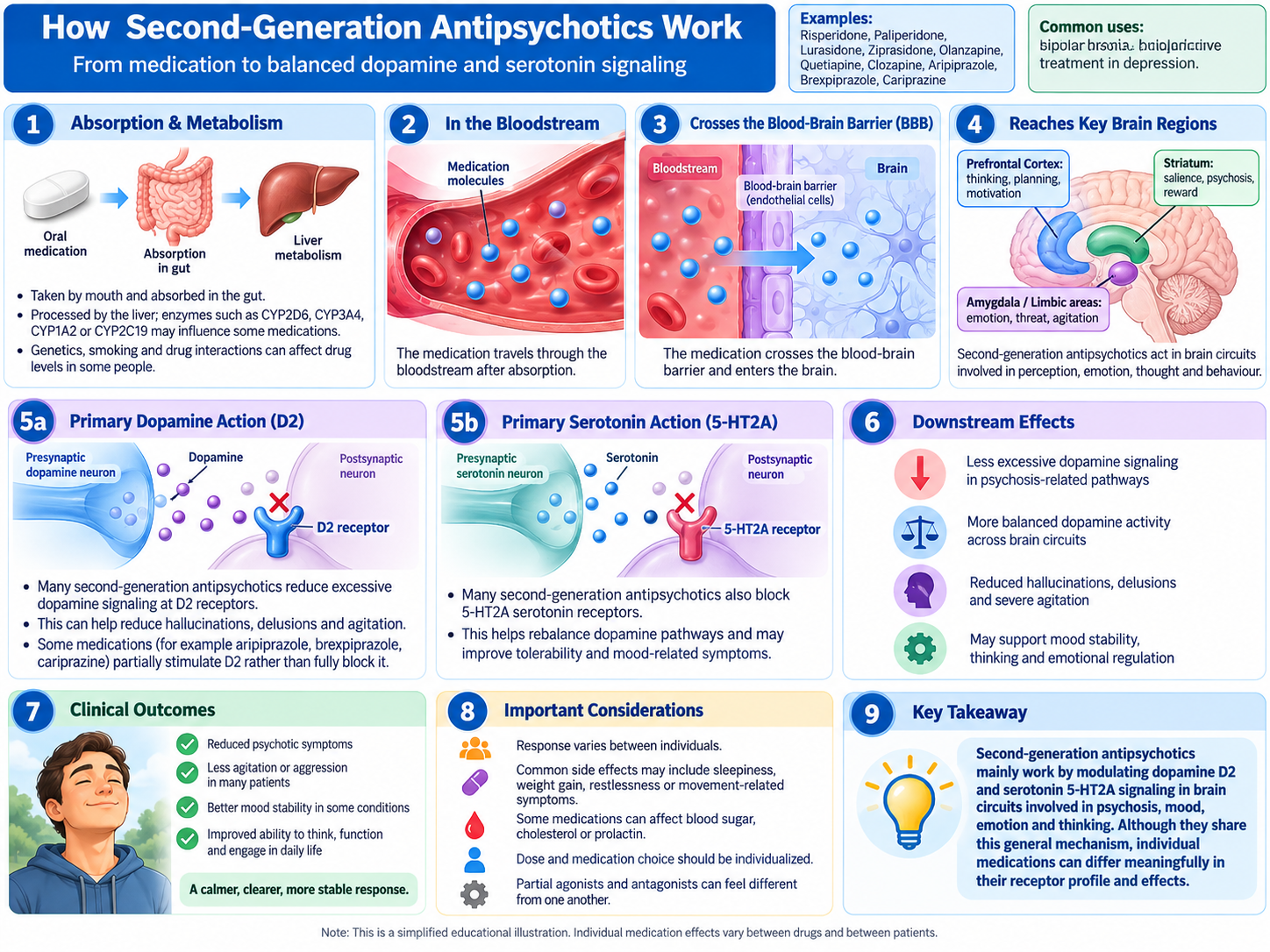
How Does Vilazodone Work for Depression?
Depression should not be described simply as:
“Low serotonin.”
Major depressive disorder can involve dysregulation across systems responsible for:
- Mood
- Motivation
- Reward
- Stress response
- Emotional regulation
- Concentration
- Sleep
- Appetite
- Repetitive negative thinking Serotonin is one component of these broader networks.
Vilazodone acts through:
- Vilazodone
- SERT inhibition
- Serotonin availability increases
plus:
- 5-HT1A partial agonism
- Serotonin signaling is modified directly
- Autoreceptors + postsynaptic receptors + intracellular pathways adapt
- Prefrontal and limbic emotional networks gradually change
- Depressive symptoms may improve
A more accurate explanation is therefore:
Vilazodone changes the regulation of serotonin signaling rather than simply correcting a serotonin deficiency.
Which Brain Regions May Be Affected by Vilazodone?
Serotonin neurons project widely throughout the brain. Important regions involved in depression include the:
- Prefrontal Cortex — PFC- involved in executive function, emotional regulation and cognitive control.
- Amygdala- involved in emotional salience, fear and threat processing.
- Hippocampus- involved in memory, context and stress regulation.
- Striatum- involved in motivation, reward and behaviour.
- Raphe Nuclei- the major source of serotonergic projections and location of important 5-HT1A autoreceptors. Vilazodone’s effects therefore cannot be reduced to one brain region.
The more useful model is:
- SERT + 5-HT1A modulation
- Serotonin signaling changes across interconnected brain networks
- Emotional regulation may gradually improve
How May Vilazodone Affect the Prefrontal Cortex?
The prefrontal cortex helps regulate:
- Attention
- Decision-making
- Emotional control
- Working memory
- Behaviour
- Top-down control of limbic responses Serotonin receptors, including 5-HT1A receptors, help regulate cortical neurons.
Therefore:
Vilazodone
- Serotonin availability increases
- 5-HT1A signaling changes
- Prefrontal network activity may be modulated
- Potentially improved:
Emotional regulation and cognitive control
However, these are network-level models rather than direct patient-specific predictions.
How May Vilazodone Affect the Amygdala?
The amygdala is involved in:
- Threat detection
- Emotional salience
- Fear learning
- Stress responses Serotonin helps regulate amygdala activity and communication between the amygdala and prefrontal cortex.
Conceptually:
- Vilazodone
- SERT inhibition + 5-HT1A modulation
- Serotonergic regulation of emotional circuits changes
- Threat and negative-emotional processing may gradually become better regulated
It is more accurate to describe this as:
Modulating emotional reactivity
rather than simply “turning down the amygdala.”
Does Vilazodone Work for Anxiety?
Vilazodone’s pharmacology has a strong theoretical relationship with anxiety because:
5-HT1A receptors- play an important role in anxiety regulation. The anxiolytic medication: Buspirone also acts as a 5-HT1A partial agonist.
Vilazodone therefore combines:
An SSRI-like SERT mechanism
with:
A buspirone-like 5-HT1A mechanism
at a broad conceptual level.
However, vilazodone is approved in Canada for:
Major Depressive Disorder
—not as a general treatment for anxiety disorders.
Its effects on anxiety symptoms occurring as part of depression may still be clinically relevant, but its 5-HT1A pharmacology should not be used to imply a Health Canada anxiety indication.
Is Vilazodone the Same as Taking an SSRI Plus Buspirone?
No.
There is a conceptual similarity:
- SSRI → SERT inhibition
- Buspirone → 5-HT1A partial agonism Vilazodone
→ both actions in one molecule
But they are not pharmacologically identical.
Vilazodone has its own:
- Receptor affinity
- Intrinsic 5-HT1A activity
- Pharmacokinetics
- Brain concentrations
- Dosing profile and buspirone has additional pharmacological characteristics and metabolites.
Therefore:
Vilazodone can be thought of conceptually as combining SERT inhibition with 5-HT1A partial agonism, but it should not be described as simply “an SSRI plus buspirone in one pill.”
Does Vilazodone Work Faster Than SSRIs?
This has been proposed but: It has not been convincingly established.
The theory is:
Vilazodone
- SERT inhibition
- 5-HT1A partial agonism
- Potentially faster autoreceptor adaptation
- Potentially faster serotonergic enhancement
Preclinical studies support this possibility. Some clinical studies identified early symptom improvement, but there are no convincing head-to-head data demonstrating that vilazodone reliably produces a faster antidepressant response than other antidepressants.
For website copy, I would not claim:
“Vilazodone works faster than SSRIs.”
A safer formulation is:
Vilazodone’s 5-HT1A activity has been proposed to influence the adaptation of serotonin feedback pathways, but whether this translates into a faster clinical response than conventional SSRIs remains uncertain.
Does Vilazodone Cause Less Sexual Dysfunction Than SSRIs?
Possibly in some patients, but this should also be presented carefully.
5-HT1A receptor stimulation can influence downstream dopamine and sexual-response pathways, leading to the hypothesis that vilazodone may produce fewer sexual adverse effects than some conventional SSRIs.
However:
Vilazodone can still cause sexual dysfunction
including:
- Reduced libido
- Erectile dysfunction
- Delayed ejaculation
- Delayed orgasm
- Difficulty reaching orgasm Head-to-head evidence is not strong enough to conclude that vilazodone universally has a lower sexual-side-effect burden than all SSRIs.
A suitable website statement is:
Vilazodone has been investigated for potentially lower sexual side effects because of its 5-HT1A partial-agonist activity, but sexual dysfunction can still occur and comparative advantages over other antidepressants are not firmly established.
Does Vilazodone Increase Dopamine?
Vilazodone is not a dopamine-reuptake inhibitor to a clinically important degree.
Its affinity for the serotonin transporter is far greater than its affinity for the dopamine transporter. Current pharmacology reports a SERT binding affinity around 0.1 nM, compared with approximately 37 nM at the dopamine-reuptake site.
Therefore:
Vilazodone’s direct mechanism is strongly serotonergic.
However, serotonin receptors can indirectly regulate dopamine neurons.
Postsynaptic 5-HT1A activation has been proposed to facilitate dopamine release in selected cortical pathways, but this is a downstream effect rather than evidence that vilazodone is a dopaminergic antidepressant.
Does Vilazodone Increase Norepinephrine?
Not substantially through direct transporter inhibition.
Vilazodone has much lower affinity for:
NET — Norepinephrine Transporter
than for SERT. Current pharmacology reports approximately 56 nM affinity at the norepinephrine-reuptake site versus 0.1 nM at SERT.
Therefore, vilazodone should not be classified as an SNRI.
Its principal mechanism remains:
SERT inhibition + 5-HT1A partial agonism
Why Does Vilazodone Cause Nausea?
Serotonin is highly active in the gastrointestinal tract.
When SERT is inhibited:
- Vilazodone
- GI serotonin reuptake decreases
- Serotonin signaling increases
- 5-HT3 and other gastrointestinal serotonin receptors are stimulated
- Possible:
Nausea
This is one reason nausea is particularly common when treatment begins.
Why Does Vilazodone Cause Diarrhea?
Serotonin regulates:
- Intestinal motility
- Secretion
- Sensory signaling Therefore:
- SERT inhibition in the gut
- Serotonergic activity increases
- Intestinal motility and secretion may increase
- Diarrhea
Gastrointestinal effects are among vilazodone’s most characteristic adverse effects.
Why Can Vilazodone Cause Insomnia or Activation?
Serotonin is involved in both:
- Sleep
- Wakefulness
- Anxiety
- Arousal depending on the receptor and brain region.
Early in treatment:
- SERT inhibition
- 5-HT1A partial agonism
- Serotonergic signaling changes before adaptation is complete
- Possible:
- Restlessness
- Jitteriness
- Insomnia
- Anxiety
- Vivid dreams These effects may improve as the nervous system adapts.
Why Can Vilazodone Cause Emotional Blunting?
Like other strongly serotonergic antidepressants, vilazodone may occasionally be associated with:
- Reduced emotional intensity
- Reduced distress
- Reduced positive emotional responsiveness The mechanism is not well established.
A possible model is:
- Sustained serotonergic modulation
- Emotional-salience networks become less reactive
- Negative emotional responses decrease
but potentially:
Positive emotional intensity also decreases
This must be differentiated clinically from persistent depression, fatigue or low motivation.
How Is Vilazodone Different from Sertraline?
Both drugs inhibit: SERT But: Sertraline primarily works through SERT inhibition.
Vilazodone combines: SERT inhibition + direct 5-HT1A partial agonism
Sertraline also has weak dopamine-transporter activity, whereas vilazodone’s distinctive secondary mechanism is direct 5-HT1A receptor activity.
Therefore, the major difference is not simply “more serotonin,” but:
Transporter inhibition alone versus transporter inhibition plus direct receptor modulation.
How Is Vilazodone Different from Escitalopram?
Escitalopram is a highly selective: SERT inhibitor
Vilazodone is also a potent SERT inhibitor but additionally: Partially activates 5-HT1A receptors.
Their pharmacokinetics also differ:
Escitalopram has clinically actionable CYP2C19 pharmacogenomic guidance.
Vilazodone is primarily metabolized by CYP3A4 and currently has no established genotype-based dosing guideline.
How Is Vilazodone Different from Buspirone?
Both can partially stimulate: 5-HT1A
But buspirone does not act as a clinically important serotonin-reuptake inhibitor.
Therefore: Buspirone → primarily 5-HT1A partial agonism
Vilazodone → SERT inhibition plus 5-HT1A partial agonism
This explains why vilazodone is principally used as an: Antidepressant
whereas buspirone is principally used as an: Anxiolytic medication.
How Is Vilazodone Different from Vortioxetine?
Both are sometimes described as: Multimodal serotonergic antidepressants
but their mechanisms differ.
Vilazodone
primarily:
- Inhibits SERT
- Partially agonizes 5-HT1A Vortioxetine
inhibits SERT while directly modulating several serotonin receptors, including 5-HT1A, 5-HT1B, 5-HT3 and others.
Vilazodone therefore has a: More focused dual serotonergic mechanism whereas vortioxetine has a broader receptor profile.
Why Must Vilazodone Be Taken with Food?
This is a pharmacokinetic rather than pharmacodynamic effect, but it is essential to how the medication works clinically.
Vilazodone absorption is highly: Food-dependent
Taking it without food can substantially lower drug exposure.
Therefore:
- Vilazodone taken with food
- Adequate absorption
- Adequate bloodstream concentration
- Adequate brain exposure
- SERT + 5-HT1A effects
Taking vilazodone consistently without food may produce lower exposure and potentially reduce treatment effectiveness.
This makes food an unusually important component of vilazodone pharmacokinetics. Canadian Health Canada records confirm Viibryd remains marketed in 10, 20 and 40 mg strengths.
How Is Vilazodone Metabolized?
Vilazodone undergoes extensive liver metabolism.
The most important metabolic enzyme is:
Vilazodone
- CYP3A4 — major pathway
- CYP2C19 / CYP2D6 — smaller pathways
- Metabolites
- Elimination
Unlike medications such as fluoxetine or venlafaxine, vilazodone does not depend on a major clinically important active metabolite for its therapeutic effect.
Why Are CYP3A4 Drug Interactions Important?
Because CYP3A4 is the major metabolic pathway.
A strong CYP3A4 inhibitor can produce:
- CYP3A4 activity decreases
- Vilazodone metabolism slows
- Vilazodone concentration rises
- Potential increase in:
- Nausea
- Diarrhea
- Dizziness
- Activation
- Other serotonergic effects Conversely:
- Strong CYP3A4 inducer
- Vilazodone metabolism increases
- Vilazodone concentration decreases
- Potential:
Reduced treatment effectiveness
For vilazodone, drug-induced CYP3A4 changes currently have clearer clinical significance than inherited CYP3A4 genotype.
Vilazodone Pharmacokinetics — PK
PK asks: How much vilazodone reaches the brain?
The pathway is:
- Vilazodone dose
- Food-dependent absorption
- Bloodstream
- CYP3A4 metabolism
- Vilazodone concentration
- Medication reaches the brain
Important pharmacokinetic factors include:
- Taking vilazodone with food
- CYP3A4 inhibitors
- CYP3A4 inducers
- Liver function
- Dose
- Treatment adherence
Vilazodone Pharmacodynamics — PD
PD asks: What does vilazodone do after it reaches the brain?
- Vilazodone
- SERT / SLC6A4 inhibition
- Serotonin reuptake decreases
- 5-HT1A / HTR1A partial agonism
- Serotonin signaling changes directly
- Autoreceptors + postsynaptic receptors + neural networks adapt
- Depressive symptoms may improve
Therefore: Normal vilazodone pharmacokinetics do not automatically mean optimal pharmacodynamic response.
Two patients can achieve similar blood concentrations yet experience very different:
- Antidepressant response
- GI effects
- Anxiety
- Sexual effects
- Emotional effects because their underlying serotonergic systems may respond differently.
Does CYP3A4 Genotype Affect Vilazodone?
CYP3A4 is clearly important for vilazodone metabolism, but:
There is currently no validated CYP3A4 genotype-based vilazodone dosing recommendation.
Reduced-function CYP3A4 variants can affect the metabolism of some CYP3A4 substrates, but there is insufficient vilazodone-specific evidence to assign routine doses based on genotype.
Therefore: CYP3A4 drug interactions are actionable while: CYP3A4 genotype is not currently an established vilazodone prescribing marker.
Does CYP2C19 Affect Vilazodone?
CYP2C19 contributes only modestly to vilazodone metabolism.
Unlike:
- Citalopram
- Escitalopram
- Sertraline there is no established CYP2C19 genotype-guided vilazodone dose recommendation.
CPIC’s serotonin-reuptake-inhibitor guideline includes vilazodone in its evidence review but does not provide a CYP2C19-based dosing recommendation for the drug.
Does CYP2D6 Affect Vilazodone?
CYP2D6 also plays only a minor role.
Therefore:
-
CYP2D6 Poor Metabolizer- does not currently require an established vilazodone dose reduction,
-
CYP2D6 Ultrarapid Metabolizer- does not require a routine genotype-based dose increase. This contrasts with medications such as:
-
Paroxetine
-
Venlafaxine
-
Atomoxetine
-
Nortriptyline where CYP2D6 can be clinically actionable.
What Is the Role of SLC6A4?
SLC6A4 encodes: SERT which is one of vilazodone’s two direct pharmacodynamic targets.
The pathway is:
- SLC6A4
- SERT expression/function
- Vilazodone inhibits SERT
- Serotonin reuptake changes
- Potential differences in treatment response
Commonly investigated variants include: 5-HTTLPR and: rs25531
These variants can influence serotonin-transporter biology and therefore have a strong mechanistic rationale.
However, CPIC concluded that the available SLC6A4 evidence is mixed and insufficient to support genotype-based antidepressant prescribing.
Therefore: SLC6A4 is biologically relevant but: not currently an independently actionable vilazodone marker.
What Is the Role of HTR1A?
HTR1A encodes: 5-HT1A Receptor and is particularly interesting for vilazodone because:
5-HT1A is a direct drug target.
The relationship is:
- HTR1A
- 5-HT1A receptor expression/function
- Vilazodone partially activates 5-HT1A
- Autoreceptor and postsynaptic signaling changes
- Potential differences in antidepressant or anxiety-related response
This creates a strong mechanistic rationale for investigating HTR1A variants.
However: There is currently no validated HTR1A genotype-based vilazodone prescribing recommendation.
HTR1A should therefore be considered: Mechanistically relevant / investigational rather than clinically deterministic.
What Is the Role of HTR2A?
HTR2A encodes: 5-HT2A
Vilazodone does not directly target 5-HT2A as its primary mechanism.
Instead:
- Vilazodone inhibits SERT
- More serotonin becomes available
- Serotonin activates downstream receptors including 5-HT2A
HTR2A variants have been extensively investigated in antidepressant response, but CPIC concluded that evidence is insufficient for routine clinical antidepressant prescribing based on HTR2A genotype.
Can Pharmacogenomic Testing Predict Whether Vilazodone Will Work?
For vilazodone, the PGx picture can be divided into:
- **Pharmacokinetics -**The dominant enzyme is: CYP3A4 but there is currently no established genotype-guided vilazodone dose recommendation.
- Pharmacodynamics The two most mechanistically interesting genes are:
- SLC6A4 — SERT
HTR1A — 5-HT1A
because both encode direct drug targets.
However, these do not currently provide validated stand-alone treatment rules.
CPIC specifically classifies current SLC6A4 and HTR2A evidence as insufficient for clinical antidepressant prescribing recommendations.
Therefore:
Genetics may help explain some biological variability, but current pharmacogenomic evidence cannot reliably determine whether vilazodone will succeed or fail in an individual patient.
Vilazodone Requires Both Appropriate Exposure and Brain Compatibility
The complete pathway can be summarized as:
- Vilazodone taken with food
- PK — Pharmacokinetics
- Adequate absorption
- CYP3A4 metabolism
- Appropriate vilazodone concentration
- Medication reaches the brain
- PD — Pharmacodynamics
- SERT inhibition
- 5-HT1A partial agonism
- Serotonin signaling changes
- Autoreceptor + postsynaptic receptor adaptation
- Mood and emotional networks adapt
- Depressive symptoms may improve
Both matter.
Why Might Vilazodone Work for One Person but Not Another?
Two people with the same diagnosis of depression can have very different symptom patterns.
One person may experience predominantly:
Low mood + anxiety + excessive worry + emotional reactivity
while another may have:
Low motivation + anhedonia + fatigue + cognitive slowing
The first pattern may involve a stronger serotonergic component, whereas the second may involve greater dopamine or norepinephrine dysfunction.
At the same time, individuals can differ in:
- SERT expression
- 5-HT1A autoreceptor activity
- Postsynaptic 5-HT1A signaling
- CYP3A4 activity
- Medication interactions
- Gastrointestinal sensitivity
- Previous medication response Therefore:
Having major depressive disorder does not mean that every patient has the same underlying neurotransmitter pattern or will respond equally to a strongly serotonergic medication.
This article is educational. It does not diagnose, and it does not replace advice from your prescriber or pharmacist. Never start, stop or change a medication based on a web page.