
Vortioxetine · How it works
How Does Vortioxetine (Trintellix) Work?
Vortioxetine, best known by the brand name Trintellix, is an antidepressant used in Canada for major depressive disorder in adults.
 Written by Sanjida Ahmed, PhD, Cellular and Molecular BiologyChief Operating Officer and Lead Scientist, Personalized Prescribing. Last reviewed October 2, 2026.
- Class
- SSRI (selective serotonin reuptake inhibitor)
On this page
- What Makes Vortioxetine Different From an SSRI?
- Blocking SERT
- Traditional SSRI
- Does Vortioxetine Increase Serotonin?
- Which Serotonin Receptors Does Vortioxetine Affect?
- What Does 5-HT1A Agonism Mean?
- What Are 5-HT1A Autoreceptors?
- What Does Vortioxetine Do to Postsynaptic 5-HT1A Receptors?
- What Does 5-HT1B Partial Agonism Mean?
- What Does 5-HT3 Antagonism Mean?
- If Vortioxetine Blocks 5-HT3, Why Does It Still Cause Nausea?
- What Does 5-HT7 Antagonism Mean?
- What Does 5-HT1D Antagonism Mean?
- How Does Vortioxetine Work for Depression?
- “Low serotonin.”
- Serotonergic signaling
- Why Doesn’t Vortioxetine Work Immediately?
- Which Brain Regions May Vortioxetine Affect?
- How Might Vortioxetine Affect the Prefrontal Cortex?
- Does Vortioxetine Improve Cognition?
- Digit Symbol Substitution Test — DSST
- Improvement in depression itself
- Direct or partly independent effects on cognitive neural networks
- Why Might Vortioxetine Affect Cognition Differently from a Traditional SSRI?
- Multimodal serotonin receptor profile
- Does Vortioxetine Increase Dopamine?
- Does Vortioxetine Increase Norepinephrine?
- Does Vortioxetine Affect Glutamate and GABA?
- Does Vortioxetine Work for Anxiety?
- Why Can Vortioxetine Initially Increase Anxiety or Restlessness?
- Why Does Vortioxetine Cause Nausea?
- Why Can Vortioxetine Cause Sexual Dysfunction?
- Does Vortioxetine Cause Emotional Blunting?
- Positive emotional intensity may also decrease
- How Is Vortioxetine Different from Sertraline?
- How Is Vortioxetine Different from Vilazodone?
- How Is Vortioxetine Different from Venlafaxine?
- How Is Vortioxetine Metabolized?
- Why Do CYP2D6 Inhibitors Matter?
- Greater concentration-related adverse effects
- How Does CYP2D6 Poor Metabolizer Status Affect Vortioxetine?
- Greater risk of concentration-related adverse effects
- Starting at approximately 50% of the usual starting dose
- 5 mg/day
- 10 mg/day
- What About CYP2D6 Intermediate Metabolizers?
- What About CYP2D6 Normal Metabolizers?
- What About CYP2D6 Ultrarapid Metabolizers?
- Lower probability of adequate clinical benefit
- CPIC CYP2D6 Guidance for Vortioxetine
- What Is the Role of SLC6A4?
- What Is the Role of HTR1A?
- Pharmacodynamically relevant but investigational
- What Is the Role of HTR1B?
- What Is the Role of HTR3A and HTR3B?
- Antagonizes 5-HT3
- What Is the Role of HTR7?
- Can Pharmacogenomic Testing Predict Whether Vortioxetine Will Work?
- Why Might Vortioxetine Work Well for One Person but Poorly for Another?
- Anxiety + repetitive negative thinking + emotional reactivity
- Anhedonia + low motivation + fatigue + cognitive slowing
- CYP2D6-related exposure differences
Vortioxetine, best known by the brand name Trintellix, is an antidepressant used in Canada for major depressive disorder in adults. Health Canada currently lists Trintellix as marketed, with a product monograph updated in July 2026.
Vortioxetine is different from a conventional SSRI because it does more than inhibit serotonin reuptake. It combines: SERT — Serotonin Transporter inhibition
with direct activity at several serotonin receptors:
- 5-HT1A agonism
- 5-HT1B partial agonism
- 5-HT3 antagonism
- 5-HT7 antagonism
- 5-HT1D antagonism This is why vortioxetine is often described as a:
Multimodal Serotonergic Antidepressant
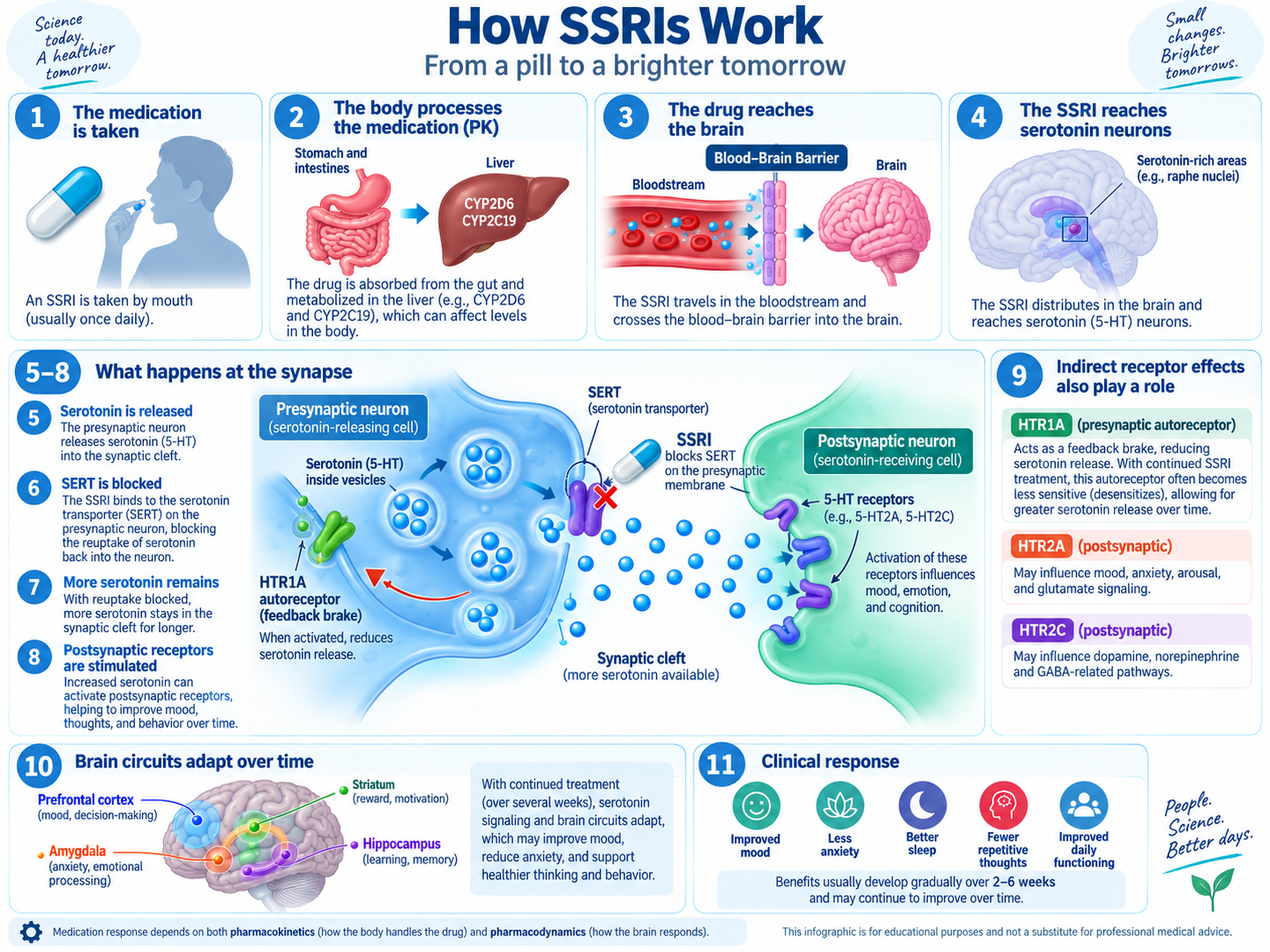
The simplified mechanism is:
- Vortioxetine
- Blocks SERT
- Serotonin reuptake decreases
- Directly modulates several serotonin receptors
- Serotonin signaling changes across multiple brain pathways
- Emotional, cognitive and stress-regulation networks gradually adapt
- Depressive symptoms may improve
The exact antidepressant mechanism is not completely understood. SERT inhibition is considered central, while the contribution of each individual serotonin receptor action to clinical antidepressant efficacy has not been definitively established.
What Makes Vortioxetine Different From an SSRI?
A conventional SSRI such as sertraline, escitalopram or citalopram primarily works by:
Blocking SERT
Vortioxetine also blocks SERT but additionally acts directly on several serotonin receptors.
Conceptually:
Traditional SSRI
- SERT inhibition
- Serotonin availability increases
- Serotonin indirectly activates its receptors
Vortioxetine
- SERT inhibition
- Direct 5-HT receptor modulation Serotonin signaling changes through several mechanisms simultaneously This broader pharmacology does not necessarily mean vortioxetine is universally more effective than an SSRI. It means the way it modifies serotonergic signaling is more complex.
What Is SERT? SERT stands for: Serotonin Transporter and is encoded by: SLC6A4
After serotonin is released from one neuron, SERT helps transport it back into the releasing neuron.
Normally:
- Serotonin released
- Serotonin activates receptors
- SERT removes serotonin from the synapse
- Serotonin signaling decreases
Vortioxetine blocks SERT:
- Vortioxetine
- SERT inhibited
- Serotonin reuptake slows
- Serotonin remains available between neurons for longer
- Serotonergic signaling increases
Vortioxetine binds strongly to SERT and has much weaker affinity for norepinephrine and dopamine transporters, meaning its direct transporter pharmacology is predominantly serotonergic.
Does Vortioxetine Increase Serotonin?
Yes, primarily by reducing serotonin reuptake.
It does not mainly make the brain: Produce more serotonin or: Release large amounts of serotonin
Instead:
- Serotonin released normally
- Vortioxetine blocks SERT
- Serotonin is removed more slowly
- Extracellular serotonin availability increases
This allows serotonin to interact more extensively with multiple receptor systems.
Vortioxetine then adds another layer by directly acting on several of those receptors itself.
Which Serotonin Receptors Does Vortioxetine Affect?
Vortioxetine has a particularly broad serotonin-receptor profile.
| Target | Vortioxetine action |
|---|---|
| SERT | Inhibition |
| 5-HT1A | Agonist |
| 5-HT1B | Partial agonist |
| 5-HT3 | Antagonist |
| 5-HT7 | Antagonist |
| 5-HT1D | Antagonist |
These actions are established pharmacologically, although the exact contribution of each receptor to antidepressant response remains uncertain.
What Does 5-HT1A Agonism Mean?
Vortioxetine acts as an: 5-HT1A Agonist- An agonist activates a receptor.
5-HT1A receptors are important because they exist in at least two functionally different locations:
- Presynaptic 5-HT1A autoreceptors
Postsynaptic 5-HT1A receptors
This allows vortioxetine potentially to influence both: Serotonin-neuron feedback and: Downstream emotional and cognitive signaling
What Are 5-HT1A Autoreceptors?
Serotonin-producing neurons originate primarily within the: Raphe Nuclei
These neurons contain 5-HT1A autoreceptors that act partly as a: Feedback brake
When serotonin activity rises:
- Serotonin
- 5-HT1A autoreceptor activated
- Serotonin-neuron firing is restrained
- Further serotonin release is reduced
This allows the brain to regulate its own serotonergic activity.
When antidepressant treatment continues over time, these feedback mechanisms can adapt.
What Does Vortioxetine Do to Postsynaptic 5-HT1A Receptors?
5-HT1A receptors are also located on neurons in areas involved in:
- Mood
- Anxiety
- Stress regulation
- Memory
- Prefrontal function Vortioxetine directly stimulates these receptors.
Therefore:
- Vortioxetine
- 5-HT1A activation
- Serotonergic signaling changes in downstream neural networks
- Potential contribution to mood and anxiety regulation
However, it would be too strong to say that 5-HT1A agonism is proven to be the reason vortioxetine works better for any particular depressive symptom. The prescribing information explicitly notes that the contribution of individual receptor activities to antidepressant efficacy has not been established.
What Does 5-HT1B Partial Agonism Mean?
Vortioxetine is a: 5-HT1B Partial Agonist
A partial agonist activates a receptor, but produces less maximal stimulation than a full agonist.
5-HT1B receptors can function as:
- Serotonin terminal autoreceptors
- Heteroreceptors controlling release of other neurotransmitters Therefore:
- Vortioxetine
- Partially stimulates 5-HT1B
- Neurotransmitter-release regulation may change
This provides another possible route through which vortioxetine can alter neural signaling beyond simple SERT blockade.
Again, the clinical importance of this receptor effect is not fully established.
What Does 5-HT3 Antagonism Mean?
Vortioxetine blocks: 5-HT3 Receptors
This receptor is unusual because, unlike most serotonin receptors, 5-HT3 is a: Ligand-gated ion channel rather than a G-protein-coupled receptor.
5-HT3 receptors are involved in:
- Gastrointestinal signaling
- Nausea pathways
- GABA interneuron activity
- Glutamate regulation
- Cortical neurotransmission Therefore:
- Vortioxetine
- 5-HT3 blocked
- Serotonin cannot stimulate this receptor as strongly
- Downstream inhibitory and excitatory neurotransmitter systems may be modified
Preclinical work suggests 5-HT3 antagonism may influence GABA, glutamate, dopamine, norepinephrine and acetylcholine pathways indirectly. These broader neurotransmitter effects should be regarded as downstream mechanistic effects, not direct transporter actions.
If Vortioxetine Blocks 5-HT3, Why Does It Still Cause Nausea?
Because nausea is not controlled by only one receptor.
Vortioxetine simultaneously: Blocks SERT which increases overall serotonin availability throughout the gastrointestinal system.
Therefore:
- SERT inhibition
- GI serotonin signaling increases
- Multiple serotonin receptor pathways are affected
- Nausea may occur
Even though vortioxetine antagonizes 5-HT3 receptors, its overall serotonergic effect can still produce substantial nausea.
That is why: 5-HT3 antagonism does not make vortioxetine nausea-free.
What Does 5-HT7 Antagonism Mean?
Vortioxetine also blocks: 5-HT7 Receptors
5-HT7 receptors have been investigated in connection with:
- Mood
- Circadian rhythms
- Sleep
- Learning
- Memory
- Cognitive flexibility Therefore:
- Vortioxetine
- 5-HT7 antagonism
- Serotonin signaling through 5-HT7 decreases
- Potential changes in mood, sleep and cognitive networks
This receptor has received particular scientific interest in relation to vortioxetine’s broader pharmacological profile.
However: 5-HT7 antagonism should not be presented as a proven independent treatment for cognition or depression.
The clinical contribution of this receptor effect remains uncertain.
What Does 5-HT1D Antagonism Mean?
Vortioxetine also antagonizes: 5-HT1D
5-HT1D receptors participate in the regulation of serotonin and other neurotransmitter release.
Blocking this receptor may therefore modify: Presynaptic neurotransmitter regulation
and contribute to vortioxetine’s broader serotonergic profile.
However, compared with SERT, 5-HT1A and 5-HT3, the clinical importance of 5-HT1D antagonism is particularly uncertain.
How Does Vortioxetine Work for Depression?
Depression should not be described simply as:
“Low serotonin.”
Major depressive disorder can involve dysregulation across neural systems involved in:
- Mood
- Motivation
- Reward
- Attention
- Memory
- Stress response
- Emotional regulation
- Sleep
- Appetite
- Negative thinking Vortioxetine acts primarily by reorganizing:
Serotonergic signaling
The pathway is:
- Vortioxetine
- SERT inhibition
-
Serotonin availability increases plus:
-
5-HT1A activation
-
5-HT1B partial activation
-
5-HT3 blockade
-
5-HT7 blockade
-
5-HT1D blockade
- Serotonin signaling becomes redistributed across different receptor pathways
- Other neurotransmitter systems may also be affected indirectly
- Prefrontal, limbic and emotional networks adapt
- Depressive symptoms may improve
A more scientifically accurate explanation is:
Vortioxetine changes how serotonin is transported and how several serotonin receptors respond, producing broader downstream changes in neural networks involved in depression.
Why Doesn’t Vortioxetine Work Immediately?
Transporter and receptor binding begins quickly once adequate drug concentrations are achieved.
But clinical antidepressant response usually takes longer.
The process is:
- Vortioxetine reaches the brain
- SERT and serotonin receptors are affected
- Neurotransmitter signaling changes
- Autoreceptors and feedback systems adapt
- Intracellular signaling changes
- Neural circuits and neuroplasticity gradually adapt
- Clinical improvement develops
Therefore:
Changing serotonin pharmacology happens quickly; reorganizing the neural networks involved in depression takes considerably longer.
Which Brain Regions May Vortioxetine Affect?
Serotonin neurons project widely throughout the brain.
Relevant regions include the:
- Prefrontal Cortex — PFC- involved in executive function, emotional control and attention.
- Amygdala- involved in emotional salience and threat processing.
- Hippocampus- involved in memory and stress regulation.
- Striatum- involved in reward, motivation and behaviour.
- Raphe Nuclei- the main origin of serotonin projections. Vortioxetine should therefore not be thought of as acting in just one brain area.
Its effects emerge from:
Changes in communication between interconnected neural networks.
How Might Vortioxetine Affect the Prefrontal Cortex?
The prefrontal cortex contributes to:
-
Attention
-
Working memory
-
Planning
-
Cognitive flexibility
-
Decision-making
-
Emotional regulation Vortioxetine can modify serotonergic input to the PFC through:
-
SERT inhibition
Multiple serotonin receptor actions
Preclinical research suggests its receptor profile can also influence glutamate, GABA, dopamine, norepinephrine and acetylcholine signaling indirectly.
Therefore:
- Vortioxetine
- Multimodal serotonergic modulation
- Cortical neurotransmitter interactions change
- Prefrontal network function may change
This is one proposed explanation for why vortioxetine has been studied extensively for cognitive symptoms in depression.
Does Vortioxetine Improve Cognition?
There is meaningful clinical evidence that vortioxetine can improve some measures of cognition in people with major depressive disorder.
Randomized-trial meta-analyses have reported improvements in measures such as:
Digit Symbol Substitution Test — DSST
and patient-reported cognitive symptoms compared with placebo. A 2022 meta-analysis of six randomized trials involving 1,782 patients found improvements in DSST and perceived cognitive-function scores, although the authors also emphasized the need for longer-term evidence.
This may involve a combination of:
Improvement in depression itself
and potentially:
Direct or partly independent effects on cognitive neural networks
Earlier analyses reported cognitive improvements that persisted after statistical adjustment for improvement in depressive symptoms.
However, the responsible website wording is:
Vortioxetine has evidence for improving cognitive symptoms associated with depression, but it should not be described as a general cognitive enhancer or as guaranteed to improve cognition in every patient.
Why Might Vortioxetine Affect Cognition Differently from a Traditional SSRI?
One hypothesis involves its:
Multimodal serotonin receptor profile
particularly:
- 5-HT1A agonism
- 5-HT1B partial agonism
- 5-HT3 antagonism
- 5-HT7 antagonism These receptors can influence other neurotransmitter systems involved in cognition.
Preclinical models suggest that vortioxetine may indirectly influence:
- Glutamate
- GABA
- Dopamine
- Norepinephrine
- Acetylcholine especially in cortical and hippocampal networks.
This provides biological plausibility for cognitive effects.
But:
These downstream transmitter effects are not the same as directly blocking dopamine, norepinephrine or acetylcholine transporters.
Does Vortioxetine Increase Dopamine?
Not directly through meaningful dopamine-transporter inhibition.
Its affinity for: DAT — Dopamine Transporter is more than 1,000 nM compared with approximately: 1.6 nM for SERT showing a very large preference for the serotonin transporter.
Therefore: Vortioxetine is not a dopamine reuptake inhibitor.
However, its serotonin-receptor effects can indirectly influence dopamine signaling in selected brain regions.
Conceptually:
- 5-HT receptor modulation
- GABA / glutamate regulation changes
- Dopamine-neuron activity may change regionally
This may be relevant to:
- Motivation
- Reward
- Cognitive processing but vortioxetine remains fundamentally a: Serotonergic antidepressant rather than a dopaminergic drug.
Does Vortioxetine Increase Norepinephrine?
Not through direct clinically important NET inhibition.
Vortioxetine’s affinity for the:
Norepinephrine Transporter — NET is approximately 113 nM, compared with about 1.6 nM for SERT.
Therefore: Vortioxetine is not an SNRI.
Indirect norepinephrine effects may occur through its serotonin-receptor actions, but its primary mechanism remains serotonergic.
Does Vortioxetine Affect Glutamate and GABA?
Potentially, indirectly.
This is particularly relevant to: 5-HT3 antagonism
5-HT3 receptors are expressed on subsets of inhibitory interneurons.
Blocking them can alter: GABA-mediated inhibition which can then modify:
Glutamate signaling.
Conceptually:
- Vortioxetine
- 5-HT3 antagonism
- GABA interneuron activity changes
- Glutamate signaling can be altered
- Cortical network activity changes
This is mainly supported by mechanistic and preclinical evidence and should not be presented as a validated clinical biomarker of response.
Does Vortioxetine Work for Anxiety?
Vortioxetine’s pharmacology clearly interacts with anxiety-related serotonin pathways.
For example:
5-HT1A receptors are strongly involved in anxiety regulation.
However, in Canada, vortioxetine is approved for: Major Depressive Disorder not as a general treatment for anxiety disorders.
A patient with depression may experience improvement in associated anxiety symptoms, but this should be distinguished from a formal anxiety-disorder indication.
Why Can Vortioxetine Initially Increase Anxiety or Restlessness?
Early in treatment:
- SERT inhibited
- Serotonin availability changes rapidly
plus:
- Direct serotonin receptor effects begin
- Brain networks respond before adaptation is complete
- Possible temporary:
- Anxiety
- Restlessness
- Agitation
- Insomnia
- Jitteriness As treatment continues: Feedback mechanisms and neural circuits adapt and these early effects may lessen.
Why Does Vortioxetine Cause Nausea?
Nausea is one of vortioxetine’s most characteristic adverse effects.
The gastrointestinal tract contains extensive serotonin signaling.
Therefore:
- Vortioxetine
- SERT inhibited in the GI system
- Serotonin availability increases
- GI sensory and motility pathways change
- Nausea
Even though vortioxetine blocks 5-HT3 receptors, the overall increase in gastrointestinal serotonergic signaling can still produce nausea.
Why Can Vortioxetine Cause Sexual Dysfunction?
Sexual function depends on a balance among:
- Serotonin
- Dopamine
- Norepinephrine
- Nitric oxide and hormonal and autonomic pathways.
Increasing serotonin can inhibit components of sexual-response pathways.
Therefore:
- SERT inhibition
- Serotonergic signaling increases
- Downstream sexual-response pathways may be inhibited
- Possible:
- Reduced libido
- Delayed orgasm
- Difficulty reaching orgasm
- Erectile dysfunction
- Ejaculatory problems Vortioxetine may have a favourable sexual side-effect profile for some patients compared with certain SSRIs, but it can still cause treatment-emergent sexual dysfunction.
Does Vortioxetine Cause Emotional Blunting?
It can potentially occur, as with other serotonergic antidepressants, although the exact frequency and mechanism remain uncertain.
One proposed pathway is:
- Sustained serotonergic modulation
- Emotional-salience networks become less reactive
- Negative emotional intensity decreases
but sometimes:
Positive emotional intensity may also decrease
This can be difficult to distinguish from:
- Residual depression
- Anhedonia
- Low motivation
- Cognitive fatigue and should therefore be assessed clinically rather than assumed to be a medication effect.
How Is Vortioxetine Different from Sertraline?
Both drugs inhibit: SERT But:
Sertraline
primarily works through serotonin-reuptake inhibition.
Vortioxetine
- SERT inhibition with:
- 5-HT1A agonism
- 5-HT1B partial agonism
- 5-HT3 antagonism
- 5-HT7 antagonism
- 5-HT1D antagonism Therefore, vortioxetine has a: Broader serotonin-receptor mechanism than sertraline.
How Is Vortioxetine Different from Vilazodone?
This comparison is particularly useful.
Vilazodone
primarily combines:
- SERT inhibition
- 5-HT1A partial agonism Vortioxetine
combines:
- SERT inhibition
- 5-HT1A agonism
- 5-HT1B partial agonism
- 5-HT3, 5-HT7 and 5-HT1D antagonism Therefore:
Vilazodone has a relatively focused dual serotonergic mechanism, while vortioxetine modulates a broader set of serotonin receptors.
Their metabolism also differs:
Vilazodone → primarily CYP3A4
Vortioxetine → primarily CYP2D6
which creates different drug-interaction and pharmacogenomic considerations.
How Is Vortioxetine Different from Venlafaxine?
Venlafaxine is an: SNRI and directly inhibits: SERT + NET
Vortioxetine instead: Strongly inhibits SERT but has little direct NET inhibition.
Therefore:
Venlafaxine- directly enhances serotonin and norepinephrine through transporter blockade.
Vortioxetine- primarily modifies serotonin through transporter inhibition plus multiple serotonin receptors.
Any norepinephrine effects from vortioxetine are largely indirect.
How Is Vortioxetine Metabolized?
The most clinically important metabolic enzyme is:
CYP2D6
Vortioxetine undergoes extensive hepatic metabolism to metabolites that are not considered major contributors to its antidepressant effect.
The simplified pathway is:
Vortioxetine
- CYP2D6 — major clinically important pathway
- Additional CYP enzymes
- Less active / inactive metabolites
- Elimination
This differs from venlafaxine, where CYP2D6 produces another important active antidepressant.
For vortioxetine:
Reduced CYP2D6 function primarily increases exposure to the active parent drug.
Why Do CYP2D6 Inhibitors Matter?
Strong CYP2D6 inhibitors can reduce vortioxetine metabolism.
Important examples include:
Fluoxetine Paroxetine
and:
Bupropion
The pathway is:
- Strong CYP2D6 inhibitor
- CYP2D6 activity decreases
- Vortioxetine metabolism slows
- Vortioxetine concentration increases
- Potential:
Greater concentration-related adverse effects
This can happen even in someone who’s genetic CYP2D6 result is: Normal Metabolizer because medication inhibition can change their functional phenotype.
This is called: Phenoconversion
Vortioxetine Pharmacokinetics — PK
PK asks: How much vortioxetine reaches the brain?
- Vortioxetine dose
- Absorption
- CYP2D6 metabolism
- Drug interactions + genotype
- Vortioxetine concentration
- Medication reaches the brain
Important influences include:
- CYP2D6 genotype
- Strong CYP2D6 inhibitors
- CYP-inducing medications
- Dose
- Age
- Liver function
- Adherence
Vortioxetine Pharmacodynamics — PD
PD asks: What happens after vortioxetine reaches the brain? Vortioxetine
- SERT inhibition
- 5-HT1A agonism
- 5-HT1B partial agonism
- 5-HT3 antagonism
- 5-HT7 antagonism
- 5-HT1D antagonism
- Serotonergic signaling changes through several pathways
- Other neurotransmitter systems may be altered indirectly
- Emotional and cognitive networks adapt
- Depressive symptoms may improve
This makes vortioxetine particularly useful for demonstrating why:
Normal drug metabolism does not automatically mean optimal pharmacodynamic response.
How Does CYP2D6 Poor Metabolizer Status Affect Vortioxetine?
A CYP2D6 Poor Metabolizer has little functional CYP2D6 activity.
Therefore:
- Low CYP2D6
- Vortioxetine metabolism decreases
- Vortioxetine exposure increases
- Potential:
Greater risk of concentration-related adverse effects
CPIC recommends:
Starting at approximately 50% of the usual starting dose
for example:
5 mg/day
and titrating up to a maximum recommended:
10 mg/day
or considering an alternative medication not predominantly metabolized by CYP2D6.
These are clinician-level recommendations rather than instructions for patient self-adjustment.
What About CYP2D6 Intermediate Metabolizers?
Intermediate Metabolizers have reduced CYP2D6 activity.
Therefore: Vortioxetine exposure may be somewhat higher than in Normal Metabolizers.
However, CPIC currently recommends: The standard starting dose because the evidence does not justify routine dose reduction solely for Intermediate Metabolizer status.
What About CYP2D6 Normal Metabolizers?
Normal Metabolizers have the expected level of CYP2D6 activity.
CPIC recommends: The standard recommended starting dose.
What About CYP2D6 Ultrarapid Metabolizers?
A CYP2D6 Ultrarapid Metabolizer has increased enzyme activity.
Therefore:
- High CYP2D6 activity
- Vortioxetine metabolism accelerates
- Vortioxetine concentration decreases
- Potential:
Lower probability of adequate clinical benefit
CPIC recommends considering: An alternative antidepressant not predominantly metabolized by CYP2D6 when clinically appropriate.
If vortioxetine is still used, CPIC recommends starting with the usual dose and titrating according to response and tolerability; a higher maintenance dose may sometimes be necessary.
CPIC CYP2D6 Guidance for Vortioxetine
| CYP2D6 phenotype | Expected effect | CPIC approach |
|---|---|---|
| Ultrarapid Metabolizer | Lower exposure | Prefer alternative not predominantly metabolized by CYP2D6; if used, titrate to response |
| Normal Metabolizer | Expected exposure | Standard starting dose |
| Intermediate Metabolizer | Moderately increased exposure | Standard starting dose |
| Poor Metabolizer | Significantly increased exposure | Start at ~50%; maximum 10 mg/day or consider alternative |
What Is the Role of SLC6A4?
SLC6A4 encodes: SERT which is vortioxetine’s principal transporter target.
The pathway is:
- SLC6A4
- SERT expression and function
- Vortioxetine inhibits SERT
- Serotonin availability changes
- Potential differences in pharmacodynamic response
Commonly studied variants include: 5-HTTLPR and: rs25531
These variants are highly relevant biologically because they can affect serotonin-transporter biology.
However:
There is currently no validated SLC6A4 genotype-based vortioxetine prescribing recommendation.
CPIC concluded that available SLC6A4 evidence is insufficient to guide routine antidepressant selection or dosing.
What Is the Role of HTR1A?
HTR1A encodes: 5-HT1A which is a direct vortioxetine target.
Therefore:
- HTR1A genotype
- 5-HT1A receptor expression/function
- Vortioxetine stimulates 5-HT1A
- Autoreceptor and postsynaptic signaling changes
This gives HTR1A a particularly strong mechanistic rationale.
However:
No validated HTR1A-guided vortioxetine prescribing rule currently exists.
It should therefore be considered:
Pharmacodynamically relevant but investigational
rather than an established clinical-action gene.
What Is the Role of HTR1B?
HTR1B encodes the: 5-HT1B Receptor
Vortioxetine acts as a: 5-HT1B partial agonist so this is also a direct drug-target gene.
Potentially:
- HTR1B variation
- 5-HT1B receptor function changes
- Response to vortioxetine's partial agonism could differ
However, no validated HTR1B-based vortioxetine dosing or medication-selection recommendation currently exists.
What Is the Role of HTR3A and HTR3B?
5-HT3 receptors contain subunits encoded by genes including:
- HTR3A
- HTR3B Vortioxetine directly:
Antagonizes 5-HT3
Therefore, these genes have a clear mechanistic relationship to one component of the medication’s pharmacology.
Potential areas of interest include:
- Nausea
- GABA regulation
- Glutamate regulation
- Cognitive pathways However:
HTR3A and HTR3B are not currently validated vortioxetine prescribing biomarkers.
What Is the Role of HTR7?
HTR7 encodes: 5-HT7 which vortioxetine directly antagonizes.
5-HT7 is involved in:
- Mood regulation
- Circadian rhythms
- Learning
- Memory
- Cognitive processes Therefore, HTR7 is another biologically plausible pharmacodynamic gene.
But:
No HTR7 genotype-based treatment guideline currently exists for vortioxetine.
Can Pharmacogenomic Testing Predict Whether Vortioxetine Will Work?
For vortioxetine, the evidence divides naturally into two layers.
- Established pharmacokinetic information- CYP2D6 is clinically actionable because it can substantially change vortioxetine exposure, and CPIC provides specific recommendations for Poor and Ultrarapid Metabolizers.
Emerging pharmacodynamic information
Potentially relevant direct-target genes include:
- SLC6A4
- HTR1A
- HTR1B
- HTR3A / HTR3B
- HTR7 These pathways closely match vortioxetine pharmacology, but none currently provides a validated stand-alone prescribing rule.
Therefore:
CYP2D6 can help determine how much vortioxetine reaches the brain, but it cannot by itself determine whether vortioxetine’s multimodal serotonin-receptor profile is the best biological match for that patient.
Vortioxetine Requires Both Appropriate Exposure and Brain Compatibility
The complete pathway can be summarized as:
- Vortioxetine taken
- PK — Pharmacokinetics
- CYP2D6 metabolism
- Vortioxetine concentration
- Medication reaches the brain
- PD — Pharmacodynamics
- SERT inhibition
- 5-HT1A agonism
- 5-HT1B partial agonism
- 5-HT3 / 5-HT7 / 5-HT1D antagonism
- Multimodal serotonergic signaling
- Other neurotransmitter networks may change indirectly
- Emotional and cognitive networks adapt
- Depressive symptoms may improve
Both matter.
Why Might Vortioxetine Work Well for One Person but Poorly for Another?
Two people with major depressive disorder can have very different biological and symptom patterns.
One patient may predominantly experience:
Anxiety + repetitive negative thinking + emotional reactivity
while another may experience:
Anhedonia + low motivation + fatigue + cognitive slowing
Another may have substantial:
CYP2D6-related exposure differences
while another may have normal PK but very different serotonin-receptor biology.
Treatment response can therefore vary because of differences in:
- Drug metabolism
- SERT biology
- 5-HT receptor biology
- Baseline neurotransmission
- Brain-region involvement
- Symptom pattern
- Other medications
- Previous treatment response This is why:
Having the same diagnosis does not necessarily mean having the same pharmacodynamic treatment needs.
This article is educational. It does not diagnose, and it does not replace advice from your prescriber or pharmacist. Never start, stop or change a medication based on a web page.