Sertraline · How it works
How Does Sertraline Work?
Sertraline, best known by the brand name Zoloft, is a Selective Serotonin Reuptake Inhibitor (SSRI) used in Canada for depression, panic disorder and obsessiv
 Written by Sanjida Ahmed, PhD, Cellular and Molecular BiologyChief Operating Officer and Lead Scientist, Personalized Prescribing. Last reviewed October 2, 2026.
- Class
- SSRI (selective serotonin reuptake inhibitor)
On this page
- What Is SERT?
- Does Sertraline Increase Serotonin?
- Selective Serotonin Reuptake Inhibitor
- How Does Sertraline Work for Depression?
- Why Doesn’t Sertraline Work Immediately?
- Serotonin changes quickly
- What Is Serotonin Autoreceptors?
- Which Serotonin Receptors Does Sertraline Affect?
- How Does Sertraline Work for Anxiety and Panic Disorder?
- How Does Sertraline Affect the Amygdala?
- Sertraline helps modify threat-regulation networks
- Why Can Sertraline Initially Increase Anxiety?
- How Does Sertraline Work for OCD?
- Why Can OCD Require a Longer Treatment Trial?
- Does Sertraline Increase Dopamine?
- Is Sertraline More Dopaminergic Than Other SSRIs?
- A serotonin-dopamine reuptake inhibitor
- Does Sertraline Increase Norepinephrine?
- SERT + NET
- Why Does Sertraline Cause Nausea?
- Why Does Sertraline Cause Diarrhea?
- Why Does Sertraline Cause Sexual Dysfunction?
- Why Can Sertraline Cause Emotional Blunting?
- Emotional Blunting
- Why Can Sertraline Cause Insomnia?
- Why Can Sertraline Cause Tremor or Sweating?
- How Does Sertraline Differ from Paroxetine?
- How Does Sertraline Differ from Fluoxetine?
- How Does Sertraline Differ from Citalopram and Escitalopram?
- How Is Sertraline Metabolized?
- What Is N-Desmethylsertraline?
- How Does CYP2C19 Affect Sertraline?
- Greater probability of concentration-related adverse effects
- CPIC CYP2C19 Guidance for Sertraline
- What Is the Role of CYP2B6?
- Why Can CYP2C19 and CYP2B6 Both Matter?
- CYP2C19 Intermediate Metabolizer
- CYP2B6 Poor Metabolizer
- Does CYP2D6 Matter for Sertraline?
- CYP2C19 + CYP2B6
- What Is the Role of SLC6A4 Genetics?
- What Is the Role of HTR1A?
- Autoreceptor signaling adapts
- What Is the Role of HTR2A Genetics?
- What Is the Role of HTR2C?
- Can Pharmacogenomic Testing Predict Whether Sertraline Will Work?
- Why Can Two People Taking the Same Sertraline Dose Respond Differently?
- 100 mg of sertraline
- Major improvement in anxiety and mood
- Nausea, tremor and sexual dysfunction
- Little therapeutic benefit
- Different Pharmacokinetics
- Different SERT Biology
- Different Serotonin Receptor Biology
- Different Symptom Biology
Sertraline, best known by the brand name Zoloft, is a Selective Serotonin Reuptake Inhibitor (SSRI) used in Canada for depression, panic disorder and obsessive-compulsive disorder (OCD). Zoloft remains marketed in Canada in 25 mg, 50 mg and 100 mg oral formulations.
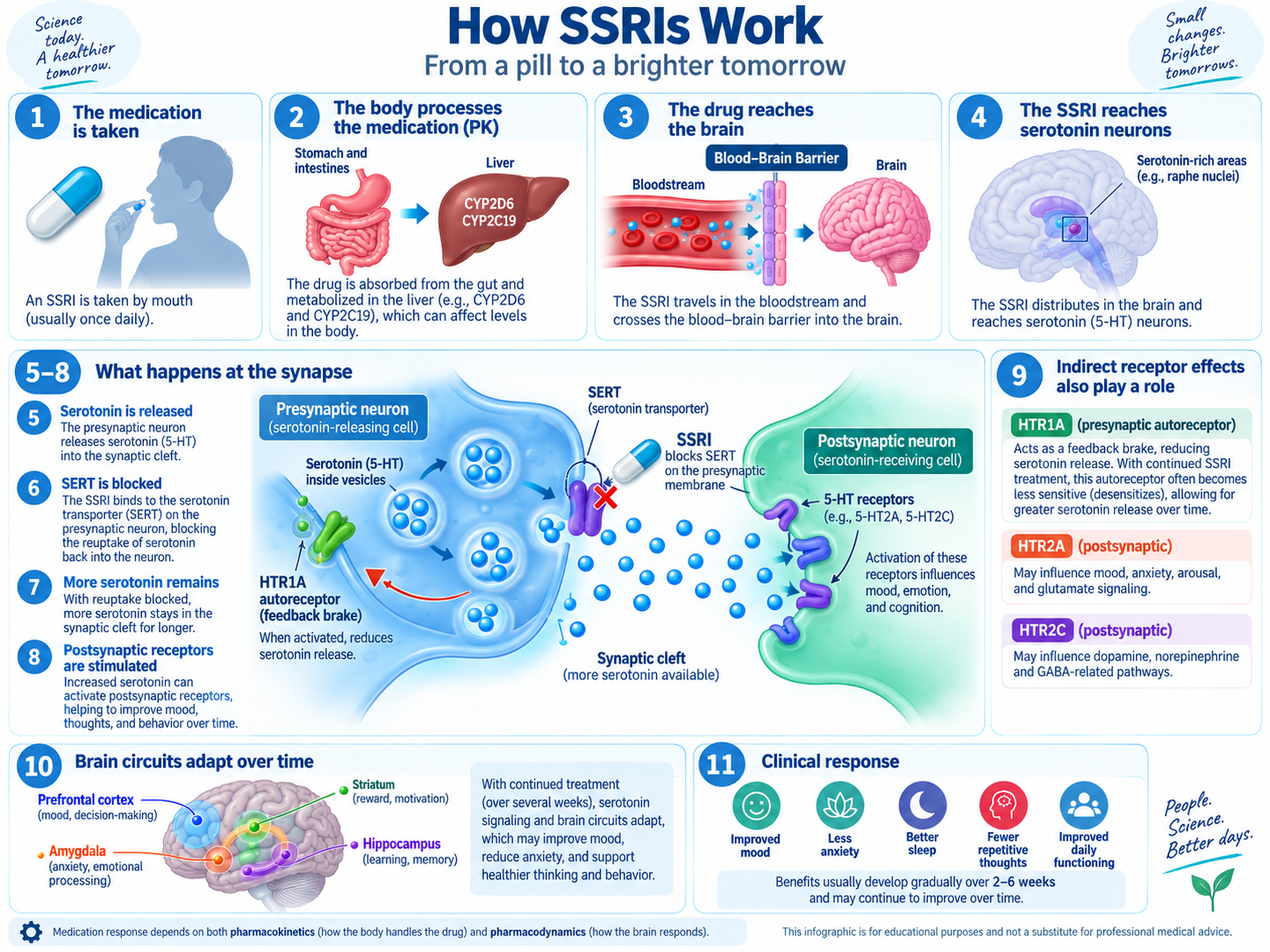
Sertraline works primarily by blocking: SERT — Serotonin Transporter
SERT is responsible for transporting serotonin back into the nerve cell after it has been released.
The basic mechanism is:
- Sertraline
- Blocks SERT
- Serotonin reuptake decreases
- More serotonin remains available between neurons
- Serotonin receptor signaling changes
- Mood, anxiety and repetitive-thinking networks gradually adapt
- Depression, panic or OCD symptoms may improve
Sertraline is a potent and relatively selective inhibitor of serotonin reuptake. At clinically relevant concentrations, its direct effects on norepinephrine and dopamine reuptake are much weaker and are not considered its primary therapeutic mechanism.
What Is SERT?
SERT stands for: Serotonin Transporter
It is encoded by the gene: SLC6A4
Serotonin neurons release serotonin into the small space between nerve cells called the:
Synapse Normally:
- Serotonin is released
- Serotonin activates receptors on other neurons
- SERT transports serotonin back into the releasing neuron
- The serotonin signal is reduced
Sertraline interferes with this recycling process.
- Sertraline
- SERT blocked
- Serotonin is removed from the synapse more slowly
- Serotonin remains available longer
This is the central pharmacodynamic action of sertraline.
Does Sertraline Increase Serotonin?
Yes, indirectly.
Sertraline does not primarily cause neurons to manufacture more serotonin or suddenly release large amounts of it.
Instead:
- Serotonin is normally released
- Sertraline prevents rapid reuptake
- Serotonin remains outside the neuron longer
- Extracellular serotonin signaling increases
This is why sertraline is called a:
Selective Serotonin Reuptake Inhibitor
rather than a serotonin-releasing drug.
The official pharmacology describes sertraline as increasing serotonergic activity in the central nervous system through inhibition of neuronal serotonin reuptake.
How Does Sertraline Work for Depression?
Depression should not be described simply as: “Low serotonin.”
Depression involves dysregulation across multiple systems responsible for:
- Mood
- Motivation
- Reward
- Attention
- Stress response
- Emotional regulation
- Sleep
- Appetite
- Repetitive negative thinking Serotonin is one of the neurotransmitters involved in regulating these networks.
Sertraline changes the way serotonin signaling is regulated.
- Sertraline
- SERT inhibition
- Serotonin availability increases
- Serotonin receptor activity changes
- Feedback systems adapt
- Prefrontal, limbic and mood-related neural networks gradually reorganize
- Depressive symptoms may improve
Therefore, a more scientifically accurate description is:
Sertraline modifies serotonin signaling within brain networks involved in mood and emotional regulation rather than simply correcting a serotonin deficiency.
Why Doesn’t Sertraline Work Immediately?
SERT inhibition occurs relatively quickly.
However, antidepressant benefit often takes: Several weeks because SERT blockade is only the first step.
Canadian Zoloft labeling notes that the full therapeutic response may take four weeks or longer.
The sequence is better understood as:
- Sertraline blocks SERT
- Serotonin rises around serotonin neurons
- Serotonin autoreceptors detect the increase
- Feedback mechanisms temporarily restrain serotonin-neuron firing
- With continued treatment:
- Autoreceptor sensitivity and downstream signaling adapt
- Serotonin transmission becomes reorganized
- Gene expression, receptor signaling and neural networks change
- Clinical improvement develops
This explains why:
Serotonin changes quickly
but:
Mood often improves slowly.
What Is Serotonin Autoreceptors?
Serotonin neurons contain receptors that monitor their own serotonin release.
One of the most important is: 5-HT1A Autoreceptor
These receptors are located particularly on serotonin neurons in the: Raphe nuclei
and function partly as a feedback brake.
Normally:
- Serotonin released
- 5-HT1A autoreceptor activated
- Serotonin-neuron firing decreases
When sertraline initially increases serotonin:
- SERT inhibited
- Serotonin near the serotonin neuron increases
- 5-HT1A autoreceptors become activated
- Neuronal firing may initially be restrained
With continued treatment, this feedback system can adapt and become less restrictive.
This is one proposed mechanism contributing to the delayed antidepressant effect of SSRIs.
Which Serotonin Receptors Does Sertraline Affect?
Sertraline’s main direct target is: SERT not a serotonin receptor.
Once SERT is blocked and serotonin availability increases, serotonin can interact with multiple receptor systems, including:
- 5-HT1A
- 5-HT1B
- 5-HT2A
- 5-HT2C
- 5-HT3 and others.
Different serotonin receptors have different functions.
For example:
- 5-HT1A- may contribute to mood and anxiety regulation.
- 5-HT2A / 5-HT2C- can influence mood, anxiety, sexual function, appetite and other neurotransmitter systems.
- 5-HT3- is particularly relevant to nausea and gastrointestinal effects. Importantly, sertraline itself does not significantly bind these serotonin receptors as its primary mechanism; it changes the amount of serotonin available to stimulate them.
How Does Sertraline Work for Anxiety and Panic Disorder?
Panic and anxiety involve several interacting brain systems, including:
- Amygdala
- Prefrontal cortex
- Insula
- Hippocampus
- Brainstem arousal centres
- Serotonin
- Norepinephrine
- GABA
- Glutamate The: Amygdala helps detect emotional threat.
In panic disorder, fear and body-sensation networks can become unusually reactive.
Sertraline gradually modifies serotonin regulation of these circuits.
- Sertraline
- SERT inhibition
- Serotonin signaling changes
- Amygdala, PFC and brainstem fear networks adapt
- Threat reactivity may decrease
- Panic attacks and anticipatory anxiety may become less frequent or intense
Sertraline is approved in Canada for panic disorder with or without agoraphobia.
How Does Sertraline Affect the Amygdala?
The amygdala is involved in:
- Detecting threat
- Fear learning
- Emotional salience
- Stress responses Serotonin helps regulate amygdala activity.
Therefore:
- Sertraline
- SERT inhibited
- Serotonergic input to the amygdala changes
- Threat-processing circuits gradually adapt
- Emotional reactivity may become less intense
At the same time, serotonergic changes can influence communication between the: Prefrontal cortex and: Amygdala potentially improving top-down emotional regulation.
It is more accurate to say:
Sertraline helps modify threat-regulation networks
rather than:
Sertraline simply calms the amygdala.
Why Can Sertraline Initially Increase Anxiety?
This seems paradoxical, but it is common with SSRIs.
Early in treatment:
- SERT blocked
- Serotonin signaling changes rapidly
- Multiple serotonin receptors are stimulated before neural circuits have adapted
- Possible temporary:
- Anxiety
- Jitteriness
- Restlessness
- Tremor
- Insomnia
- Increased awareness of bodily sensations Over time:
- Receptor and autoreceptor adaptation
- The initial activation often decreases
- Anxiolytic effects may emerge
This is why Canadian dosing for panic disorder begins at: 25 mg/day rather than the 50 mg starting dose used for depression or OCD.
How Does Sertraline Work for OCD?
Obsessive-compulsive disorder involves dysregulation within circuits connecting the:
- Prefrontal cortex
- Striatum
- Thalamus
- Cortex
These are often referred to as: Cortico-Striato-Thalamo-Cortical — CSTC Circuits
These networks help regulate:
- Habit formation
- Error detection
- Cognitive control
- Behavioural repetition
- Perceived threat or incompleteness Serotonin is one of several neurotransmitters involved.
The simplified mechanism is:
- Sertraline
- SERT inhibition
- Serotonin transmission changes
- Cortico-striatal signaling gradually adapts
- Obsessive thoughts may become less intrusive
and:
Compulsive urges may become easier to resist
Sertraline is approved in Canada for symptomatic treatment of OCD.
Why Can OCD Require a Longer Treatment Trial?
The neurocircuitry involved in OCD is complex.
While SERT blockade happens rapidly:
- Sertraline
- Serotonin increases
- CSTC circuits require time to adapt
- Compulsive loops gradually become less persistent
For some patients, meaningful OCD improvement occurs more slowly than early changes seen in anxiety or sleep.
Dose should nevertheless be increased gradually; Canadian labeling recommends dose changes at intervals of at least one week and a maximum of 200 mg/day.
Does Sertraline Increase Dopamine?
Only weakly and not as its primary mechanism.
Sertraline has been shown in laboratory studies to have:
- Weak dopamine-transporter inhibition but this effect is much smaller than its inhibition of SERT.
- Official pharmacology describes sertraline as having only very weak effects on dopamine and norepinephrine neuronal reuptake. Therefore: Sertraline is not a dopamine reuptake inhibitor in the same sense as bupropion.
- Its primary action remains: SERT inhibition- Any clinically relevant dopamine changes are more appropriately considered:
- Secondary or downstream effects- of altered serotonin signaling.
Is Sertraline More Dopaminergic Than Other SSRIs?
Laboratory binding studies suggest sertraline has somewhat greater dopamine-transporter affinity than several other SSRIs, but this distinction can easily be overstated.
At ordinary clinical doses:
Sertraline remains overwhelmingly a serotonergic medication.
It should not be described as:
A serotonin-dopamine reuptake inhibitor
or:
An SSRI with a major dopamine mechanism.
The best website wording is:
Sertraline may have weak secondary dopamine-transporter activity, but SERT inhibition is by far its principal therapeutic mechanism.
Does Sertraline Increase Norepinephrine?
Not substantially through direct transporter blockade.
Sertraline has only weak direct effects on: NET — Norepinephrine Transporter compared with its much stronger effect on SERT.
This distinguishes it from:
SNRIs
such as:
- Duloxetine
- Venlafaxine
- Levomilnacipran which intentionally inhibit:
SERT + NET
Sertraline should therefore be considered predominantly: Serotonergic rather than noradrenergic.
Why Does Sertraline Cause Nausea?
Serotonin plays a major role in the gastrointestinal tract.
When sertraline blocks SERT:
- Serotonin signaling in the gut increases
- 5-HT3 and other serotonin receptors are stimulated
- Gastrointestinal sensory signaling increases
- Nausea may occur
This helps explain why nausea is particularly common early in SSRI treatment.
Why Does Sertraline Cause Diarrhea?
Serotonin regulates:
- Intestinal secretion
- Motility
- Sensory signaling Therefore:
- Sertraline
- SERT inhibition in the gastrointestinal system
- Serotonin signaling increases
- GI motility and secretion may increase
- Loose stools or diarrhea
This is one of sertraline’s more characteristic adverse effects.
Why Does Sertraline Cause Sexual Dysfunction?
Sexual function depends on a balance among:
- Serotonin
- Dopamine
- Norepinephrine
- Nitric oxide
- Hormonal signals
- Autonomic reflexes Increasing serotonin can inhibit several sexual pathways.
Conceptually:
- Sertraline
- SERT inhibition
- Serotonin signaling increases
- 5-HT2 and other serotonergic pathways become more active
- Dopaminergic and spinal sexual-response pathways may be inhibited
- Possible:
- Reduced libido
- Delayed ejaculation
- Difficulty reaching orgasm
- Erectile dysfunction
- Reduced sexual arousal Canadian product information recognizes sexual dysfunction with sertraline and reports that persistent sexual symptoms after discontinuation have also been described with SSRIs.
Why Can Sertraline Cause Emotional Blunting?
Some people taking SSRIs describe:
- Reduced emotional intensity
- Less distress
- Less reactivity
- But sometimes reduced positive emotion as well The mechanism is not completely established.
One possible model is:
- Sustained serotonergic enhancement
- Emotional salience and threat networks become less reactive
- Negative emotional intensity decreases
but in some people:
Positive emotional intensity may also decrease
This is sometimes called:
Emotional Blunting
It should be distinguished from:
- Persistent depression
- Apathy
- Fatigue
- Low dopamine-related motivation because the management may differ.
Why Can Sertraline Cause Insomnia?
Serotonin is involved in both: Sleep and: Wakefulness depending on receptor subtype and brain region.
Early SERT inhibition can increase activity in serotonergic arousal pathways.
Therefore:
- Sertraline
- Serotonin signaling changes
- Possible:
- Activation
- Difficulty falling asleep
- Restlessness
- Vivid dreams
- Earlier waking Other people instead experience:
Somnolence
because the effect of serotonin on sleep networks varies substantially between individuals.
Why Can Sertraline Cause Tremor or Sweating?
Serotonin interacts with:
- Motor pathways
- Autonomic pathways
- Thermoregulation Increasing serotonergic signaling can therefore produce: Tremor and: Increased sweating.
These effects are generally pharmacodynamic rather than the result of a separate receptor-blocking property of sertraline.
How Does Sertraline Differ from Paroxetine?
Both medications are SSRIs and principally inhibit: SERT
However, their pharmacokinetics differ substantially.
Sertraline
-
CYP2C19 and CYP2B6 are important
-
Relatively modest CYP2D6 inhibition
-
Half-life approximately 26 hours
-
Major metabolite is much less active Paroxetine
-
CYP2D6 is the major actionable pathway
-
Strong CYP2D6 inhibitor
-
Produces significant CYP2D6 phenoconversion
-
Greater tendency toward discontinuation symptoms Therefore, the drugs are pharmacologically related but not interchangeable.
How Does Sertraline Differ from Fluoxetine?
Both strongly inhibit SERT.
However:
Fluoxetine
has:
- A very long half-life
- A long-lived active metabolite, norfluoxetine
- Strong CYP2D6 inhibition Sertraline
has:
- A shorter half-life
- A much less active major metabolite
- CYP2C19 and CYP2B6 PGx relevance
- Much less CYP2D6 inhibition than fluoxetine This means fluoxetine persists much longer in the body after discontinuation.
How Does Sertraline Differ from Citalopram and Escitalopram?
All are predominantly serotonergic SSRIs.
Citalopram and escitalopram are particularly selective for SERT and are strongly influenced by: CYP2C19
Sertraline also has important CYP2C19 metabolism, but: CYP2B6 contributes sufficiently that CPIC also provides CYP2B6-specific guidance.
Sertraline additionally has somewhat greater weak DAT affinity than citalopram or escitalopram, although this should not be interpreted as a major dopamine mechanism.
How Is Sertraline Metabolized?
Sertraline undergoes extensive hepatic metabolism.
The important enzymes include: CYP2C19 and: CYP2B6 with contributions from other CYP pathways.
A major metabolic pathway produces: N-Desmethylsertraline which has substantially weaker pharmacological activity than parent sertraline.
The simplified pathway is:
- Sertraline
- CYP2C19 + CYP2B6 + additional enzymes
- N-Desmethylsertraline and other metabolites
- Further metabolism and elimination
This means sertraline’s pharmacogenomics is somewhat more complex than medications controlled predominantly by a single enzyme.
What Is N-Desmethylsertraline?
N-desmethylsertraline is sertraline’s major metabolite.
It remains in the body longer than parent sertraline, but it has much weaker serotonin-reuptake activity and is not considered a major contributor to sertraline’s antidepressant effect.
Therefore:
- Sertraline
- Active parent medication
while:
- N-desmethylsertraline
- Much less pharmacologically active
This differs from drugs such as:
Risperidone where the principal metabolite remains strongly active, or: Fluoxetine where norfluoxetine contributes significantly to prolonged pharmacological activity.
Sertraline Pharmacokinetics — PK
PK asks: How much sertraline reaches the brain?
The pathway is:
- Sertraline dose
- Absorption
- CYP2C19 + CYP2B6 metabolism
- Other metabolic pathways
- Sertraline concentration
- Medication reaches the brain
Important factors include:
- CYP2C19 genotype
- CYP2B6 genotype
- Liver function
- Age
- Drug interactions
- Dose
- Treatment adherence
Sertraline Pharmacodynamics — PD
PD asks: What happens after sertraline reaches the brain?
- Sertraline
- SERT / SLC6A4 inhibition
- Serotonin reuptake decreases
- Serotonin availability increases
- 5-HT1A + 5-HT2A + 5-HT2C + other serotonin systems respond
- Autoreceptors and neural circuits adapt
- Mood, anxiety or OCD symptoms may improve
Therefore: Normal sertraline pharmacokinetics do not automatically mean an optimal pharmacodynamic response.
A person can metabolize sertraline normally yet experience:
- Little benefit
- Sexual dysfunction
- Emotional blunting
- Excessive activation
- GI side effects because the brain’s response to enhanced serotonergic signaling differs between individuals.
How Does CYP2C19 Affect Sertraline?
CYP2C19 is the most established pharmacogenomic enzyme for sertraline.
Reduced CYP2C19 function can lead to:
- Slower sertraline metabolism
- Higher sertraline concentrations
- Potential:
Greater probability of concentration-related adverse effects
CPIC provides sertraline recommendations based on CYP2C19 phenotype.
CYP2C19 Normal Metabolizer and Sertraline
A CYP2C19 Normal Metabolizer has expected CYP2C19 activity.
Therefore:
- Normal CYP2C19
- Expected sertraline metabolism
CPIC recommends:
Use the recommended starting dose.
CYP2C19 Rapid and Ultrarapid Metabolizers
Rapid and Ultrarapid Metabolizers have increased CYP2C19 activity.
For sertraline, however, the increase in metabolism is usually modest because other pathways also contribute.
CPIC therefore recommends: Use the usual recommended starting dose for both Rapid and Ultrarapid Metabolizers.
This differs from drugs such as citalopram and escitalopram, where CYP2C19 ultrarapid metabolism can be more problematic.
CYP2C19 Intermediate Metabolizer and Sertraline
An Intermediate Metabolizer has reduced CYP2C19 activity.
Therefore:
- Reduced CYP2C19
- Sertraline metabolism decreases
- Exposure may increase
CPIC recommends: Use the recommended starting dose but consider: Slower titration and: A lower maintenance dose compared with a Normal Metabolizer.
CYP2C19 Poor Metabolizer and Sertraline
A Poor Metabolizer has little functional CYP2C19 activity.
Therefore:
- Very low CYP2C19 activity
- Sertraline metabolism decreases
- Sertraline concentration rises
- Potential increase in:
- Nausea
- Diarrhea
- Tremor
- Sedation
- Activation
- Sexual side effects
- Other concentration-related adverse effects Current CPIC guidance recommends:
A lower starting dose plus: Slower titration and approximately: 50% lower maintenance dosing
compared with a Normal Metabolizer, or consideration of an alternative antidepressant not predominantly metabolized by CYP2C19.
These are clinician-level recommendations and should not be used for self-adjustment.
CPIC CYP2C19 Guidance for Sertraline
| CYP2C19 phenotype | Expected effect | CPIC approach |
|---|---|---|
| Ultrarapid | Modestly increased metabolism | Standard starting dose |
| Rapid | Modestly increased metabolism | Standard starting dose |
| Normal | Expected metabolism | Standard starting dose |
| Intermediate | Reduced metabolism; higher exposure possible | Standard start; consider slower titration/lower maintenance |
| Poor | Significantly reduced metabolism | Lower starting dose, slower titration, ~50% lower maintenance or alternative |
What Is the Role of CYP2B6?
CYP2B6 also contributes meaningfully to sertraline metabolism.
CPIC therefore provides separate recommendations for: CYP2B6 as well as CYP2C19.
For CYP2B6:
- Normal, Rapid or Ultrarapid Metabolizers generally start with the usual dose.
- Intermediate Metabolizers, can generally start normally, but slower titration and lower maintenance dosing may be considered.
- Poor Metabolizers may have increased sertraline exposure. CPIC recommends considering:
A lower starting dose Slower titration and approximately: 25% lower maintenance dosing
or an alternative medication.
Why Can CYP2C19 and CYP2B6 Both Matter?
Sertraline is metabolized through multiple pathways.
Therefore, a patient might have:
CYP2C19 Intermediate Metabolizer
plus:
CYP2B6 Poor Metabolizer
The combined reduction in metabolism could potentially produce a larger exposure change than either result considered alone.
CPIC specifically provides combined CYP2C19/CYP2B6 guidance because multiple-enzyme interpretation can be useful for sertraline.
This illustrates an important pharmacogenomic principle:
Drug metabolism is not always adequately described by one gene at a time.
Does CYP2D6 Matter for Sertraline?
Not enough to provide an established sertraline genotype-based dosing recommendation.
CYP2D6 may contribute to sertraline metabolism to some extent, but the relationship is much weaker than for medications such as:
- Paroxetine
- Atomoxetine
- Nortriptyline
- Risperidone For sertraline:
CYP2C19 + CYP2B6
are the more clinically relevant PGx pathways.
What Is the Role of SLC6A4 Genetics?
SLC6A4 encodes: SERT which is sertraline’s direct pharmacodynamic target.
The pathway is:
- SLC6A4
- SERT expression and function
- Sertraline inhibits SERT
- Serotonin signaling changes
- Potential differences in clinical response
Two commonly studied variants are:
5-HTTLPR
and:
rs25531
Because these variants may influence SERT expression, they have a strong biological rationale.
However, CPIC reviewed available SLC6A4 evidence and concluded that it is not sufficiently established to support genotype-based antidepressant prescribing recommendations.
Therefore: SLC6A4 is directly biologically relevant but: not currently an independently actionable sertraline marker.
What Is the Role of HTR1A?
HTR1A encodes: 5-HT1A Receptor
5-HT1A is important because it exists both as: A serotonin autoreceptor and: A postsynaptic receptor.
The autoreceptor helps regulate serotonin-neuron firing.
Therefore:
- Sertraline
- SERT inhibition
- Serotonin around raphe neurons increases
- 5-HT1A autoreceptors respond
- Serotonin firing changes
- With repeated treatment:
Autoreceptor signaling adapts
HTR1A variation therefore has a plausible relationship to SSRI response.
However: There is no validated HTR1A genotype-based sertraline dosing or selection guideline.
What Is the Role of HTR2A Genetics?
HTR2A encodes: 5-HT2A Receptor
Sertraline does not directly block 5-HT2A as its main mechanism.
Instead:
- Sertraline blocks SERT
- Serotonin availability increases
- Serotonin stimulates 5-HT2A and other receptors
HTR2A variants have been investigated for:
- Antidepressant response
- Side effects
- Sexual dysfunction However, CPIC concluded that existing HTR2A evidence does not support routine genotype-guided antidepressant prescribing.
What Is the Role of HTR2C?
HTR2C encodes: 5-HT2C Receptor
This receptor participates in:
- Anxiety
- Appetite
- Dopamine regulation
- Norepinephrine regulation
- Reward
- Sexual function Sertraline increases serotonin availability, which can alter downstream 5-HT2C signaling.
HTR2C is therefore biologically relevant to:
- Activation
- Appetite changes
- Sexual effects
- Individual serotonergic response But: HTR2C currently has no validated genotype-based sertraline prescribing recommendation.
Can Pharmacogenomic Testing Predict Whether Sertraline Will Work?
Pharmacogenomic information is strongest for:
Pharmacokinetics- especially: CYP2C19 and: CYP2B6
These genes can help identify patients likely to have unusually high sertraline exposure.
But treatment success also depends on:
Pharmacodynamics- including:
- SERT biology
- Serotonin receptor signaling
- Baseline serotonin-related symptoms
- Dopamine and norepinephrine involvement
- Brain region
- Diagnosis
- Previous treatment response Therefore:
CYP2C19 and CYP2B6 can help estimate sertraline exposure, but they cannot independently determine whether increasing serotonergic signaling is the optimal treatment mechanism for an individual patient.
Sertraline Requires Both Appropriate Exposure and Brain Compatibility
The complete process can be summarized as:
- Sertraline is taken
- PK — Pharmacokinetics
- CYP2C19 + CYP2B6
- Sertraline concentration
- Medication reaches the brain
- PD — Pharmacodynamics
- SERT / SLC6A4 inhibition
- Serotonin availability increases
- 5-HT1A + 5-HT2A + 5-HT2C + other serotonin pathways respond
- PFC + amygdala + cortico-striatal + emotional networks adapt
- Depression, panic or OCD symptoms may improve
This creates two different personalized-prescribing questions:
Both matter.
Why Can Two People Taking the Same Sertraline Dose Respond Differently?
Consider two patients each taking:
100 mg of sertraline
One may experience:
Major improvement in anxiety and mood
another:
Nausea, tremor and sexual dysfunction
and another:
Little therapeutic benefit
Possible reasons include:
Different Pharmacokinetics
CYP2C19 and CYP2B6 may produce different drug concentrations.
Different SERT Biology
SLC6A4 expression and function may vary.
Different Serotonin Receptor Biology
5-HT1A, 5-HT2A and 5-HT2C signaling may differ.
Different Symptom Biology
One person’s illness may be dominated by:
-
Threat sensitivity
-
Anxiety
-
Repetitive thinking while another may have prominent:
-
Anhedonia
-
Low motivation
-
Fatigue involving stronger dopamine or norepinephrine components.
This explains why:
Having the same diagnosis does not necessarily mean having the same underlying neurochemical pattern.
This article is educational. It does not diagnose, and it does not replace advice from your prescriber or pharmacist. Never start, stop or change a medication based on a web page.