
Fluvoxamine · How it works
How Does Fluvoxamine Work?
Fluvoxamine, commonly known by the brand name Luvox, is a selective serotonin reuptake inhibitor (SSRI) used especially for obsessive-compulsive disorder (OCD
 Written by Sanjida Ahmed, PhD, Cellular and Molecular BiologyChief Operating Officer and Lead Scientist, Personalized Prescribing. Last reviewed October 2, 2026.
- Class
- SSRI (selective serotonin reuptake inhibitor)
On this page
- How Does Fluvoxamine Work for OCD?
- What Does Fluvoxamine Do to Serotonin?
- SLC6A4 gene
- Does Fluvoxamine Simply Increase Serotonin?
- Why Does Fluvoxamine Take Several Weeks to Work?
- What Is the Role of the 5-HT1A Receptor?
- What Is the Role of 5-HT2A and 5-HT2C?
- Why Is Fluvoxamine Particularly Effective for OCD?
- How Does Fluvoxamine Work for Depression?
- How Does Fluvoxamine Work for Anxiety?
- Why Can Fluvoxamine Initially Increase Anxiety or Restlessness?
- Does Fluvoxamine Affect Dopamine?
- Does Fluvoxamine Affect Norepinephrine?
- What Is Unique About the Sigma-1 Receptor and Fluvoxamine?
- Sigma-1 Receptor — SIGMAR1
- Why Can Fluvoxamine Cause Nausea?
- Why Can Fluvoxamine Affect Sleep?
- Sleepiness in some people
- Insomnia in others
- Why Can Fluvoxamine Cause Sexual Side Effects?
- Why Can the Same Dose Affect Two People Differently?
- Good OCD response + few side effects
- Nausea + sleepiness + little improvement
- How Is Fluvoxamine Metabolized?
- How Does CYP2D6 Affect Fluvoxamine?
- CYP2D6 Poor Metabolizer
- What Happens in a CYP2D6 Poor Metabolizer?
- What About CYP2D6 Intermediate Metabolizers?
- What About CYP2D6 Ultrarapid Metabolizers?
- Fluvoxamine Also Changes the Metabolism of Other Medications
- Why Is CYP1A2 Inhibition So Important?
- Why Can Coffee Suddenly Feel Stronger with Fluvoxamine?
- Why Can Fluvoxamine Greatly Increase Clozapine Levels?
- Can Fluvoxamine Fail Even If CYP2D6 Metabolism Is Normal?
- Does an appropriate amount of fluvoxamine reach the brain?
- How does the brain respond once fluvoxamine arrives?
- Can SLC6A4 Genetics Affect Fluvoxamine Response?
- “Fluvoxamine will work”
- “Fluvoxamine will fail.”
- Can HTR2A Genetics Affect Fluvoxamine Response?
- What About HTR1A and HTR2C?
- HTR1A — 5-HT1A
- HTR2C — 5-HT2C
- Can Pharmacogenomic Testing Tell Whether Fluvoxamine Will Work?
- CYP2D6 metabolism
- Why Might Fluvoxamine Work Well for One Person but Not Another?
- Intrusive contamination fears + washing compulsions
- Repetitive checking + doubt + intrusive thoughts
- Different drug concentrations
- Different pharmacodynamic responses
- How Is Fluvoxamine Different from Fluoxetine?
- CYP1A2 + CYP2C19
- How Is Fluvoxamine Different from Escitalopram?
Fluvoxamine, commonly known by the brand name Luvox, is a selective serotonin reuptake inhibitor (SSRI) used especially for obsessive-compulsive disorder (OCD) and, in Canada, depression.
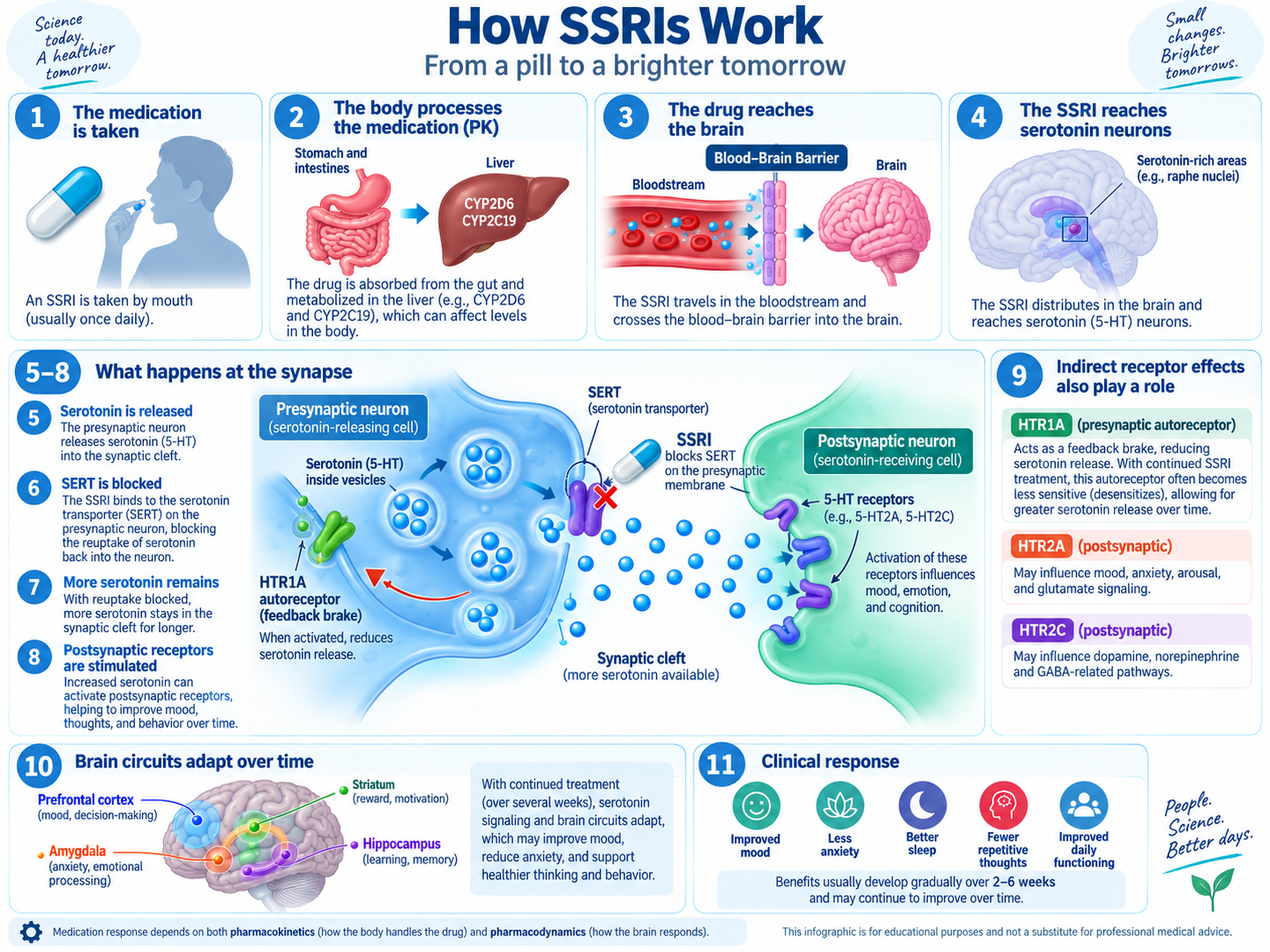
Like other SSRIs, fluvoxamine works primarily by changing the activity of: Serotonin
Its main pharmacological target is the: Serotonin Transporter — SERT
SERT normally removes serotonin from the space between nerve cells and transports it back into the serotonin-releasing neuron.
Fluvoxamine blocks SERT.
The basic mechanism is:
- Fluvoxamine
- Blocks SERT
- Serotonin reuptake decreases
- More serotonin remains available between nerve cells
- Serotonin receptor signaling changes
- Brain circuits gradually adapt
- OCD or depressive symptoms may improve
Current prescribing information describes inhibition of neuronal serotonin reuptake as the presumed mechanism underlying fluvoxamine’s benefit in OCD. It has little significant direct affinity for dopamine, histamine, muscarinic or adrenergic receptors.
How Does Fluvoxamine Work for OCD?
Fluvoxamine is particularly well known as an OCD medication.
OCD involves recurrent:
Obsessions- unwanted thoughts, images, impulses or fears
and/or:
Compulsions- repetitive behaviours or mental acts that a person feels driven to perform.
OCD is associated with dysregulation in interconnected brain circuits involving areas of the:
- Prefrontal cortex
- Orbitofrontal cortex
- Anterior cingulate cortex
- Striatum
- Thalamus These are often described collectively as cortico-striato-thalamo-cortical circuits.
Serotonin helps regulate communication within these pathways.
A simplified model is:
- Fluvoxamine
- SERT inhibition
- Serotonin signaling changes
- Serotonin receptors and feedback systems adapt
- Prefrontal-striatal-thalamic circuitry gradually changes
- Obsessive thoughts and compulsive behaviours may decrease
This does not mean OCD is simply caused by “low serotonin.”
The more accurate concept is that fluvoxamine changes serotonin signaling within neural circuits that regulate repetitive thoughts, behavioural inhibition, threat processing and cognitive flexibility.
What Does Fluvoxamine Do to Serotonin?
Serotonin is a neurotransmitter involved in:
- Mood
- Anxiety
- Emotional regulation
- Threat processing
- Repetitive thinking
- Sleep
- Appetite
- Impulse control
- Sexual function After serotonin is released from one neuron, it communicates with receptors on neighbouring cells.
Then: SERT transports serotonin back into the original neuron. SERT is encoded by the:
SLC6A4 gene
Fluvoxamine inhibits SERT.
Therefore:
- Serotonin is released
- Fluvoxamine blocks SERT
- Serotonin recycling decreases
- More serotonin remains available for signaling
This is fluvoxamine’s principal established pharmacodynamic action.
Does Fluvoxamine Simply Increase Serotonin?
Not exactly.
Fluvoxamine increases the availability of serotonin between neurons, but that is only the beginning of the therapeutic process.
Once serotonin availability changes, serotonin interacts with many receptor types, including:
- 5-HT1A
- 5-HT2A
- 5-HT2C and many others.
Different serotonin receptors can have very different effects.
Some influence:
- Anxiety
- Mood
- Sleep
- Cognition
- Dopamine signaling
- Norepinephrine signaling
- Appetite
- Sexual function Therefore:
The therapeutic effect of fluvoxamine is not simply “more serotonin.” It is the brain’s response and adaptation to altered serotonin signaling.
Why Does Fluvoxamine Take Several Weeks to Work?
Fluvoxamine starts inhibiting SERT relatively quickly.
Yet improvement in OCD or depression generally takes much longer.
Why?
Because transporter inhibition is only the first step.
The process is more like:
- Fluvoxamine blocks SERT
- Serotonin availability changes
- Serotonin receptors respond
- Feedback systems adapt
- Intracellular signaling changes
- Neural networks gradually adjust
- Clinical improvement develops
This explains an important feature of SSRIs:
The chemical effect occurs quickly, but the therapeutic brain response develops gradually.
Fluvoxamine concentrations themselves also accumulate over repeated dosing, with steady state reached in approximately a week in pharmacokinetic studies.
What Is the Role of the 5-HT1A Receptor?
One important serotonin receptor is: 5-HT1A encoded by: HTR1A
Some 5-HT1A receptors act as autoreceptors on serotonin-producing neurons.
They function somewhat like a feedback brake.
When serotonin signaling increases:
- Serotonin activates 5-HT1A autoreceptors
- Serotonin-neuron firing may initially decrease
This may partly counteract the immediate effect of an SSRI.
With continued treatment:
- 5-HT1A feedback mechanisms adapt
- Serotonergic signaling becomes differently regulated
- Therapeutic effects may gradually emerge
This is one proposed reason SSRIs such as fluvoxamine take time to produce their full effect.
What Is the Role of 5-HT2A and 5-HT2C?
Increased serotonin also acts through receptors such as:
5-HT2A
and:
5-HT2C
These receptors can influence:
- Anxiety
- Cognition
- Emotional processing
- Sleep
- Dopamine signaling
- Norepinephrine signaling
- Appetite
- Sexual function This helps explain why changing serotonin signaling can produce both therapeutic effects and side effects.
For example, increased serotonin activity may help reduce repetitive thinking over time but can also initially contribute to:
- Restlessness
- Insomnia
- Nausea
- Sexual side effects The eventual response reflects the combined activity of many serotonin receptors across multiple brain regions.
Why Is Fluvoxamine Particularly Effective for OCD?
Fluvoxamine is not uniquely capable of treating OCD—other SSRIs are also effective—but it has been extensively studied and used for this condition.
OCD appears to involve abnormal persistence of activity within circuits responsible for:
- Detecting potential errors or threats
- Deciding whether an action is complete
- Suppressing repetitive behaviour
- Shifting attention away from intrusive thoughts One simplified model is:
- Intrusive thought or perceived threat
- OCD-related cortical-striatal circuit becomes activated
- Signal fails to shut down appropriately
- Thought persists
- Compulsive behaviour may temporarily reduce distress
Fluvoxamine gradually changes serotonin regulation within these networks:
- SERT inhibition
- Serotonin signaling changes
- Circuit regulation gradually adapts
- Intrusive thoughts may become less persistent and compulsive urges easier to resist
This remains a simplified explanation—the full biological mechanism of OCD and SSRI response is considerably more complex.
How Does Fluvoxamine Work for Depression?
Depression can involve dysregulation across several systems responsible for:
- Mood
- Emotional regulation
- Stress response
- Sleep
- Motivation
- Cognition
- Negative thinking
- Reward and pleasure Fluvoxamine changes serotonin signaling within these interconnected networks.
The pathway is:
- Fluvoxamine
- SERT inhibition
- Serotonin availability changes
- Serotonin receptors and feedback systems adapt
- Emotional and cognitive networks gradually change
- Depressive symptoms may improve
Depression should therefore not be described simply as a serotonin deficiency.
Two people with depression may have very different symptom patterns and may respond differently to the same SSRI.
How Does Fluvoxamine Work for Anxiety?
Although regulatory indications vary by country, fluvoxamine’s serotonergic mechanism can also influence anxiety-related pathways.
Serotonin participates in communication between:
The amygdala
important for threat detection and emotional reactivity,
and:
The prefrontal cortex
important for regulation, interpretation and control of emotional responses.
Over time:
- Fluvoxamine inhibits SERT
- Serotonin signaling changes
- Amygdala-prefrontal and other anxiety networks adapt
- Threat responses and excessive worry may become better regulated
Again, the goal is not simply to produce “high serotonin.”
It is to improve regulation of serotonergic signaling within the appropriate neural circuits.
Why Can Fluvoxamine Initially Increase Anxiety or Restlessness?
When treatment begins, serotonin signaling changes before the broader nervous system has fully adapted.
Some patients can temporarily experience:
- Nervousness
- Restlessness
- Increased anxiety
- Nausea
- Sleep disturbance The sequence may be:
- SERT inhibition begins
- Serotonin availability changes rapidly
- Multiple serotonin receptors respond
- Temporary activation or discomfort
- Receptors and circuits gradually adapt
- Therapeutic benefit may subsequently emerge
This is why early side effects do not necessarily predict the eventual therapeutic response.
Does Fluvoxamine Affect Dopamine?
Not directly to a major degree.
Fluvoxamine has little significant direct affinity for dopamine receptors and is not primarily a dopamine reuptake inhibitor.
However, serotonin and dopamine systems interact.
Therefore:
- Fluvoxamine changes serotonin
- Serotonin receptors influence dopamine neurons
- Dopamine activity may change indirectly in certain brain regions
These indirect effects may be relevant to:
- Motivation
- Reward
- Cognition
- Emotional processing
- Sexual function But fluvoxamine should still be described primarily as a: Serotonergic medication
Does Fluvoxamine Affect Norepinephrine?
Fluvoxamine does not primarily block the norepinephrine transporter like an SNRI such as duloxetine.
Its direct pharmacological action is much more selective for: SERT
However, serotonin receptors can indirectly influence norepinephrine pathways.
So, fluvoxamine may ultimately change some norepinephrine activity through downstream serotonergic regulation, but it is not considered a serotonin-norepinephrine reuptake inhibitor.
What Is Unique About the Sigma-1 Receptor and Fluvoxamine?
Fluvoxamine has another interesting pharmacological property that distinguishes it from many SSRIs.
It has relatively high affinity for the:
Sigma-1 Receptor — SIGMAR1
The sigma-1 receptor is not a conventional serotonin receptor.
It is an intracellular regulatory protein, concentrated particularly around the endoplasmic reticulum, that can influence:
- Cellular stress responses
- Calcium signaling
- Mitochondrial function
- Neuroplasticity
- Protein regulation
- Communication between cellular signaling systems Experimental studies describe fluvoxamine as having sigma-1 receptor agonist activity, and PET research has demonstrated that therapeutic fluvoxamine doses can bind sigma-1 receptors in the human brain.
A simplified concept is:
- Fluvoxamine
- Sigma-1 receptor interaction
- Cellular signaling and stress-response pathways may be modified
- Potential effects on neuronal function and plasticity
However, this needs an important qualification:
SERT inhibition remains fluvoxamine’s established primary psychiatric mechanism.
Although sigma-1 activity is scientifically interesting, we currently cannot say that a patient’s OCD or depression improves specifically because of sigma-1 receptor activation.
There is also no established SIGMAR1 pharmacogenomic prescribing guideline for fluvoxamine.
Why Can Fluvoxamine Cause Nausea?
Serotonin is not only present in the brain.
A large amount of serotonin signaling occurs in the gastrointestinal system.
When fluvoxamine increases serotonin activity:
- SERT inhibition
- Serotonin signaling increases in the gastrointestinal system
- Nausea, diarrhea or digestive discomfort may occur
Nausea is one of the most common early adverse effects of fluvoxamine.
For many patients it becomes less troublesome as the body adapts.
Why Can Fluvoxamine Affect Sleep?
Serotonin participates in regulation of:
- Sleep
- Wakefulness
- Melatonin-related pathways
- Arousal Fluvoxamine can therefore cause:
Sleepiness in some people
but:
Insomnia in others
The direction of the effect depends on the individual’s neural response.
This is why fluvoxamine is often initially given at bedtime, but dosing may be individualized.
Why Can Fluvoxamine Cause Sexual Side Effects?
Serotonin interacts with dopamine and other systems controlling sexual function.
Increasing serotonin activity can inhibit some neural pathways involved in:
- Sexual desire
- Arousal
- Orgasm
- Ejaculation Therefore:
- Fluvoxamine
- ↑ serotonergic signaling
- Changes in dopamine and sexual-response pathways
- Possible:
- Reduced libido
- Delayed orgasm
- Difficulty reaching orgasm
- Delayed ejaculation
- Erectile difficulty These effects are pharmacodynamic—they reflect how the nervous system responds to the medication.
Why Can the Same Dose Affect Two People Differently?
Two people can take exactly the same fluvoxamine dose and have very different experiences.
One person may experience:
Good OCD response + few side effects
Another may experience:
Nausea + sleepiness + little improvement
Another may develop unexpectedly high medication concentrations.
There are two broad reasons:
Pharmacokinetics — different drug exposure
People can metabolize fluvoxamine differently.
Pharmacodynamics — different brain response
People can differ in:
- SERT function
- Serotonin receptor signaling
- Baseline neurotransmitter activity
- Brain circuits
- Symptoms
- Other biological factors This is why medication response cannot be predicted from dose alone.
How Is Fluvoxamine Metabolized?
Fluvoxamine is extensively metabolized in the liver.
One particularly important enzyme is:
CYP2D6
CPIC describes fluvoxamine as being extensively metabolized by CYP2D6 into less active compounds.
A simplified pathway is:
- Fluvoxamine
- CYP2D6 + other metabolic pathways
- Less active metabolites
- Elimination
Genetic differences in CYP2D6 can therefore affect fluvoxamine exposure.
How Does CYP2D6 Affect Fluvoxamine?
The: CYP2D6 gene determines how much functional CYP2D6 enzyme a person produces.
People can be classified as:
- Ultrarapid Metabolizers
- Normal Metabolizers
- Intermediate Metabolizers
- Poor Metabolizers The most clinically important established relationship for fluvoxamine is the:
CYP2D6 Poor Metabolizer
What Happens in a CYP2D6 Poor Metabolizer?
A CYP2D6 Poor Metabolizer has little or no functional CYP2D6 activity.
Therefore:
- Low CYP2D6 activity
- Fluvoxamine metabolism decreases
- Fluvoxamine exposure increases
- Concentration-related side effects may become more likely
CPIC recommends considering either:
A 25–50% lower starting dose with slower titration
or:
An appropriate alternative antidepressant not predominantly metabolized by CYP2D6
for CYP2D6 Poor Metabolizers. The recommendation is classified as optional, reflecting the limitations of the available evidence.
What About CYP2D6 Intermediate Metabolizers?
Intermediate Metabolizers have reduced CYP2D6 activity and can have somewhat higher fluvoxamine concentrations.
However, current CPIC guidance recommends: Starting with the usual recommended dose
rather than automatically reducing it.
Clinical tolerability and response should guide subsequent adjustments.
What About CYP2D6 Ultrarapid Metabolizers?
An Ultrarapid Metabolizer has increased CYP2D6 activity.
One might expect faster metabolism and lower drug exposure.
However, for fluvoxamine:
The available evidence is not sufficient to support a specific dose recommendation.
CPIC therefore currently gives: No recommendation for CYP2D6 Ultrarapid Metabolizers.
It would therefore be inappropriate to automatically increase fluvoxamine simply because someone has an Ultrarapid Metabolizer result.
Fluvoxamine Also Changes the Metabolism of Other Medications
This is one of the most clinically important characteristics of fluvoxamine.
Fluvoxamine inhibits several CYP enzymes, particularly:
CYP1A2
and:
CYP2C19
with effects on other enzymes including CYP3A4 and CYP2C9. Current labeling describes clinically significant inhibition of several of these pathways.
This means fluvoxamine can change the concentration of other medications even when the fluvoxamine dose itself has not changed.
Why Is CYP1A2 Inhibition So Important?
CYP1A2 metabolizes several commonly used medications and substances.
Fluvoxamine inhibits CYP1A2.
Therefore:
- Fluvoxamine
- CYP1A2 inhibition
- Another CYP1A2 drug is metabolized more slowly
- Its concentration may increase
Important examples include:
- Clozapine
- Olanzapine
- Tizanidine
- Theophylline
- Propranolol
- Caffeine This is why fluvoxamine has one of the more substantial drug-interaction profiles among SSRIs.
Why Can Coffee Suddenly Feel Stronger with Fluvoxamine?
Caffeine is metabolized primarily through:
CYP1A2
Fluvoxamine inhibits CYP1A2.
Therefore:
- Coffee or caffeine
- Fluvoxamine
- Caffeine metabolism slows
- Caffeine concentration increases
- Possible:
- Jitteriness
- Tremor
- Palpitations
- Anxiety
- Insomnia This is an excellent example of how a medication can change the effect of another substance without changing that substance’s dose.
Why Can Fluvoxamine Greatly Increase Clozapine Levels?
Clozapine depends strongly on: CYP1A2 for metabolism.
Fluvoxamine inhibits CYP1A2.
Therefore:
- Fluvoxamine added
- CYP1A2 activity decreases
- Clozapine metabolism slows
- Clozapine concentration can increase substantially
This can increase risks such as:
- Sedation
- Seizures
- Low blood pressure
- Tachycardia
- Other concentration-related adverse effects Specialists sometimes deliberately use this interaction in carefully managed circumstances, but it requires clozapine dose adjustment and therapeutic drug monitoring.
Can Fluvoxamine Fail Even If CYP2D6 Metabolism Is Normal?
Absolutely.
CYP2D6 only addresses part of the question.
Medication response has two major dimensions.
Pharmacokinetics — PK
PK asks:
Does an appropriate amount of fluvoxamine reach the brain?
Important factors include:
- CYP2D6
- Other metabolic pathways
- Dose
- Drug interactions
- Liver function Fluvoxamine exposure But appropriate exposure does not guarantee treatment success.
Pharmacodynamics — PD
PD asks:
How does the brain respond once fluvoxamine arrives?
The pathway is:
- Fluvoxamine reaches the brain
- SERT inhibition
- ↑ serotonin availability
- 5-HT1A + 5-HT2A + 5-HT2C + other receptors respond
- Serotonin feedback systems change
- OCD, mood and anxiety circuits adapt
- Symptoms may improve
Therefore:
Normal PK does not automatically mean optimal PD response.
A patient can metabolize fluvoxamine normally and still have an inadequate response because the serotonin system and relevant brain circuits may respond differently.
Fluvoxamine Needs Both Drug Exposure and Brain Response
The complete process can be summarized as:
- Fluvoxamine is taken
- The body absorbs and metabolizes fluvoxamine — PK
- CYP2D6 + other metabolic pathways
- An appropriate amount reaches the brain
- Fluvoxamine blocks SERT — PD
- Serotonin availability increases
- 5-HT1A + 5-HT2A + 5-HT2C + other serotonin systems respond
- OCD and mood-related neural networks adapt
- Symptoms may improve
This produces two fundamentally different questions:
PK
Does enough fluvoxamine reach the brain without excessive exposure?
PD
Does the patient’s serotonin system respond favourably once the medication reaches its target?
Both can influence clinical outcome.
Can SLC6A4 Genetics Affect Fluvoxamine Response?
Fluvoxamine’s principal target is: SERT encoded by: SLC6A4
The biological rationale is straightforward:
- SLC6A4 genetics
- SERT expression/function
- Fluvoxamine's main drug target
Variants in SLC6A4, including 5-HTTLPR, have been studied extensively in relation to SSRI response and adverse effects.
However, the results have been inconsistent across studies and populations.
Current CPIC guidance concludes that the evidence for SLC6A4 is insufficient to support routine genotype-based antidepressant prescribing.
Therefore, an SLC6A4 result should not be interpreted as:
“Fluvoxamine will work”
or:
“Fluvoxamine will fail.”
Can HTR2A Genetics Affect Fluvoxamine Response?
HTR2A encodes the: 5-HT2A receptor
Once fluvoxamine increases serotonin availability, serotonin acts on 5-HT2A and many other receptors.
HTR2A variants have therefore been studied in antidepressant response.
However, CPIC similarly concluded that existing evidence does not support using HTR2A genotype alone for routine antidepressant prescribing.
The gene is biologically relevant, but its clinical interpretation is more complex than the established CYP2D6 pharmacokinetic relationship.
What About HTR1A and HTR2C?
Fluvoxamine’s increased serotonin signaling also involves:
HTR1A — 5-HT1A
and:
HTR2C — 5-HT2C
along with many other serotonin receptors.
These genes are biologically relevant because they influence downstream serotonergic signaling.
However:
There are currently no established HTR1A- or HTR2C-based fluvoxamine dosing guidelines.
They should therefore be considered part of the broader pharmacodynamic biology, rather than deterministic predictors of treatment response.
Can Pharmacogenomic Testing Tell Whether Fluvoxamine Will Work?
Pharmacogenomics can provide useful information—particularly about:
CYP2D6 metabolism
but treatment response also depends on:
- Drug exposure
- Other medications
- SERT function
- Serotonin receptor signaling
- OCD symptom biology
- Baseline neurotransmitter function
- Dose
- Treatment duration
- Previous medication response
- Individual brain circuitry A comprehensive personalized assessment therefore considers genetics together with clinical symptoms and the medication’s mechanism, rather than relying on one genetic variant.
Why Might Fluvoxamine Work Well for One Person but Not Another?
Two patients can both have OCD but experience very different symptoms.
One may mainly experience:
Intrusive contamination fears + washing compulsions
while another experiences:
Repetitive checking + doubt + intrusive thoughts
Their underlying neural and neurotransmitter patterns may not be identical.
Similarly, two patients taking the same fluvoxamine dose can have:
Different drug concentrations
and:
Different pharmacodynamic responses
because of differences in:
- Genetics
- Metabolism
- Drug interactions
- SERT biology
- Serotonin receptors
- Brain-region activity
- Symptom patterns This helps explain why treatment response varies even among people with the same diagnosis.
How Is Fluvoxamine Different from Fluoxetine?
Fluvoxamine and fluoxetine are both SSRIs, but they are pharmacologically different.
Both primarily inhibit: SERT
However:
Fluvoxamine
is particularly associated with OCD treatment and has strong inhibitory effects on:
CYP1A2 + CYP2C19
It also has a clinically actionable CYP2D6 Poor Metabolizer recommendation.
Fluoxetine has an exceptionally long half-life and strongly inhibits: CYP2D6
but CPIC does not currently recommend CYP2D6 genotype-based fluoxetine dosing.
The two medications should therefore not be considered interchangeable simply because both are SSRIs.
How Is Fluvoxamine Different from Escitalopram?
Both inhibit serotonin reuptake.
However: Escitalopram has a strong established pharmacogenomic relationship with:
CYP2C19 while: Fluvoxamine has clinically actionable guidance primarily involving:
CYP2D6.
Fluvoxamine also inhibits CYP1A2 much more strongly, giving it a distinctive interaction profile.
This means the choice between SSRIs can involve not just their shared serotonin mechanism but also:
- Metabolism
- Drug interactions
- Other medications
- Side-effect sensitivity
- Individual symptoms
This article is educational. It does not diagnose, and it does not replace advice from your prescriber or pharmacist. Never start, stop or change a medication based on a web page.