
Aripiprazole · How it works
How Does Aripiprazole Work?
Aripiprazole, commonly known by the brand name Abilify, is an atypical antipsychotic medication used to treat conditions including schizophrenia and bipolar d
 Written by Sanjida Ahmed, PhD, Cellular and Molecular BiologyChief Operating Officer and Lead Scientist, Personalized Prescribing. Last reviewed October 2, 2026.
- Class
- Atypical antipsychotic
On this page
- How Does Aripiprazole Affect Dopamine?
- When dopamine activity is relatively high
- When dopamine activity is relatively low
- How Does Aripiprazole Work for Schizophrenia and Psychosis?
- How Does Aripiprazole Work for Bipolar Disorder?
- How Does Aripiprazole Work for Depression?
- What Does Aripiprazole Do to Serotonin?
- Why Is Aripiprazole Different from Traditional Antipsychotics?
- Traditional D2 antagonist
- Why Can Aripiprazole Cause Akathisia?
- Why Can the Same Dose of Aripiprazole Affect Two People Differently?
- How Is Aripiprazole Metabolized?
- How Does CYP2D6 Affect Aripiprazole?
- CYP2D6 Poor Metabolizers
- Can Medications Change Aripiprazole Metabolism?
- CYP2D6 Normal Metabolizer genetically
- What Is the Role of CYP3A4?
- CYP3A4 inhibitor
- CYP3A4 inducer
- Can Aripiprazole Fail Even If You Metabolize It Normally?
- DRD2 — Dopamine D2 Receptor
- Aripiprazole Needs Both Drug Metabolism and Brain Response
- Why Can Too Much or Too Little Dopamine Modulation Be a Problem?
- Too much dopamine signaling in certain pathways
- Too little dopamine signaling in other pathways
- “Reduce dopamine.”
- Does a Genetic Test Tell You Whether Aripiprazole Will Work?
- Can Pharmacogenomic Testing Help with Aripiprazole Response?
Aripiprazole, commonly known by the brand name Abilify, is an atypical antipsychotic medication used to treat conditions including schizophrenia and bipolar disorder. At lower doses, it can also be added to an antidepressant when major depressive disorder has not responded adequately to antidepressant treatment alone.
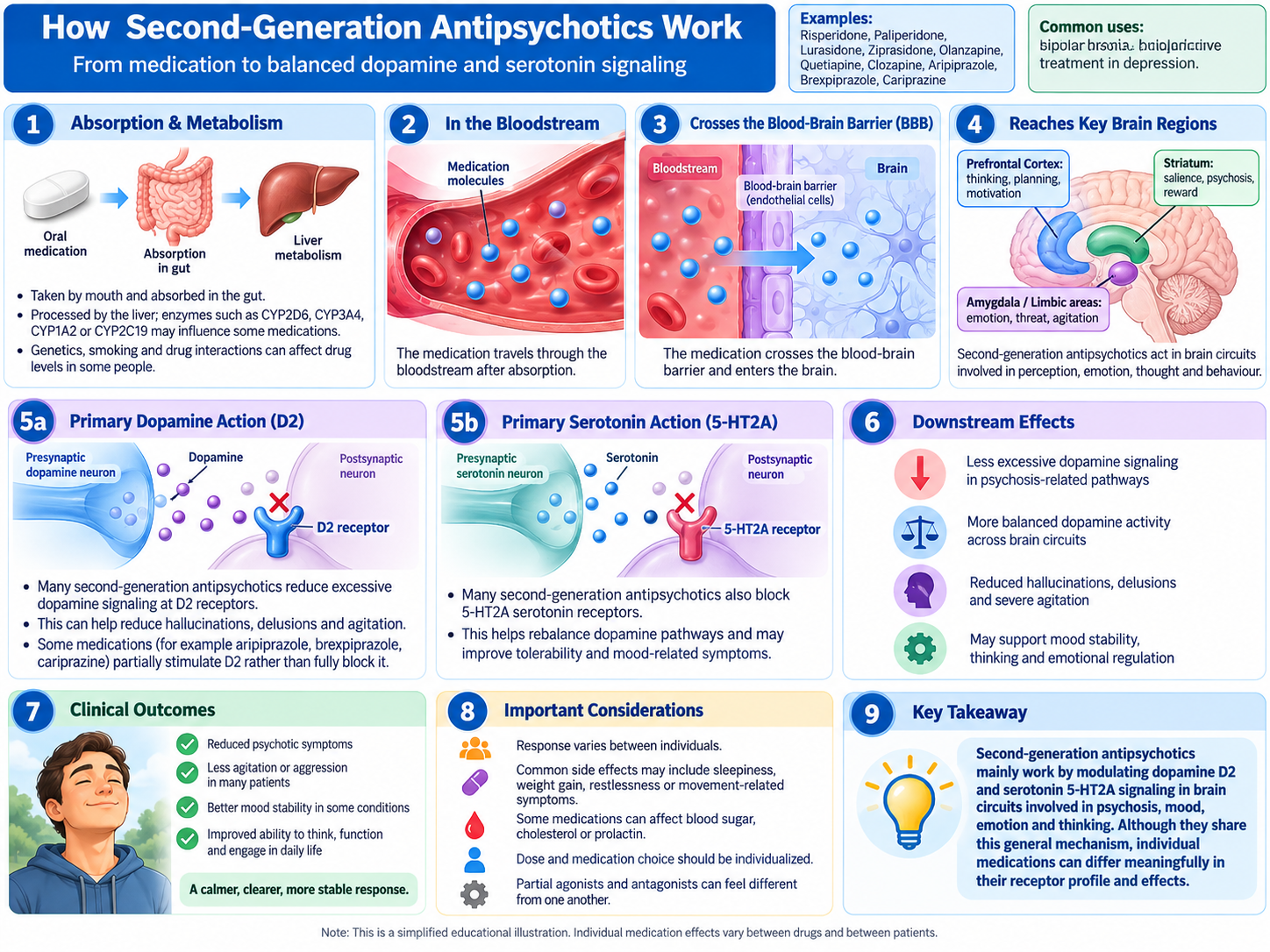
Aripiprazole works mainly by changing the activity of two important neurotransmitter systems in the brain:
- Dopamine
- Serotonin What makes aripiprazole different from many traditional antipsychotic medications is that it does not simply block dopamine receptors. It acts as a partial agonist at dopamine D2 receptors, meaning it activates these receptors, but less strongly than dopamine itself.
Aripiprazole also acts as a partial agonist at serotonin 5-HT1A receptors and an antagonist at serotonin 5-HT2A receptors. These combined actions are thought to contribute to its therapeutic effects, although the exact mechanism responsible for its clinical benefits is not completely understood.
How Does Aripiprazole Affect Dopamine?
Dopamine is involved in many brain functions, including:
- Motivation
- Reward
- Attention
- Movement
- Emotional processing
- Thinking
- Perception Some symptoms of psychosis are associated with excessive dopamine signaling in certain brain pathways, while reduced dopamine signaling in other pathways may contribute to symptoms involving motivation, cognition or emotional expression.
Aripiprazole interacts strongly with the dopamine D2 receptor.
Unlike traditional D2-blocking antipsychotics, aripiprazole is a partial D2 agonist.
A simplified way to understand this is:
When dopamine activity is relatively high
Large amounts of dopamine may strongly activate D2 receptors.
Aripiprazole competes with dopamine for these receptors but produces a weaker signal than dopamine itself.
This can result in:
- Excessive dopamine activity
- Aripiprazole occupies D2 receptors
- Less intense receptor activation
- Dopamine signaling may be reduced
When dopamine activity is relatively low
Aripiprazole can still activate D2 receptors to some degree.
Therefore:
- Low dopamine activity
- Aripiprazole provides partial D2 receptor stimulation
- Some dopamine signaling is preserved
This is why aripiprazole is sometimes informally described as a dopamine modulator rather than simply a dopamine blocker.
However, this is a simplified explanation. The actual effect depends on brain region, dopamine concentration, receptor occupancy and downstream neural signaling.
How Does Aripiprazole Work for Schizophrenia and Psychosis?
Psychotic symptoms can include:
- Hallucinations
- Delusions
- Disorganized thinking
- Suspiciousness or paranoia
- Disorganized behaviour Dopamine signaling in the mesolimbic pathway is particularly important in understanding positive psychotic symptoms.
Excessive dopamine D2 receptor stimulation in these pathways is associated with symptoms such as hallucinations and delusions.
Aripiprazole can compete with dopamine at D2 receptors while producing less receptor activation than dopamine itself.
The simplified pathway is:
- Excessive dopamine signaling
- Aripiprazole occupies D2 receptors
- D2 signaling is moderated
- Activity in psychosis-related pathways decreases
- Hallucinations, delusions and other symptoms may improve
Traditional antipsychotic medications generally achieve this by blocking D2 receptors.
Aripiprazole’s partial agonist activity makes its pharmacology somewhat different.
How Does Aripiprazole Work for Bipolar Disorder?
During mania, brain signaling involving dopamine and other neurotransmitters can become dysregulated.
Symptoms can include:
- Excessive energy
- Reduced need for sleep
- Racing thoughts
- Increased activity
- Impulsivity
- Irritability
- Grandiosity
- Agitation By modulating D2 dopamine signaling and interacting with serotonin receptors, aripiprazole can help reduce excessive activity within neural circuits involved in mania.
A simplified pathway is:
- Excessive or dysregulated dopamine signaling
- Aripiprazole partially activates rather than fully activates D2 receptors
- Dopamine signaling is moderated
- Relevant brain circuits become less overactive
- Manic symptoms may improve
The exact mechanism by which aripiprazole improves bipolar mania is not fully established. The prescribing information identifies its combination of D2 and 5-HT1A partial agonism and 5-HT2A antagonism as likely contributors.
How Does Aripiprazole Work for Depression?
Aripiprazole can also be prescribed as an add-on treatment for major depressive disorder when an antidepressant alone has not provided enough benefit.
In this situation, aripiprazole is generally used at lower doses than those commonly used for schizophrenia.
Depression can involve abnormalities in several neurotransmitter systems, including:
- Serotonin
- Dopamine
- Norepinephrine Aripiprazole may complement an antidepressant by altering dopamine and serotonin receptor signaling rather than simply increasing the concentration of one neurotransmitter.
Its important actions include:
- D2 partial agonism
- 5-HT1A partial agonism
- 5-HT2A antagonism
- Changes in dopamine and serotonin signaling
- Changes in mood, motivation and emotional-regulation circuits
- Depressive symptoms may improve
This may be particularly useful in some people who have experienced only a partial response to an antidepressant.
What Does Aripiprazole Do to Serotonin?
Aripiprazole is not an SSRI and does not work primarily by increasing serotonin concentrations.
Instead, it acts directly on specific serotonin receptors.
Two are especially important.
- 5-HT1A Receptor Aripiprazole is a partial agonist at the 5-HT1A receptor.
5-HT1A receptors are involved in:
-
Mood
-
Anxiety
-
Stress response
-
Serotonin regulation
-
Interactions between serotonin and dopamine pathways Partial stimulation of these receptors may contribute to some of aripiprazole’s effects on mood and anxiety.
-
5-HT2A Receptor Aripiprazole acts as an antagonist at 5-HT2A receptors.
This means it prevents serotonin from fully activating these receptors when aripiprazole occupies them.
5-HT2A receptors influence:
- Perception
- Cognition
- Mood
- Dopamine release
- Sleep and arousal Blocking 5-HT2A receptors is a common feature of many atypical antipsychotic medications.
Aripiprazole has high affinity for D2, D3, 5-HT1A and 5-HT2A receptors.
Why Is Aripiprazole Different from Traditional Antipsychotics?
Traditional antipsychotic medications such as haloperidol primarily work by strongly blocking dopamine D2 receptors.
That can be useful when dopamine signaling is excessive, but strong dopamine blockade can also interfere with normal dopamine function in other pathways.
Aripiprazole works differently:
Traditional D2 antagonist
- Dopamine receptor
- Blocked
- Dopamine signaling substantially reduced
Aripiprazole
- Dopamine receptor
- Partially activated
- Dopamine signaling is modified rather than completely blocked
This difference does not mean aripiprazole cannot cause dopamine-related side effects. It can still cause akathisia, tremor and other movement symptoms, particularly when exposure or receptor occupancy is high.
Why Can Aripiprazole Cause Akathisia?
One of the most characteristic aripiprazole side effects is akathisia.
Akathisia is an uncomfortable feeling of internal restlessness that can produce:
- Difficulty sitting still
- Pacing
- Repeated leg movement
- Physical agitation
- A strong urge to move Aripiprazole occupies dopamine D2 receptors very effectively.
Its partial agonist activity changes dopamine signaling in pathways involved in movement and behavioural activation. In some individuals this can produce excessive restlessness rather than therapeutic benefit.
Importantly, akathisia can sometimes feel like anxiety or worsening agitation, so recognizing the difference can be clinically important.
Why Can the Same Dose of Aripiprazole Affect Two People Differently?
Two people can take exactly the same dose of aripiprazole and experience very different results.
One person may experience good symptom control with few adverse effects.
Another may experience:
- Severe restlessness
- Akathisia
- Insomnia
- Tremor
- Sedation
- Nausea A third person may experience inadequate benefit.
One reason is that people do not all metabolize aripiprazole at the same rate.
Two liver enzymes are particularly important:
- CYP2D6
- CYP3A4 Aripiprazole is also converted into an active metabolite called dehydro-aripiprazole, which has similar affinity for D2 receptors and contributes meaningfully to overall active exposure.
How Is Aripiprazole Metabolized?
A simplified pathway is:
- Aripiprazole
- CYP2D6 + CYP3A4
- Aripiprazole + dehydro-aripiprazole
- Active drug exposure
- Drug reaches the brain
CYP2D6 is especially important because CYP2D6 activity varies substantially between people due to genetics.
How Does CYP2D6 Affect Aripiprazole?
The CYP2D6 gene determines how much functional CYP2D6 enzyme a person produces.
Some people have normal CYP2D6 activity.
Others have very little or no activity and are classified as:
CYP2D6 Poor Metabolizers
In these patients:
- Reduced CYP2D6 activity
- Slower aripiprazole metabolism
- Higher aripiprazole exposure
- Potentially greater likelihood of dose-related adverse effects
This relationship is strong enough that current U.S. prescribing information recommends giving known CYP2D6 Poor Metabolizers approximately half the usual aripiprazole dose in applicable treatment settings.
This makes CYP2D6 one of the more clinically established pharmacogenomic relationships for aripiprazole.
Can Medications Change Aripiprazole Metabolism?
Yes.
Someone can genetically be a CYP2D6 Normal Metabolizer but take another medication that strongly inhibits CYP2D6.
Examples include:
- Fluoxetine
- Paroxetine
- Bupropion The result may be:
CYP2D6 Normal Metabolizer genetically
- Strong CYP2D6 inhibitor
- Functional CYP2D6 activity decreases
- Aripiprazole metabolism slows
- Aripiprazole exposure may increase
This is sometimes called phenoconversion.
The current product labeling recommends dose reduction with strong CYP2D6 inhibitors such as fluoxetine or paroxetine in applicable settings.
What Is the Role of CYP3A4?
CYP3A4 is the other major liver enzyme involved in aripiprazole metabolism.
Some medications inhibit CYP3A4 and can increase aripiprazole exposure.
Examples include:
- Clarithromycin
- Itraconazole
- Ketoconazole Other medications induce CYP3A4, increasing its activity and potentially reducing aripiprazole exposure.
An important example is:
- Carbamazepine Therefore:
CYP3A4 inhibitor
→ slower metabolism → higher aripiprazole exposure
while:
CYP3A4 inducer
→ faster metabolism → lower aripiprazole exposure
Current prescribing guidance specifically recommends aripiprazole dose modifications for strong CYP2D6/CYP3A4 inhibitors and strong CYP3A4 inducers.
Can Aripiprazole Fail Even If You Metabolize It Normally?
Yes. Normal CYP2D6 and CYP3A4 metabolism does not guarantee that aripiprazole will work.
There are two major parts to medication response.
Pharmacokinetics: How Your Body Handles Aripiprazole
Pharmacokinetics, or PK, describes what the body does to the medication.
This includes:
- Absorption
- Distribution
- Metabolism
- Formation of active metabolites
- Elimination For aripiprazole, CYP2D6 and CYP3A4 are particularly important.
The purpose of PK is ultimately to determine whether an appropriate amount of active medication reaches the brain.
But this is only the first step.
Pharmacodynamics: How Your Brain Responds to Aripiprazole
Pharmacodynamics, or PD, describes what aripiprazole does once it reaches its biological targets.
Several receptors are particularly important.
DRD2 — Dopamine D2 Receptor
The D2 receptor is aripiprazole’s principal dopamine target.
Aripiprazole binds strongly to this receptor and acts as a partial agonist.
DRD3 — Dopamine D3 Receptor
Aripiprazole also has high affinity for D3 receptors.
D3 receptors are found particularly in brain regions involved in:
- Motivation
- Reward
- Emotion
- Behaviour Their contribution to the overall clinical response is still being investigated.
HTR1A — Serotonin 5-HT1A Receptor
Aripiprazole acts as a partial agonist at this receptor.
5-HT1A signaling can influence:
- Mood
- Anxiety
- Stress regulation
- Dopamine release
HTR2A — Serotonin 5-HT2A Receptor
Aripiprazole acts as an antagonist at this receptor.
5-HT2A signaling interacts with dopamine pathways and can affect:
- Perception
- Cognition
- Mood
- Arousal The combination of D2/D3, 5-HT1A and 5-HT2A activity forms the core of aripiprazole’s pharmacodynamic profile.
Aripiprazole Needs Both Drug Metabolism and Brain Response
A simplified way of understanding aripiprazole response is:
- Aripiprazole is taken
- The body absorbs and metabolizes the medication — PK
- CYP2D6 + CYP3A4
- An appropriate amount of aripiprazole and active metabolite reaches the brain
- Aripiprazole interacts with dopamine and serotonin receptors — PD
- D2/D3 + 5-HT1A + 5-HT2A signaling changes
- Relevant brain circuits respond
- Symptoms may improve
This explains why:
Normal PK does not automatically mean optimal PD response.
A person can metabolize aripiprazole normally but still have an inadequate response—or experience side effects—because clinical response depends on what happens after the medication reaches the brain.
Why Can Too Much or Too Little Dopamine Modulation Be a Problem?
Dopamine signaling needs to remain within a useful functional range.
Too much dopamine signaling in certain pathways
may contribute to:
- Hallucinations
- Delusions
- Mania
- Agitation
Too little dopamine signaling in other pathways
may contribute to:
- Reduced motivation
- Reduced pleasure
- Cognitive difficulties
- Movement-related adverse effects The goal of treatment is therefore not simply:
“Reduce dopamine.”
A better way to think about aripiprazole is:
Modify dopamine signaling appropriately within different neural systems.
Its partial D2 agonist properties are central to this distinction.
Does a Genetic Test Tell You Whether Aripiprazole Will Work?
No genetic test can currently guarantee whether aripiprazole will or will not work for a particular person.
Medication response depends on many factors, including:
- Genetics
- Diagnosis
- Symptoms
- Dose
- Other medications
- CYP2D6 activity
- CYP3A4 drug interactions
- Dopamine receptor signaling
- Serotonin receptor signaling
- Previous treatment response
- Side-effect sensitivity
- Individual brain biology A genetic result should therefore be considered as one component of personalized medication selection rather than a stand-alone answer.
Can Pharmacogenomic Testing Help with Aripiprazole Response?
Yes, particularly for understanding drug metabolism.
For aripiprazole, the strongest established pharmacogenomic relationship involves:
CYP2D6
A CYP2D6 genetic test can determine whether a person is likely to have:
- Poor
- Intermediate
- Normal
- Ultrarapid CYP2D6 metabolic activity.
For CYP2D6 Poor Metabolizers, established prescribing information recommends a lower aripiprazole dose in applicable circumstances because drug exposure can be increased.
Some pharmacogenomic approaches also examine genes associated with aripiprazole’s pharmacodynamic targets, including:
- DRD2
- DRD3
- HTR1A
- HTR2A
- HTR2C These genes are biologically relevant to dopamine and serotonin signaling and have been investigated for their relationships with antipsychotic response or adverse effects.
However, their clinical interpretation is more complex and does not currently have the same level of established prescribing guidance as CYP2D6 metabolism.
Therefore, the most useful approach is to consider:
- Drug metabolism
- Drug interactions
- Pharmacodynamic biology
- Symptoms and diagnosis
- Previous treatment response Personalized clinical decision-making
This article is educational. It does not diagnose, and it does not replace advice from your prescriber or pharmacist. Never start, stop or change a medication based on a web page.