Amphetamine · How it works
How Do Amphetamines Work?
Amphetamines are stimulant medications used primarily to treat attention-deficit/hyperactivity disorder (ADHD) and, with certain formulations, narcolepsy.
 Written by Sanjida Ahmed, PhD, Cellular and Molecular BiologyChief Operating Officer and Lead Scientist, Personalized Prescribing. Last reviewed October 2, 2026.
- Class
- Stimulant
On this page
- How Do Amphetamines Work for ADHD?
- What Does Amphetamine Do to Dopamine?
- What Does Amphetamine Do to Norepinephrine?
- Why Can a Stimulant Make Someone with ADHD Feel Calmer?
- Where in the Brain Do Amphetamines Work?
- What Is the Role of the Dopamine Transporter — DAT?
- What Is the Role of the Norepinephrine Transporter — NET?
- How Is Amphetamine Different from Bupropion?
- How Is Amphetamine Different from Methylphenidate?
- Why Can the Same Dose of Amphetamine Affect Two People Differently?
- How Is Amphetamine Metabolized?
- Can Genetics Affect Amphetamine Metabolism?
- Can Other Medications Affect Amphetamine Metabolism?
- CYP2D6 Normal Metabolizer
- Can Amphetamine Fail Even If You Metabolize It Normally?
- Amphetamine Needs Both Drug Metabolism and Brain Response
- Why Can Too Little or Too Much Stimulation Both Be a Problem?
- Too little signaling
- Appropriate signaling
- Excessive signaling
- Maximum dopamine + maximum norepinephrine
- Does a Genetic Test Tell You Whether Amphetamine Will Work?
- Can Pharmacogenomic Testing Help with Amphetamine Response?
- Why Might Amphetamine Work Better Than Methylphenidate for One Person—and Worse for Another?
- Primarily blocking neurotransmitter reuptake
- Increasing neurotransmitter availability and release
Amphetamines are stimulant medications used primarily to treat attention-deficit/hyperactivity disorder (ADHD) and, with certain formulations, narcolepsy.
Common prescription amphetamine medications include mixed amphetamine salts (Adderall/Adderall XR) and dextroamphetamine. Lisdexamfetamine (Vyvanse) is closely related but is a prodrug that the body converts into dextroamphetamine.
Amphetamines work mainly by increasing the activity of two important chemical messengers in the brain:
-
Dopamine (DA)
-
Norepinephrine (NE) These neurotransmitters play important roles in:
-
Attention
-
Concentration
-
Motivation
-
Alertness
-
Impulse control
-
Task initiation
-
Executive function For a person with ADHD, appropriately dosed amphetamine can improve signaling within brain circuits responsible for attention and behavioural control, helping the person become more focused and less impulsive.
How Do Amphetamines Work for ADHD?
Amphetamine works differently from medications that simply block neurotransmitter reuptake.
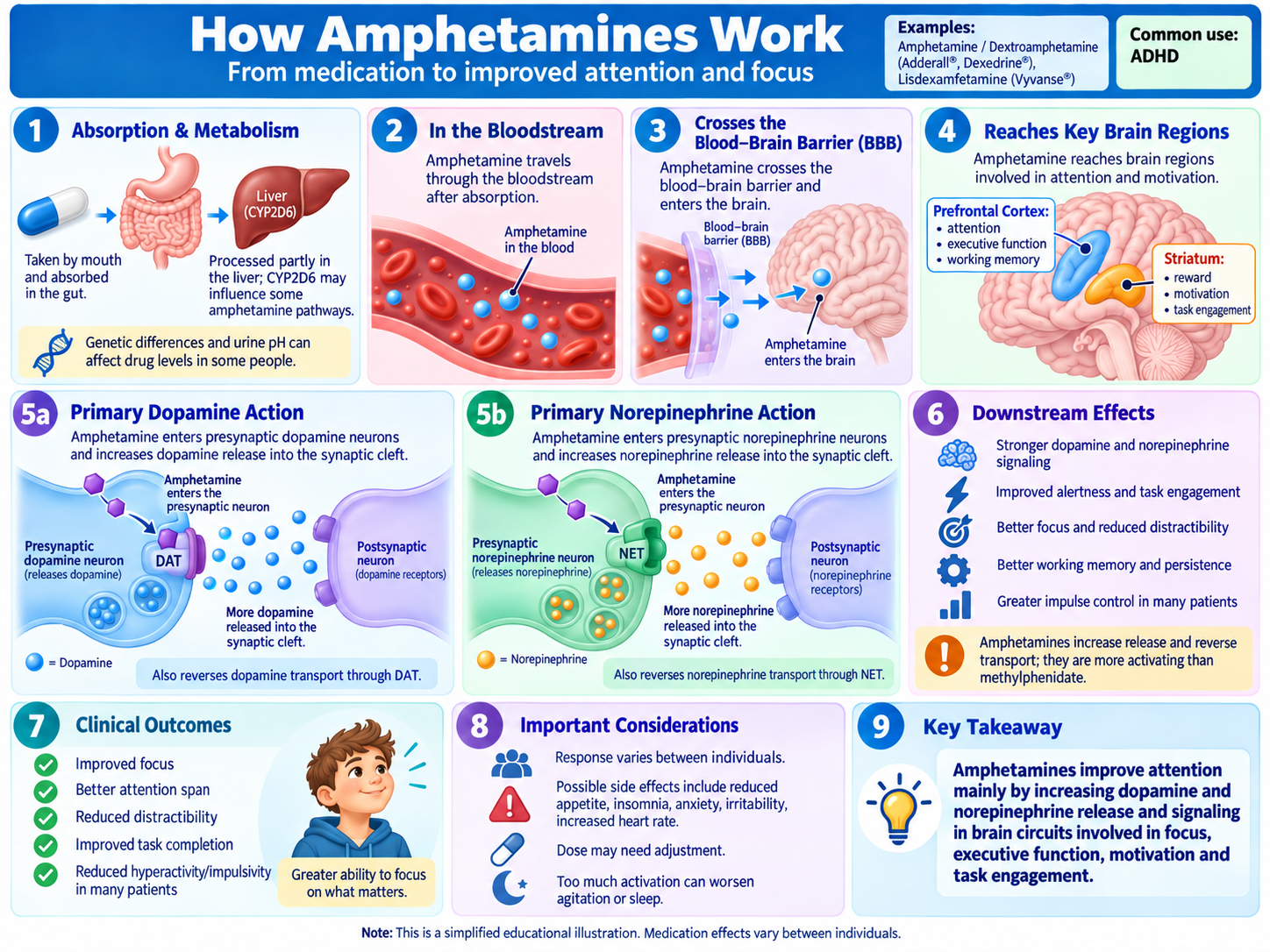
After entering dopamine- and norepinephrine-producing nerve cells, amphetamine can increase the amount of these neurotransmitters available for release and alter the way their transporter’s function. The result is increased signaling of: Dopamine and Norepinephrine
A simplified pathway is:
- Amphetamine reaches the brain
- Enters dopamine and norepinephrine nerve cells
- Increases dopamine and norepinephrine availability and release
- More dopamine and norepinephrine signaling between nerve cells
- Activity changes in attention and executive-function circuits
- ADHD symptoms may improve
The effect begins much more quickly than with most antidepressants because amphetamine directly changes neurotransmitter signaling rather than relying primarily on slower adaptive changes that develop over several weeks.
What Does Amphetamine Do to Dopamine?
Amphetamine increases dopamine signaling through several related mechanisms.
Normally, after dopamine is released between nerve cells, a protein called the dopamine transporter (DAT) helps move it back into the nerve terminal.
Amphetamine interacts with this system and can:
- Enter dopamine-producing neurons through DAT
- Increase dopamine availability inside the nerve terminal
- Promote dopamine movement out of the neuron
- Reduce normal dopamine recycling The simplified process is:
- Amphetamine
- DAT and intracellular dopamine systems are affected
- More dopamine becomes available for signaling
- Dopamine signaling increases
This can improve the function of brain pathways involved in attention, motivation and behavioural control. Dopamine plays an important role in:
-
Motivation
-
Reward
-
Attention
-
Working memory
-
Task initiation
-
Reinforcement
-
Impulse control However, more dopamine is not always better. Excessive stimulation can contribute to:
-
Restlessness
-
Irritability
-
Anxiety
-
Insomnia
-
Excessive focus or rigidity
-
At very high exposures, more serious psychiatric effects The objective is therefore not to maximize dopamine, but to bring signaling into a range that supports more effective brain function.
What Does Amphetamine Do to Norepinephrine?
Amphetamine also interacts with the norepinephrine transporter (NET) and increases norepinephrine availability and release.
A simplified pathway is:
- Amphetamine
- Increased norepinephrine availability
- Greater norepinephrine signaling
- Improved alertness and attention
In the prefrontal cortex, appropriate norepinephrine signaling helps the brain maintain attention, organize information and resist distractions. Norepinephrine is particularly important for:
- Alertness
- Sustained attention
- Concentration
- Working memory
- Response to important information
- Cognitive control This is one reason amphetamines can improve attention even though they are classified as stimulants.
Why Can a Stimulant Make Someone with ADHD Feel Calmer?
It may seem contradictory that a stimulant could make someone with ADHD feel calmer.
ADHD, however, is not simply a condition of having “too much energy.”
Important brain circuits—particularly in the prefrontal cortex—help control:
- Attention
- Impulses
- Planning
- Working memory
- Emotional regulation
- Behaviour When dopamine and norepinephrine signaling within these circuits is not functioning optimally, it can become difficult to maintain attention and control competing impulses.
By increasing dopamine and norepinephrine signaling to a more effective range, amphetamine may improve the brain’s top-down control.
The result can be:
- Better attention
- Better impulse control
- Less distractibility
- Improved behavioural regulation The person may actually feel calmer and more organized
Where in the Brain Do Amphetamines Work?
Amphetamine does not affect every brain region in exactly the same way.
Two areas are particularly relevant to ADHD.
Prefrontal Cortex — Attention and Executive Function
The prefrontal cortex is involved in:
- Attention
- Working memory
- Planning
- Organization
- Decision-making
- Task completion
- Impulse control Both dopamine and norepinephrine are important here.
Appropriate stimulant treatment can strengthen signaling in these circuits and improve executive function.
Striatum — Motivation, Reward and Behaviour
The striatum is strongly influenced by dopamine and contributes to:
- Motivation
- Reward
- Reinforcement
- Movement
- Behavioural activation
- Impulse regulation Changes in dopamine signaling in this region may contribute to some of amphetamine’s effects on motivation and behavioural control.
This regional difference is important because ADHD should not simply be described as having “low dopamine everywhere.”
Different dopamine pathways can function differently within the same person.
What Is the Role of the Dopamine Transporter — DAT?
The dopamine transporter is coded by the SLC6A3 gene.
DAT acts somewhat like a recycling system.
After dopamine is released:
- Dopamine enters the space between neurons
- DAT normally transports dopamine back into the nerve cell
- Dopamine is recycled
Amphetamine interacts with DAT and alters this process.
Rather than simply allowing DAT to recycle dopamine normally, amphetamine can promote increased dopamine availability and release.
Therefore: DAT is an important biological target of amphetamine.
What Is the Role of the Norepinephrine Transporter — NET?
The norepinephrine transporter is coded by the SLC6A2 gene.
NET normally removes norepinephrine from the space between neurons.
Amphetamine interacts with this transporter and increases norepinephrine availability.
This is particularly important in the prefrontal cortex, where norepinephrine helps regulate attention and executive function.
Interestingly, NET can also participate in dopamine clearance within parts of the prefrontal cortex because DAT expression is relatively limited there.
This means changes in NET activity can influence both norepinephrine and dopamine signaling in the prefrontal cortex.
How Is Amphetamine Different from Bupropion?
Both amphetamine and bupropion influence dopamine and norepinephrine, but they do not work in exactly the same way.
Bupropion
Primarily reduces the reuptake of dopamine and norepinephrine.
Amphetamine
Has a more direct neurotransmitter-releasing effect.
Amphetamine can:
- Enter the nerve terminal
- Increase intracellular dopamine and norepinephrine availability
- Alter transporter activity
- Promote neurotransmitter release
- Increase synaptic dopamine and norepinephrine
This generally produces a stronger and more immediate stimulant effect than bupropion.
How Is Amphetamine Different from Methylphenidate?
Both medications increase dopamine and norepinephrine signaling and are used for ADHD, but their mechanisms differ.
Methylphenidate
Primarily acts by blocking dopamine and norepinephrine reuptake.
Amphetamine
Both affects transporter function and promotes greater neurotransmitter release.
Simplified:
Methylphenidate
→ mainly reduces DA/NE recycling
versus
Amphetamine
→ increases DA/NE availability and promotes release
Both can be effective for ADHD, but an individual may respond better or tolerate one stimulant family better than the other.
Why Can the Same Dose of Amphetamine Affect Two People Differently?
Two people can take the same dose of an amphetamine medication and experience very different effects.
One person may have:
-
Better concentration
-
Improved task completion
-
Reduced impulsivity
-
Few side effects Another may experience:
-
Anxiety
-
Insomnia
-
Irritability
-
Increased heart rate
-
Loss of appetite
-
Excessive stimulation A third may experience very little benefit.
Several factors can contribute, including:
- Genetics
- Body size
- Kidney function
- Urinary pH
- Other medications
- Drug interactions
- Dose
- Formulation
- Individual neurotransmitter biology
- Differences in brain response Amphetamine therefore illustrates an important principle:
The same dose does not necessarily produce the same drug metabolism or the same brain response in every person.
How Is Amphetamine Metabolized?
Amphetamine is processed through several pathways rather than relying on one liver enzyme.
One enzyme that contributes is:
CYP2D6
CYP2D6 participates in the metabolism of amphetamine, including formation of 4-hydroxyamphetamine.
However, amphetamine is different from medications such as atomoxetine, where CYP2D6 is a dominant metabolic pathway.
Amphetamine metabolism is also influenced by kidney elimination and urinary pH.
Therefore:
- Liver metabolism
- Kidney elimination
- Urinary pH
- Drug interactions Overall amphetamine metabolism and clearance. This makes its pharmacokinetics more complex than simply assigning a CYP2D6 phenotype.
Can Genetics Affect Amphetamine Metabolism?
Possibly.
The CYP2D6 gene varies considerably between individuals.
People may genetically have:
- Little or no CYP2D6 activity
- Reduced CYP2D6 activity
- Normal CYP2D6 activity
- Unusually high CYP2D6 activity Because CYP2D6 participates in amphetamine metabolism, these genetic differences may contribute to individual differences in exposure.
However, CYP2D6 is not the only route through which amphetamine is processed.
At present, there is no established CPIC genotype-based amphetamine dosing guideline that allows a clinician to select an amphetamine dose simply from a patient’s CYP2D6 genotype.
This is an important distinction from medications such as atomoxetine, for which CYP2D6 has a much stronger established pharmacogenomic relationship.
Can Other Medications Affect Amphetamine Metabolism?
Yes.
Some medications can inhibit CYP2D6.
Examples include:
- Bupropion
- Fluoxetine
- Paroxetine A person might genetically be a:
CYP2D6 Normal Metabolizer
- but then take a strong CYP2D6 inhibitor.
- CYP2D6 activity becomes reduced
- Amphetamine metabolism through this pathway may decrease
- Metabolism may increase
Because amphetamine has additional metabolic and elimination pathways, the magnitude of this effect can vary.
Drug interactions therefore need to be considered together with genetics.
Can Amphetamine Fail Even If You Metabolize It Normally?
Yes.
Normal metabolism does not guarantee that an amphetamine medication will work.
There are two major parts to medication response.
Pharmacokinetics: How Your Body Handles Amphetamine
Pharmacokinetics, or PK, describes what the body does to the medication.
This includes:
- Absorption
- Distribution
- Metabolism
- Kidney elimination
- Drug interactions The goal is for an appropriate amount of medication to reach the brain.
But that is only the first step.
Pharmacodynamics: How Your Brain Responds to Amphetamine
Pharmacodynamics, or PD, describes what the medication does after it reaches its biological targets.
Amphetamine interacts with several components of dopamine and norepinephrine signaling.
These include:
DAT — Dopamine Transporter
Encoded by SLC6A3
Helps regulate dopamine recycling and is an important target of amphetamine.
NET — Norepinephrine Transporter
Encoded by SLC6A2
Regulates norepinephrine recycling and contributes to dopamine regulation in the prefrontal cortex.
-
Dopamine Receptors Including receptors encoded by genes such as:
-
DRD2
-
DRD4 These receptors help translate increased dopamine signaling into changes within neural circuits.
-
Adrenergic Receptors Norepinephrine acts through adrenergic receptors involved in attention, alertness and executive control.
An important example in ADHD biology is: ADRA2A
- COMT The COMT enzyme helps regulate dopamine and norepinephrine, particularly dopamine availability within the prefrontal cortex.
These pathways may contribute to differences between patients, although genetic variants in these pharmacodynamic genes do not currently provide established stand-alone dosing recommendations for amphetamine.
Amphetamine Needs Both Drug Metabolism and Brain Response
A simplified way of understanding amphetamine response is:
- Amphetamine is taken
- The body absorbs and processes the medication — PK
- An appropriate amount reaches the brain
- Amphetamine interacts with dopamine and norepinephrine systems — PD
- DAT + NET + dopamine/adrenergic receptors + neural pathways
- Dopamine and norepinephrine signaling changes
- Attention and executive-function circuits respond
- ADHD symptoms may improve
This explains why:
Normal PK does not automatically mean optimal PD response.
A patient can metabolize amphetamine normally but still experience inadequate benefit if the medication’s mechanism does not produce an optimal response within that individual’s relevant brain pathways.
Why Can Too Little or Too Much Stimulation Both Be a Problem?
Dopamine and norepinephrine function differently from a simple “more is better” system.
Particularly within the prefrontal cortex, performance is often described conceptually as an inverted-U relationship.
Too little signaling
May contribute to:
- Distractibility
- Poor concentration
- Low alertness
- Weak working memory
- Difficulty initiating tasks
Appropriate signaling
May support:
- Sustained attention
- Working memory
- Planning
- Impulse control
- Executive function
Excessive signaling
May contribute to:
- Anxiety
- Restlessness
- Irritability
- Insomnia
- Cognitive rigidity
- Excessive physiological arousal Therefore, the objective of treatment is not:
Maximum dopamine + maximum norepinephrine
It is:
Appropriate dopamine and norepinephrine signaling for that individual.
Does a Genetic Test Tell You Whether Amphetamine Will Work?
No genetic test can currently guarantee whether amphetamine will work for a particular person.
Medication response depends on many factors, including:
- Genetics
- ADHD symptom pattern
- Dose
- Drug formulation
- Other medications
- Drug interactions
- Kidney function
- Side-effect sensitivity
- Dopamine and norepinephrine biology
- Previous medication response
- Individual brain circuitry Pharmacogenomic information should therefore be considered as one component of personalized medication selection, rather than a stand-alone answer.
Can Pharmacogenomic Testing Help with Amphetamine Response?
Pharmacogenomic testing, or PGx testing, can examine genetic differences that may contribute to how medications are processed or how their biological pathways function.
For amphetamine, CYP2D6 contributes to metabolism, but the pharmacokinetic relationship is not currently strong enough to support a universally accepted CYP2D6 genotype-based amphetamine dosing algorithm.
Some pharmacogenomic approaches also examine genes involved in amphetamine’s pharmacodynamic pathways, including:
- SLC6A3 — dopamine transporter
- SLC6A2 — norepinephrine transporter
- DRD2 — dopamine receptor
- DRD4 — dopamine receptor
- ADRA2A — adrenergic receptor
COMT — catecholamine regulation
These genes are biologically relevant and have been investigated for relationships with stimulant response.
However, their clinical interpretation is more complex, and they do not currently have the same level of established prescribing guidance as validated pharmacokinetic drug-gene relationships such as CYP2D6–atomoxetine.
Pharmacogenomic results should therefore be interpreted together with:
- The patient’s ADHD symptoms
- Previous stimulant response
- Side effects
- Current medications
- Comorbid conditions
- Dose and formulation
- Overall clinical history
Why Might Amphetamine Work Better Than Methylphenidate for One Person—and Worse for Another?
Amphetamine and methylphenidate both increase dopamine and norepinephrine signaling, but they do so differently.
One person’s underlying neurobiology may respond better to:
Primarily blocking neurotransmitter reuptake
while another may respond better to:
Increasing neurotransmitter availability and release
Differences in:
- Dopamine transporter function
- Norepinephrine transporter function
- Dopamine receptor signaling
- Prefrontal dopamine regulation
- Baseline neurotransmitter activity
- Drug metabolism
- Side-effect sensitivity may all potentially contribute to these individual differences.
This is one reason ADHD treatment remains individualized rather than assuming that one stimulant is best for everyone.
This article is educational. It does not diagnose, and it does not replace advice from your prescriber or pharmacist. Never start, stop or change a medication based on a web page.