
Bupropion · How it works
How Does Bupropion Work?
Bupropion is an antidepressant used primarily to treat major depressive disorder and seasonal affective disorder.
 Written by Sanjida Ahmed, PhD, Cellular and Molecular BiologyChief Operating Officer and Lead Scientist, Personalized Prescribing. Last reviewed October 2, 2026.
- Class
- NDRI (norepinephrine-dopamine reuptake inhibitor)
On this page
- How Does Bupropion Work for Depression?
- What Does Bupropion Do to Dopamine?
- What Does Bupropion Do to Norepinephrine?
- Does Bupropion Increase Serotonin?
- Why Can Bupropion Help with Motivation and Loss of Pleasure?
- How Does Bupropion Help with Smoking Cessation?
- Why Can Bupropion Feel Activating?
- Why Can the Same Dose of Bupropion Affect Two People Differently?
- What Is the Role of CYP2B6 in Bupropion Metabolism?
- Bupropion and Active Metabolites
- Is Bupropion Metabolized by CYP2D6?
- Can Bupropion Change a Person’s CYP2D6 Metabolizer Status?
- Can Bupropion Fail Even If You Metabolize It Normally?
- Does a Genetic Test Tell You Whether Bupropion Will Work?
- Can Pharmacogenomic Testing Help with Bupropion Response?
- Why Can Bupropion Work Well for One Person but Not Another?
- Low motivation + loss of pleasure + fatigue + poor concentration
- Anxiety + rumination + emotional distress + insomnia
Bupropion is an antidepressant used primarily to treat major depressive disorder and seasonal affective disorder. It is also used for smoking cessation and is sometimes prescribed off-label for conditions such as ADHD.
Bupropion works differently from most commonly prescribed antidepressants.
Rather than primarily increasing serotonin, bupropion mainly affects two important chemical messengers in the brain:
- Dopamine
- Norepinephrine These neurotransmitters are involved in motivation, reward, pleasure, energy, alertness, attention and concentration.
Because of these effects, bupropion may be particularly helpful for some people whose depression includes symptoms such as low motivation, reduced pleasure, fatigue or difficulty concentrating.
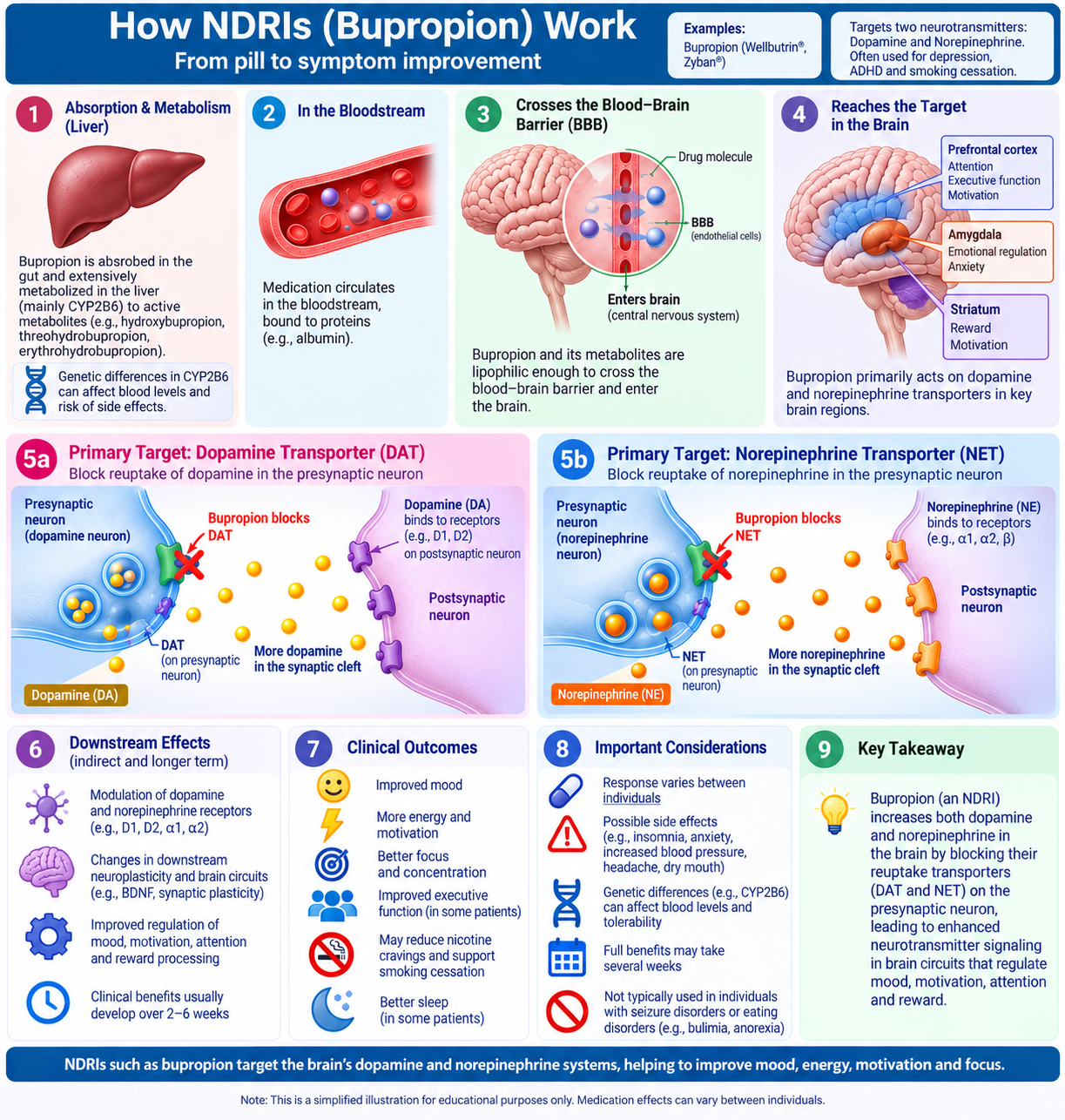
How Does Bupropion Work for Depression?
Bupropion is often described as a norepinephrine-dopamine reuptake inhibitor, or NDRI.
It reduces the reuptake of:
- Dopamine (DA)
- Norepinephrine (NE) Normally, specialized transporters remove dopamine and norepinephrine from the space between nerve cells after these neurotransmitters have transmitted their signals.
Bupropion reduces this recycling process, allowing dopamine and norepinephrine signaling to remain active for longer.
A simplified pathway is:
- Bupropion
- Reduced dopamine and norepinephrine reuptake
- ↑ Dopamine and norepinephrine signaling
- Changes in brain circuits involved in mood, motivation, reward and attention
- Depressive symptoms may improve
Over time, these changes can influence brain networks involved in:
-
Mood
-
Motivation
-
Pleasure and reward
-
Energy
-
Attention
-
Concentration
-
Alertness
-
Goal-directed behaviour As a result, bupropion may gradually help improve symptoms such as:
-
Low mood
-
Loss of interest or pleasure
-
Low motivation
-
Fatigue
-
Difficulty concentrating
-
Reduced drive
-
Mental sluggishness The antidepressant effect is not usually immediate. Changes in neurotransmitter signaling begin after treatment starts, but improvement in depression generally develops gradually as the brain adapts over several weeks.
What Does Bupropion Do to Dopamine?
Bupropion reduces the activity of the dopamine transporter, or DAT, which normally helps recycle dopamine after it has been released.
The simplified process is:
- Dopamine is released
- DAT normally transports dopamine back into the nerve cell
- Bupropion partially inhibits dopamine reuptake
- Dopamine signaling remains available for longer
This may contribute to improvements in motivation, interest, concentration and the ability to experience reward or pleasure. Dopamine is an important neurotransmitter involved in:
- Motivation
- Reward
- Pleasure
- Attention
- Concentration
- Learning
- Goal-directed behaviour However, depression should not be thought of simply as “low dopamine.” Dopamine activity differs between brain regions, and depressive symptoms result from interactions between multiple neurotransmitters, brain circuits, genetics and environmental factors.
What Does Bupropion Do to Norepinephrine?
Bupropion inhibits the norepinephrine transporter, or NET, which normally removes norepinephrine from the space between nerve cells. This can increase norepinephrine signaling within certain brain pathways.
Norepinephrine plays an important role in:
-
Energy
-
Alertness
-
Attention
-
Concentration
-
Motivation
-
Cognitive performance
-
Response to stress For some people, increased norepinephrine may contribute to:
-
Greater mental energy
-
Improved alertness
-
Better concentration
-
Increased motivation
-
Improved ability to initiate tasks This activating effect is one reason bupropion has a different clinical profile from many serotonergic antidepressants.
Does Bupropion Increase Serotonin?
Bupropion is not an SSRI and does not substantially inhibit serotonin reuptake.
Its antidepressant effects are primarily associated with dopamine and norepinephrine pathways, rather than directly increasing serotonin availability.
This distinguishes bupropion from SSRIs such as:
-
Sertraline
-
Escitalopram
-
Citalopram
-
Fluoxetine
-
Paroxetine and from SNRIs such as:
-
Venlafaxine
-
Desvenlafaxine
-
Duloxetine Because bupropion works differently, it may sometimes be considered when a person has had inadequate benefit or troublesome side effects with a serotonergic antidepressant.
Why Can Bupropion Help with Motivation and Loss of Pleasure?
Two symptoms that can occur in depression are:
- Anhedonia — reduced ability to experience pleasure
- Avolition — reduced motivation or drive. Dopamine pathways are particularly important in the brain’s reward and motivation systems.
Bupropion’s effects on dopamine and norepinephrine signaling may therefore help some people who experience depression predominantly as:
- Low motivation
- Reduced interest
- Difficulty getting started
- Loss of enjoyment
- Fatigue
- Reduced concentration This does not mean bupropion is automatically the best medication whenever these symptoms are present. Medication selection should consider the person’s overall symptom profile and medical history.
How Does Bupropion Help with Smoking Cessation?
Bupropion is also used to help people stop smoking, commonly under the brand name Zyban.
Nicotine affects dopamine pathways involved in reward and reinforcement.
Bupropion’s effects on dopamine and norepinephrine can help reduce some symptoms of nicotine withdrawal, including:
- Cravings
- Irritability
- Difficulty concentrating
- Restlessness
- Low mood Bupropion and some of its metabolites also interact with nicotinic acetylcholine receptors, which are the receptors through which nicotine produces many of its effects.
This combination of actions can help reduce the rewarding effects associated with nicotine and make smoking cessation easier for some people.
Why Can Bupropion Feel Activating?
Unlike some other antidepressants, bupropion is generally more activating than sedating.
Its effects on dopamine and norepinephrine may increase:
- Alertness
- Mental energy
- Wakefulness
- Motivation For some people, these effects are beneficial.
For others, particularly when treatment begins or after a dose increase, they may contribute to:
- Insomnia
- Restlessness
- Anxiety
- Agitation
- Tremor
- Increased heart rate or palpitations This is one reason extended-release bupropion is commonly taken in the morning.
The appropriate dose and timing should be determined with a healthcare professional.
Why Can the Same Dose of Bupropion Affect Two People Differently?
Two people can take exactly the same dose of bupropion and have very different experiences.
One person may experience improved motivation and mood with few side effects.
Another may experience:
- Insomnia
- Anxiety
- Tremor
- Agitation
- Little therapeutic benefit One reason is that people do not all metabolize bupropion in the same way.
After bupropion is taken, the body converts it into several metabolites. One of the most important is: Hydroxybupropion
Hydroxybupropion is not simply an inactive waste product. It is itself pharmacologically active and may contribute significantly to the medication’s overall clinical effect.
An important liver enzyme involved in this conversion is:
CYP2B6
The pathway can be simplified as:
- Bupropion
- CYP2B6
- Hydroxybupropion
- Contributes to overall drug activity
Genetic differences in CYP2B6 can affect how efficiently this conversion occurs.
What Is the Role of CYP2B6 in Bupropion Metabolism?
CYP2B6 is one of the principal liver enzymes responsible for converting bupropion into hydroxybupropion. The CYP2B6 gene contains the instructions used by the body to make this enzyme. Different people inherit different versions of CYP2B6. Some genetic variants are associated with reduced CYP2B6 activity.
This means two people taking the same bupropion dose may produce different amounts of hydroxybupropion.
For example:
Reduced CYP2B6 activity
- Bupropion
- Less efficient conversion
- Less hydroxybupropion may be produced
- Different balance of parent drug and active metabolite
This may alter overall medication exposure.
However, the relationship between CYP2B6 genetics and whether bupropion will actually improve depression is still being studied.
Unlike CYP2D6/CYP2C19 for some antidepressants, there is currently no widely established genotype-based bupropion dosing guideline that reliably tells clinicians what dose to prescribe based solely on CYP2B6 genotype.
Bupropion and Active Metabolites
Bupropion is somewhat different from medications where metabolism simply removes the active drug.
Its metabolites include:
- Hydroxybupropion
- Threohydrobupropion
- Erythrohydrobupropion These metabolites have pharmacological activity.
Therefore, bupropion response depends not only on the concentration of bupropion itself but also on the amount and activity of its metabolites.
A simplified view is:
- Bupropion
- Metabolism
- Bupropion + active metabolites
- Dopamine and norepinephrine effects
- Clinical response
This makes the relationship between genetics, blood concentration and clinical response more complex than simply:
slow metabolism = too much medication.
Is Bupropion Metabolized by CYP2D6?
This is an important distinction.
Bupropion is not primarily metabolized by CYP2D6.
Its major CYP-mediated pathway involves CYP2B6.
However, bupropion is a clinically important inhibitor of CYP2D6.
This means bupropion can interfere with the metabolism of other medications that depend on CYP2D6.
For example:
- Bupropion is taken
- CYP2D6 activity is inhibited
- Another CYP2D6 medication may be metabolized more slowly
- Its drug exposure may increase
This can be relevant for medications such as:
- Amitriptyline
- Nortriptyline
- Venlafaxine
- Risperidone
- Aripiprazole
- Some other CYP2D6 substrates This interaction should be considered when multiple medications are being taken.
Can Bupropion Change a Person’s CYP2D6 Metabolizer Status?
Bupropion does not change a person’s CYP2D6 genes.
However, because it inhibits CYP2D6, it can change the enzyme’s actual functional activity.
For example, pharmacogenomic testing may show:
CYP2D6 Normal Metabolizer
But while taking bupropion:
- CYP2D6 inhibition
- Reduced CYP2D6 activity
- The person may function more like a slower CYP2D6 metabolizer for other medications.
This is sometimes called phenoconversion.
It is an important example of why pharmacogenomic results should always be considered together with a person’s current medications.
Can Bupropion Fail Even If You Metabolize It Normally?
Yes.
Normal bupropion metabolism does not guarantee that the medication will provide the desired clinical response.
There are two major parts to medication response.
- Pharmacokinetics: How Your Body Handles Bupropion Pharmacokinetics, or PK, describes what the body does to a medication.
This includes:
- Absorption
- Distribution
- Metabolism
- Formation of active metabolites
- Elimination For bupropion, CYP2B6 is an important genetic contributor to formation of hydroxybupropion.
But producing an appropriate amount of bupropion and its active metabolites is only the first step.
- Pharmacodynamics: How Your Brain Responds to Bupropion Pharmacodynamics, or PD, describes what a medication does once it reaches its biological targets.
Bupropion primarily influences dopamine and norepinephrine pathways.
Several components contribute to these systems.
- DAT — Dopamine Transporter The dopamine transporter, encoded by the SLC6A3 gene, helps recycle dopamine after it has been released between nerve cells.
Bupropion reduces dopamine reuptake, allowing dopamine signaling to remain active for longer.
The simplified pathway is:
- Dopamine release
- DAT normally recycles dopamine
- Bupropion partially reduces reuptake
- Dopamine signaling changes
- NET — Norepinephrine Transporter The norepinephrine transporter, encoded by SLC6A2, performs a similar function for norepinephrine.
It helps remove norepinephrine from the space between nerve cells.
By reducing norepinephrine reuptake, bupropion can increase norepinephrine signaling within relevant brain circuits.
- Dopamine Receptors Once dopamine remains available between nerve cells, it must interact with dopamine receptors.
Dopamine receptors such as DRD2 and DRD4 participate in neural pathways involved in:
-
Reward
-
Motivation
-
Attention
-
Behaviour
-
Cognitive processing Genetic differences in these pathways have been studied as possible contributors to differences in antidepressant response, although they do not currently provide the same level of established prescribing guidance as well-validated pharmacokinetic genes.
-
Norepinephrine Receptors Norepinephrine also acts through several adrenergic receptors.
These receptors help influence:
-
Attention
-
Alertness
-
Energy
-
Stress response
-
Cognitive function The clinical effect therefore depends not simply on how much norepinephrine is present, but on how the broader norepinephrine system responds.
-
COMT — Dopamine Regulation The enzyme catechol-O-methyltransferase, encoded by the COMT gene, helps regulate catecholamines such as dopamine and norepinephrine.
COMT is particularly important for dopamine regulation in parts of the prefrontal cortex, which is involved in:
- Attention
- Working memory
- Planning
- Executive function Genetic variation in COMT has been extensively studied, although it is not currently an established stand-alone predictor of bupropion response.
Bupropion Needs Both Drug Metabolism and Brain Response-
A simplified way of understanding bupropion treatment is:
- Bupropion is taken
- The body absorbs and metabolizes the medication — PK
- Bupropion and active metabolites reach the brain
- Bupropion influences dopamine and norepinephrine pathways — PD
- Dopamine and norepinephrine signaling changes
- Brain circuits adapt
- Symptoms may improve
This helps explain why bupropion can sometimes fail even when metabolism appears normal.
Normal PK does not automatically mean optimal PD response.
The medication must reach the brain at an appropriate exposure and produce a beneficial response within the relevant neural pathways.
Does a Genetic Test Tell You Whether Bupropion Will Work?
No genetic test can currently guarantee whether bupropion will or will not work for a particular person.
Medication response is influenced by many factors, including:
- Genetics
- Diagnosis
- Symptoms
- Other medications
- Dose
- Drug interactions
- Medical conditions
- Previous medication response
- Side-effect sensitivity
- Dopamine and norepinephrine biology
- Individual differences in brain circuitry A pharmacogenomic result should therefore be considered as one component of personalized medication selection, rather than a stand-alone answer.
Can Pharmacogenomic Testing Help with Bupropion Response?
Pharmacogenomic testing, often called PGx testing, examines genetic differences that may influence how a person processes or responds to medications.
For bupropion, one of the most important pharmacokinetic genes is:
CYP2B6
Genetic differences in CYP2B6 can influence how efficiently bupropion is converted into the active metabolite hydroxybupropion.
Pharmacogenomic information may therefore help a healthcare professional better understand:
- Bupropion metabolism
- Formation of hydroxybupropion
- Differences in parent-drug versus metabolite exposure
- Potential drug interactions
- Reasons for unexpected medication response or side effects However, CYP2B6 testing does not currently provide a universally accepted bupropion dosing formula.
Some pharmacogenomic tests also examine genes involved in the medication’s pharmacodynamic pathways, including genes related to:
- Dopamine transport
- Norepinephrine transport
- Dopamine receptors
- Adrenergic receptors
- Catecholamine regulation Research suggests these biological pathways may contribute to differences in response, but their interpretation is generally more complex and less firmly established than validated pharmacokinetic drug-gene relationships.
The genetic result should therefore always be interpreted together with:
- Symptoms
- Diagnosis
- Current medications
- Previous medication trials
- Side effects
- Medical history
- Clinical treatment response
Why Can Bupropion Work Well for One Person but Not Another?
Two people with the same diagnosis can have very different depressive symptoms.
One person may primarily experience:
Low motivation + loss of pleasure + fatigue + poor concentration
while another may experience:
Anxiety + rumination + emotional distress + insomnia
The neurotransmitter systems contributing to those symptoms may also differ.
Bupropion primarily affects dopamine and norepinephrine, so the medication’s mechanism may align better with the symptom pattern and biology of some patients than others.
At the same time:
PK determines whether appropriate amounts of bupropion and its active metabolites are available.
PD influences how the brain responds once they get there. Both contribute to the eventual clinical response.
This article is educational. It does not diagnose, and it does not replace advice from your prescriber or pharmacist. Never start, stop or change a medication based on a web page.