
Levomilnacipran · How it works
How Does Levomilnacipran Work?
Levomilnacipran, best known by the brand name Fetzima, is a serotonin-norepinephrine reuptake inhibitor (SNRI) used to treat major depressive disorder (MDD) i
 Written by Sanjida Ahmed, PhD, Cellular and Molecular BiologyChief Operating Officer and Lead Scientist, Personalized Prescribing. Last reviewed October 2, 2026.
- Class
- SNRI (serotonin-norepinephrine reuptake inhibitor)
On this page
- How Does Levomilnacipran Work for Depression?
- “Low serotonin”
- “Low norepinephrine.”
- What Is Special About Levomilnacipran Compared with Other SNRIs?
- Serotonin reuptake
- Norepinephrine-forward SNRI profile
- What Does Levomilnacipran Do to Norepinephrine?
- “More norepinephrine.”
- What Does Levomilnacipran Do to Serotonin?
- Does Levomilnacipran Bind Directly to Serotonin or Adrenergic Receptors?
- NET + SERT inhibition
- Direct receptor blockade or stimulation
- Why Might Levomilnacipran Help Energy and Concentration?
- Prefrontal Cortex — PFC
- Can Levomilnacipran Also Affect Dopamine in the Prefrontal Cortex?
- NET helps clear some dopamine from the extracellular space
- Dopamine may increase indirectly
- Why Does Levomilnacipran Take Time to Work?
- Why Can Levomilnacipran Initially Cause Anxiety or Restlessness?
- If Norepinephrine Can Increase Anxiety, How Can Levomilnacipran Treat Depression with Anxiety Symptoms?
- Brain region + receptor + baseline activity + dose
- Why Can Levomilnacipran Increase Heart Rate?
- Sympathetic Nervous System
- Why Can Levomilnacipran Increase Blood Pressure?
- Blood-vessel constriction
- Cardiovascular activation
- Why Can Levomilnacipran Cause Urinary Hesitation?
- Urethral resistance
- Why Can Levomilnacipran Cause Sexual Side Effects?
- How Is Levomilnacipran Different From an SSRI?
- SERT + NET
- How Is Levomilnacipran Different from Duloxetine?
- SERT + NET
- How Is Levomilnacipran Different from Venlafaxine?
- More serotonergic at lower exposures
- How Is Levomilnacipran Different from Milnacipran?
- 1S,2R enantiomer of milnacipran
- Major depressive disorder
- Why Might Levomilnacipran Be Considered for Depression With Low Energy or Poor Concentration?
- Why Can the Same Levomilnacipran Dose Affect Two People Differently?
- Better mood + greater energy + improved concentration
- Palpitations + sweating + insomnia
- Minimal improvement
- How Is Levomilnacipran Metabolized?
- Unchanged through the kidneys
- Why Is CYP3A4 Important?
- Why Is Kidney Function Important for Levomilnacipran?
- Renal clearance
- Can Levomilnacipran Fail Even If Metabolism Is Normal?
- Pharmacokinetics — PK
- Pharmacodynamics — PD
- Pharmacokinetics: Does the Right Amount of Levomilnacipran Reach the Brain?
- Does an appropriate amount of levomilnacipran reach the brain without excessive exposure?
- Pharmacodynamics: How Does the Brain Respond?
- What Is the Role of the SLC6A2 Gene?
- NET — Norepinephrine Transporter
- “Levomilnacipran will work”
- “Levomilnacipran will fail.”
- What Is the Role of SLC6A4?
- Biologically relevant
- What About HTR2A Genetics?
- 5-HT2A serotonin receptor
- Does CYP2D6 Genotype Determine Levomilnacipran Dose?
- CYP2D6 Poor Metabolizer
- CYP2D6 Ultrarapid Metabolizer
- Does CYP2C19 Genotype Determine Levomilnacipran Dose?
- Does CYP3A4 Genetic Testing Determine the Levomilnacipran Dose?
- Medication interaction
- Inherited CYP3A4 genotype
- Can Pharmacogenomic Testing Tell Whether Levomilnacipran Will Work?
- “Levomilnacipran will work”
- “Levomilnacipran will not work”
- Why Might Levomilnacipran Work Very Well for One Person but Poorly for Another?
- Low mental energy + poor concentration + reduced motivation
- Anxiety + hyperarousal + insomnia
- Low mood + repetitive negative thinking
- Levomilnacipran Needs Both Drug Exposure and Brain Compatibility
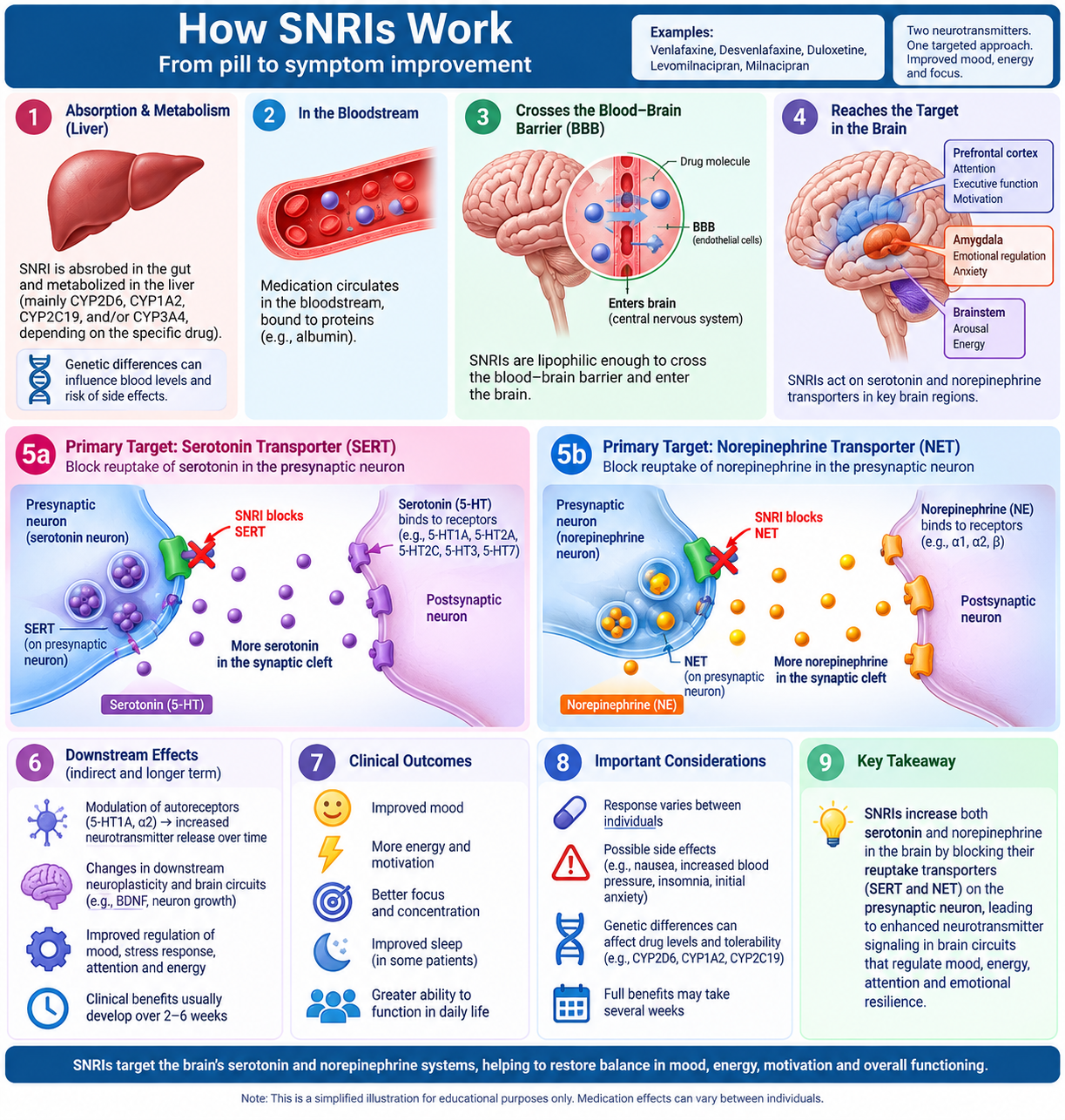
Levomilnacipran, best known by the brand name Fetzima, is a serotonin-norepinephrine reuptake inhibitor (SNRI) used to treat major depressive disorder (MDD) in adults.
Levomilnacipran works primarily by increasing the availability of two neurotransmitters:
Norepinephrine and: Serotonin
It does this by blocking two transporter proteins:
NET — Norepinephrine Transporter
and:
SERT — Serotonin Transporter
These transporters normally recycle norepinephrine and serotonin after they have been released from nerve cells.
The basic mechanism is:
- Levomilnacipran
- Blocks NET + SERT
- Norepinephrine reuptake decreases
- Serotonin reuptake decreases
- More norepinephrine + serotonin remain available for signaling
- Receptors and intracellular signaling systems respond
- Mood, cognitive and emotional networks gradually adapt
- Depressive symptoms may improve
The exact mechanism responsible for levomilnacipran’s antidepressant effect is not completely understood. Current prescribing information describes its therapeutic action as being related to potentiation of serotonin and norepinephrine signaling through inhibition of their transporters.
How Does Levomilnacipran Work for Depression?
Depression should not be thought of simply as having:
“Low serotonin”
or:
“Low norepinephrine.”
Major depressive disorder can involve dysregulation across several interacting brain systems responsible for:
- Mood
- Motivation
- Energy
- Attention
- Concentration
- Stress response
- Emotional regulation
- Reward and pleasure
- Sleep
- Negative or repetitive thinking Levomilnacipran changes the way serotonin and norepinephrine communicate within these networks.
The process is better described as:
- Levomilnacipran inhibits NET + SERT
- Norepinephrine + serotonin signaling changes
- Adrenergic and serotonin receptors respond
- Neural feedback systems adapt
- Brain networks involved in mood, cognition and motivation gradually change
- Depressive symptoms may improve
Therefore, levomilnacipran does not simply “replace missing neurotransmitters.”
It changes neurotransmitter signaling, and the brain then adapts to those changes.
What Is Special About Levomilnacipran Compared with Other SNRIs?
Levomilnacipran is somewhat unusual among commonly prescribed SNRIs because its functional effect on: Norepinephrine reuptake is relatively strong compared with its effect on:
Serotonin reuptake
Laboratory studies show potent inhibition of both NET and SERT, with norepinephrine reuptake inhibition somewhat more potent than serotonin reuptake inhibition. This is often described as an approximately two-fold norepinephrine preference in functional uptake assays.
This gives levomilnacipran a relatively:
Norepinephrine-forward SNRI profile
compared with medications such as duloxetine or venlafaxine.
However:
A stronger norepinephrine component does not automatically mean better antidepressant treatment.
The best medication depends on the patient’s symptoms, tolerability, cardiovascular status, other medications and individual neurobiology.
What Does Levomilnacipran Do to Norepinephrine?
Norepinephrine helps regulate:
- Alertness
- Attention
- Mental energy
- Working memory
- Motivation
- Stress response
- Sympathetic arousal The norepinephrine transporter is: NET and is encoded by the: SLC6A2 gene
Normally:
- Norepinephrine is released
- Norepinephrine activates adrenergic receptors
- NET transports norepinephrine back into the nerve cell
Levomilnacipran blocks this recycling process.
Therefore:
- Levomilnacipran
- NET inhibition
- Norepinephrine reuptake decreases
- More norepinephrine remains available between neurons
- Adrenergic receptor signaling changes
This increased noradrenergic activity may contribute to improvements in:
- Mental energy
- Alertness
- Concentration
- Motivation for some patients.
But the same mechanism can also contribute to:
- Increased heart rate
- Increased blood pressure
- Sweating
- Restlessness
- Insomnia
- Urinary hesitation So the therapeutic objective is not simply:
“More norepinephrine.”
It is:
More appropriate norepinephrine signaling within the relevant neural circuits.
What Does Levomilnacipran Do to Serotonin?
The serotonin transporter is:
SERT
encoded by:
SLC6A4
Normally:
- Serotonin is released
- Serotonin activates receptors
- SERT recycles serotonin back into the neuron
Levomilnacipran inhibits SERT.
Therefore:
- Levomilnacipran
- SERT inhibition
- Serotonin reuptake decreases
- More serotonin remains available for signaling
Serotonin contributes to regulation of:
-
Mood
-
Anxiety
-
Emotional responses
-
Repetitive thinking
-
Sleep
-
Appetite
-
Stress responses
-
Sexual function Once serotonin availability changes, many different serotonin receptors respond, including:
-
5-HT1A
-
5-HT2A
-
5-HT2C
-
Other serotonin receptors The final clinical effect depends on how this broader serotonin system adapts.
Does Levomilnacipran Bind Directly to Serotonin or Adrenergic Receptors?
Not significantly.
This is an important pharmacological distinction.
Levomilnacipran works primarily at the:
Transporters
rather than by directly stimulating or blocking a large number of neurotransmitter receptors.
Current prescribing information reports that levomilnacipran has no significant affinity for the serotonin receptor families tested, alpha- or beta-adrenergic receptors, muscarinic receptors, histamine receptors or the major ion channels examined in vitro.
Therefore its core mechanism is relatively focused:
NET + SERT inhibition
rather than:
Direct receptor blockade or stimulation
This distinguishes it from medications such as:
- Mirtazapine
- Tricyclic antidepressants
- Antipsychotics which often have broader receptor-binding profiles.
Why Might Levomilnacipran Help Energy and Concentration?
Norepinephrine plays a particularly important role in the:
Prefrontal Cortex — PFC
The PFC helps regulate:
- Attention
- Working memory
- Planning
- Decision-making
- Cognitive control
- Motivation
- Goal-directed behaviour By blocking NET:
- Levomilnacipran
- Norepinephrine availability increases
- Adrenergic signaling in the PFC changes
- Attention and executive function may improve as depression improves
This may be relevant for patients whose depression prominently involves:
- Mental fatigue
- Difficulty concentrating
- Reduced initiation
- Cognitive slowing
- Low energy However, these symptoms are not caused exclusively by norepinephrine, and levomilnacipran should not be selected solely from a simple “low-NE” assumption.
Can Levomilnacipran Also Affect Dopamine in the Prefrontal Cortex?
Potentially, indirectly.
Levomilnacipran is not primarily a dopamine transporter inhibitor.
However, the prefrontal cortex has relatively limited dopamine transporter activity, and:
NET helps clear some dopamine from the extracellular space
in this region.
Research with NET inhibitors shows that blocking NET can therefore indirectly increase extracellular dopamine in the prefrontal cortex.
The possible pathway is:
- NET inhibition
- Less norepinephrine reuptake
and, in the PFC:
- Less dopamine clearance through NET
- Norepinephrine increases
Dopamine may increase indirectly
This could theoretically contribute to effects on:
- Motivation
- Attention
- Working memory
- Executive function But an important qualification is needed:
Levomilnacipran is not classified as a dopamine reuptake inhibitor, and indirect prefrontal dopamine effects are not considered its primary established antidepressant mechanism.
Its principal pharmacology remains:
NET + SERT inhibition.
Why Does Levomilnacipran Take Time to Work?
NET and SERT inhibition occur relatively quickly.
But depression generally does not disappear immediately.
That is because increasing neurotransmitter availability is only the first step.
The process is more like:
- NET + SERT inhibited
- Norepinephrine + serotonin availability changes
- Receptors respond
- Feedback mechanisms adapt
- Intracellular signaling changes
- Neural networks gradually adapt
- Clinical improvement emerges
Therefore:
Levomilnacipran changes neurotransmitter signaling quickly, but the antidepressant effect develops more slowly because the brain itself must adapt.
This same principle applies to most antidepressants.
Why Can Levomilnacipran Initially Cause Anxiety or Restlessness?
Because norepinephrine is also involved in:
-
Arousal
-
Vigilance
-
Fight-or-flight responses
-
Heart rate
-
Stress responses increasing noradrenergic signaling can initially produce:
-
Restlessness
-
Nervousness
-
Increased anxiety
-
Insomnia
-
Sweating
-
Palpitations
-
Increased heart rate The sequence may be:
- Levomilnacipran begins
- NET inhibition
- Norepinephrine signaling increases
- Temporary activation may occur
- Neural systems gradually adapt
- Antidepressant benefit may subsequently emerge
This does not happen to everyone, but it helps explain why levomilnacipran may feel relatively activating in some patients.
If Norepinephrine Can Increase Anxiety, How Can Levomilnacipran Treat Depression with Anxiety Symptoms?
Norepinephrine does not have one effect everywhere in the brain.
In some pathways, excessive norepinephrine can contribute to:
-
Hyperarousal
-
Palpitations
-
Tremor
-
Threat sensitivity But appropriately regulated norepinephrine in areas such as the prefrontal cortex supports:
-
Attention
-
Cognitive control
-
Working memory
-
Emotional regulation Serotonin also contributes to anxiety-related circuitry.
Therefore, levomilnacipran’s effect depends on:
Brain region + receptor + baseline activity + dose
rather than simply whether norepinephrine rises.
A better model is:
Levomilnacipran changes serotonin and norepinephrine signaling so that emotional and cognitive networks can gradually become better regulated.
Why Can Levomilnacipran Increase Heart Rate?
Norepinephrine participates in the:
Sympathetic Nervous System
which regulates:
- Heart rate
- Blood-vessel tone
- Blood pressure
- Physical arousal Therefore:
- Levomilnacipran
- NET inhibition
- Norepinephrine signaling increases
- Sympathetic cardiovascular activity can increase
- Heart rate may rise
This is a direct extension of the same noradrenergic mechanism that contributes to its antidepressant pharmacology.
Why Can Levomilnacipran Increase Blood Pressure?
Norepinephrine can stimulate adrenergic receptors involved in:
Blood-vessel constriction
and:
Cardiovascular activation
Therefore:
- ↑ norepinephrine signaling
- ↑ vascular and sympathetic tone in some patients
- Blood pressure may increase
This is why blood pressure and pulse should be considered before and during treatment, particularly in patients with cardiovascular disease or pre-existing hypertension. Canadian Fetzima information specifically recognizes increases in both blood pressure and heart rate as important treatment considerations.
Why Can Levomilnacipran Cause Urinary Hesitation?
This is a particularly characteristic levomilnacipran adverse effect.
Norepinephrine helps regulate smooth muscle and sphincter tone within the urinary tract.
Greater noradrenergic signaling can increase:
Urethral resistance
Therefore:
- Levomilnacipran
- ↑ norepinephrine signaling
- Urethral/sphincter tone may increase
- Possible:
-
Difficulty starting urination
-
Weak urine stream
-
Urinary hesitation
-
Urinary retention This effect may be especially relevant in people with:
-
Enlarged prostate
-
Existing urinary obstruction
-
Previous urinary retention The U.S. prescribing information specifically identifies urinary hesitation or retention as an important warning.
Why Can Levomilnacipran Cause Sexual Side Effects?
Both serotonin and norepinephrine participate in sexual function.
Increased serotonin signaling in particular can interfere with pathways controlling:
- Sexual desire
- Arousal
- Dopamine-mediated reward
- Orgasm
- Ejaculation Therefore:
- SERT inhibition
- Serotonin signaling increases
- Sexual-response pathways are altered
- Possible:
- Reduced libido
- Delayed orgasm
- Difficulty reaching orgasm
- Erectile difficulties
- Ejaculatory problems Noradrenergic effects may also contribute to certain sexual or urinary symptoms.
How Is Levomilnacipran Different From an SSRI?
An SSRI such as escitalopram primarily inhibits:
SERT
Therefore:
- SSRI
- ↑ serotonin signaling
Levomilnacipran inhibits:
SERT + NET
Therefore:
- Levomilnacipran
- ↑ serotonin
↑ norepinephrine
This broader catecholamine-serotonin mechanism gives levomilnacipran a different clinical and side-effect profile from a purely serotonergic antidepressant.
How Is Levomilnacipran Different from Duloxetine?
Both medications are:
SNRIs
and both inhibit:
SERT + NET
But their relative effects are different.
Duloxetine
has relatively stronger serotonin reuptake inhibition compared with norepinephrine.
Levomilnacipran
is relatively more norepinephrine-forward.
This can help explain why levomilnacipran may be more associated with noradrenergic effects such as:
- Increased heart rate
- Increased blood pressure
- Sweating
- Activation
- Urinary hesitation Duloxetine also has important established indications for several pain disorders, whereas levomilnacipran’s principal approved indication is major depressive disorder.
Neither is universally better.
How Is Levomilnacipran Different from Venlafaxine?
Venlafaxine is also an SNRI.
However, venlafaxine’s pharmacology is relatively:
More serotonergic at lower exposures
with progressively greater norepinephrine reuptake inhibition as exposure increases.
Levomilnacipran displays substantial NET inhibition across its therapeutic pharmacology and is relatively more norepinephrine-preferring.
They also differ pharmacokinetically:
Venlafaxine
depends strongly on CYP2D6 conversion to active desvenlafaxine.
Levomilnacipran
is metabolized partly through CYP3A4 and is also substantially eliminated unchanged through the kidneys.
These differences can matter when selecting an antidepressant.
How Is Levomilnacipran Different from Milnacipran?
Levomilnacipran is the:
1S,2R enantiomer of milnacipran
In other words, the two molecules are closely related, but levomilnacipran represents one specific stereochemical form of milnacipran. Current prescribing information identifies levomilnacipran as this enantiomer.
Although both influence NET and SERT, they are different medications and should not be considered interchangeable.
Fetzima is used for:
Major depressive disorder
while regulatory indications for milnacipran differ by country.
Why Might Levomilnacipran Be Considered for Depression With Low Energy or Poor Concentration?
Its relatively strong NET activity makes levomilnacipran mechanistically interesting when depression prominently includes:
- Low mental energy
- Difficulty concentrating
- Reduced initiation
- Reduced motivation
- Cognitive slowing The concept is:
- NET inhibition
- More PFC norepinephrine availability
- Potentially stronger attention and executive-control signaling
- Cognitive and motivational symptoms may improve
But this should remain a clinical hypothesis, not a deterministic rule.
A patient with fatigue may not necessarily have insufficient norepinephrine signaling, and increasing norepinephrine may produce activation rather than improvement in another patient.
Why Can the Same Levomilnacipran Dose Affect Two People Differently?
Two people taking the same dose can have very different experiences.
One person may experience:
Better mood + greater energy + improved concentration
another:
Palpitations + sweating + insomnia
and another:
Minimal improvement
There are two broad reasons:
Pharmacokinetics — PK
They may have different drug exposure.
Pharmacodynamics — PD
Their brains may respond differently to the same drug concentration.
How Is Levomilnacipran Metabolized?
Levomilnacipran is partly metabolized through:
CYP3A4
with smaller contributions from enzymes including:
- CYP2C8
- CYP2C19
- CYP2D6
- CYP2J2 However, unlike many antidepressants, levomilnacipran is also substantially eliminated:
Unchanged through the kidneys
This means renal function can have a particularly important effect on drug exposure.
Current CPIC guidance describes levomilnacipran as predominantly metabolized through CYP3A4, with minor CYP2C8, CYP2C19 and CYP2D6 contributions.
Why Is CYP3A4 Important?
A strong CYP3A4 inhibitor can slow part of levomilnacipran metabolism.
Therefore:
- CYP3A4 inhibitor
- Levomilnacipran metabolism decreases
- Drug exposure may increase
This can potentially increase:
- Nausea
- Sweating
- Activation
- Tachycardia
- Blood-pressure effects
- Urinary symptoms Conversely:
- CYP3A4 induction
- Levomilnacipran metabolism increases
- Drug exposure may decrease
This means drug-drug interactions involving CYP3A4 can be more clinically important than CYP3A4 genetic testing.
Why Is Kidney Function Important for Levomilnacipran?
A substantial proportion of levomilnacipran is eliminated unchanged in the urine.
Therefore:
- Reduced kidney function
- Levomilnacipran elimination decreases
- Drug exposure increases
- Dose limitations may become necessary
This means levomilnacipran pharmacokinetics depend not only on liver metabolism but also strongly on:
Renal clearance
For this medication, kidney function can therefore be more clinically important than several commonly tested CYP genotypes.
Can Levomilnacipran Fail Even If Metabolism Is Normal?
Yes.
Normal drug metabolism does not guarantee antidepressant response.
This is the distinction between:
Pharmacokinetics — PK
and:
Pharmacodynamics — PD
Pharmacokinetics: Does the Right Amount of Levomilnacipran Reach the Brain?
PK includes:
- Levomilnacipran is taken
- Absorption
- Renal elimination
- CYP3A4 metabolism
- Drug interactions
- Levomilnacipran exposure
PK asks:
Does an appropriate amount of levomilnacipran reach the brain without excessive exposure?
But that is only the first part of treatment.
Pharmacodynamics: How Does the Brain Respond?
Once levomilnacipran reaches the brain:
Levomilnacipran
- NET / SLC6A2 inhibition
- SERT / SLC6A4 inhibition
- ↑ norepinephrine + ↑ serotonin availability
- Adrenergic + serotonin receptors respond
- Neural feedback systems adapt
- Mood, attention, motivation and emotional circuits change
- Depressive symptoms may improve
Therefore:
Normal PK does not automatically mean optimal PD response.
A patient may achieve appropriate levomilnacipran exposure but have limited benefit because the medication’s serotonin-norepinephrine mechanism is not optimally matched to that individual’s symptoms and neurobiology.
What Is the Role of the SLC6A2 Gene?
SLC6A2
encodes:
NET — Norepinephrine Transporter
This is one of levomilnacipran’s two principal pharmacodynamic targets.
The biological relationship is direct:
- SLC6A2
- NET expression/function
- Levomilnacipran blocks NET
- Norepinephrine signaling changes
- Clinical response
SLC6A2 variants have been studied in relation to:
- Norepinephrine signaling
- Attention
- Depression
- Antidepressant response This makes SLC6A2 biologically relevant.
However:
There is currently no validated SLC6A2 genotype-based levomilnacipran prescribing guideline.
An SLC6A2 result should therefore not be interpreted by itself as:
“Levomilnacipran will work”
or:
“Levomilnacipran will fail.”
What Is the Role of SLC6A4?
SLC6A4 encodes: SERT — Serotonin Transporter, Levomilnacipran’s another principal drug target.
Therefore:
- SLC6A4
- SERT expression/function
- Levomilnacipran inhibits SERT
- Serotonin signaling changes
- Downstream clinical response
Variants involving SLC6A4, including 5-HTTLPR, have been studied extensively in antidepressant treatment.
However, CPIC concluded that current evidence for SLC6A4 is not sufficiently consistent to support routine genotype-guided antidepressant prescribing.
So SLC6A4 is:
Biologically relevant
but not:
A validated stand-alone levomilnacipran response test.
What About HTR2A Genetics?
HTR2A
encodes the:
5-HT2A serotonin receptor
Levomilnacipran does not directly target 5-HT2A.
Instead:
- Levomilnacipran blocks SERT
- Serotonin availability increases
- Serotonin interacts with 5-HT2A and other receptors
HTR2A variants have been studied in antidepressant response and side effects.
However, CPIC concluded that current HTR2A evidence does not support routine genotype-based antidepressant prescribing.
Does CYP2D6 Genotype Determine Levomilnacipran Dose?
No.
CYP2D6 contributes only modestly to levomilnacipran metabolism.
CPIC reviewed the available evidence and specifically noted that levomilnacipran is not sufficiently affected by CYP2D6 or CYP2C19 variation to justify genotype-based prescribing recommendations. CPIC therefore did not assign a CYP2D6 or CYP2C19 dosing recommendation for levomilnacipran.
Therefore:
CYP2D6 Poor Metabolizer
does not automatically mean the levomilnacipran dose should be reduced.
Likewise:
CYP2D6 Ultrarapid Metabolizer
does not automatically justify a higher dose.
Does CYP2C19 Genotype Determine Levomilnacipran Dose?
No.
CYP2C19 contributes only modestly to levomilnacipran metabolism.
There is currently:
No CPIC CYP2C19-based levomilnacipran dosing recommendation.
This differs from antidepressants such as:
- Citalopram
- Escitalopram where CYP2C19 genotype has established clinical prescribing implications.
Does CYP3A4 Genetic Testing Determine the Levomilnacipran Dose?
Currently:
No.
CYP3A4 is an important levomilnacipran metabolic pathway, but there is no established CYP3A4 genotype-based levomilnacipran dosing guideline.
For CYP3A4, the more clinically actionable issue is generally:
Medication interaction
rather than:
Inherited CYP3A4 genotype
Can Pharmacogenomic Testing Tell Whether Levomilnacipran Will Work?
Levomilnacipran response may depend on:
Pharmacokinetics
- Kidney function
- CYP3A4 activity
- Drug interactions
- Dose
- Absorption and:
Pharmacodynamics
- SLC6A2 / NET biology
- SLC6A4 / SERT biology
- Serotonin receptors
- Adrenergic receptors
- Baseline norepinephrine signaling
- Baseline serotonin signaling
- Symptoms and neural circuitry No single genetic marker currently provides a reliable:
“Levomilnacipran will work”
or:
“Levomilnacipran will not work”
prediction.
Pharmacogenomic information is therefore best interpreted as one component of a broader personalized medication assessment.
Why Might Levomilnacipran Work Very Well for One Person but Poorly for Another?
Two people can both meet criteria for major depressive disorder but have very different symptom patterns.
One may experience mainly:
Low mental energy + poor concentration + reduced motivation
Another may have:
Anxiety + hyperarousal + insomnia
Another may primarily experience:
Low mood + repetitive negative thinking
These patients may not have identical serotonin and norepinephrine patterns.
A relatively noradrenergic antidepressant may be very useful for one patient but too activating for another.
This helps explain why:
The diagnosis alone does not identify the optimal antidepressant mechanism for every patient.
Levomilnacipran Needs Both Drug Exposure and Brain Compatibility
The entire process can be summarized as:
- Levomilnacipran is taken
- PK — Pharmacokinetics
- Absorption
- Renal elimination + CYP3A4 metabolism
- Drug interactions
- Appropriate levomilnacipran exposure
- PD — Pharmacodynamics
- NET + SERT inhibition
- ↑ norepinephrine + ↑ serotonin availability
- Adrenergic + serotonin receptors respond
- Prefrontal, mood and emotional networks adapt
- Depressive symptoms may improve
This produces two different clinical questions:
PK asks:
Does an appropriate amount of levomilnacipran reach the brain?
PD asks:
Is levomilnacipran’s serotonin-norepinephrine mechanism compatible with this patient’s underlying biology and symptoms?
Both can influence the final treatment outcome.
This article is educational. It does not diagnose, and it does not replace advice from your prescriber or pharmacist. Never start, stop or change a medication based on a web page.