
Citalopram and Escitalopram · How it works
How Do Citalopram and Escitalopram Work?
Citalopram, commonly known by the brand name Celexa, and escitalopram, commonly known as Lexapro or Cipralex, are antidepressants in a class called selective
 Written by Sanjida Ahmed, PhD, Cellular and Molecular BiologyChief Operating Officer and Lead Scientist, Personalized Prescribing. Last reviewed October 2, 2026.
- Class
- SSRI (selective serotonin reuptake inhibitor)
On this page
- Serotonin Transporter — SERT
- How Are Citalopram and Escitalopram Related?
- Citalopram 20 mg
- Escitalopram 10 mg
- How Do Citalopram and Escitalopram Work for Depression?
- How Do Citalopram and Escitalopram Work for Anxiety?
- What Does SERT Do?
- SLC6A4 gene
- Why Does Increasing Serotonin Not Improve Symptoms Immediately?
- What Is the Role of the 5-HT1A Receptor?
- What Is the Role of 5-HT2A and 5-HT2C Receptors?
- Why Can SSRIs Initially Increase Anxiety?
- Why Can Citalopram and Escitalopram Cause Sexual Side Effects?
- Why Can the Same Dose Affect Two People Differently?
- How Are Citalopram and Escitalopram Metabolized?
- How Does CYP2C19 Affect Citalopram and Escitalopram?
- Why Is CYP2C19 Particularly Important for Citalopram?
- Can Other Medications Affect CYP2C19?
- CYP2C19 Normal Metabolizer
- Can Citalopram or Escitalopram Fail Even If You Metabolize Them Normally?
- Why Might Escitalopram Work Better Than Citalopram for One Person?
- Does a Genetic Test Tell You Whether Citalopram or Escitalopram Will Work?
- Can Pharmacogenomic Testing Help with Citalopram or Escitalopram Response?
- The Bottom Line
- Serotonin Transporter — SERT
- PK — Pharmacokinetics
- PD — Pharmacodynamics
- SERT + 5-HT1A + 5-HT2A + 5-HT2C + broader serotonin pathways
Citalopram, commonly known by the brand name Celexa, and escitalopram, commonly known as Lexapro or Cipralex, are antidepressants in a class called selective serotonin reuptake inhibitors, or SSRIs.
They are used primarily to treat depression and anxiety disorders.
Both medications work mainly by changing the activity of serotonin, an important chemical messenger involved in:
- Mood
- Anxiety
- Emotional regulation
- Stress response
- Sleep
- Repetitive thinking
- Social and emotional processing Their main biological target is the:
Serotonin Transporter — SERT
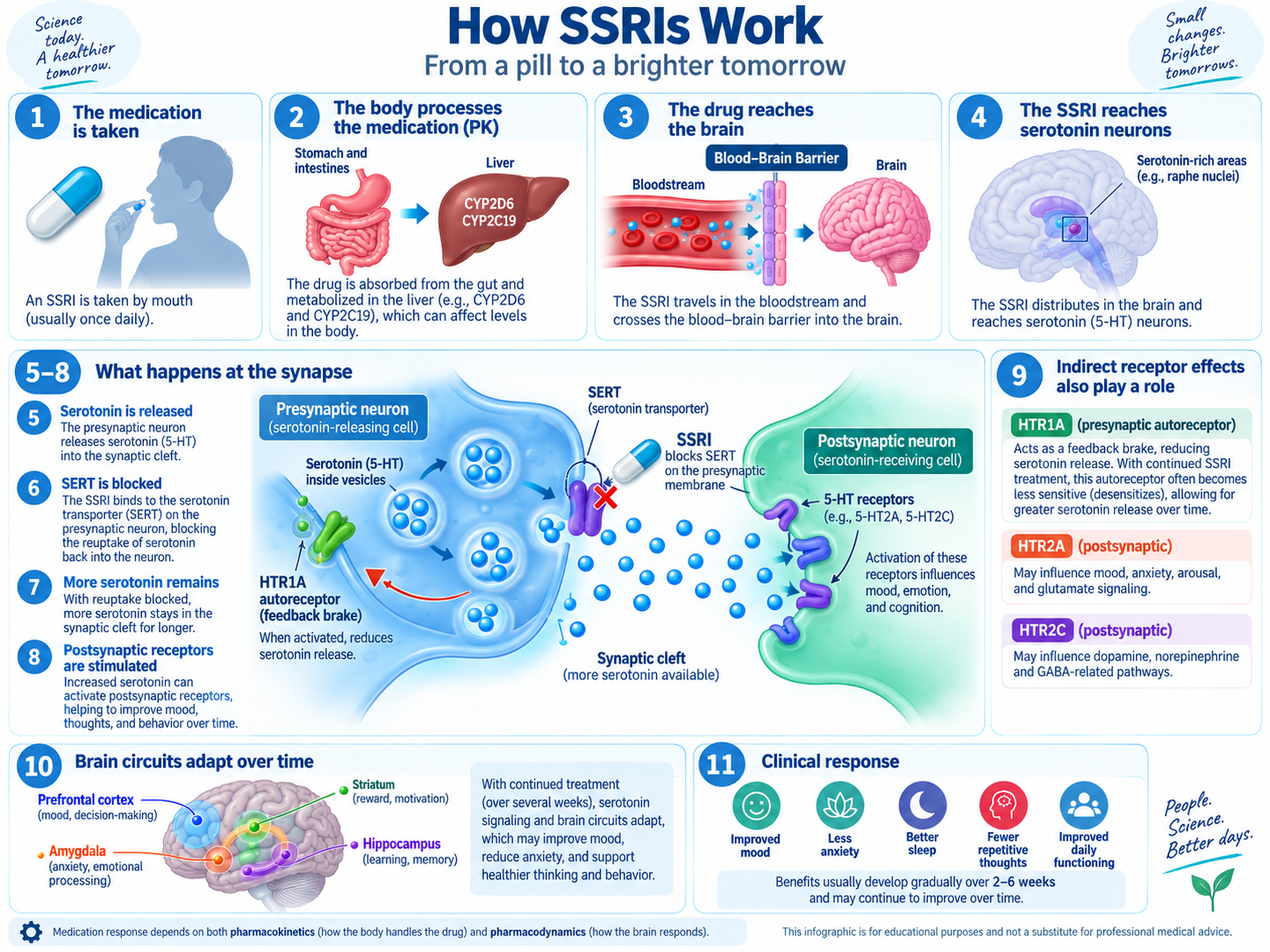
By blocking SERT, citalopram and escitalopram reduce the recycling of serotonin back into nerve cells.
This allows serotonin to remain available between neurons for longer.
A simplified pathway is:
- Citalopram or Escitalopram
- Blocks the serotonin transporter — SERT
- Less serotonin is immediately recycled
- More serotonin remains available between nerve cells
- Serotonin receptor signaling changes
- Brain circuits gradually adapt
- Depression or anxiety symptoms may improve
Although serotonin reuptake is inhibited soon after the medication is taken, the full therapeutic effect usually takes several weeks because the brain needs time to adapt to the change in serotonin signaling.
How Are Citalopram and Escitalopram Related?
Citalopram and escitalopram are extremely closely related.
Citalopram contains two mirror-image forms of the same molecule:
- S-citalopram
- R-citalopram Escitalopram contains only: S-citalopram
The S-form is primarily responsible for blocking the serotonin transporter.
Citalopram contains: S-citalopram + R-citalopram
This is why escitalopram is generally used at lower milligram doses than citalopram.
For example:
Citalopram 20 mg
and
Escitalopram 10 mg
are commonly used therapeutic doses, although they should not be considered automatically interchangeable without clinical guidance.
How Do Citalopram and Escitalopram Work for Depression?
Depression can affect multiple brain systems involved in:
- Mood
- Motivation
- Emotional processing
- Sleep
- Concentration
- Stress response
- Reward and pleasure Serotonin participates in communication between many of these systems.
Normally:
- Serotonin is released from a nerve cell
- Serotonin activates receptors on nearby neurons
- SERT transports serotonin back into the original neuron
Citalopram and escitalopram inhibit SERT.
Therefore:
- SERT activity decreases
- Serotonin remains available for longer
- Serotonin signaling increases and changes
- Serotonin receptors and neural circuits gradually adapt
- Depressive symptoms may improve
Over time, these changes can contribute to improvements in symptoms such as:
- Low mood
- Persistent sadness
- Anxiety associated with depression
- Negative or repetitive thinking
- Emotional distress
- Sleep difficulties
- Reduced ability to cope with stress However, depression should not simply be described as having “low serotonin.”
The therapeutic response involves changes across multiple receptors, neurotransmitter systems and brain networks.
How Do Citalopram and Escitalopram Work for Anxiety?
Serotonin is also involved in brain circuits that regulate:
-
Fear
-
Worry
-
Threat detection
-
Emotional reactivity
-
Stress
-
Repetitive thinking Important regions include the:
-
Amygdala
-
Prefrontal cortex
-
Other limbic and emotional-regulation networks In anxiety disorders, some of these circuits may become excessively reactive or poorly regulated.
By increasing serotonin availability and allowing the serotonin system to adapt over time, citalopram and escitalopram may help reduce:
- Excessive worry
- Persistent anxiety
- Emotional reactivity
- Rumination
- Physical tension
- Difficulty relaxing Escitalopram is particularly widely used for anxiety disorders, including generalized anxiety disorder.
What Does SERT Do?
The serotonin transporter, or SERT, is encoded by the:
SLC6A4 gene
SERT acts somewhat like a serotonin recycling system.
After serotonin is released:
- Serotonin enters the space between neurons
- Serotonin activates receptors
- SERT transports serotonin back into the nerve terminal
- Serotonin is recycled
Citalopram and escitalopram inhibit SERT.
Therefore:
- Citalopram / Escitalopram
- SERT inhibition
- Serotonin recycling decreases
- More serotonin remains available for signaling
SERT is therefore the principal pharmacodynamic target of both medications.
Why Does Increasing Serotonin Not Improve Symptoms Immediately?
This is one of the most important questions about SSRIs.
Citalopram and escitalopram block SERT relatively quickly.
But patients usually do not feel the full antidepressant effect immediately.
Why?
Because increasing serotonin availability is only the beginning.
The brain then needs to make a series of adaptive changes involving:
- Serotonin autoreceptors
- Postsynaptic serotonin receptors
- Gene expression
- Neural connectivity
- Stress-response pathways
- Emotional-regulation networks A simplified process is:
- SERT is blocked
- Serotonin availability increases
- Feedback receptors initially respond
- Serotonin pathways gradually adapt
- Downstream neural circuits change
- Clinical improvement may develop
This process can take several weeks.
What Is the Role of the 5-HT1A Receptor?
One important serotonin receptor is:
5-HT1A encoded by the HTR1A gene
Some 5-HT1A receptors are located on serotonin-producing neurons and function as autoreceptors.
They act somewhat like a feedback brake.
When serotonin activity increases:
- 5-HT1A autoreceptors are activated
- Serotonin neuron firing can temporarily decrease
This may initially limit the effect of an SSRI.
With continued treatment, these feedback systems can become less responsive.
The simplified process is:
- SSRI treatment begins
- Serotonin increases
- 5-HT1A feedback brake activates
- Serotonin release is initially restrained
- Feedback system gradually adapts
- Serotonin signaling becomes more sustained
- Therapeutic effects may emerge
This is one explanation for why SSRIs take time to work.
What Is the Role of 5-HT2A and 5-HT2C Receptors?
Once serotonin remains available between neurons, it interacts with many different receptor subtypes.
These include: 5-HT2A and 5-HT2C
These receptors participate in pathways involving:
- Anxiety
- Arousal
- Sleep
- Cognition
- Dopamine signaling
- Norepinephrine signaling
- Appetite
- Sexual function Therefore, increasing serotonin does not produce one simple effect.
The response depends partly on which serotonin receptors are activated, in which brain regions, and how the broader neural network responds.
This helps explain why SSRIs can improve anxiety in some people but may initially cause:
- Restlessness
- Increased anxiety
- Sleep disturbance before the serotonin system adapts.
Why Can SSRIs Initially Increase Anxiety?
Some people experience:
- Increased nervousness
- Restlessness
- Irritability
- Sleep difficulty
- A temporary increase in anxiety during the first days or weeks of SSRI treatment.
One reason may be that serotonin increases before the broader serotonin-receptor system has fully adapted.
The simplified process is:
- Serotonin rises
- Multiple serotonin receptors are stimulated
- Some pathways become temporarily more activated
- Anxiety or restlessness may increase
Over time:
- Receptors and neural circuits adapt
- Anxiety may decrease
This is one reason clinicians often begin SSRIs at lower doses in patients who are particularly sensitive to activation or anxiety.
Why Can Citalopram and Escitalopram Cause Sexual Side Effects?
Serotonin interacts with pathways involving:
- Dopamine
- Norepinephrine
- Sexual arousal
- Orgasm
- Libido Increased serotonin signaling can suppress some dopamine-related sexual pathways.
This can contribute to:
- Reduced sexual desire
- Delayed orgasm
- Difficulty reaching orgasm
- Delayed ejaculation
- Erectile difficulties The likelihood and severity vary substantially between individuals.
Why Can the Same Dose Affect Two People Differently?
Two people can take the same dose of citalopram or escitalopram and experience very different results.
One person may have:
-
Good symptom improvement
-
Few side effects Another may experience:
-
Nausea
-
Sexual side effects
-
Excessive sleepiness
-
Restlessness
-
Little improvement One important reason is that people do not all metabolize these medications at the same rate.
The most important pharmacogenomic enzyme is:
CYP2C19
Other enzymes contribute as well, but CYP2C19 has the strongest established genetic prescribing relationship for both citalopram and escitalopram.
How Are Citalopram and Escitalopram Metabolized?
After the medication is absorbed, liver enzymes help break it down.
CYP2C19 is particularly important.
A simplified pathway is:
- Citalopram / Escitalopram
- CYP2C19 metabolism
- Less active metabolites
- Elimination
Different CYP2C19 genetic profiles can therefore affect how much medication remains in the body.
How Does CYP2C19 Affect Citalopram and Escitalopram?
People can genetically have:
- Ultrarapid CYP2C19 metabolism
- Rapid metabolism
- Normal metabolism
- Intermediate metabolism
- Poor metabolism These differences can alter drug exposure.
CYP2C19 Rapid or Ultrarapid Metabolizer
Higher CYP2C19 activity can result in:
- Faster metabolism
- Lower citalopram or escitalopram concentration
- Potentially reduced therapeutic effect
In some patients, the medication may be cleared too quickly to produce an optimal response at a standard dose.
CYP2C19 Poor Metabolizer
A Poor Metabolizer has very low CYP2C19 activity.
Therefore:
- Slower metabolism
- Higher drug concentration
- Greater risk of concentration-related side effects
For citalopram, this is particularly important because higher exposure can also increase the risk of QT prolongation, an abnormal electrical change in the heart.
Established pharmacogenomic prescribing guidelines therefore recommend altered treatment strategies for CYP2C19 Poor Metabolizers.
Why Is CYP2C19 Particularly Important for Citalopram?
Citalopram has a dose- and exposure-related risk of QT prolongation.
Therefore:
- Reduced CYP2C19 metabolism
- Higher citalopram concentration
- Greater QT-prolongation risk
This is why CYP2C19 Poor Metabolizer status can affect citalopram dose limits.
Escitalopram can also affect the QT interval, but this concern is generally more prominent with citalopram.
Can Other Medications Affect CYP2C19?
Yes.
Someone may genetically be a:
CYP2C19 Normal Metabolizer
but take another medication that inhibits CYP2C19.
Examples include:
-
Omeprazole
-
Esomeprazole
-
Cimetidine The result can be:
-
Normal CYP2C19 genetics
-
CYP2C19 inhibitor
- Functional CYP2C19 activity decreases
- Citalopram or escitalopram metabolism slows
- Drug exposure increases
This is why pharmacogenomic results should always be interpreted together with the patient’s current medications.
Can Citalopram or Escitalopram Fail Even If You Metabolize Them Normally?
Yes.
Normal CYP2C19 metabolism does not guarantee that an SSRI will work.
There are two major parts to antidepressant response.
Pharmacokinetics: How Your Body Handles the Medication
Pharmacokinetics, or PK, includes:
- Absorption
- Distribution
- CYP2C19 metabolism
- Drug interactions
- Elimination The goal is for an appropriate amount of medication to reach the brain.
But this is only the first part of treatment response.
Pharmacodynamics: How Your Brain Responds
Pharmacodynamics, or PD, describes what happens once the medication reaches the brain.
For citalopram and escitalopram, important biological components include:
SERT — SLC6A4
The serotonin transporter and principal medication target.
5-HT1A — HTR1A
Important in serotonin feedback and regulation.
5-HT2A — HTR2A
Involved in mood, cognition, anxiety and downstream neurotransmitter signaling.
5-HT2C — HTR2C
Can influence anxiety, appetite, dopamine and norepinephrine pathways.
- MAO-A Helps regulate serotonin breakdown after serotonin is recycled into neurons.
The overall response therefore depends on considerably more than how much medication reaches the brain.
Citalopram and Escitalopram Need Both Drug Exposure and Brain Response
A simplified way of understanding treatment is:
- Citalopram or Escitalopram is taken
- The body absorbs and metabolizes the medication — PK
- CYP2C19 influences drug exposure
- An appropriate amount reaches the brain
- The medication blocks the serotonin transporter — PD
- SERT inhibition
- Serotonin availability increases
- 5-HT1A + 5-HT2A + 5-HT2C and other serotonin receptors respond
- Serotonin signaling changes
- Brain circuits gradually adapt
- Depression or anxiety symptoms may improve
This illustrates an important principle:
Normal PK does not automatically mean optimal PD response.
A person can metabolize citalopram or escitalopram normally but still receive limited benefit because the serotonin system may not respond optimally.
Why Might Escitalopram Work Better Than Citalopram for One Person?
Although the two medications are closely related, they are not identical.
Escitalopram contains only the pharmacologically active S-enantiomer, whereas citalopram contains both the S- and R-enantiomers.
Individual response may also differ because of:
- Drug concentration
- CYP2C19 metabolism
- Dose
- Other medications
- Side effects
- Serotonin transporter biology
- Receptor signaling
- Individual brain response Therefore, one person may tolerate or respond better to escitalopram, while another may do well with citalopram.
The fact that the medications are chemically related does not mean their clinical effects will be identical for every patient.
Does a Genetic Test Tell You Whether Citalopram or Escitalopram Will Work?
No genetic test can guarantee whether either medication will work.
However, genetic testing can provide useful information about drug metabolism and exposure.
For both medications, the strongest established pharmacogenomic gene is:
CYP2C19
Medication response is also influenced by:
- Symptoms
- Diagnosis
- Dose
- Other medications
- Drug interactions
- Age
- Liver function
- Serotonin signaling
- Previous treatment response
- Individual brain biology Genetics should therefore be considered as one part of personalized prescribing, rather than a stand-alone answer.
Can Pharmacogenomic Testing Help with Citalopram or Escitalopram Response?
Yes.
Citalopram and escitalopram have one of the more established antidepressants pharmacogenomic relationships.
CYP2C19 testing can help identify whether a patient is likely to metabolize these medications:
- Too quickly
- At an expected rate
- More slowly than expected This can help explain situations such as:
Too little exposure
- Rapid metabolism
- Lower medication concentration
- Potentially inadequate response
Too much exposure
- Slow metabolism
- Higher medication concentration
- Greater side-effect risk
For citalopram, higher exposure also has additional importance because of QT-prolongation risk.
Some pharmacogenomic approaches also examine genes involved in serotonin pharmacodynamics, including:
- SLC6A4
- HTR1A
- HTR2A
- HTR2C These genes are biologically relevant to SSRI response, but their interpretation is currently more complex and less firmly established than the CYP2C19 pharmacokinetic relationship.
They should therefore not be treated as equivalent to established CYP2C19 prescribing guidance.
The Bottom Line
Citalopram and escitalopram are SSRIs that work primarily by blocking the:
Serotonin Transporter — SERT
The simplified mechanism is:
- Citalopram / Escitalopram
- SERT inhibition
- More serotonin remains available between nerve cells
- Serotonin receptors and feedback systems respond
- Brain circuits gradually adapt
- Depression and anxiety symptoms may improve
At the same time:
PK — Pharmacokinetics
Does an appropriate amount of medication reach the brain?
The key pharmacogenomic gene is:
CYP2C19
PD — Pharmacodynamics
Does the serotonin system respond appropriately once the medication gets there?
Important biology includes:
SERT + 5-HT1A + 5-HT2A + 5-HT2C + broader serotonin pathways
Both drug exposure and brain response contribute to clinical outcome.
This article is educational. It does not diagnose, and it does not replace advice from your prescriber or pharmacist. Never start, stop or change a medication based on a web page.